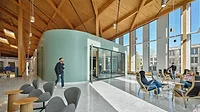
Terasaki Research Institute by Atelier Hitoshi Abe
Los Angeles

Abe reused the existing reinforced-concrete street-facing facade, streamlining its crown and removing decorative iron, plaster, and tile before applying a new stucco finish.
Photo © Roland Halbe

A deep glazed opening in a mezzanine bridge frames a view toward the institute’s entry foyer.
Photo © Roland Halbe

The wide stair from the foyer to the atrium spaces, necessary due to the site’s elevation changes, establishes a sense of arrival.
Photo © Roland Halbe
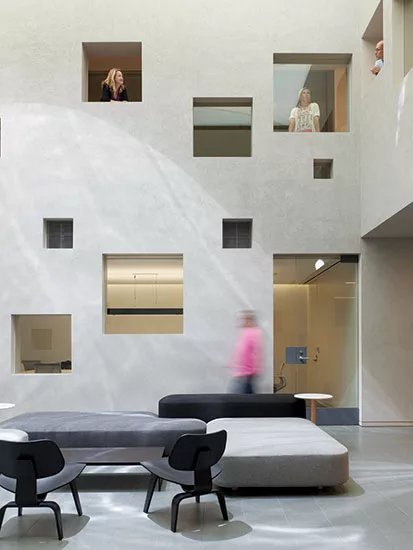
The variety of openings in the atria walls creates a dynamic pattern and permits glimpses of the areas beyond.
Photo © Roland Halbe

The institute’s foyer features a crescent-shaped welcome desk and credits an area to display books for sale.
Photo © Roland Halbe

A light well illuminates a stair between the ground floor and mezzanine.
Photo © Roland Halbe

Casual seating encourages quick, informal get-togethers.
Photo © Roland Halbe

Image courtesy Atelier Hitoshi Abe

Image courtesy Atelier Hitoshi Abe

Image courtesy Atelier Hitoshi Abe

Image courtesy Atelier Hitoshi Abe
Architects & Firms
According to architect Hitoshi Abe, Dr. Paul I. Terasaki, a scientist and philanthropist, loved three things: his Japanese heritage; the University of California, Los Angeles (UCLA), his alma mater and longtime employer; and his ground-breaking research on human tissue typing, a process critical to the success of organ transplants. The late doctor’s three passions come together in Abe’s newest project, the Terasaki Research Institute, a serene, inviting facility near UCLA’s campus that serves as the public face and headquarters of the namesake scientific organization.
Additional Content:
Jump to credits & specifications
Location is part of its appeal. Abe revamped a 1930s-era masonry infill building on a busy street in L.A.’s Westwood neighborhood to craft the 15,000-square-foot project, nestled within an eclectic but unremarkable stretch of low-rise chain stores and eateries. Its streamlined stucco facade featuring a crisp aluminum canopy offers visual relief from the surrounding hodgepodge of corporate logos and promotional signs—an example of the power of simplicity. “Pedestrians often stop to look through the windows and see what’s happening inside,” Abe says.
These glimpses reveal a foyer with a small bookstore and a reading room, and beyond them a generous atrium with clusters of seating, a space far brighter and more expansive than suggested by the surrounding context. Not only is this interior a big departure from others in the neighborhood, it doesn’t resemble a typical office building or headquarters.
From the outset, Terasaki envisioned a new headquarters that would reflect the institute’s emerging role in public outreach to promote organ donation. (Its core scientific research still takes place in a laboratory a few miles away.) He wanted some kind of central space for lectures, public events, and informal gatherings, surrounded by workspaces for administrative and managerial personnel. He gave a sketch of his ideas to Abe soon after tapping him for the commission; the two men had met in 2007, when the Japanese architect was named chair of UCLA’s Department of Architecture and Urban Design, a post he held for 10 years. “We agreed that including a large common area would reflect the institute’s values of collaboration, innovation, and engaging the community,” Abe says. The challenge was fitting an ambitious program—multipurpose public space, offices, a few conference rooms, a small laboratory, and support spaces—into a tight, two-story shell, where the only significant exposure to daylight comes from the westfacing street elevation.
Abe used these constraints to maximum benefit. By demolishing the building’s unreinforced masonry interior walls and replacing them with a steel-framed structure, he was able to devote roughly half the ground floor’s square footage to a wide, two-story atrium, topped with a double membrane of translucent fiberglass and PTFE. A pair of mezzanine-level bridges and two oculi in the roof visually break down this larger ground-floor space into two smaller ones. With their filtered daylight and textured plaster walls featuring staggered, square-shaped openings of different sizes, they have the feel of outdoor plazas tucked between buildings—an effect that’s intentional. “We wanted to extend the street indoors, so to speak, to provoke interest and engage the community,” explains Abe. “And because this building has so few windows, it was important to create an exterior-like experience inside, so employees have some connection to the outdoors.”
Abe calls the multitasking roof “a cloud that creates and controls the indoor climate.” The plenum space between the two membranes vents hot air that rises through the atrium to the outdoors. Sun streaming through the translucent roof casts patterns of light and shadow that vary with the time of day, season, and weather; at night, an LED lighting system transforms it into a glowing lantern, complete with shifting colors and patterns as the occasion dictates. In an ingenious effect, the mirror finish on the cast-fiberglass oculi reflects the roof lines of nearby buildings to the indoors, furthering the connection between the institute and the public. “When these two huge, shiny assemblies arrived at the site on the back of a trailer, people thought they looked like alien spacecraft,” Abe says.
The acoustics of the atrium spaces can accommodate everything from receptions to lectures to musical performances. A grid of high-definition screens on the back wall displays video, images, or text during presentations and events. Cushioned benches and low tables and chairs support small gatherings and create opportunities for chance encounters.
The offices, conference rooms, and support spaces surrounding the atrium on both floors have glass walls and cutouts that permit partial glimpses through the square openings and into the larger space, balancing openness and privacy. All of the workspaces are straightforward and minimalist, and a quiet palette of whites and grays (“so many grays,” says Abe) lends calmness to the interior, where even sprinkler heads and mechanical vents are cleverly integrated and concealed.
The building opened in September 2017, and currently about 30 people work there full-time—a mix of institute employees and organ transplant research partners from UCLA and beyond. It seems fitting that Abe’s first finished project in Los Angeles was done for a client and friend whose close ties to both UCLA and Japan mirror his own. Terasaki was a longtime supporter of Abe, who remains director of UCLA’s Terasaki Center for Japanese Studies. Though the renowned scientist passed away shortly after the project broke ground, the new headquarters is an homage to his accomplishments and ideals.
CreditsArchitect: Atelier Hitoshi Abe, 4472 W. Adams Blvd. Los Angeles, CA 90016, 323.378.6780, www.a-slash.net
Personnel in architect's firm who should receive special credit: Hitoshi Abe, Pierre De Angelis, Cecilia Brock, Cat Pham
Architect of record: House & Robertson Architects Inc., 10125 Washington Blvd. Culver City, CA 90232, 323.935.3158, www.hrarch.com
Personnel in Architect of Record's firm who should receive special credit: Jim House, James Black, Silvija Olar, Khristeen Decastro
Interior designer: Atelier Hitoshi Abe
Engineers: SMEP: Burohappold
Consultants: Skylight Engineer: NOUS Engineering Inc Lighting Design: Burohappold Skylight Fabricator: EIDE Industries, Inc. Oculus Fabircator: Machineous Consultants Canopy Fabricator: Cinnabar Furniture Procurement: Sheridan Group Construction Manager: MGAC
General contractor: Taslimi Construction Company, Inc.
Photographer: Roland Halbe |
SpecificationsExterior Cladding Storefront: Arcadia
Roofing Sikaplan Adhered Energysmart Roof Membrane: Sika Corporation
Glazing Sloped Skylights: Arcadia Domed Skylight: Bristolite
Doors Custom: Atelier Hitoshi Abe Wood Doors: Western Integrated Glass Doors: Herculite
Interior Finishes Custom: Atelier Hitoshi Abe Designer White: Corian STUDIO Porcelain Floor Tile: Stone Source Special interior finishes unique to this project: Interior Plaster: Custom Finish
Furnishings Office furniture Canvas Desks: Herman Miller Sayal Chair (desk): Herman Miller Eames Molded plastic (side): Herman Miller
Reception furniture: COMMON modular sofa: Viccarbe COMMON side table: Viccarbe Smile Sofa and armchair: Niche Wegner Shell Chair:Carl Hansen & Son Eames Molded Plywood Lounge Chair: Herman Miller Eames Wood Side Chair: Herman Miller Chairs: Physix Conference: Vitra Magis Chair: Herman Miller Chiaro Chair: Mattiazzi Uchiwa Lounge: Hay Tables: AGL Table: Herman Miller Magis Tavolo: Herman Miller Heron Side Tables: Niche Saarinen Dining Table: Knoll Other furniture: Softwall: Molo Design
Lighting Interior ambient lighting: LED Wall Grazer: Prudential LED Linear: Downlights: USAI Office Tasklighting: Axis Exterior: Bega, LED Linear Dimming system or other lighting controls: Architectural Lighting Control: Lutron Skylight Lighting Control: Lumenpulse
Conveyance Elevators/escalators: Hydraulic, with Custom Fit-out Package: Schindler
Plumbing Kitchen Sink: Elkay Kitchen Faucets: Kohler WC Lav: Cube WC Faucets: Kohler Toilettes Wall Hung: Kohler Toilettes Floor Mounted: Duravit Urinals: TOTO Energy Add any additional building components or special equipment that made a significant contribution to this project: SOLATUBE Daylighting System |
Looking for a reprint of this article?
From high-res PDFs to custom plaques, order your copy today!