Casa Bruma by Fernanda Canales and Claudia Rodríguez
Estado de México

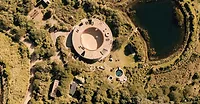
Casa Bruma comprises nine volumes of poured-in-place concrete, set at angles in its partially wooded site to create an irregularly shaped courtyard.
Photo © Rafael Gamo

The courtyard pavers conceal a below-grade cistern for collecting and storing rainwater, the house’s only water source.
Photo © Rafael Gamo

The family’s primary shared spaces, including the living room and the dining room, are linked with glazed connectors.
Photo © Rafael Gamo

The main living spaces have polished basalt floors and oak ceilings.
Photo © Rafael Gamo

The main living spaces have polished basalt floors and oak ceilings
Photo © Rafael Gamo

Many apertures, such as one in the kitchen (seen in the background), are placed to create long views through multiple spaces.
Photo © Rafael Gamo

Most of the rooms, including a guest house, have windows on two sides.
Photo © Rafael Gamo

Though nominally black, the concrete, especially on the exterior, has considerable color variation.
Photo © Rafael Gamo

Image courtesy Fernanda Canales + Claudia Rodríguez

Image courtesy Fernanda Canales + Claudia Rodríguez
A house made of black concrete, inside and out, sounds aggressive and brooding—not an inviting place to live. And a black concrete country house? If you knew anything about its setting, you would assume such a dwelling would be terribly out of place in a forested rural environment.
Additional Content:
Jump to credits & specifications
But a recently completed residence made almost entirely of exposed black concrete defies all expectations. Designed by collaborating architects Fernanda Canales and Claudia Rodríguez, the house, located in the mountains about 100 miles southwest of Mexico City, is an engaging cluster of rustic board-formed boxes that are nestled at angles into their site around an irregularly shaped courtyard. Dubbed Casa Bruma for the mist that often shrouds the surrounding landscape, the 6,500-square-foot assemblage is a weekend retreat for an attorney, his marketing-executive wife, and their two young children. It is one of the first buildings to be constructed within a secluded community that will eventually contain only 70 houses on 500 mostly untamed acres.
The clients sought out Canales—known for her small but impressive body of residential and cultural projects, as well as her books and exhibitions on Mexican architecture—because they wanted an architect “who is hands-on.” Canales spends much of her time on construction sites and does not have a traditional office or employees. But she often forms alliances, this time turning to Rodríguez, whom she has known since their days in architecture school at the Universidad Iberoamericana, in Mexico City.
Rodríguez had helped create the master plan for the new development and so was well versed in the construction restrictions, intended to restore the ecology of the land. For decades, it had been used for grazing cattle and logged for its once-plentiful supply of old-growth oak trees. The master plan placed few constraints on architectural form but included several pertaining to the individual homeowners’ sites. Among them was: a requirement that the houses be designed so that all of their water, even for drinking, come from collected rainwater; a restriction on nonnative vegetation, and on cutting down trees. The idea, says Rodríguez, “was to allow freedom in expression of the houses, but strengthen the identity of the landscape.”
In keeping with this philosophy, Canales and Rodríguez opted not to build on a flat, meadow-like portion of the clients’ 2.7-acre, roughly rectangular property. Instead they chose a sloping spot at the edge of a wooded area, carefully tucking pieces of the residence among the trees. Canales explains that a desire for camouflage was one of the reasons for this placement and why Casa Bruma is “exploded” into nine discrete one- and two-story volumes. It was also the rationale for adding the black pigment to the concrete mix for the site-cast walls. The dark color, she says, makes the house recede into the shadows.
This strategy had another benefit: it allowed the architects to create the courtyard, building on a long history of such spaces in Mexican architecture. “It is a typology I’m always rethinking,” says Canales. In fact, a house she just completed for her own family in the same development is organized as barrel-vaulted elements surrounding rectilinear open-air living spaces. But at Casa Bruma, the almost village-like grouping defines a less traditional, more organically shaped courtyard. Here clover sprouts between the stone pavers that conceal the below-grade rainwater cistern, and fringy ferns grow at the perimeter—almost as though the forest is intruding and trying to take over.
Four shaggy green roofs—another requirement of the master plan—and two planted roof terraces reinforce the impression that the architecture is an extension of nature. A variation in the texture and color of the concrete walls’ exterior surface—shades from inky black to medium gray—also support this effect, making them appear to be products of weather and nature rather than man-made. “We thought of the buildings as rocks,” explains Rodríguez.
Although Casa Bruma’s exterior is almost wild and rough, the inside is more refined. The four volumes that contain the primary living areas—the kitchen, the dining room, the living room, and bedrooms—are linked with glazed connectors. The remaining five standalone concrete boxes, meanwhile, house two guest pavilions, a caretaker’s apartment, a garage, and the utilities. Many of the spaces feature a pleasant palette of basalt floors, polished to reflect light, and oak ceilings, stairs, and doors made by local artisans, which add warmth and richness to the otherwise black interiors.
Almost all of the rooms have windows or generously sized glass doors on two exposures. These offer views of the woods, the courtyard, and the surrounding hills, as well as allow cross ventilation. The operable doors and windows, along with wood-burning stoves and fireplaces, are sufficient to keep the house comfortable despite temperatures that can swing more than 30 degrees Fahrenheit over the course of single day. Casa Bruma has no mechanical climate-control systems.
Throughout the house are clues revealing how the architects were constantly thinking from their clients’ point of view. These range from the choice of concrete as the primary material, which should be almost maintenance-free, they point out, to ingenious touches like built-in bunk beds concealed behind sliding doors in the guest quarters. These allow the rooms to be used by families with small children or by single friends. The designers insist that addressing such practical concerns is a priority. “I never sacrifice comfort for image,” says Canales. “Otherwise, the occupants suffer the consequence.” No sacrifices have been made at Casa Bruma. She and Rodríguez have created striking architecture that is as effortlessly inhabitable as it is inventive.
CreditsArchitect: Fernanda Canales + Claudia Rodríguez — Fernanda Canales, Claudia
Engineering: Grupos SAI
General contractor: CM2 |
SpecificationsMetal frame windows: Cortizo, Venster Glass: Venster Skylights: Venster Locksets: Baldwin Cabinetwork and custom woodwork: CM2, Quetzal Cocinas Paints and stains: Comex Oak wood floors: Fine Floors Stone living room and dining room floors: Marmoles Arca
Furnishings Living room sofa: Studio Roca Butterfly chairs: Studio Roca Tray Table: Studio Roca Chairs: Blu Dot, Herman Miller Interior ambient lighting: David Pompa Ceilings and wall lamps: Estevez, Cesa Ilumination Wall lamps: Flos, Antonio Citterio Ceiling light in bedrooms: Flos Exterior: Estevez, Cesa Iluminación
|
Looking for a reprint of this article?
From high-res PDFs to custom plaques, order your copy today!