How to Take the Perfect Architectural Photo
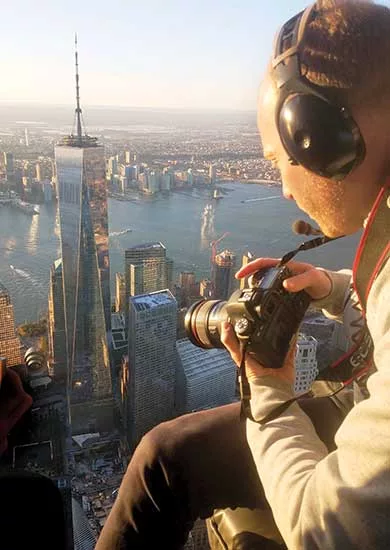
Lucas Blair takes to the skies to photograph lower Manhattan.
Photo © Meredith Bostwick-Lorenzo Eiroa
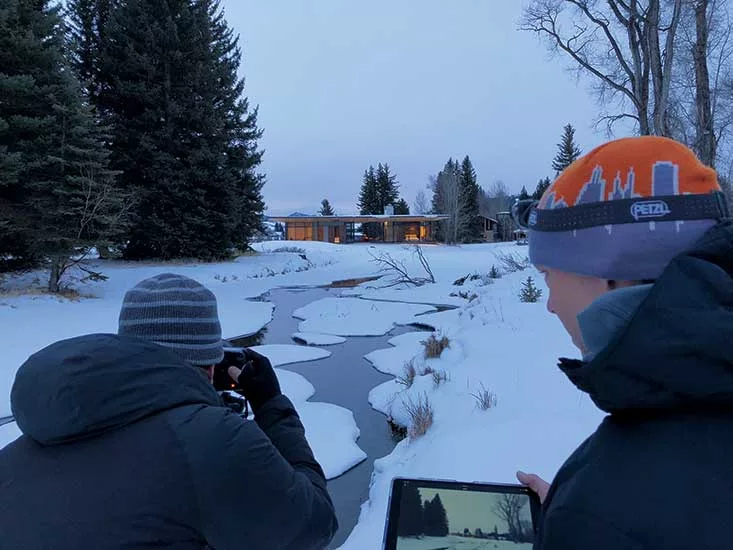
Matthew Millman (left) and his assistant shoot a house in Wyoming.
Photo © Eric Logan
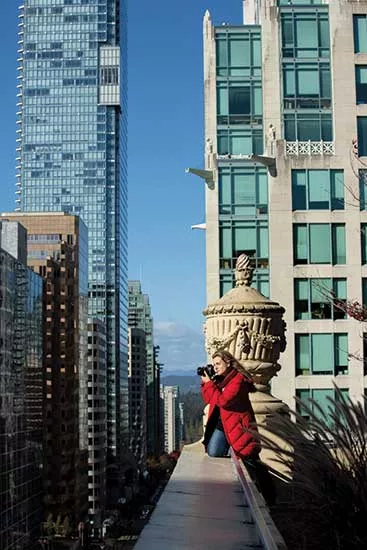
Ema Peter perches atop a hotel roof in Vancouver to capture the plaza below.
Photo © Tina Krueger Kulic
Photographs wield tremendous power. In the world of architecture, a captivating image can win editorial coverage for a project, attract a dream client, or lead to a prestigious award. In a larger sense, photographs can shape the perception of a building, influencing which works become icons or earn a place in the history books.
But getting the perfect set of photos isn’t easy. Who to hire, how much to pay, and when to schedule the shoot are among the many questions architects face when seeking to document their work in photographs. Technological advances and the ever-changing digital realm have made these questions even tougher to address. To shed light on navigating this complex process, we spoke with a range of firms, photographers, and agents about issues to consider when commissioning a shoot—from costs and copyright to preventing problems on picture day—and how to maximize your resources to ensure a positive result.
Consider Your Needs and Budget
When setting out to photograph a project, the first step is identifying where the images will be used. Of course, firms typically need strong photos for proposals, presentations, and marketing materials. Photos might also be used in award submissions, editorial coverage, exhibitions, lectures, and books. And, in the digital era, firms should consider their websites and social-media channels—outlets that also use moving images like time-lapse films and drone footage. “Video is important if there is something about the space that a moving image captures differently than a still photo,” says Greg Keffer, a partner at New York–based Rockwell Group. “In the NeueHouse, we have chandeliers that move up and down to mark time throughout the day. And we’ve designed dynamic stage sets with a lot of movement.” Beyond moving images, firms say a wide variety of photographs can ensure that all needs are met. While the “hero” shot is always critical, images showing construction progress can be useful for social media, and detail shots can convey technical aspects. “The big shots are really important, but details are also important—the hardware, the coffee cup sitting on the bar, whatever it may be,” says Keffer.
Next, determine the budget. The cost of commissioning a shoot and securing usage rights can vary widely, from a few thousand dollars to over $40,000. A photographer’s invoice may include fees for time, travel expenses, and an assistant; processing and editing; and usage fees. Some firms opt for full usage and rights “in perpetuity,” with few to no restrictions on how and when they use imagery. Other firms go with more limited (but cheaper) licensing. To help pay the bill, architects sometimes team up with clients, contractors, and suppliers. “When it’s applicable, I’ll ask other parties to join,” says Sean Airhart, the photography manager at global firm NBBJ. “When you’re spending $20,000 on a shoot, it helps to have partners sharing in the costs.” Airhart also handles a lot of the shooting himself on smaller projects, along with construction and scouting shots, and employee head shots. He formerly worked as an interior designer for the firm and took on his current job 12 years ago. “I was always known as the guy with the camera,” he says. “I began by helping with portraits, and it blossomed from there.”
Misconceptions can arise about photo usage. In most scenarios, copyright is held by the photographer, even when a firm pays for the shoot. If a photo appears online—on an architect’s website, for instance—that does not mean it can be used by others. “The Internet has made it so easy to share and post pictures,” says Bill Hannigan, founder of the photo agency OTTO. “Unfortunately, it does not always occur to people that a license, or at least permission, is required to use an image.”
Selecting the Right Photographer
Perhaps the most important aspect of photographing a project is choosing the person behind the camera. To find photographers, architects can consult fellow designers and peruse magazines and websites. A photographer’s style, pace, and personality should all figure into the hiring decision. As for experience level, emerging photographers may provide images at a reduced price; seasoned professionals may be more expensive, but they probably will be adept at handling complications and will have longstanding relationships in the media world.
Some architects gravitate toward a single photographer. Fayetteville, Arkansas–based Marlon Blackwell has worked with photographer Timothy Hursley for two decades. “He ‘gets’ our work, and he ‘gets’ the places in which we work,” says Blackwell, whose projects dot the American heartland. Hursley’s respectful nature enables him to connect with people—important when he is shooting in underserved communities. “He makes people feel as if they are part of the environment,” says Blackwell, “rather than just a prop.”
Looking for quick answers on architecture and design topics?
Try Ask RECORD, our new smart AI search tool.
Ask RECORD →
At the other end of the spectrum, global firm Skidmore, Owings & Merrill (SOM) has a stable of regular photographers, but the office constantly searches for fresh talent. One key criterion: proof that a photographer can deftly manage light and shadow. “A lot of portfolios have a tremendous number of dusk shots,” says Lucas Blair Simpson, an SOM senior producer who oversees the firm’s photography. “They can be beautiful, but it’s an easy shot to achieve. “We’re looking for a variety of conditions. We want to see if a photographer can get a great shot with direct sunlight, with sun and shadow part of the compositional conditions.” And Blair Simpson looks for a photographer who can handle unexpected challenges: “Even in the best-planned shoots, there’s going to be a hiccup,” he says.
That grace under pressure is a critical skill. For Eric Logan, a principal at Wyoming-based Carney Logan Burke, a photographer must be able to adapt and stay calm. The firm’s projects are typically situated in rugged settings, where nature’s whims are fully felt. One shoot, of a cabin, required a mile-and-a-half hike to the site wearing snowshoes. Another shoot was lined up for the perfect fall day, but the weather turned, and the leaves fell off the trees. “The photos are still amazing,” says Logan, noting that the bare branches make it look as if the project is under water. “Once everyone is there, and access has been arranged, planes have landed, and stuff is unpacked, it’s go time,” he says, adding that a good rapport with the photographer is essential, especially when assignments last several days. “We’re up early and out late with photographers,” says Logan. The more we can laugh together and get the work done, the more the relationship endures over time.”
Ensuring A Great Shoot
Problems are inevitable, but an architect can increase the chances of a successful shoot. Have conversations with the photographer about expectations; ideally, you can visit the site together to discuss the best features to capture. It can be helpful to develop a storyboard and a detailed shot list. Once shooting is under way, having a firm representative on-site is beneficial. “It’s great if someone from the architect’s office is there who knows how to work with the client,” says Erica Stoller, director of Esto, the photo agency started by her father, famed photographer Ezra Stoller. The representative can help with gaining access to spaces, controlling the lighting, and borrowing ladders, among other tasks. Moreover, last-minute requests for insurance certificates are not uncommon, says Stoller. “If the photographer has to do all this and make the images,” she says, “it may either compromise the coverage or involve more time and money.”
To help avoid logistical snafus, Esto has developed a pre-shoot checklist. For instance: Will cars be parked out front? Are flags at full mast? Are the windows clean? One common problem: a photographer arrives to find a building still under construction and not yet ready for its close-up. “Recently, I had to shoot a swimming pool before it opened. There was construction up to the last minute,” says Ema Peter, a Vancouver-based photographer. “When I showed up, the workers were still inside painting. I had to ask everyone to move.” While every photo shoot comes with its own challenges, the end result can make it all worthwhile. “When my clients are happy and the photos help them get another project,” says Peter, “nothing feels better.”
Looking for a reprint of this article?
From high-res PDFs to custom plaques, order your copy today!