Continuing Education: Vertical School Expansions
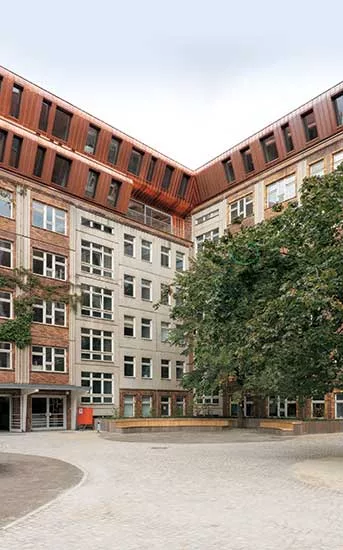
Sauerbruch Hutton’s copper-clad rooftop expansion of the Berlin Metropolitan School projects out over the existing building’s courtyard.
Photo © Jan Bitter

Sauerbruch Hutton’s copper-clad rooftop expansion of the Berlin Metropolitan School projects out over the existing building’s courtyard.
Photo © Jan Bitter
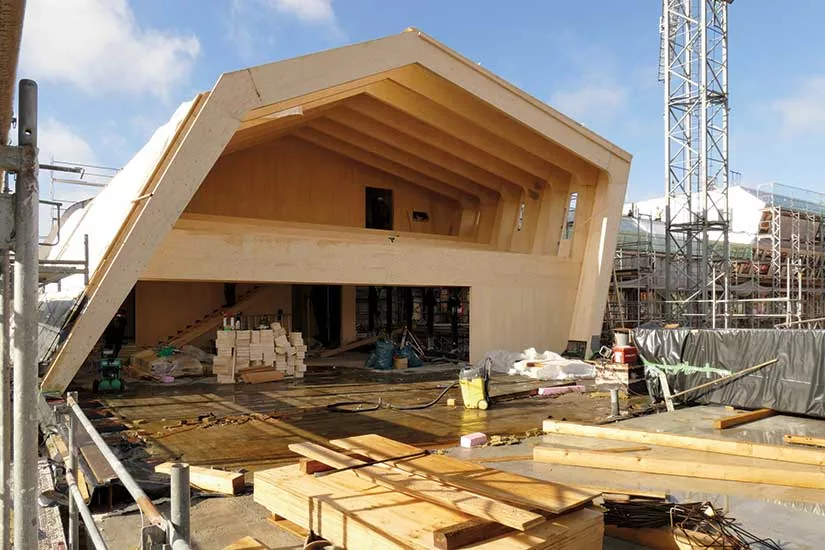
To support the new CLT addition, the architects took advantage of spare capacity in the shear walls of the structure below.
Photo courtesy Sauerbruch Hutton
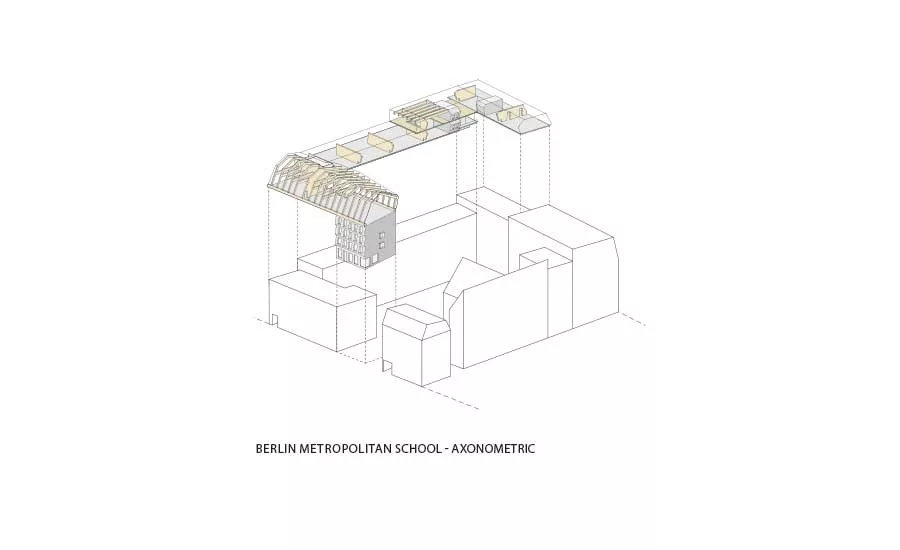
Image courtesy Sauerbruch Hutton
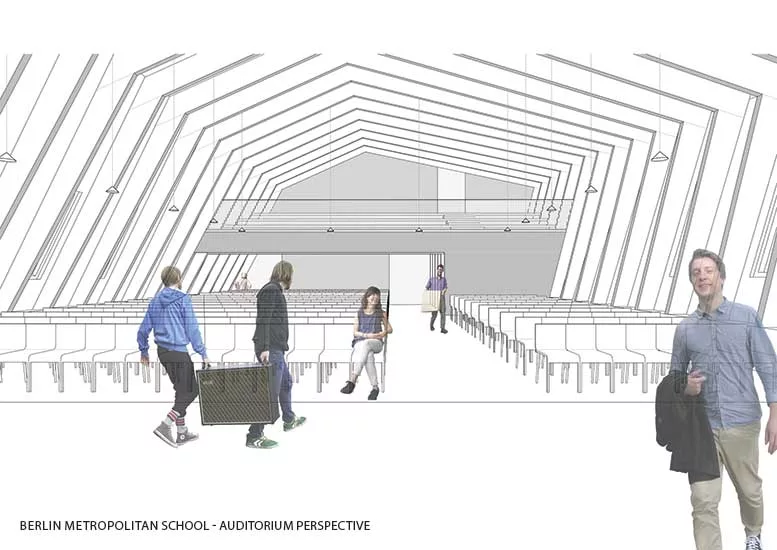
Image courtesy Sauerbruch Hutton
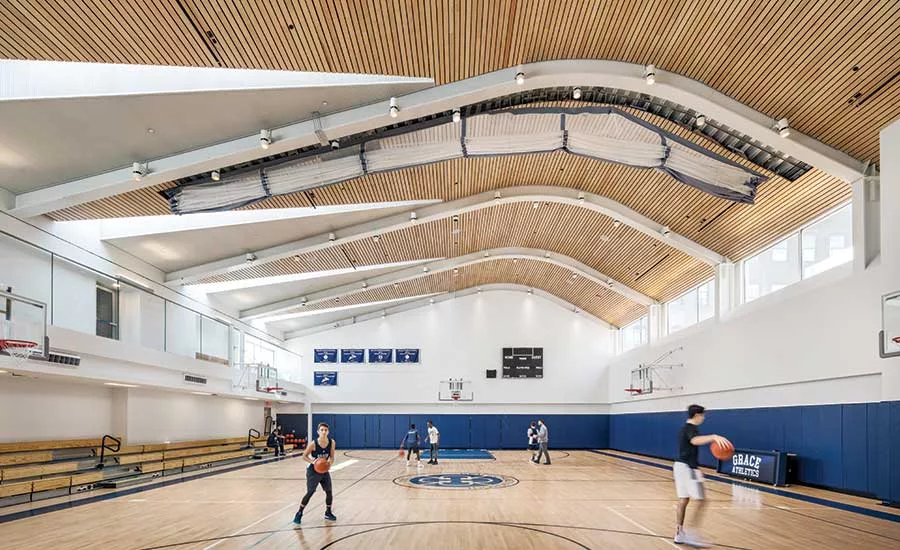
A new gym, designed by Murphy Burnham & Buttrick for the Grace Church School in Manhattan has a boomerang-shaped roof invisible from the street.
Photo © 2018 Francis Dzikowski/Otto
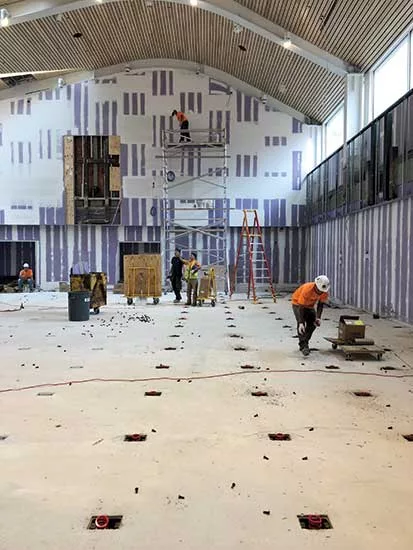
A jack slab with springs provides an acoustic break between the new gym at the Grace Church School and the classrooms below.
Photo courtesy MBB
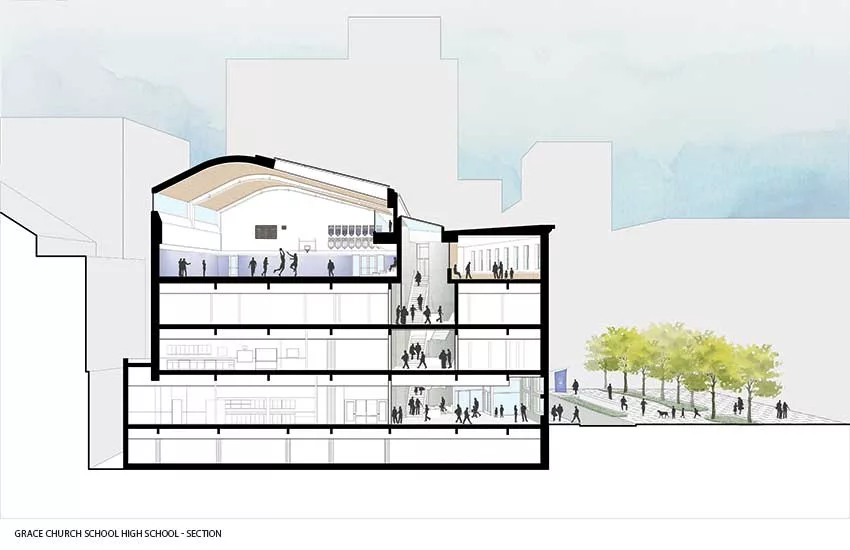
Image courtesy MBB
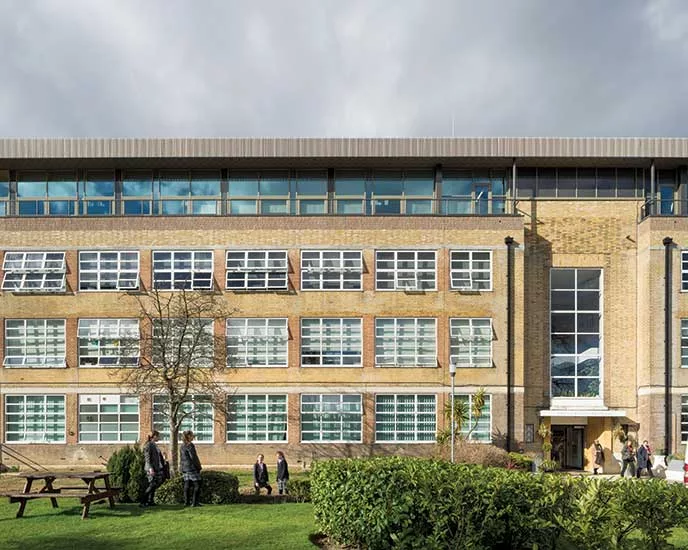
From the exterior, Cottrell and Vermeulen’s new top floor at Streatham & Clapham High School in London appears almost as though it has always been there.
Photo © Anthony Coleman
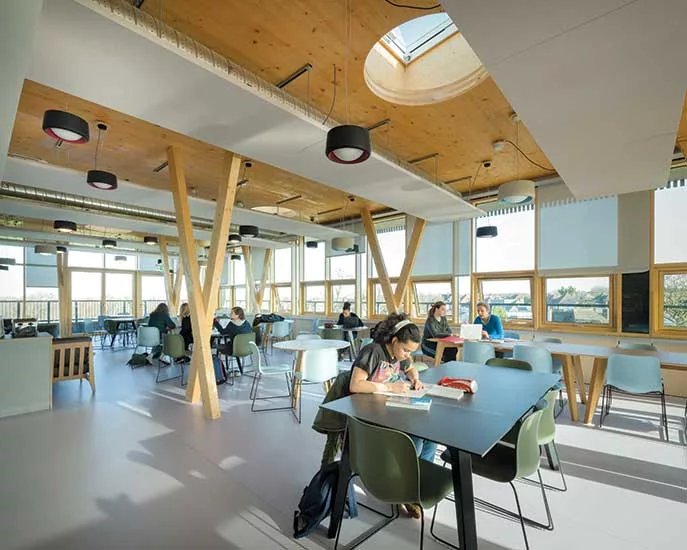
The interior of the Streatham & Clapham rooftop addition looks more contemporary than the exterior, with structural elements that include glulam columns that branch and cross, and CLT ceiling panels.
Photo © Anthony Coleman
Architects & Firms
Building on top of another building is nobody’s first choice. Issues of structural capacity, construction logistics, approvals for extra height, and aesthetic and programmatic relationships make it almost a last resort. Yet, for urban schools that need to grow, raising the roof is often the only option. “Real estate is incredibly challenging for many of these institutions,” says Mary Burnham, a principal at New York–based Murphy Burnham & Buttrick Architects (MBB). “If you can’t expand to the right or left, it’s very logical to look at air rights as potential for development.”
As a result, the architecture of vertical school expansions is emerging as a distinct and intriguing subtype. Berlin-based Sauerbruch Hutton’s extension of the Berlin Metropolitan School, for example, complements an existing ceramic-tile-clad facade with a sloping—but not the way you expect—copper attic. At Grace Church School, New York, an addition by MBB pushes through the roof with an elegant new form. And in London, Cottrell & Vermeulen Architecture completes Streatham & Clapham High School’s masonry construction with a glassy frieze that looks as though it should have been there from the start. While these vertical extensions share certain strategies—lightweight structure, careful attention to construction staging, and a deliberate approach to topping a completed work—each intervention exemplifies a unique approach to the brief.
The Berlin Metropolitan School’s building was built in 1987 from a prefabricated concrete- panel kit, part of a collection of gifts the major cities of the former East Germany sent to celebrate the 750th anniversary of the capital. Clad in precast concrete and the brick-like ceramic tiles for which the donor city (Rostock) is known, the K–12 school comprises four wings of four to seven stories, built to the lot lines of a midblock site, and enclosing a large courtyard playground. By the 2010s, with 1,000 pupils and an expanding program, the school needed more space. Its historic urban setting offered no scope for expanding outward, and Berlin’s high water table eliminated the possibility of digging beneath the courtyard. The only way the school could grow was up.
“It’s hard to put something on top that is equal but different,” says Vera Hartmann, architect with Sauerbruch Hutton, summing up the central design challenge. The solution, now under construction, tops three of the school’s stepped-height wings with a new roof form enclosing a 50,000-square-foot, one- and two-story extension. Its copper cladding harmonizes with the weathered ceramic, and the rhythm of its standing seams relates to vertical elements in the facade below. The major move, however, is formal. Along the lot lines, the new roof angles back in compliance with development restrictions; but on courtyard facing sides, it does the opposite, projecting out and over the existing facade. Primarily intended to increase the attic’s usable floor area, this move also creates an amiable impression, despite the extra height, as though the building is bending toward the playground, as an adult might bend toward a child.
The structure consists of glulam-timber trusses and cross-laminated timber (CLT) panels generating forms that in section look like “house” shapes that have slipped heavily to one side. The prefabricated system was erected quickly—six weeks for Phase I—without interrupting the school’s operation. To avoid the need for structural reinforcing of the original precast structure, an ingenious design takes advantage of spare capacity in the interior shear walls, which were built to the same standard as the load-bearing exterior walls. The lightweight addition is configured to transmit its gravity loads at 90 degrees to the gravity loads of the original structure, through those overbuilt shear walls. “How to use the old structure was a challenge at first,” says Hartmann, “but to use it in this clever way is one of the most successful aspects of the project.”
The extension includes an auditorium, a library with access to a roof garden, music rooms, classrooms, administrative offices, and, on the ground floor of a new stair leg, a community-facing coffee shop. Except where acoustic cladding is required, the timber structure is left exposed on the interior, to express the structure’s materiality and to reduce resource consumption. From the project’s completed portion, which has been in use for a year, Hartmann reports that the CLT panels are wearing better than conventional classroom surfaces.
Because the Berlin Metropolitan School is one of many that were built with this kit of parts, the principles of Sauerbruch Hutton’s solution are transferable, and Hartmann is already speaking with another school board about the option.
Looking for quick answers on architecture and design topics?
Try Ask RECORD, our new smart AI search tool.
Ask RECORD →
In New York City, where real-estate pressures are squeezing buildings ever upward, MBB has also built several rooftop extensions for schools, especially in cases of adaptive reuse. Grace Church School, for example, established the high school component of its program about seven years ago in what was originally a mid-19th-century row of dwellings, planning to add a gymnasium in the future on the roof. Recently completed, the school’s 14,000-square-foot extension provides large multipurpose spaces that can accommodate courts for team sports as well as all-school gatherings and events.
An array of long skylights in a new, arched steel roof works with large windows to let daylight into the addition, and a palette that includes exposed steel structural elements, glass, and wood complements the school’s original building. The expansion also adds offices, locker rooms, and storage areas, as well as a new fitness center. Designed for flexibility, the athletic facility doubles as a performance space for theatrical productions; the new space for storage makes for ease of transformation.
Long-span spaces like gymnasiums represent one of the key opportunities of rooftop additions, says Burnham, where a large, open volume can be designed without structural responsibilities for loads above. That doesn’t mean the construction of Grace Church’s athletic center was without structural challenges, though. The historic building that houses the high school program has a single brick facade, but consists structurally of multiple smaller buildings of lightweight construction—wood-frame, with some steel— that were incapable of supporting the load of the new gym. The first phase of construction entailed reinforcing the original structure. New steel members were tied into the existing columns to augment their capacity and carry the new loads to existing foundations. “It was a lot of work,” says Burnham.
The addition also presented sound-transmission issues. To separate the noise of basketballs thumping on the gym floor from conversations in the classrooms below, the athletic facility sits on a jack slab lifted on springs above the original roof level, with a 5-inch air space between the two slabs providing an acoustic break. But solving that problem complicated elevator access. An existing elevator, recalibrated to serve the extra story, couldn’t quite account for the jack slab, so subtle ramps make up the difference. More straightforward is the stair access: a wide existing flight was extended to reach the new floor, with overscaled glazing above to bring daylight deep into the floors below.
Like Vera Hartmann, Burnham says that working a rooftop extension into the fabric of an existing building poses a major design challenge: “Do you make it look as if it has always been there, or do you make it look like a new thing sitting on top of the building?” she says. Ultimately this may not be up to the architect. To win approval from the city’s Landmarks Preservation Commission, which oversees development applications in Grace Church School’s historic district, the boomerang-shaped roof of the new construction conforms to a sight-line-defined envelope that conceals it from street view. The resulting form, says Burnham, “emerges out of the roof as an object. Even though it’s invisible from the street, it creates its own identity, and contributes to the school’s. It’s a wonderful thing to be all in one place at once.”
For an extension to accommodate students in their final two years at London’s Streatham & Clapham High School for girls, Cottrell and Vermeulen took the opposite strategy. “We had the idea that we were completing the building rather than extending it,” says Simon Tucker, a director at the firm. A glassy new fourth-floor pavilion respects and enhances the character of the original 1930s three-story load-bearing masonry structure, and provides what Tucker calls a “thermal cap”: the properly insulated fourth floor, including a green roof, will considerably improve the thermal performance of the otherwise uninsulated building.
Sparing the school’s outdoor space in a fully built-out neighborhood, the vertical extension is the first phase (completed in 2016) of a RIBA Regional Award–winning project that also includes a new street-facing entrance, reception, and dining commons (completed in 2018). The 14,500-square-foot fourth floor provides a spine of classrooms, offices, science lab, and service spaces bookended by a dining and social gathering space and a new library. It operates almost as a school within a school, with most of the final two years’ programming occurring on this level.
Ample daylight and spectacular views toward the City of London, from the social and study spaces in particular, mark them as special points, part of the school’s larger aspiration to provide a sense of balance and uplift to young women going through these critical academic years. “Hopefully, that’s one of the biggest contributions that we’ve made,” says Tucker. “Rather than just giving them a conventional series of educational spaces, this is something that might address the wider issue of well-being.”
Configuring the new spaces in a way similar to floors below allowed the extension to take advantage of surplus structural capacity in the original masonry walls. A lightweight prefabricated system of glulam columns, in shapes that branch and cross, and exposed CLT panels required no upgrade to the base structure. In addition to its light weight, the prefabricated solution helped meet the challenge of building the rooftop addition in a single academic year, with minimal dust and noise while the school continued to operate. The primary structure went up in two to three weeks, with subsequent work conducted under cover and protected from the elements.
Also key to meeting the schedule, says Tucker, was the decision to bring the contractor on board immediately after schematic design to help resolve construction logistics, develop familiarity with the site to facilitate planning, and build relationships with school personnel to smooth the flow of work.
The new fourth floor is reached via two glass-enclosed stair towers, which underwent a major upgrade to serve as fire-fighting stairs for the extra height and to safeguard exiting for an extended time. Improvements included higher-rated doors and screens to achieve a two-hour fire separation, protected lobbies at each level, a new smoke-venting strategy for the staircases, dry risers in each stairwell for fire-hose attachments at every floor, and direct exterior egress at the ground floor. The common room, designed to accommodate more than 60 pupils, required an additional escape stair. “Going higher is a serious issue now,” says Tucker, mentioning London’s Grenfell Tower disaster (which Streatham & Clapham’s rooftop expansion predates). “There needs to be rigorous analysis of what the fire and escape issues are, particularly with schools and the age of the children you’re dealing with.”
As the pressures driving urban schools higher become more widely felt, the key to the success of vertical extensions is care in integrating height into operations. Otherwise, transitions between floors that are farther and farther apart will result in significant time loss in the learning day. “It isn’t useful to build more accommodation on top of a building and expect it just to extend the school’s existing educational model,” says Tucker.
Each of the three profiled schools has programmed its vertical addition to limit the number of times in a day that students will have to make the climb. Streatham & Clapham operates the top floor as a self-contained component. Grace Church School uses its extension for a single program element. Berlin Metropolitan School’s new upper levels accommodate special destination spaces. “If you build up, it has to be the right educational model for that school,” says Tucker. “You have to conceive of the school’s operation as a whole.”
|
Continuing Education
 To earn one AIA learning unit (LU), including one hour of health, safety, and welfare (HSW) credit, read "Continuing Education: Vertical School Expansions," review the supplemental material listed below, and complete the online test. Upon passing the test, you will receive a certificate of completion, and your credit will be automatically reported to the AIA. Additional information regarding credit-reporting and continuing-education requirements can be found online at continuingeducation.bnpmedia.com. To earn one AIA learning unit (LU), including one hour of health, safety, and welfare (HSW) credit, read "Continuing Education: Vertical School Expansions," review the supplemental material listed below, and complete the online test. Upon passing the test, you will receive a certificate of completion, and your credit will be automatically reported to the AIA. Additional information regarding credit-reporting and continuing-education requirements can be found online at continuingeducation.bnpmedia.com.Supplemental Material
Adam Swinburn, NSW Architects Registration Board, Byera Hadley Travelling Scholarship Journal Series Pages 1 through 25 Learning Objectives 1 Discuss the physical circumstances that could make the vertical expansion of an existing school building a practical option. 2 Explain how the structures of the three schools profiled here were reinforced to support their vertical additions. 3 For the three schools, describe the construction and sequencing strategies that allowed the additions to be built with minimal disruption to operations. 4 Explain how vertical circulation and emergency-exiting requirements were met for each of the three expansions.
AIA/CES Course #K1901A
For CEU credit, read "Continuing Education: Vertical School Expansions" and take the quiz at continuingeducation.bnpmedia.com, or use our Architectural Record Continuing Education app, available in the iTunes store. structure, finishes, and other original fabric when
a building is moved.
significant buildings.
|
Looking for a reprint of this article?
From high-res PDFs to custom plaques, order your copy today!