PATH by ARTechnic architects
Tokyo

Bracketed by planters, gently rising steps lead up from the street to the front door. While solid concrete shields much of the interior from passersby, large, stragically placed windows admit light and views.
Photo © Nacasa & Partners Inc.

A roof garden overlooks the courtyard. Clad with wood decking, it features a place for outdoor dining amid patches of greenery.
Photo © Gen Inoue

Concrete planters integrate with the architecture in the courtyard. They contain native Japanese plants and trees, which are nourished by an automatic irrigation system.
Photo © Nacasa & Partners Inc.
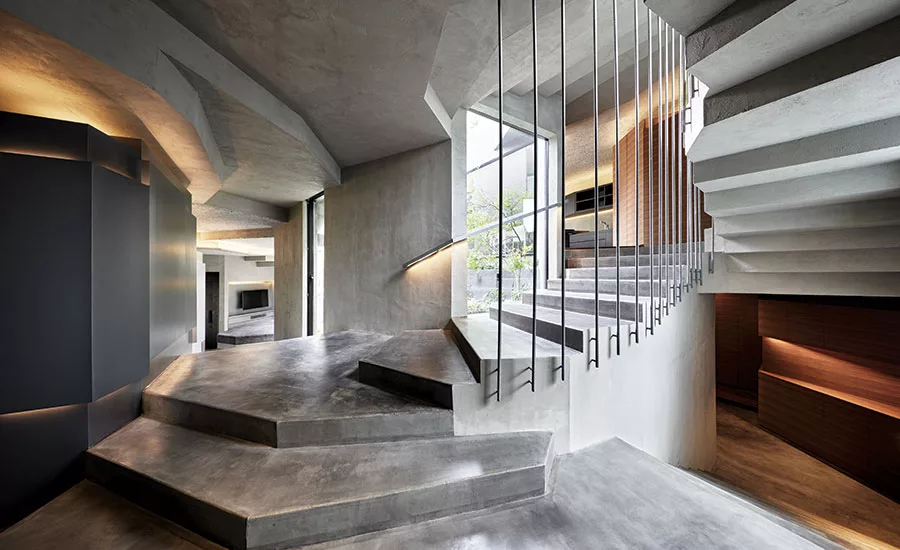
At the entrance foyer, stairs ascend to the kitchen/dining and living areas on the second floor and descend to the garage.
Photo © Nacasa & Partners Inc.

On the second floor, the dining room segues into a living area, which contains seating that overlooks the courtyard.
Photo © Nacasa & Partners Inc.

A custom platform bed and built-in storage in a child’s bedroom adapt to the architecture.
Photo © Nacasa & Partners Inc.

Jutting into the courtyard, the living room’s glass enclosure makes one of the only right angles in the house.
Photo © Hiroyasu Sakaguci A to Z
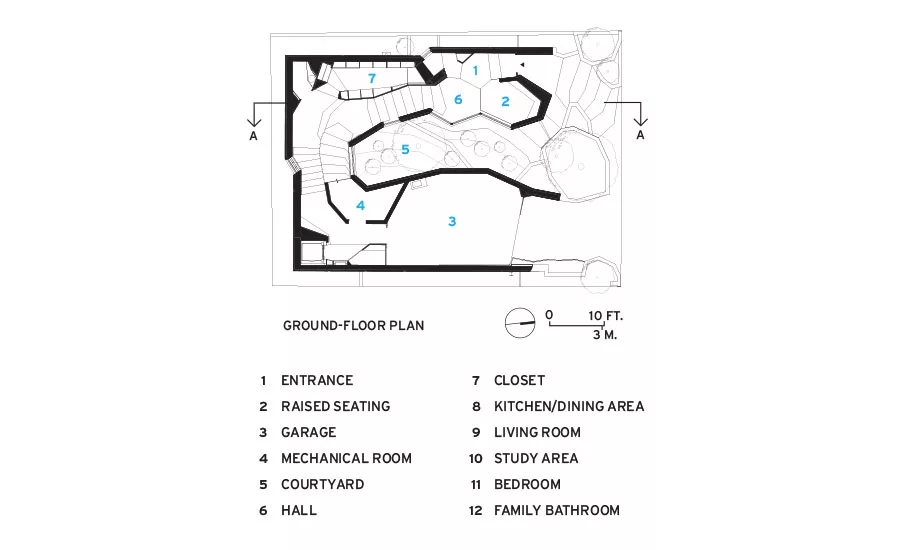
Image courtesy ARTechnic architects

Image courtesy ARTechnic architects

Image courtesy ARTechnic architects

Image courtesy ARTechnic architects
Architects & Firms
A craggy mountain of a house, the appropriately named PATH, is as much a piece of the landscape as a place to live—except that it is located in central Tokyo and is made almost entirely of concrete. Belonging to a couple with three children, the structure was designed by ARTechnic architects, whose principal, Kotaro Ide, dreams of building amid big rocks and bold natural places. “But we never have that kind of site,” laments the Tokyo architect. Compensating for this deficit, Ide took the actual conditions, a 3,122-square-foot plot surrounded by houses on three sides, and recast them as his ideal property.
Additional Content:
Jump to credits & specifications
Oriented toward the street in front, PATH is a U-shaped structure with a courtyard and outcroppings of greenery in the middle. Essentially, it has no facade. “I am more interested in the internal space than the external appearance,” explains Ide. Though regarded as a three-story house, the floors of the two wings differ by a half-story. The resulting six levels are connected in the middle by stairs that switch back and forth like a hilly hiking trail. Starting at grade, one wing houses the garage and the other the main entrance, with a passageway linking the two in back. From the foyer, stairs ascend to the kitchen/dining and living areas on the second floor, above the garage. The third floor contains individual bedrooms for the children plus a communal study space, followed by bedrooms for each parent on the fourth floor, and the family bathroom—a trio of discrete spaces for a sink, water closet, shower, and bathtub—on the fifth. Topping the entire building is a roof terrace that can also be accessed by taking the elevator at the rear of the house.
Except where partitions are needed for privacy, the interior is essentially a continuous multilevel corridor containing a chain of functional areas. To develop his design, Ide began with the volume instead of starting with the plan. His inspiration for this extremely complex shape was “columnar jointing,” a natural geological formation defined by faceted, pillar-like protrusions resulting from cooling lava. With that image in mind, he designed the building using parametric modeling, which enabled the concurrent manipulation of multiple variables, such as how the volume would step up as it moves back on the site, and the ratio of the building’s height to the width of the courtyard void. Once the basic form was decided, Ide carved out its interior and inserted the programmatic pieces, massaging the volumes to make everything fit comfortably without compromising the building’s overall proportions.
Construction had its challenges. The building’s unusual shape required more sophisticated analysis tools than is typical to calculate the load-bearing capacity of a single-family home. Consulting with two structural engineers, the architects determined that the concrete structure needed to be reinforced with numerous small beams, as well as copious amounts of rebar in the concrete itself. Forgoing the usual practice of positioning the reinforcing steel and then constructing the forms around it, the contractors used 2-D measurements taken directly from Ide’s 3-D model to build the complex wood molds first. “We had to provide more drawings than usual, but most of my work is like that,” laughs Ide. Due to the concrete slabs’ irregular geometry, locating formwork panel joints and rebar anchors in a balanced, visually pleasing pattern was nearly impossible. To conceal the irregularities, Ide applied a thin layer of mortar to the surfaces of the interior concrete walls, followed by a coat of semitransparent silicate-base paint. The concrete on the outside of the building is covered with foam insulation and finished with stucco.
Walnut floors and custom cabinetry provide a warm contrast to the gray-hued concrete surfaces. Because of the quirky room shapes—there are only three right angles in the entire house—custom was the only option for most of the furniture. While the polygonal dining table echoes the angled walls nearby, the living area’s modular seating nestles cozily against the stepped wood floor and the concrete walls. Even the bed frames had to be designed to mediate between conventional rectangular mattresses and Ide’s unconventional architecture. Integrated with the fit-out and furnishings are ambient lighting and HVAC systems. These include strips of LED fixtures, lining the tops of cabinets as well as in coves tucked around the ceilings and air-handling ducts built into the floors.
Even in Japan, a place that spawns some of the world’s most distinctive dwellings, homes of this complexity are uncommon. Most houses in this country last a mere 25 years—they wear out, the land changes hands, the owner wants something new. Yet there is a method to Ide’s seeming madness. As with any stony peak, PATH’s sharp edges will naturally soften over time: its surfaces will weather, and new growth is likely to overtake the current plantings. But beneath those superficial changes, Ide’s architecture is rock solid. According to the designer, “If an architect were to discover this concrete structure in the future, they would reuse it.”
CreditsArchitect: ARTechnic architects — Kotaro Ide, principal; Bala Sivakumar, Ruri Mitsuyasu, Yukako Kitae, Takume Sugi, design team
Engineering: Naomi Kitayama and Hiroki Osanai (structural); TNA (mechanical); Makoto Electric Design (electrical)
Consultants: Lysing (landscape design); Chizuki Iizuka (lighting design)
General contractor: Wada Construction |
SpecificationsExterior insulation and finish system Toho Leo
Roof Handywood (regenerated-wood deck); Aqasoil (green roof system)
Windows YKK AP
Hardware Miwa Lock; SECOM; West Hardware
Paint KEIM; Ducale
Tile IOC
Carpet Karastan
Furnishings Cassina
Lighting Daiko; Luci; Moriyama; Yamada
Elevator Mitsubishi Hitachi Home Elevator
Plumbing Hansgrohe; Cera: Toto; Kaldewei |
Looking for a reprint of this article?
From high-res PDFs to custom plaques, order your copy today!