Architectural Record
search
cart
facebook twitter linkedin youtube
  • Sign In
  • Subscribe
  • Sign Out
  • My Account
Architectural Record
  • NEWS
    • Latest News
    • Awards
    • Interviews
    • Obituaries
    • Podcasts
      • Design:Ed Podcast
      • Sponsored Podcasts
  • OPINION
    • Book Reviews / Excerpts
    • Exhibition Reviews
    • Forum
  • EXCLUSIVES
    • Videos
    • Design Vanguard
    • Top 300 Firms
    • Sponsored Content
    • Sponsored eBooks
    • From the Archives
  • CONTINUING ED
    • Editorial Continuing Ed
    • CE Center
    • CE Academies
  • PROJECTS
    • Buildings By Type
    • Reuse & Renovation
    • Museums & Arts Centers
    • Colleges & Universities
    • Multifamily Housing
    • Interiors
    • Lighting
    • Kitchen & Bath
  • HOUSES
    • Record Houses
    • House of the Month
    • Featured Houses
  • PRODUCTS
    • Products by Category
    • Record Products of the Year
    • Latest Products
  • EVENTS
    • Dates & Events
    • Record on the Road
    • Innovation Conference
    • Sustainability in Practice
    • Women In Architecture
    • Webinars
    • Ad Excellence Awards
    • Submit an Event
  • CONNECT
    • Ask RECORD AI
    • Newsletters
    • Contact
    • Advertise
    • Editorial Calendar
    • Store
    • Customer Service
  • SUBMIT
    • Submission Guidelines
    • RECORD Competitions
  • MAGAZINE
    • Subscribe
    • My Account
    • Digital Edition
    • Current Issue
    • Firm Pass
    • Historic Archive
Architecture News

OMA’s First Ground-Up Project in New York City Now Complete
By Alex Klimoski
121 East 22nd Street

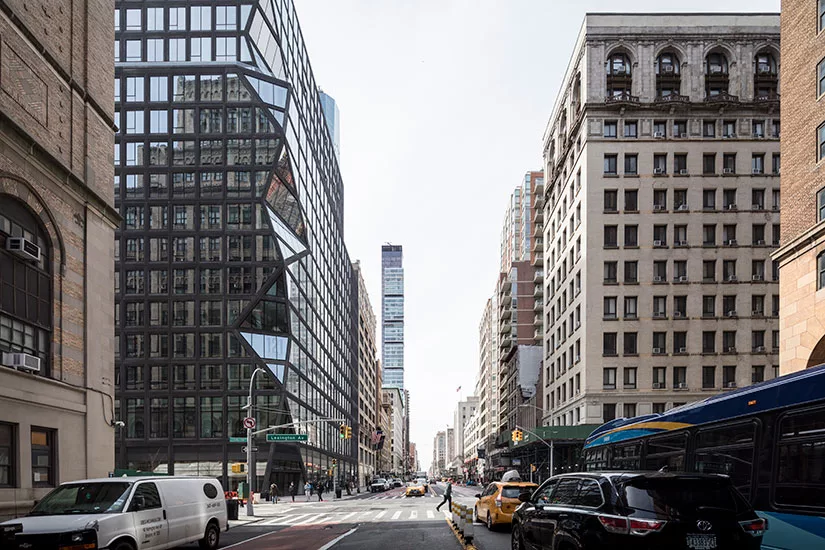
OMA’s first building in New York City is a residential complex comprising two towers. The larger tower (shown) includes an articulated corner at a busy intersection.

Photo © Laurian Ghinitoiu
121 East 22nd Street

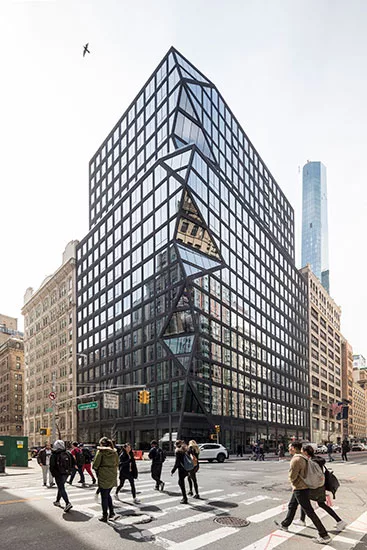
Moving away from the corner, the 18-story north tower’s two façades become more contextual with the window openings modulated to the neighboring pre-war buildings.

Photo © Laurian Ghinitoiu
121 East 22nd Street

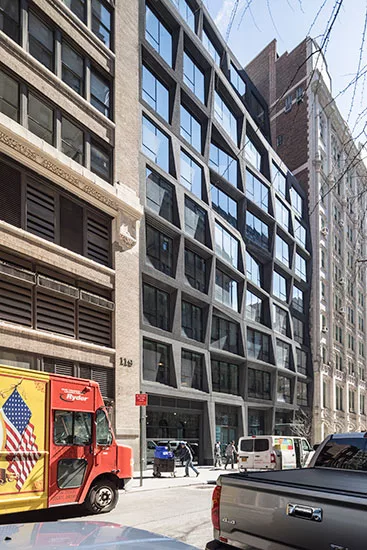
The 13-story south tower features a fractured grid of punched windows overlooking a quieter side street.

Photo © Laurian Ghinitoiu

121 East 22nd Street

The dark gray precast panels of the facades are sandblasted to expose the aggregate, making the building stand apart from its masonry neighbors.

Photo © Iwan Baan
121 East 22nd Street

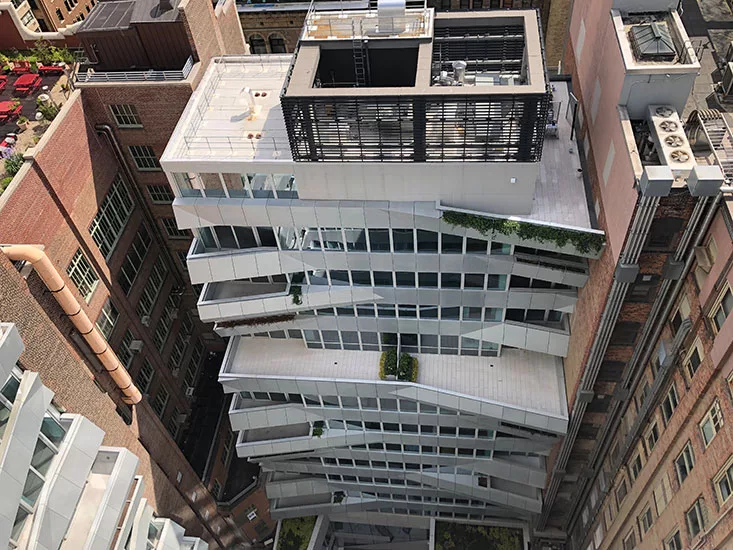
The L-shaped site produces an interior courtyard with amenity spaces and balconies.

Photo © Architectural Record
121 East 22nd Street

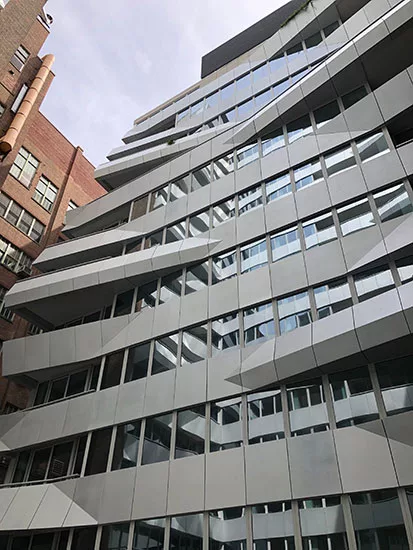
The irregularly-shaped balconies feature railings in a perforated metal.

Photo © Architectural Record

121 East 22nd Street
May 23, 2019

Architects & Firms

OMA

It’s been a busy May for Shohei Shigematsu and OMA New York. Earlier in the month, the OMA-designed renovation of Sotheby's New York headquarters opened to the public. Just last week, the firm’s exhibition design for Dior: From Paris to the World, opened at the Dallas Museum of Art, and OMA was named the winner of the competition for the University of Illinois at Chicago’s Center for the Arts. Today, OMA’s first ground-up project in New York City—a residential complex in Manhattan’s Gramercy Park neighborhood—is officially complete.

The new development, 121 East 22nd Street, comprises two towers, the taller of which marks its presence at the intersection of East 23rd Street and Lexington Avenue with its facade of charcoal-colored precast concrete panels and a glazed, faceted corner that reflects passersby, traffic, and the surrounding buildings at multiple angles.

The residence’s main entrance—at the smaller, south tower—is tucked into a melange of historic residential buildings along the quieter East 22nd street, which includes an early twentieth-century C.B.J. Snyder-designed school. Shigematsu took inspiration from the surrounding structures for the fenestration: at the north tower, the inset windows are arranged in a gradient, reflecting the narrow apertures of adjacent buildings at the ends and getting wider as they approach the corner; the south tower’s refracted window grid has a more subtle expression.

The 18-story and 13-story towers are connected on the L-shaped site via a shared courtyard, which is wrapped with amenities, including a pool, gym, and automated parking (whose moving cars are visible from the courtyard through translucent glass panels). Rather than have terraces face the busy streets, Shigematsu arranged them to open out to this quiet outdoor space—what he refers to as the “valley”; each of the balconies takes a different angular form, echoing the north tower’s dynamic corner condition.

Located at the crossroads of busy city streets and the private residential area anchored by Gramercy Park, the new development “reflects a split-personality,” says Shigematsu, managing to respect the surrounding context while creating a unique and contemporary identity.

Looking for quick answers on architecture and design topics?
Try Ask RECORD, our new smart AI search tool.
Ask RECORD →

KEYWORDS: New York City

Share This Story

Looking for a reprint of this article?
From high-res PDFs to custom plaques, order your copy today!

Alexandrea klimoski web 2

Alex was an associate editor at Architectural Record. Prior to joining the magazine, she worked in marketing and communications for New York–based architecture firms. Her writing has appeared in the Architect’s Newspaper and CityLab. Alex holds a master’s degree in design criticism from the School of Visual Arts and a bachelor’s degree from Cornell University.

Post a comment to this article

Report Abusive Comment

Subscription Center
  • Create an Account
  • Start a Subscription
  • Manage My Account
  • Sign Up for Newsletters
  • Visit Customer Service
  • Update Preferences

More Videos

Sponsored Content

Sponsored Content is a special paid section where industry companies provide high quality, objective, non-commercial content around topics of interest to the Architectural Record audience. All Sponsored Content is supplied by the advertising company and any opinions expressed in this article are those of the author and not necessarily reflect the views of Architectural Record or its parent company, BNP Media. Interested in participating in our Sponsored Content section? Contact your local rep!

close
  • TAMLYN XtremeTrim Exterior Trim
    Sponsored byTamlyn

    Designing Cleaner Panel Facades: Why Exterior Trim Details Matter

  • Building with Vapor Barriers
    Sponsored byReef Industries, Inc.

    Vapor Barriers Help Control Moisture in Tighter Building Designs

  • Duct Interior with Prodeq System
    Sponsored byHenry, a Carlisle Company

    Designing Resilient Water Containment Systems

DESIGN:ED Podcast
Listen to Architectural Record’s DESIGN:ED Podcast

Events

June 10, 2026

Rethinking Stormwater – The Power of Porous Paving

Credits: 1 AIA LU/HSW; 1 AIBD P-CE; 0.1 ICC CEU

Learn how porous paving systems support stormwater management, reduce heat island effects, and enhance sustainable site design performance.

June 11, 2026

Very Early Warning Fire Detection for Mission-Critical Facilities

Credits: 1 AIA LU/HSW; 1 AIBD P-CE; 0.1 ICC CEU

Examine advanced fire detection strategies that support uptime and enhance safety in data centers and other mission-critical facilities.

View All Submit An Event

Products

2026 Architect's Square Foot Costbook

2026 Architect's Square Foot Costbook

See More Products

Popular Stories

Practice Matters illustration

What’s in a (Firm’s) Name? Thinking About Succession and Legacy

Practice Matters illustration

By the Numbers: Counting America's Architects

Riverdale House by Studio Lau

Riverdale House by Studio Lau

House on a Hill

Design Vanguard 2026: Forma

Crane Cove, ONO

Design Vanguard 2026 Winners

Broader Sustainability of CMU - Free Webinar - May 21, 2026

Related Articles

  • Guggenheim and BMW Launch First Pop-Up 'Lab' in New York City

    See More
  • OMA to Design New Museum Expansion

    OMA to Design New Museum Expansion in New York City

    See More
  • SPARC deconstruction

    CO Adaptive Conducts a Salvage Operation at Hunter College in New York City

    See More

Related Products

See More Products
  • postmodern design.jpg

    Postmodern Design Complete

See More Products
×

The latest news and information

#1 Source for Architectural Design, News and Products

SUBSCRIBE
  • RESOURCES
    • Advertise
    • Contact Us
    • Submit
    • Store
  • ACCOUNT CENTER
    • Create an Account
    • Start a Subscription
    • Manage My Account
    • Sign Up for Newsletters
    • Visit Customer Service
    • Update Preferences
  • PRIVACY
    • PRIVACY POLICY
    • TERMS & CONDITIONS
    • DO NOT SELL MY PERSONAL INFORMATION
    • PRIVACY REQUEST
    • ACCESSIBILITY
  • SERVICES
    • Marketing Services
    • Reprints
    • Market Research
    • List Rental
    • Survey/Respondent Access
  • STAY CONNECTED
    • Linkedin
    • Facebook
    • Instagram
    • YouTube
    • X (Twitter)

Copyright ©2026. All Rights Reserved BNP Media, Inc. and BNP Media II, LLC.

Design, CMS, Hosting & Web Development :: ePublishing