Women of the Bauhaus: Catherine Bauer Wurster

Catherine Bauer wrote about J.J.P. Oud’s Hook of Holland Workers’ Housing
Photo © Collection Nai
As the United States faces a crisis today of inadequate affordable and low-income housing, it is a timely moment to look back at the work of Catherine Bauer, a leading 20th-century reformer and activist who helped introduce the socially minded goals of European architects to America through her seminal book, Modern Housing, published in 1934. She helped formulate the revolutionary U.S. Housing Act of 1937, with which the federal government, for the first time, embraced the concept that housing the poor was not a private affair; the legislation created a federal loan and subsidy program to spur construction of decent low-income housing. Like the Bauhaus architects and other European Modernists, Bauer believed that good design for public housing should be an abiding concern for the architectural profession.
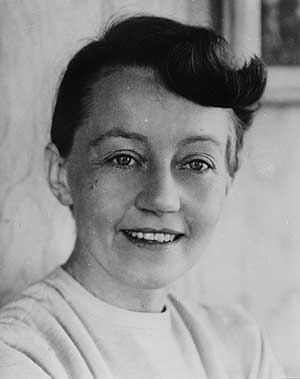
Born in Elizabeth, New Jersey, in 1905, Catherine, along with her younger sister (museum curator Elizabeth Mock Kassler) went to Vassar College. Catherine left to study architecture for a year at Cornell University, but returned to Vassar to graduate in 1926. After a sojourn in Paris, she was working in promotion and publishing in New York when she met Lewis Mumford. Through him, her interest in architecture was rekindled. The mentorship by the married man turned into a romance.
In 1930, Bauer traveled to Europe to investigate housing projects. “What I saw was so exciting,” she later recalled. “It transformed me from an aesthete to a housing reformer.”
Bauer’s winning essay on social housing, for a Fortune magazine contest sponsored by Edgar Kaufmann (who later was Frank Lloyd Wright’s client for Fallingwater), was published in 1931, and she became an “instant housing expert.” She assisted Mumford in organizing the housing section of MoMA’s Modern Architecture: International Exhibition (1932). When Fortune commissioned Mumford to write a series of articles on housing, he turned to Bauer to collaborate. Another trip to Europe ensued.
Most of the significant architecture she saw in Europe was low-income housing, including Walter Gropius’s Siemenstadt housing (1930) for Berlin and J.J.P. Oud’s Workers’ Housing at the Hook of Holland (1926). Learning the principles of existenz minimum—the goals of decent, safe, sanitary housing for all that were promulgated in Europe—had a big impact on her subsequent work in America. In Modern Housing, she urged that a functionalist, vernacular design replace the chaotic and architecturally eclectic housing being built here. Even the new International Style was promoted in this country on stylistic terms, she argued, not for the social and planning ideas implicit in its forms.
When Modern Housing first appeared in the midst of the Depression, new-home building was at a virtual standstill. So Bauer began to promote housing sponsored by labor unions, such as the Carl Mackley Houses in Philadelphia, which was backed by the American Federation of Hosiery Workers and built under a Public Works Administration program. Bauer was hired by the Labor Housing Conference to help other unions learn from this prototype. From there, she worked with reformers pushing for the landmark Housing Act of 1937. Under this legislation, the U.S. Housing Authority was created to channel loans and subsidies for low-income housing through local government. Although Bauer had been the first person to win a Guggenheim Fellowship in architecture and planning, in 1936, after the Housing Act was passed, she postponed work on a new book to become the director of Research and Information for the new U.S. Housing Authority.
Initially, Bauer advocated slum clearance and urban renewal to build new low-cost housing, and endorsed standardized construction with “superblock” planning. Through standardization, she argued, costs would be reduced. Later she modified these positions, as the pitfalls of the monotonous tower-in-the-park became all too clear in the 1950s. In her article “Dreary Deadlock in Public Housing,” for Architectural Forum in 1957, she noted that public housing had not won wide support, and that only a small percentage of eligible people—the most desperately poor—were actually applying to live in such places. Standardization had led to institutionalization; those superblocks had created large, bland buildings, and a housing project was identified with the lowest-income group. As Bauer wrote, “We’ve embraced too many functional and collectivist theories and ignored certain subtleties and aesthetic values and basic social needs.” What families needed, she concluded, were private outdoor spaces and differing design treatments.
Looking for quick answers on architecture and design topics?
Try Ask RECORD, our new smart AI search tool.
Ask RECORD →
Bauer had foreseen the danger of urban renewal as a form of “people removal” from existing slum neighborhoods. She urged a balanced clearance and relocation effort so that residents could stay in the same community during the process and be guaranteed accommodations in new housing. Other proposals of hers included zoning that would cluster different sizes and types of housing, and property-tax assessments to encourage the construction of low-scale community facilities and shops.
Another idea advocated by Bauer was for public-housing agencies to work with private investors to create an agglomerated housing market. As suburbanization became widespread following World War II, and cities faced competition from suburbs for the tax dollar, she urged that regional land controls, housing policy, and transportation be unified.
Married in 1940 to architect William Wurster, Bauer moved with him to the Bay Area, where she began teaching city planning. On November 21, 1964, she was found on the coast near Mount Tamalpais, dead of a brain concussion and exposure, apparently having fallen while on a walk. She was 59.
Bauer never forsook her early ideals for raising the quality of housing in this country. Shortly before her death, she observed that the poor still didn’t have a minimum standard of housing (nor do they today). And she castigated modern architects for not continuing their early experimentation in this social arena, which held so much promise when she began her historic role as a reformer.
The essays on Sibyl Moholy-Nagy and Catherine Bauer have been adapted from "Voices of Consequence: Four Architectural Critics," by Suzanne Stephens, published in Women in Architecture, edited by Susana Torre, ©1977 by Watson-Giuptill, an imprint of Penguin Random House LLC. Used by permission of Watson-Guptill, an imprint of Random House, a division of Penguin Random House LLC. All rights reserved.
Read about other Women of the Bauhaus: Sibyl Moholy-Nagy & Aline Saarinen
Looking for a reprint of this article?
From high-res PDFs to custom plaques, order your copy today!