Women of the Bauhaus: Aline Saarinen
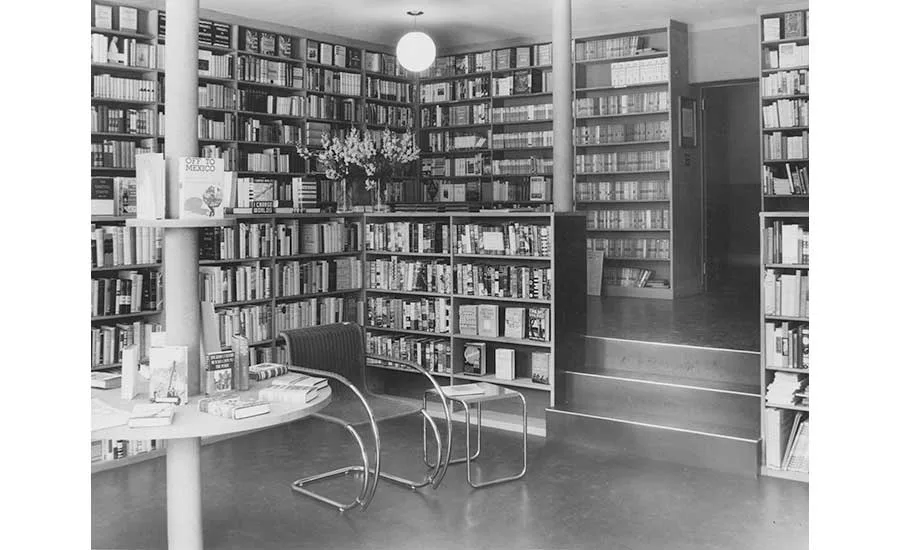
Aline Saarinen reviewed the modern Vassar bookshop.
Photo © Archives and Special Collections, Vassar College
Though Aline Bernstein Louchheim Saarinen (1914–72) was an acclaimed journalist in her day, she slipped into obscurity—only to begin to emerge as her husband Eero Saarinen’s architectural star began rising again in recent years. Yet, well before her marriage to Saarinen in 1954, she was a cultural force, writing hundreds of articles for magazines and as an art critic for The New York Times, where she was a vigorous defender of modern architecture, at a time when much of America was dubious about contemporary design.
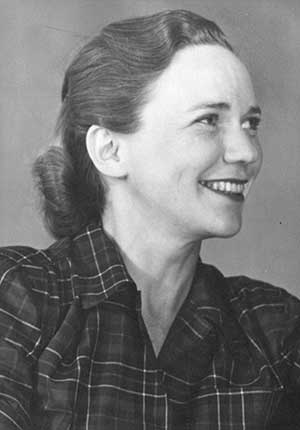
Born into a privileged New York family, Aline was taken on her first grand tour of Europe at the age of 9. But her deep education in Modernism really began at Vassar College, where John McAndrew was her influential teacher. McAndrew had studied architecture at Harvard and was part of a circle that included Henry Russell Hitchcock and Lincoln Kirstein, who became players in the nascent Museum of Modern Art. In 1929, McAndrew traveled in Europe with another member of that tribe, Philip Johnson, visiting J.J.P. Oud housing and Brinkman & Van der Vlugt’s Van Nelle Factory. At the Bauhaus in Dessau, they met Gropius, though he was no longer running the school.
The Bauhaus and other strands of European Modernism were embedded in McAndrew’s thinking when he arrived at Vassar in 1932. He not only taught the history of art and architecture, he redesigned Vassar’s art library and gallery, creating the “first modern interior of an academic building on an American campus,” according to Mardges Bacon in her book John McAndrew’s Modernist Vision. Though Aline had graduated when those spaces opened in 1937, she saw a precursor in McAndrew’s clean design of the Vassar Cooperative Bookshop, which she reviewed as art editor of the student newspaper, noting its Mies van der Rohe chairs, chairs “adapted from Le Corbusier,” and a desk by Marcel Breuer. Vassar had a strong link to MoMA—where McAndrew later became curator of architecture—and Aline likely heard both Johnson and Hitchcock lecture at the college about their 1932 International exhibition at the museum, which she well could have seen herself.
A student of exceptional promise, Aline was married to Joseph Louchheim within a week of her graduation in 1935. Yet she didn’t settle for domesticity but enrolled in the master’s program at the Institute of Fine Arts at New York University, pursuing her degree while raising two young sons.
Aline worked at Art News, rising to managing editor, and then was hired away by the Times in December 1947. In her first Times review, she argued for the link between modern art and architecture. “Abstract art still puzzles many people,” she noted, but Mondrian, for example, was “a fountainhead of inspiration” for architects such as Oud and Mies. Later pieces focused on a Marcel Breuer prototype house at MoMA; the architecture of factories; and the firm SOM, about whose work she wrote, “The shadows of Mies Van der Rohe, Le Corbusier, and Gropius fall on the drafting boards.” Her lucid writing brought her honors, including the International Award for Best Foreign Criticism at the Venice Biennale in 1951.
But it was an assignment in January 1953 that changed her life: she went to Bloomfield Hills, Michigan, to report on Eero Saarinen for the Times Magazine. In the wake of the death of his father, Eliel, Eero was moving their firm in a new direction. In her piece “Now Saarinen the Son,” Aline told, in almost Shakespearean terms, how Eero had emerged from his father’s long shadow to create an architectural idiom in which “interlock[ing] form, honest functional solutions, and structural clarity become an expression of our way of life.” The article perfectly positioned Eero for the wave of success that awaited him; he couldn’t have written it better himself—and in a way, he did. Their meeting had been a coup de foudre—and not only did Aline commit the journalistic sin of sleeping with her subject, but she let him vet the piece in advance.
Aline by then was divorced and, within a year, Eero had divorced his wife.
Looking for quick answers on architecture and design topics?
Try Ask RECORD, our new smart AI search tool.
Ask RECORD →
She could not write about Eero for the Times after they married, but, in 1955, Vogue ran her piece “Four Architects Helping to Change the Look of America.” The four were Mies, as a kind of godfather figure, plus three younger architects who were dubbed “Miesian”: Johnson, Gordon Bunshaft—and Eero. Eero declared Mies “a great moral force in architecture,” while Aline described her husband as a “professor” type who manages to “make a neatly pressed suit look slept-in within ten minutes”; she also described their house, without saying she lived in it. It was awkward, to say the least: Vogue attached an odd disclaimer saying the editors chose the four architects, not Mrs. Saarinen.
Aline and Eero were a power couple—both were extraordinarily ambitious for themselves and each other. Aline boosted his career through her East Coast connections, and helped shape his image through her deft PR skills. Her own career was in full gear as well, with articles for the Times and her 1958 bestselling book, The Proud Possessors, about great art collectors from J.P. Morgan to Peggy Guggenheim.
All that was shattered in 1961, when Eero died of a brain tumor at the age of 51. Devastated, Aline went into overdrive, becoming a kind of Yoko Ono of architecture, working hard to control his legacy. She played a hugely significant role, too, in ensuring that his many unfinished projects were completed.
In 1962, Aline arranged for the Today show to broadcast from Eero’s TWA terminal when it opened, and she chatted easily on camera with the show’s host. She soon launched her next career, in television—first covering the arts for Today, and later as a correspondent for the NBC evening news. In 1971, NBC sent her to Paris, the first woman to run a network foreign bureau. But it was a short-lived triumph: she died the next year, of cancer. A media pioneer, she knew how to communicate sophisticated ideas about culture to a popular audience, on television as she had in print. One critic put it this way: she never made “the highbrow seem high blown.”
Cathleen McGuigan is working on a biography of Aline Saarinen.
Read about other Women of the Bauhaus: Catherine Bauer Wurster & Sibyl Moholy-Nagy
Back to "Does the Bauhaus Still Matter?"
Looking for a reprint of this article?
From high-res PDFs to custom plaques, order your copy today!