Design Vanguard 2009: BIG | Bjarke Ingels Group
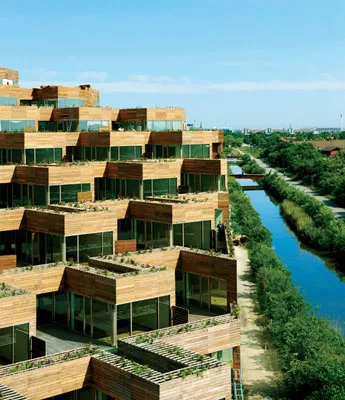
Completed in 2008, the 335,209-square-foot complex sits on a canal in the new district of Ørestad, south of Copenhagen’s downtown. BIG placed 80 south-facing apartments with 970-square-foot terraces clad with Ipé wood over a 480-slot parking garage to create this 11-story, man-made mountain. Inside the concrete parking structure, a funicular takes residents to designated floors, whose surfaces are demarcated by brightly hued, glossy aluminum panels. Outside, perforated brushed-aluminum panels clad the north and west facades, revealing a pixelated image of Mount Everest. The perforations also allow light and air to enter the parking structure.
Photo © Jacob Boserup
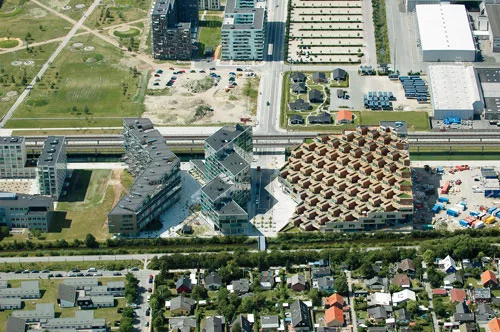
Completed in 2008, the 335,209-square-foot complex sits on a canal in the new district of Ørestad, south of Copenhagen’s downtown. BIG placed 80 south-facing apartments with 970-square-foot terraces clad with Ipé wood over a 480-slot parking garage to create this 11-story, man-made mountain. Inside the concrete parking structure, a funicular takes residents to designated floors, whose surfaces are demarcated by brightly hued, glossy aluminum panels. Outside, perforated brushed-aluminum panels clad the north and west facades, revealing a pixelated image of Mount Everest. The perforations also allow light and air to enter the parking structure.
Photo © Dragor Luftfoto
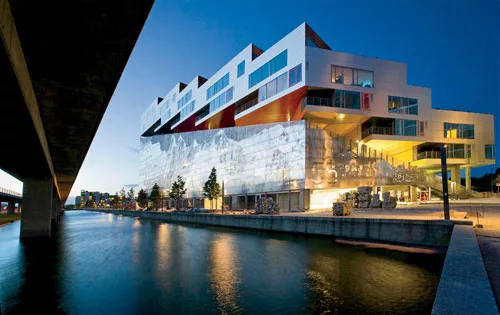
Completed in 2008, the 335,209-square-foot complex sits on a canal in the new district of Ørestad, south of Copenhagen’s downtown. BIG placed 80 south-facing apartments with 970-square-foot terraces clad with Ipé wood over a 480-slot parking garage to create this 11-story, man-made mountain. Inside the concrete parking structure, a funicular takes residents to designated floors, whose surfaces are demarcated by brightly hued, glossy aluminum panels. Outside, perforated brushed-aluminum panels clad the north and west facades, revealing a pixelated image of Mount Everest. The perforations also allow light and air to enter the parking structure.
Photo © Jens Lindhe
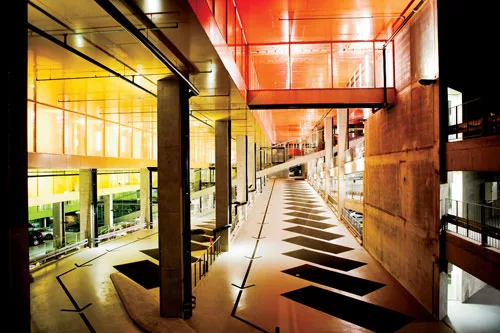
Completed in 2008, the 335,209-square-foot complex sits on a canal in the new district of Ørestad, south of Copenhagen’s downtown. BIG placed 80 south-facing apartments with 970-square-foot terraces clad with Ipé wood over a 480-slot parking garage to create this 11-story, man-made mountain. Inside the concrete parking structure, a funicular takes residents to designated floors, whose surfaces are demarcated by brightly hued, glossy aluminum panels. Outside, perforated brushed-aluminum panels clad the north and west facades, revealing a pixelated image of Mount Everest. The perforations also allow light and air to enter the parking structure.
Photo © Ulrik Jantzen
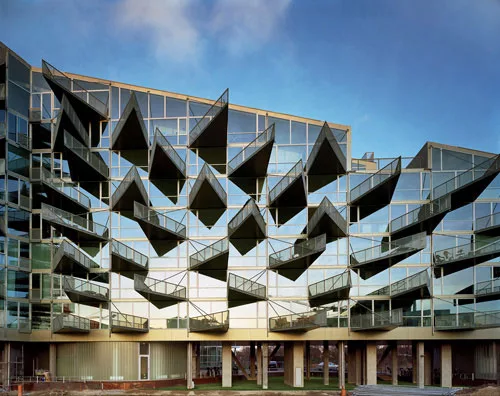
In 2005, Bjarke Ingels, then a partner with Julien De Smedt in the firm PLOT, completed the VM Houses in Ørestad. Built for the development company Høpfner and the Danish Oil Company, the complex is divided into two components shaped like a V and an M when seen from above. The buildings are lifted above the ground on 16-foot-high columns. The angular, aluminum-and-glass-clad structures, situated between two canals on the east and west and next to BIG’s Mountain complex, enclose outdoor courts and grassy areas. In the V-shaped building, steel-mesh balconies in the form of little Vs point in different directions for the view, while corridors in the M-shaped building are short.
Photo © Johan Fowelin

In 2005, Bjarke Ingels, then a partner with Julien De Smedt in the firm PLOT, completed the VM Houses in Ørestad. Built for the development company Høpfner and the Danish Oil Company, the complex is divided into two components shaped like a V and an M when seen from above. The buildings are lifted above the ground on 16-foot-high columns. The angular, aluminum-and-glass-clad structures, situated between two canals on the east and west and next to BIG’s Mountain complex, enclose outdoor courts and grassy areas. In the V-shaped building, steel-mesh balconies in the form of little Vs point in different directions for the view, while corridors in the M-shaped building are short.
Photo © Jasper Carlberg
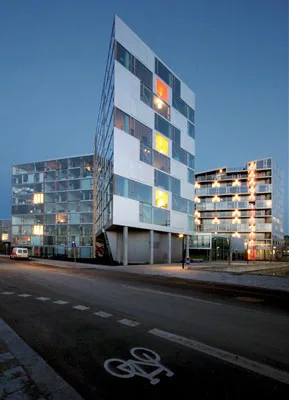
In 2005, Bjarke Ingels, then a partner with Julien De Smedt in the firm PLOT, completed the VM Houses in Ørestad. Built for the development company Høpfner and the Danish Oil Company, the complex is divided into two components shaped like a V and an M when seen from above. The buildings are lifted above the ground on 16-foot-high columns. The angular, aluminum-and-glass-clad structures, situated between two canals on the east and west and next to BIG’s Mountain complex, enclose outdoor courts and grassy areas. In the V-shaped building, steel-mesh balconies in the form of little Vs point in different directions for the view, while corridors in the M-shaped building are short.
Photo © Jimmy Cohrssen
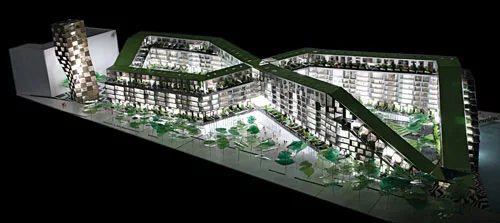
BIG’s latest mixed-use project is nearing completion at the southern point of Ørestad, a district edged by the Copenhagen Canal and, beyond that, the open space of Kalvebod Commons—a reclaimed seabed. Designed for Høpfner, the Danish Oil Company, and Store Frederikslund, the 667,362-square-foot, prefab concrete structure assumes a shape of an angular number 8, enclosing two open spaces. The double-loop form is collapsed at one end to allow pedestrian and bicycle access to the complex via broad ramps.
Rendering courtesy BIG | Bjarke Ingels Group
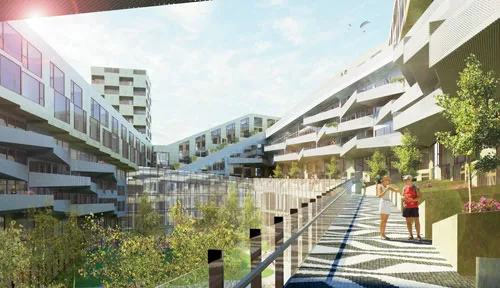
BIG’s latest mixed-use project is nearing completion at the southern point of Ørestad, a district edged by the Copenhagen Canal and, beyond that, the open space of Kalvebod Commons—a reclaimed seabed. Designed for Høpfner, the Danish Oil Company, and Store Frederikslund, the 667,362-square-foot, prefab concrete structure assumes a shape of an angular number 8, enclosing two open spaces. The double-loop form is collapsed at one end to allow pedestrian and bicycle access to the complex via broad ramps.
Rendering courtesy BIG | Bjarke Ingels Group
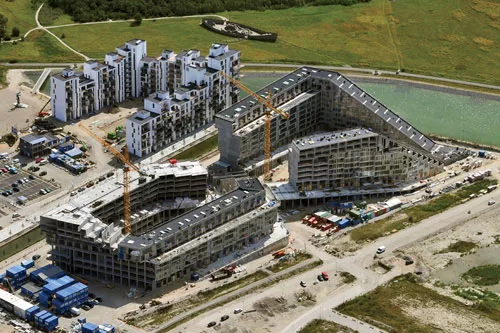
BIG’s latest mixed-use project is nearing completion at the southern point of Ørestad, a district edged by the Copenhagen Canal and, beyond that, the open space of Kalvebod Commons—a reclaimed seabed. Designed for Høpfner, the Danish Oil Company, and Store Frederikslund, the 667,362-square-foot, prefab concrete structure assumes a shape of an angular number 8, enclosing two open spaces. The double-loop form is collapsed at one end to allow pedestrian and bicycle access to the complex via broad ramps.
Photo courtesy BIG | Bjarke Ingels Group
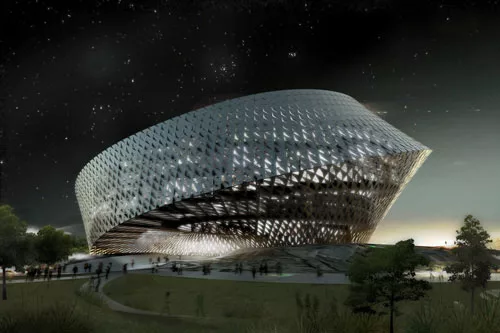
In its competition-winning scheme for the new National Library in Astana, the capital of the Republic of Kazakhstan, BIG combined four archetypal forms, the circle, the rotunda, the arch, and the yurt, into a single-surface Möbius strip. The 398,268-square-foot cultural center, museum, and archive commissioned by the Kazakhstan Presidential Office, broke ground in October. Working with Arup’s Advanced Geometry Unit in London, BIG designed a circular core devoted to the archive, with public spaces spiraling above. The library core is concrete, while the superstructure is formed of radially arranged transverse steel frames connected by longitudinal beams. The architects hope to clad the facade’s triangulated lattices with photovoltaic panels.
Rendering courtesy BIG | Bjarke Ingels Group

In its competition-winning scheme for the new National Library in Astana, the capital of the Republic of Kazakhstan, BIG combined four archetypal forms, the circle, the rotunda, the arch, and the yurt, into a single-surface Möbius strip. The 398,268-square-foot cultural center, museum, and archive commissioned by the Kazakhstan Presidential Office, broke ground in October. Working with Arup’s Advanced Geometry Unit in London, BIG designed a circular core devoted to the archive, with public spaces spiraling above. The library core is concrete, while the superstructure is formed of radially arranged transverse steel frames connected by longitudinal beams. The architects hope to clad the facade’s triangulated lattices with photovoltaic panels.
Rendering courtesy BIG | Bjarke Ingels Group

Transparency in government can be facilitated by architecture, as BIG shows in its competition-winning design for the picturesque capital of Estonia. Collaborating with London-based engineers Adams Kara Taylor, BIG has designed a 301,389-square-foot complex with Vierendeel trusses in which a geometric cluster of government spaces is elevated over and organized around a public market. The tallest of these is a prismatic tower containing a city council room where a sloping ceiling, finished in a mirrored surface, allows the public outside to see activities within through a large window, much like a periscope.
Rendering courtesy BIG | Bjarke Ingels Group
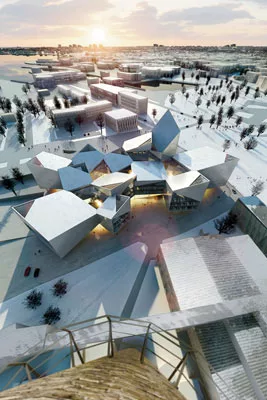
Transparency in government can be facilitated by architecture, as BIG shows in its competition-winning design for the picturesque capital of Estonia. Collaborating with London-based engineers Adams Kara Taylor, BIG has designed a 301,389-square-foot complex with Vierendeel trusses in which a geometric cluster of government spaces is elevated over and organized around a public market. The tallest of these is a prismatic tower containing a city council room where a sloping ceiling, finished in a mirrored surface, allows the public outside to see activities within through a large window, much like a periscope.
Rendering courtesy BIG | Bjarke Ingels Group
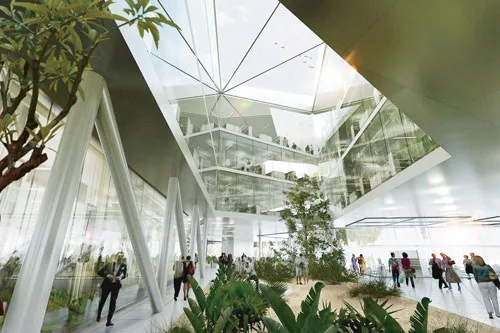
Transparency in government can be facilitated by architecture, as BIG shows in its competition-winning design for the picturesque capital of Estonia. Collaborating with London-based engineers Adams Kara Taylor, BIG has designed a 301,389-square-foot complex with Vierendeel trusses in which a geometric cluster of government spaces is elevated over and organized around a public market. The tallest of these is a prismatic tower containing a city council room where a sloping ceiling, finished in a mirrored surface, allows the public outside to see activities within through a large window, much like a periscope.
Rendering courtesy BIG | Bjarke Ingels Group

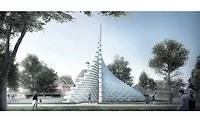
A pavilion for next year’s World Exposition in Shanghai, inspired by the Möbius strip, spirals around a pool. BIG conceived the scheme to make a point about Denmark’s affinity for bicycle transportation. The country will provide 1,000 city bikes that will be parked atop this steel double-spiral structure. Visitors will pick up bikes on the roof and pedal down the ramp, then visit other pavilions. The pool is to be filled with Copenhagen’s famous clean harbor water, shipped over to Shanghai for the occasion. In the middle will sit the Little Mermaid statue, created by Edvard Eriksen in 1909. A familiar icon of Copenhagen, the statue alludes to Hans Christian Andersen’s tale, which is well known to the Chinese.
Rendering courtesy BIG | Bjarke Ingels Group
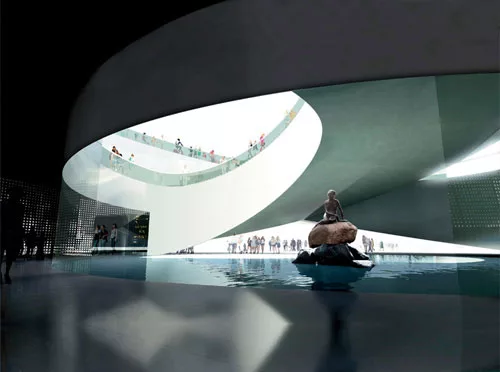
A pavilion for next year’s World Exposition in Shanghai, inspired by the Möbius strip, spirals around a pool. BIG conceived the scheme to make a point about Denmark’s affinity for bicycle transportation. The country will provide 1,000 city bikes that will be parked atop this steel double-spiral structure. Visitors will pick up bikes on the roof and pedal down the ramp, then visit other pavilions. The pool is to be filled with Copenhagen’s famous clean harbor water, shipped over to Shanghai for the occasion. In the middle will sit the Little Mermaid statue, created by Edvard Eriksen in 1909. A familiar icon of Copenhagen, the statue alludes to Hans Christian Andersen’s tale, which is well known to the Chinese.
Rendering courtesy BIG | Bjarke Ingels Group
Architects & Firms
What vitamins does he take? That might be your first question if you encounter Bjarke Ingels, founder of the four-year-old Copenhagen-based firm Bjarke Ingels Group (BIG). To say that Ingels, who just turned 35, is irrepressibly energetic and optimistic seems like a pathetic understatement. But it might partially explain why BIG is completing its third housing complex executed over the past five years in the town of Ørestad, a newly developing section of Copenhagen. In 2005, Ingels and Julien De Smedt, then partners in PLOT, a firm they started in 2001, completed the VM Houses, a complex of 221 flats in two structures shaped like a V and an M when seen from the air. The two architects parted ways, and Ingels’s new firm, BIG, finished a project called The Mountain in 2008, where 80 terraced apartments spill down the top of a parking garage next to the VM Houses. Down the road, 8 House, a mixed-use complex in the shape of an angular double-loop, is nearing completion.
This all sounds a bit ahead of the game; most architects, Danish included, don’t get large-scale projects until around age 50. But as BIG’s work shows, the bold, unbridled inventiveness in mixing programmatic typologies and forms already sets this architecture office apart from its competitors.
Of course, luck helps invention, no matter how old you are. A few years ago, Ingels met the developer Per Høpfner, who had joined up with the Danish Oil Company to create housing on land purchased from the city-and-state corporation planning Ørestad. Høpfner decided PLOT should design VM Houses, even though Ingels and De Smedt hadn’t built anything on that scale before. Per’s son Peter Høpfner, who also works in the business, explains that Ingels has a very important trait (besides creativity): “He isn’t stubborn. When we would tell him that something was too expensive, he would say, ‘Give me two days,’ and then come up with something even better.” Høpfner adds, “VM may look crazy, but it came in at budget.” For his part, Ingels notes that the developer cuts costs by acting as a general contractor and frequently discussing costs with the architect. The project succeeded, and Høpfner and Danish Oil are now clients for The Mountain and 8 House.
Born in Copenhagen, Ingels studied at the School of Architecture at the city’s Royal Danish Academy of Fine Arts, where he got his degree in 1999. He also spent a year at the Escola Tecnica Superior de Arquitectura in Barcelona and worked with Rem Koolhaas and OMA in Amsterdam, first as a student, and then right after graduating from the academy. Today, BIG’s staff includes 60 designers and architects, including associate partners Finn Nørkjaer, Andreas Klok Pedersen, and David Zahle.
The recent book by Ingels, Yes is More, an Archicomic on Architectural Evolution, captures the outsize spirit of BIG’s approach in any number of projects. Like Robert Venturi’s call for a more inclusive architecture in Complexity and Contradiction in Architecture (1966), Ingels embraces an architecture “that allows you to say yes to all aspects of human life, no matter how contradicting!” The architects experiment with program, site, and context in their design process, following, as Ingels says, “a Darwinian path to get to the most workable solution.” You could substitute “wild” for “workable” for some of the schemes the firm has on its boards in far-flung locations, including Shenzhen and Shanghai in China; Astana, Kazakhstan; and Zira Island, Azerbaijan, which is designed to be carbon neutral resort city. Like so many Danish firms, BIG incorporates green thinking into its work. But Ingels, who is currently teaching a studio, “Engineering Without Engines,” at Columbia University’s Graduate School of Architecture, Planning and Preservation, is researching ways of responding to differing climates that don’t depend on machines. He says his sustainability veers away from the green “neo-Protestant” ethos that “has to hurt.” His “hedonistic” and exuberant approach may be the answer.
Looking for quick answers on architecture and design topics?
Try Ask RECORD, our new smart AI search tool.
Ask RECORD →
Looking for a reprint of this article?
From high-res PDFs to custom plaques, order your copy today!