Design Vanguard 2009: Tham & Videgård Arkitekter

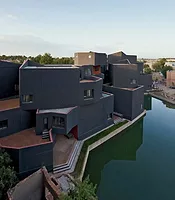
Tham & Videgård won an international competition in 2005 for the design of the Kalmar Museum of Art, which opened last year. Located in a Renaissance town in the southeast of Sweden, the simple black cube houses galleries, offices, a public library, and workshops in a series of open platforms. A stair spirals from the entrance lobby up to the fourth floor, where a sawtooth shed roof provides toplit exhibition space for the museum’s collection. While the interior features exposed concrete, the exterior is clad in black-stained plywood panels, lending a domestic scale to the public building. Extensive glazed openings on the facades offer views of the surrounding park and nearby lake and castle. At the ground level, the museum connects to a restaurant pavilion dating to the 1930s by Swedish Modernist Sven-Ivar Lind.
Photo © Åke E:son Lindman
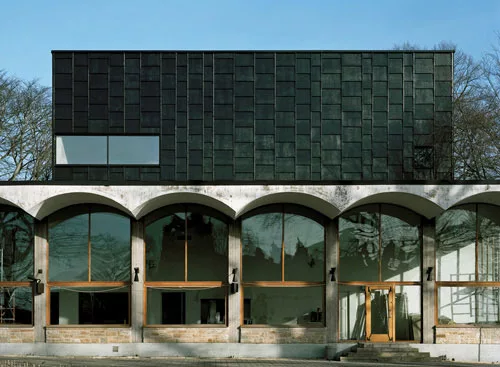
Tham & Videgård won an international competition in 2005 for the design of the Kalmar Museum of Art, which opened last year. Located in a Renaissance town in the southeast of Sweden, the simple black cube houses galleries, offices, a public library, and workshops in a series of open platforms. A stair spirals from the entrance lobby up to the fourth floor, where a sawtooth shed roof provides toplit exhibition space for the museum’s collection. While the interior features exposed concrete, the exterior is clad in black-stained plywood panels, lending a domestic scale to the public building. Extensive glazed openings on the facades offer views of the surrounding park and nearby lake and castle. At the ground level, the museum connects to a restaurant pavilion dating to the 1930s by Swedish Modernist Sven-Ivar Lind.
Photo © Åke E:son Lindman

Tham & Videgård won an international competition in 2005 for the design of the Kalmar Museum of Art, which opened last year. Located in a Renaissance town in the southeast of Sweden, the simple black cube houses galleries, offices, a public library, and workshops in a series of open platforms. A stair spirals from the entrance lobby up to the fourth floor, where a sawtooth shed roof provides toplit exhibition space for the museum’s collection. While the interior features exposed concrete, the exterior is clad in black-stained plywood panels, lending a domestic scale to the public building. Extensive glazed openings on the facades offer views of the surrounding park and nearby lake and castle. At the ground level, the museum connects to a restaurant pavilion dating to the 1930s by Swedish Modernist Sven-Ivar Lind.
Photo © Åke E:son Lindman
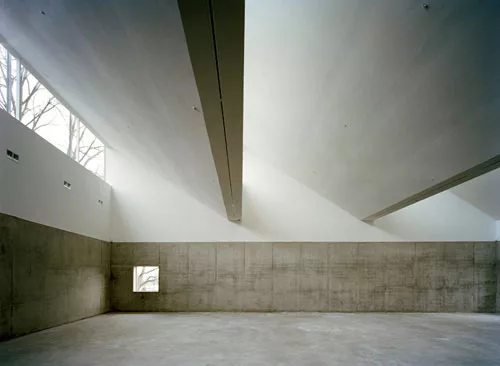
Tham & Videgård won an international competition in 2005 for the design of the Kalmar Museum of Art, which opened last year. Located in a Renaissance town in the southeast of Sweden, the simple black cube houses galleries, offices, a public library, and workshops in a series of open platforms. A stair spirals from the entrance lobby up to the fourth floor, where a sawtooth shed roof provides toplit exhibition space for the museum’s collection. While the interior features exposed concrete, the exterior is clad in black-stained plywood panels, lending a domestic scale to the public building. Extensive glazed openings on the facades offer views of the surrounding park and nearby lake and castle. At the ground level, the museum connects to a restaurant pavilion dating to the 1930s by Swedish Modernist Sven-Ivar Lind.
Photo © Åke E:son Lindman
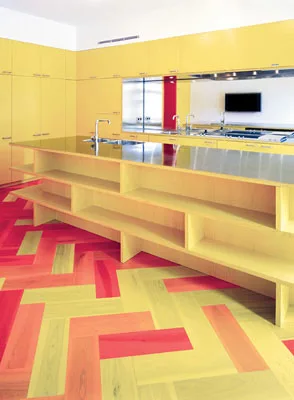
For a Swedish family returning to Stockholm after living abroad in England, Tham & Videgård updated an apartment in a very traditional building not by rearranging the floor plan, but by transforming the floors. Using the colors of autumn, the architects created a vibrant array of wood planks that designate different zones. The architects also selected the furnishings, all in white and all designed by Scandinavian artists and designers. The dining table even takes the shape of Sweden — its long, narrow form a fitting profile around which to gather. The chandelier that hangs above the table is the work of Lagombra, a Stockholm artist who remakes and recombines objects from Ikea.
Photo © Åke E:son Lindman
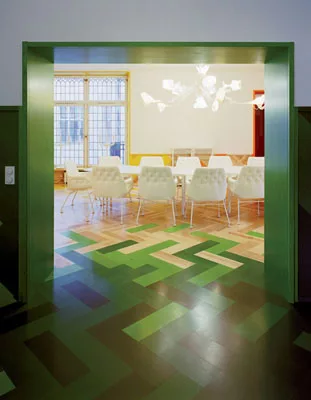
For a Swedish family returning to Stockholm after living abroad in England, Tham & Videgård updated an apartment in a very traditional building not by rearranging the floor plan, but by transforming the floors. Using the colors of autumn, the architects created a vibrant array of wood planks that designate different zones. The architects also selected the furnishings, all in white and all designed by Scandinavian artists and designers. The dining table even takes the shape of Sweden — its long, narrow form a fitting profile around which to gather. The chandelier that hangs above the table is the work of Lagombra, a Stockholm artist who remakes and recombines objects from Ikea.
Photo © Åke E:son Lindman
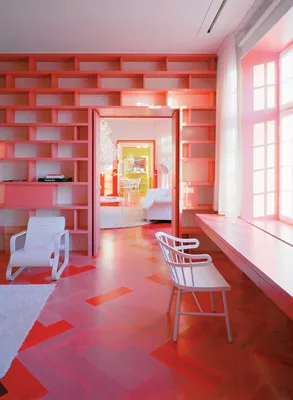
For a Swedish family returning to Stockholm after living abroad in England, Tham & Videgård updated an apartment in a very traditional building not by rearranging the floor plan, but by transforming the floors. Using the colors of autumn, the architects created a vibrant array of wood planks that designate different zones. The architects also selected the furnishings, all in white and all designed by Scandinavian artists and designers. The dining table even takes the shape of Sweden — its long, narrow form a fitting profile around which to gather. The chandelier that hangs above the table is the work of Lagombra, a Stockholm artist who remakes and recombines objects from Ikea.
Photo © Åke E:son Lindman
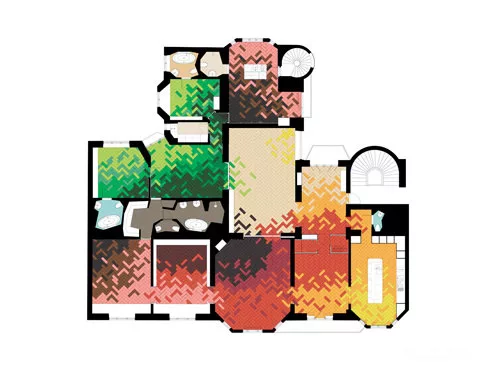
For a Swedish family returning to Stockholm after living abroad in England, Tham & Videgård updated an apartment in a very traditional building not by rearranging the floor plan, but by transforming the floors. Using the colors of autumn, the architects created a vibrant array of wood planks that designate different zones. The architects also selected the furnishings, all in white and all designed by Scandinavian artists and designers. The dining table even takes the shape of Sweden — its long, narrow form a fitting profile around which to gather. The chandelier that hangs above the table is the work of Lagombra, a Stockholm artist who remakes and recombines objects from Ikea.
Image courtesy Åke E:son Lindman
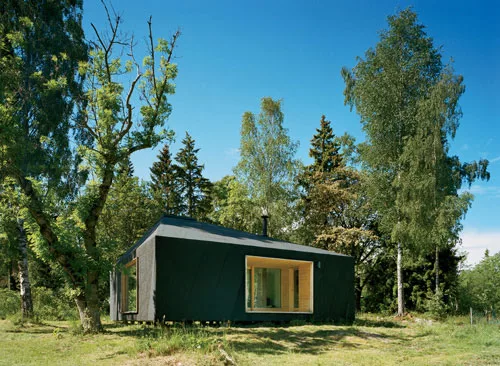
On a remote island in the Stockholm archipelago, where transport of building materials by car is restricted, the architects had to devise an ingenious solution for the construction of a summer house. The same standard bitumen product that covers the sloping roof runs down the walls. “We wrapped these sheets around the exterior like you would wrap a cast for a broken leg,” says Tham. “It creates a nice detail that can only work on such a small structure.” Inside the 970-square-foot house, the architects neatly tucked a bathroom, two bedrooms, and a storage space into the four corners of the square floor plan, arranging them around a central open space. Light enters through a large skylight at the roof’s summit. Sliding glass doors on the interior of two niches, on opposite sides of the house, also allow light to penetrate the central area (where a kitchenette flanks one wall), and provide sheltered spaces for an entry terrace and indoor-outdoor dining.
Photo © Åke E:son Lindman
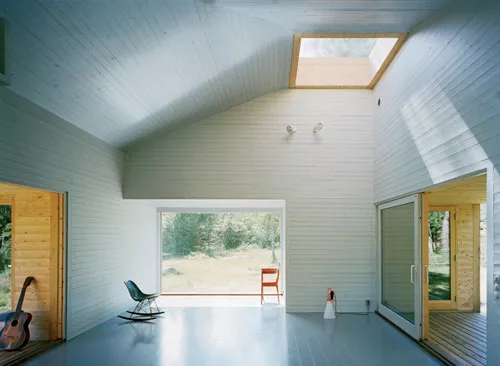
On a remote island in the Stockholm archipelago, where transport of building materials by car is restricted, the architects had to devise an ingenious solution for the construction of a summer house. The same standard bitumen product that covers the sloping roof runs down the walls. “We wrapped these sheets around the exterior like you would wrap a cast for a broken leg,” says Tham. “It creates a nice detail that can only work on such a small structure.” Inside the 970-square-foot house, the architects neatly tucked a bathroom, two bedrooms, and a storage space into the four corners of the square floor plan, arranging them around a central open space. Light enters through a large skylight at the roof’s summit. Sliding glass doors on the interior of two niches, on opposite sides of the house, also allow light to penetrate the central area (where a kitchenette flanks one wall), and provide sheltered spaces for an entry terrace and indoor-outdoor dining.
Photo © Åke E:son Lindman
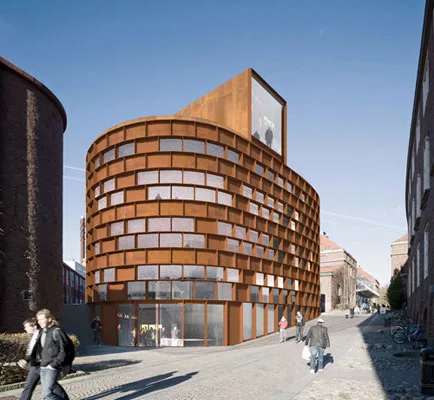
Tham & Videgård is designing a building for the architecture school where both partners were students. The deep red of the weathering steel facade matches the dark brick of the rest of the nearly 100-year-old campus. Its rounded form on a narrow courtyard site maintains the character of a continuous space. A roof terrace tops six above-grade levels. Below grade, a network of workshop spaces connects to the main library and the campus entrance building (also by Tham & Videgård) like the tentacles of an octopus.
Photo courtesy Tham & Videgård Arkitekter
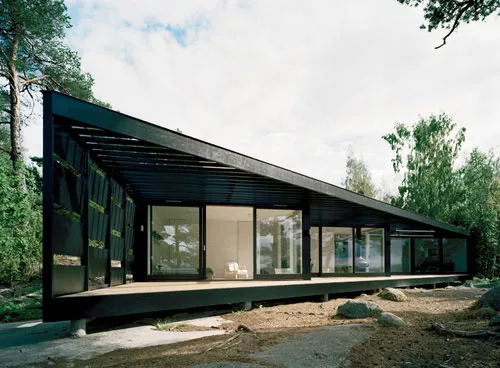
For another house whose remote location on the Stockholm archipelago limited transport of building materials, Tham & Videgård designed a lightweight structure in wood and glass. Completed in 2006, the 1,400-square-foot summer house — a common building type in Sweden — offers a frame within which to experience nature. Upon a rhomboid-shaped platform, staggered living spaces open onto a wood deck. (Small bedrooms and service areas occupy the back portion of the house.) The geometry of the plan is generated by the site, a flat parcel between mountainous rocks. The zigzag layout creates a series of outdoor spaces that are sheltered from the strong winds while providing views of the Baltic Sea to the west. The black-stained exterior cladding and trellis reference the tall surrounding pine trees.
Photo © Åke E:son Lindman
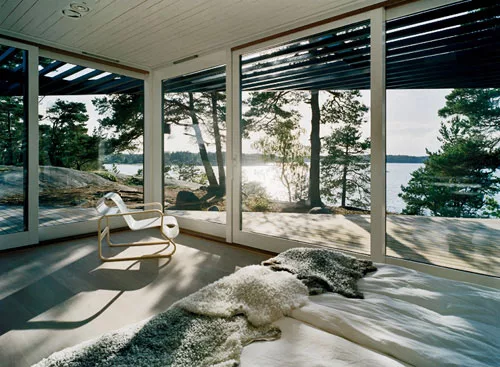
For another house whose remote location on the Stockholm archipelago limited transport of building materials, Tham & Videgård designed a lightweight structure in wood and glass. Completed in 2006, the 1,400-square-foot summer house — a common building type in Sweden — offers a frame within which to experience nature. Upon a rhomboid-shaped platform, staggered living spaces open onto a wood deck. (Small bedrooms and service areas occupy the back portion of the house.) The geometry of the plan is generated by the site, a flat parcel between mountainous rocks. The zigzag layout creates a series of outdoor spaces that are sheltered from the strong winds while providing views of the Baltic Sea to the west. The black-stained exterior cladding and trellis reference the tall surrounding pine trees.
Photo © Åke E:son Lindman
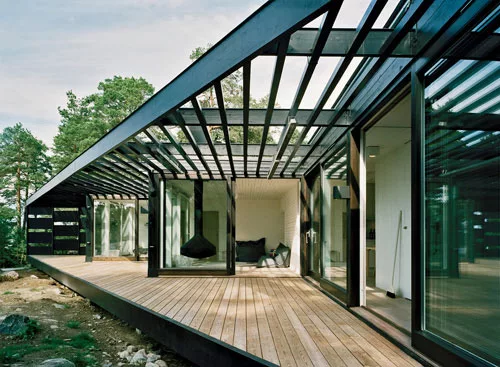
For another house whose remote location on the Stockholm archipelago limited transport of building materials, Tham & Videgård designed a lightweight structure in wood and glass. Completed in 2006, the 1,400-square-foot summer house — a common building type in Sweden — offers a frame within which to experience nature. Upon a rhomboid-shaped platform, staggered living spaces open onto a wood deck. (Small bedrooms and service areas occupy the back portion of the house.) The geometry of the plan is generated by the site, a flat parcel between mountainous rocks. The zigzag layout creates a series of outdoor spaces that are sheltered from the strong winds while providing views of the Baltic Sea to the west. The black-stained exterior cladding and trellis reference the tall surrounding pine trees.
Photo © Åke E:son Lindman
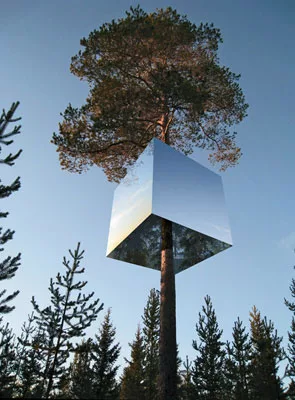
Located in the far north of Sweden, the Tree Hotel responds to heightened interest in ecotourism, where travelers can enjoy more direct encounters with nature. Tham & Videgård’s design is one of several that will be built this year by Brittas Pensionat, a hotelier in the area. A lightweight aluminum structure is hung around a tree trunk. Its mirrored glass exterior reflects the surrounding trees and sky, creating a camouflaged refuge (with a feature visible to birds to prevent collisions). The 13-by-13-by-13-foot box contains sleeping quarters and a terrace. Access to the cabin will be by a rope ladder or a rope bridge connecting it to other trees. Bathroom facilities are located on the ground.
Photo courtesy Tham & Videgård Arkitekter
Architects & Firms
When Bolle Tham and Martin Videgård opened their Stockholm office 10 years ago, the established architecture in Sweden was, according to them, boring. “We wanted to provide something different from what was out there, something more progressive and contemporary,” Tham recalls. But rather than offering a radical alternative, the twosome relied on subtle shifts in scale and unexpected material choices to create buildings whose surprising simplicity turned out to be a refreshing twist.
Like most young architecture firms just starting out, Tham & Videgård worked mainly on residential projects, developing a niche designing small summer houses in remote locations — a common building type in Sweden, as city dwellers escape to the countryside to enjoy the natural landscape following the long, cold winters. The remoteness of these settings presented both challenges for construction and opportunities for innovative design. For two houses on the outer islands of the Stockholm archipelago inaccessible to car traffic (and thus difficult to supply with building materials), Tham & Videgård built lightweight structures around compact but clever floor plans. For one, on Söderöra Island, the architects wrapped the entire house, like a mummy, in a standard bitumen roofing membrane. “We opted for a solution in which you can see detailing and craftsmanship in the facade,” says Videgård. In the other, they covered the exterior with black-stained plywood planks.
This was not the first time the architects used plywood cladding to create an expressive facade, nor would it be the last. But their decision to clad a museum in this way turned a design for a simple black box containing art into a subversive statement. “This is a ‘low’ material,” admits Tham. “It’s not like stone or glass, which you would typically associate with a public building.” Nevertheless, Tham & Videgård’s proposal for the Kalmar Museum of Art, in the Renaissance city of Kalmar, was selected out of 294 entries in an open, international competition whose theme was “Platform.” Completed in May 2008, the cast-concrete building houses a series of open platforms for art-related activities while providing expansive views of the surrounding park and the historic town’s center.
That competition win brought attention to the growing firm, and invitations to competitions soon followed. In a 2007 invited competition — among a field of architects that included the Japanese firm SANAA and influential Swedish architect Gert Wingårdh — Tham & Videgård won first prize for its design of a new School of Architecture building at Stockholm’s Royal Institute of Technology, where both partners had studied. (A new campus entrance building is also part of the commission.) While they jokingly call designing a school of architecture “architecture suicide,” the project is moving forward and is scheduled for completion in 2013. This time, the architects chose to clad the structure in weathering steel, its deep red color matching the dark brick of the surrounding campus buildings, designed in the Nordic National Romantic style of the early 20th century. The building’s rounded form is a departure from the angular geometries the architects employed in their earlier work, but is one they have used again in the design of a nursery school currently under construction in Stockholm. There, the organic layout and common interior plaza encourage movement and interaction among the children around different activities.
While it still designs private residences (including the recently completed Humlegården Apartment), the 10-person firm is presently juggling several projects, many of them public buildings. Its conversion of a former electricity plant in Malmö into a new branch of the Moderna Museet (Museum of Modern Art) is expected to open this winter. “We enjoy doing public projects because they belong to everybody,” Tham says.
Looking for quick answers on architecture and design topics?
Try Ask RECORD, our new smart AI search tool.
Ask RECORD →
Looking for a reprint of this article?
From high-res PDFs to custom plaques, order your copy today!