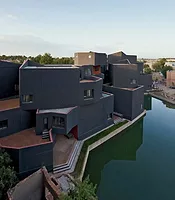
Design Vanguard 2009: José María Sánchez García
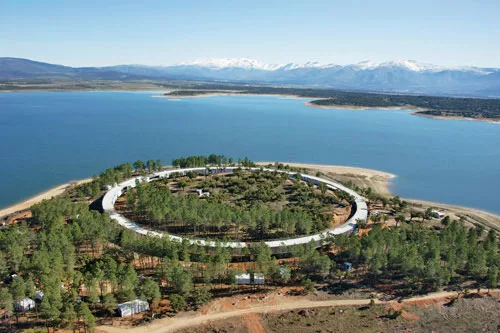
Dubbed the Ring, the center provides research and training facilities for water and mountain sports. To minimize its impact on the natural setting, Sánchez García concentrated its programmatic elements (classrooms, workshops, documentation and information centers, guest rooms, cafeteria) in a narrow structure 656 feet in diameter, then finished it in a reflective steel skin. He elevated the building on steel columns, minimizing foundation work, and built it in six months using prefabricated industrial elements. The perfect geometric form is marked at irregular intervals by access porches, while a running track occupies the roof.
Photo courtesy José María Sánchez García
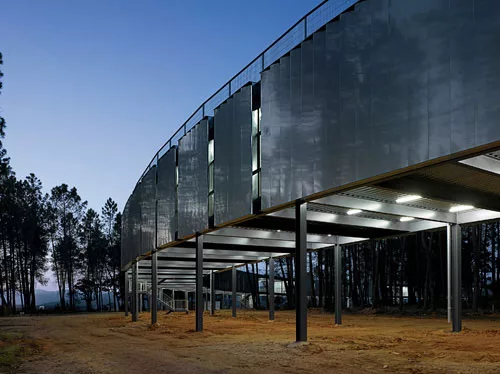
Dubbed the Ring, the center provides research and training facilities for water and mountain sports. To minimize its impact on the natural setting, Sánchez García concentrated its programmatic elements (classrooms, workshops, documentation and information centers, guest rooms, cafeteria) in a narrow structure 656 feet in diameter, then finished it in a reflective steel skin. He elevated the building on steel columns, minimizing foundation work, and built it in six months using prefabricated industrial elements. The perfect geometric form is marked at irregular intervals by access porches, while a running track occupies the roof.
Photo © Roland Halbe
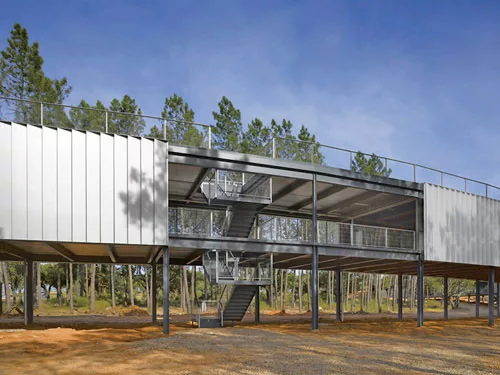
Dubbed the Ring, the center provides research and training facilities for water and mountain sports. To minimize its impact on the natural setting, Sánchez García concentrated its programmatic elements (classrooms, workshops, documentation and information centers, guest rooms, cafeteria) in a narrow structure 656 feet in diameter, then finished it in a reflective steel skin. He elevated the building on steel columns, minimizing foundation work, and built it in six months using prefabricated industrial elements. The perfect geometric form is marked at irregular intervals by access porches, while a running track occupies the roof.
Photo © Roland Halbe
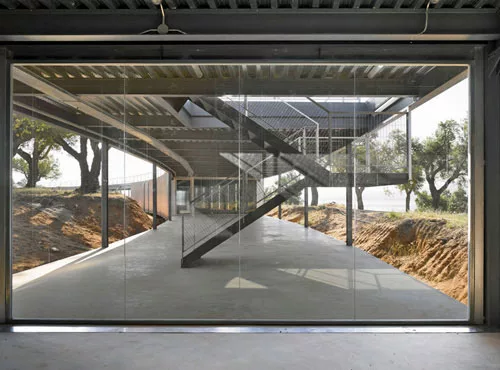
Dubbed the Ring, the center provides research and training facilities for water and mountain sports. To minimize its impact on the natural setting, Sánchez García concentrated its programmatic elements (classrooms, workshops, documentation and information centers, guest rooms, cafeteria) in a narrow structure 656 feet in diameter, then finished it in a reflective steel skin. He elevated the building on steel columns, minimizing foundation work, and built it in six months using prefabricated industrial elements. The perfect geometric form is marked at irregular intervals by access porches, while a running track occupies the roof.
Photo © Roland Halbe
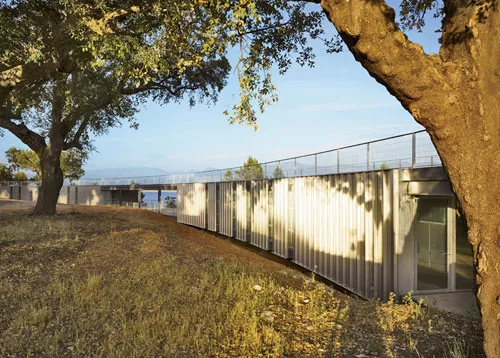
Dubbed the Ring, the center provides research and training facilities for water and mountain sports. To minimize its impact on the natural setting, Sánchez García concentrated its programmatic elements (classrooms, workshops, documentation and information centers, guest rooms, cafeteria) in a narrow structure 656 feet in diameter, then finished it in a reflective steel skin. He elevated the building on steel columns, minimizing foundation work, and built it in six months using prefabricated industrial elements. The perfect geometric form is marked at irregular intervals by access porches, while a running track occupies the roof.
Photo © Roland Halbe
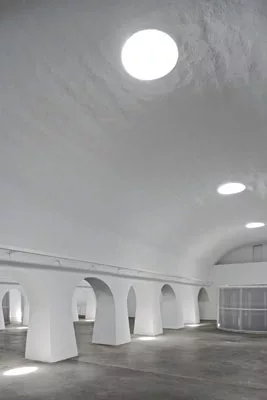
Sánchez García transformed an obsolete municipal cistern into a youth center for the creation of music, film, theater, and arts and crafts, by boring openings through 11 1/2-foot-thick concrete walls. The minimal but precise intervention reveals a series of churchlike naves, Romanesque in their solidity, and naturally illuminated by a series of round punctures in the vaulted ceilings. A group of cylindrical structures inside the base of the water tower, finished in polycarbonate panels, house mechanical services, bathrooms, a darkroom, and recording studios.
Photo © Pedro Pegenaute
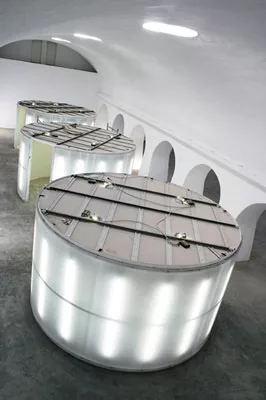
Sánchez García transformed an obsolete municipal cistern into a youth center for the creation of music, film, theater, and arts and crafts, by boring openings through 11 1/2-foot-thick concrete walls. The minimal but precise intervention reveals a series of churchlike naves, Romanesque in their solidity, and naturally illuminated by a series of round punctures in the vaulted ceilings. A group of cylindrical structures inside the base of the water tower, finished in polycarbonate panels, house mechanical services, bathrooms, a darkroom, and recording studios.
Photo courtesy José María Sánchez García-Estudio de Arquitectura
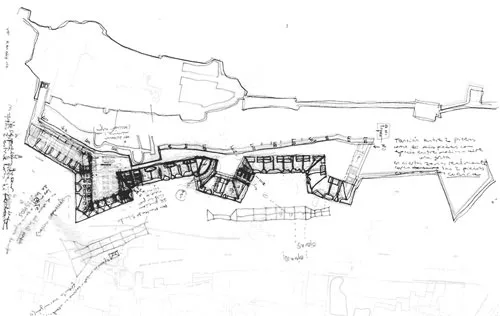
Historic monuments converted into publicly sponsored regional hotels, hospederías present architects with interesting design challenges. Respecting the integrity of the oldest structure on this site in Badajoz, Sánchez García argued not to build the hotel in the 12th-century castle, as the competition brief suggested, but rather within the 18th-century ramparts below it. He proposed excavating the earth behind the stone walls to create 35 guest rooms, each with a narrow window bored through the stone. The public spaces behind them feature a continuous "crevice" skylight. The overall effect will be "somber, like living in a castle," he affirms.
Image courtesy José María Sánchez García-Estudio de Arquitectura
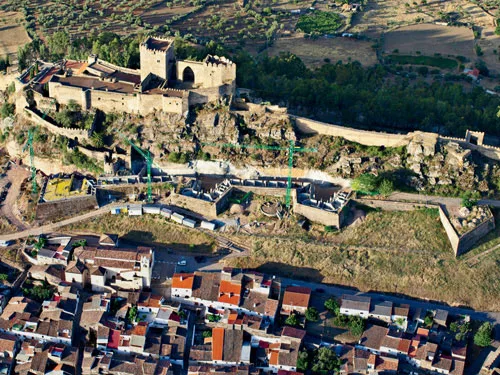
Historic monuments converted into publicly sponsored regional hotels, hospederías present architects with interesting design challenges. Respecting the integrity of the oldest structure on this site in Badajoz, Sánchez García argued not to build the hotel in the 12th-century castle, as the competition brief suggested, but rather within the 18th-century ramparts below it. He proposed excavating the earth behind the stone walls to create 35 guest rooms, each with a narrow window bored through the stone. The public spaces behind them feature a continuous "crevice" skylight. The overall effect will be "somber, like living in a castle," he affirms.
Photo courtesy José María Sánchez García-Estudio de Arquitectura
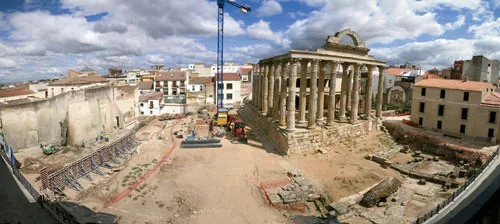
To consolidate the urban fabric around this ruined Roman temple, the architect proposed a variation on Spain's traditional portico-lined plazas. He encircled the temple on three sides with an unadorned wall and walkway, L-shaped in section, which floats over the site's original ground level (61/2 feet below the modern city), supported by a single line of pillars. Behind the wall, the structure accommodates the irregular profiles of the party walls behind it, incorporating different activities between open wells of light.
Photo courtesy José María Sánchez García-Estudio de Arquitectura
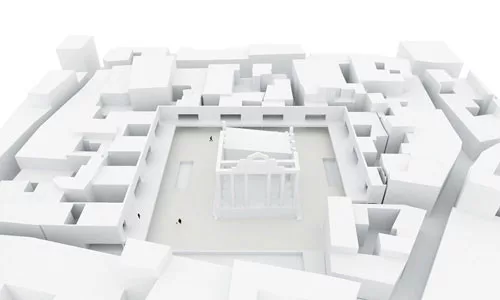
To consolidate the urban fabric around this ruined Roman temple, the architect proposed a variation on Spain's traditional portico-lined plazas. He encircled the temple on three sides with an unadorned wall and walkway, L-shaped in section, which floats over the site's original ground level (61/2 feet below the modern city), supported by a single line of pillars. Behind the wall, the structure accommodates the irregular profiles of the party walls behind it, incorporating different activities between open wells of light.
Image courtesy José María Sánchez García-Estudio de Arquitectura
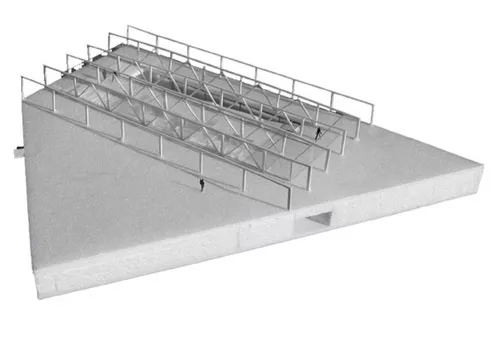
In this public center for high-performance rowing and canoeing sports near Mérida, Sánchez García designed a trapezoidal-shaped structure that doubles as a lookout platform above a reservoir. Trusses crossing the platform span a multiuse hall and are roofed to provide a porchlike shelter, glazed in part around the entry. Inside, a dramatic switchback ramp, sloped for wheelchairs and suspended from the trusses, creates a sense of movement in the simple space. Sánchez García describes the volume as "like a concrete rock with openings to the views."
Image courtesy José María Sánchez García-Estudio de Arquitectura
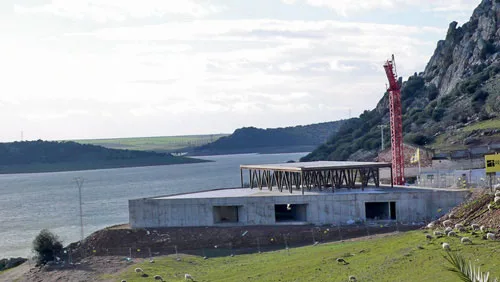
In this public center for high-performance rowing and canoeing sports near Mérida, Sánchez García designed a trapezoidal-shaped structure that doubles as a lookout platform above a reservoir. Trusses crossing the platform span a multiuse hall and are roofed to provide a porchlike shelter, glazed in part around the entry. Inside, a dramatic switchback ramp, sloped for wheelchairs and suspended from the trusses, creates a sense of movement in the simple space. Sánchez García describes the volume as "like a concrete rock with openings to the views."
Photo courtesy José María Sánchez García-Estudio de Arquitectura
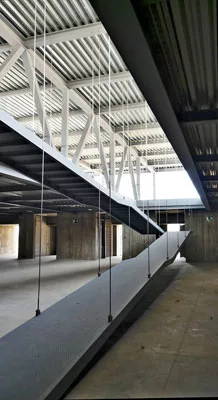
In this public center for high-performance rowing and canoeing sports near Mérida, Sánchez García designed a trapezoidal-shaped structure that doubles as a lookout platform above a reservoir. Trusses crossing the platform span a multiuse hall and are roofed to provide a porchlike shelter, glazed in part around the entry. Inside, a dramatic switchback ramp, sloped for wheelchairs and suspended from the trusses, creates a sense of movement in the simple space. Sánchez García describes the volume as "like a concrete rock with openings to the views."
Photo courtesy José María Sánchez García-Estudio de Arquitectura
Architects & Firms
Though based in Madrid, where he graduated from the School of Architecture at the Technical University of Madrid in 2002, José María Sánchez García developed his career in his native Extremadura, a relatively poor rural region in western Spain. There he has won a number of competitions for public projects in which the conservation of the region’s historic monuments and natural environment are constant themes. In response, his designs often hover over or burrow under their sites. More importantly, his work seeks a formal solidity and directness that interacts with its privileged surroundings as a forceful presence that is never loud in tone.
His attraction to solid geometries was evident in his first private commissions. For the Pronat office building in his hometown of Don Benito, he set the protruding volumes of its southern facade on a large concrete esplanade that underscores the sharply modeled play of light and shadow. For other projects, such as a creative-arts workshop for teenagers in a former water cistern, he has literally drilled through thick concrete and masonry walls to open points of access and light, in a kind of architectural piercing.
He is currently building a publicly sponsored hotel, or hospedería, within the packed-earth bastions of Luna Castle, a National Monument in Alburquerque, slicing through the stone for exterior views. Similarly, Sánchez García is adapting another historic site, the fortified 16th-century convent and military hospital of San Juan de Dios in Olivenza, for use as a hospedería by “clawing” narrow cuts out of packed-earth ramparts that surround the old structure to accommodate guest-room modules. Each room is illuminated by two patios: a light well against the exterior stone wall of the ramparts, and a larger space overlooking the courtyard around the central building. Between the rooms, fingers of packed earth, 18 feet high, house baths and services.
Some of Sánchez García’s projects practically skim over delicate sites. When devising a center for rural sports in Guijo de Granadilla in the province of Cáceres near Portugal, he organized a large program into a ring structure 2,000 feet in circumference and raised it on pillars above the flood level of an adjacent reservoir. Seen at close range, the building curves away from view, disappearing amid the trees, while its perfect geometry organizes the landscape around it.
In Mérida, a city rich in Roman monuments, he is wrapping the urban plaza around the Temple of Diana in a structure, L-shaped in section, that floats on slender pillars over the original ground level uncovered by archaeologists. In this competition-winning design, the floor of the structure forms a promenade, and its plain walls and openings discretely house activities, such as cafés and a visitors’ center, designed to bring the space to life. According to Sánchez García, “The jury was looking for a syntax, a set of rules that could respond to the changes that came up as the work advanced. The structure forms a clean, neutral facade, without references, but with the massiveness of Roman architecture.”
A stint at the Spanish Academy in Rome contributed to Sánchez García’s interest in “architecture as something massive that is hollowed out,” but he traces this affinity more intimately to the spaces of his childhood. “I always lived in a house with vaulted rooms. My bedroom had no windows. It was one of those traditional alcoves that opened on a corridor for ventilation.”
At the same time, he affirms that the perspective offered by Madrid has been crucial to his professional formation, particularly the example of the architect and teacher Alberto Campo Baeza, who instilled in him the importance of “rigor.” “You can be very original and take a step forward with every project, but without forgetting the discipline of our profession, which in the end is about knowing how to build, to be coherent, and not get caught up in passing fads.”
Looking for quick answers on architecture and design topics?
Try Ask RECORD, our new smart AI search tool.
Ask RECORD →
Looking for a reprint of this article?
From high-res PDFs to custom plaques, order your copy today!