Minneapolis and the End of the American Dream House
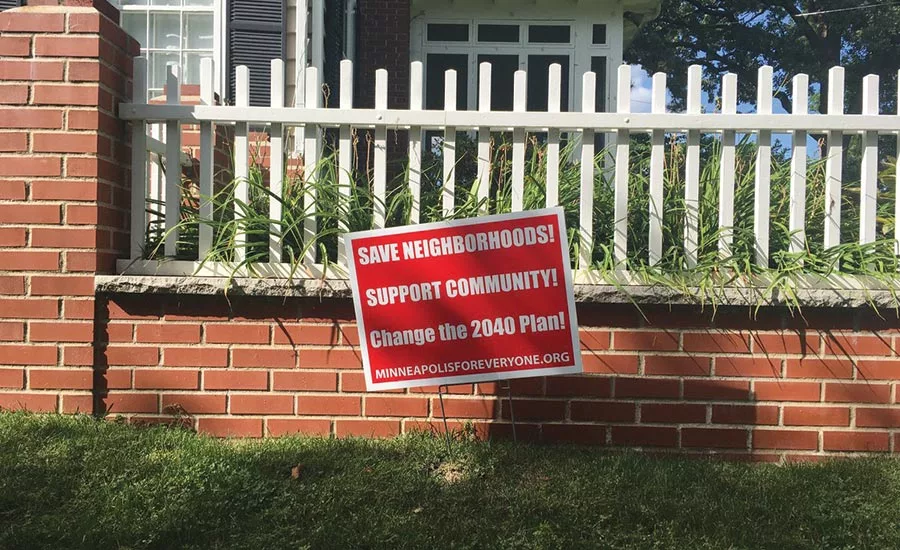
Photo © Kathryn Fink/WAMU
The headlines were electrifying: Minneapolis legislates an end to single-family zoning, the cornerstone of the American dream. In urban-development circles, the idea was a hit. A number of other localities promised to look at the plan (the state of Oregon has already passed a similar bill) and four Democratic presidential hopefuls endorse the idea. Jenney Schuetz, a fellow in the Metropolitan Policy Program at the Brookings Institution, titled her article on Minneapolis’s move, “The Most Wonderful Plan of the Year.”
A close look reveals a proposition that is less draconian than opponents feared, but also one that doesn’t get at the city’s root problem: inadequate access to housing for people with middle incomes or below.
The Minneapolis 2040 plan intends to enhance housing supply by allowing denser development in much of the city. It will permit duplexes, triplexes, and small backyard houses (accessory dwelling units, or ADUs) in once exclusively single-family zones, and it promotes large residential buildings and towers near the downtown core, as well as a variety of smaller-scaled apartment buildings along arterials and transit routes.
Though the city council approved the plan last December, it can go into effect as soon as this November, having received an OK from the regional Metro Planning Council in late September with a final city council vote scheduled for this month.
Minneapolis has grown rapidly, with a current population of about 423,000, up 12 percent from 2010. Developers have responded “to a huge resurgence of people living downtown,” says Matthew Kreilich, principal of the firm Snow Kreilich. The neighborhood’s late 19th-century warehouse district and North Loop, he says, “are seeing a diversity of uses, not just residential but commercial and office. It’s vibrant day and night.”
Yet for all the construction activity, new development is not keeping up with growth in the number of households. Increasing density is seen as necessary to accommodate the influx.
Unsurprisingly, the idea of multiunit buildings in once single-family enclaves has drawn fierce opposition and fearmongering, with false claims that new single-family houses would be outlawed. People worry that overweening structures will come to the leafy streets lined with gable-roofed dwellings and inviting porches. “Don’t bulldoze our neighborhoods” read signs that popped up in front yards of residents who felt betrayed.
Looking for quick answers on architecture and design topics?
Try Ask RECORD, our new smart AI search tool.
Ask RECORD →
In fact, Minneapolis already has “neighborhoods that mix single-family, duplexes, triplexes, and small apartments,” points out David Graham, a founding principal of ESG Architecture and Design, “and they work.” The key to reducing resistance to greater density in single-family areas, he adds, “is design that’s sensitive to neighborhood fabric, context, and materiality.” Yet while the plan limits the number of units in such neighborhoods, it does not include design guidelines.
The city won the zoning change in part by appealing to those on both the political left and the right, who see cutting back on regulations for developers as the primary means of encouraging more lower-cost housing.
But rents, especially in walkable neighborhoods, are rising, and there are not enough units for moderate and low-income tenants. Indeed, the 2040 plan notes that the median income of renters is actually down from 2000, while rents have increased 11 percent. Half of these residents are considered, by federal standards, “cost burdened,” with many of them paying more than half their income for a roof over their heads. More poor people are being pushed into marginal neighborhoods, says Myron Orfield, a law professor who directs the Institute on Metropolitan Opportunity at the University of Minnesota, exacerbating segregation, which is worse in this self-proclaimed bastion of progressivism than in peer cities.
The Minneapolis plan only indirectly addresses the needs of those low-income residents, relying on the market to lower rents by adding to the supply. While developers are already eyeing single-family houses to convert to duplexes and triplexes, many experts believe there is little evidence that adding market-rate units will have a trickle-down effect in thriving cities. After upzoning led to the construction of tens of thousands of new units, at market-rate and higher, in New York and Seattle, for example, there has been some price softening for luxury housing, but low-rent units continue to vanish.
The market is failing most middle- and lower-income renters, not just in Minneapolis but nationwide. Though 47.4 percent of all renters in the country were cost burdened, the share of newly constructed apartments available to median-income tenants fell to an infinitesimal 3 percent, according to a 2017 report published by the Urban Institute. The Minneapolis plan offers modest encouragement of lower-cost units, but its proposed policies are largely aspirational, such as promoting greater use of prefabrication.
Minneapolis, like all cities, cannot afford to build or underwrite its needed below-market units. Historically, such housing assistance was a Federal responsibility, but that role has been shrinking for decades, while needs have grown steadily. Of the lowest-income renters who qualify for such assistance nationwide, only a paltry 21 percent receive it. Despite this reality, the Minneapolis plan doesn’t commit to a numerical goal for the construction of below-market units.
Without a more robust policy to address housing costs for those most affected by the tightening market in Minneapolis, the 2040 plan could produce the result opponents have feared: the wrong kind of new housing and a continuing concentration of poverty.
Looking for a reprint of this article?
From high-res PDFs to custom plaques, order your copy today!
