See Finalist Concepts From 'LACMA Not LackMA' Ideas Competition

“LACMA Wing” by Coop Himmelb(l)au, Vienna
Emphasizing “an architecture that combines functionality with aspiration,” Coop Himmelb(l)au designed three main elements: landscape plinth and two, three-level “floating” gallery wings. Public circulation on ramps connecting the volumes would be encased by expressive amorphous forms whose openness to the outside refreshes the museum visiting experience. These public spaces are accessible without a ticket to the museum, but windows into the galleries are meant to entice people inside. The jury appreciated the curatorial flexibility of generous gallery spaces, with 22-foot floor-to-ceiling heights, the possibility of mezzanines and intimate galleries, and open floor plates. “This entry combines issues of great efficiency with moments of drama,” noted the jury. “The ‘bubbles’ offer exciting spaces that celebrate the public realm while connecting to straightforward, practical, functional galleries in the wings.”

“LACMA Wing” by Coop Himmelb(l)au, Vienna
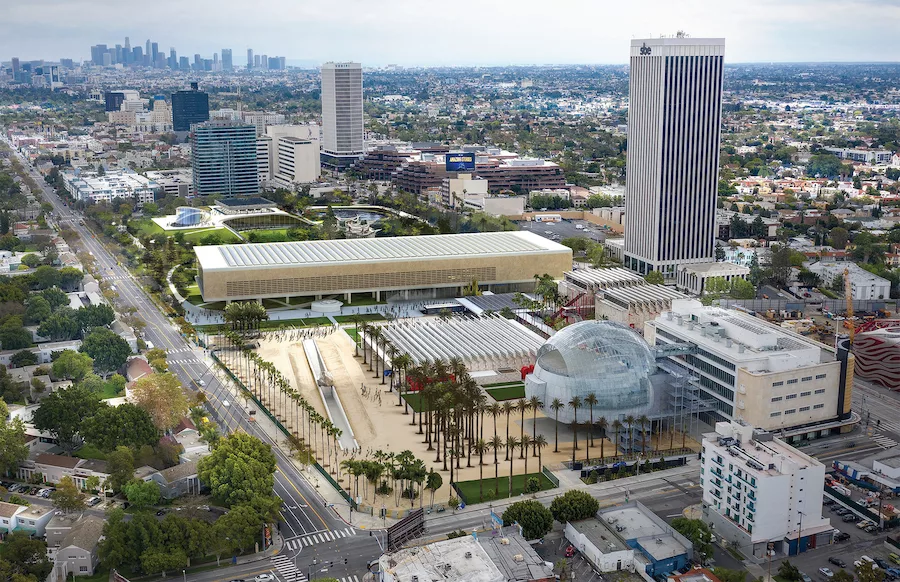
“Unified Campus” by Paul Murdoch Architects, Los Angeles
To create greater institutional cohesion, Paul Murdoch Architects took a holistic approach to the entire LACMA campus and its relationship to the cultural institutions flanking it. The design, according to the architects, is “expressive of LA in its openness, multiplicity of urban, natural, and cultural connections, and abundant use of controlled natural light.” The jury noted how this horizontal skyscraper—an on-axis version of the neighboring tower across Wilshire—corresponds to the urbanism of the area. “It restores the continuity of the Wilshire Boulevard streetfront with a respectful attitude by placing the narrow part of the building facing the street and the broad side framing the park.” The east glass façade offers a strong, complementary visual connection to Hancock Park and the La Brea Tar Pits, and the west façade forms a long public plaza bordered by BCAM and the Resnick Pavilion, uniting the two campuses.

“Unified Campus” by Paul Murdoch Architects, Los Angeles

“HILLACAM” by TheeAe (The Evolved Architectural Eclectic), Hong Kong
TheeAe (The Evolved Architectural Eclectic) considers Los Angeles’ diversity when proposing the museum as “a new cultural platform that connects people from different walks of life,” by simultaeneously offering enclosed cultural spaces and an open, sculpted, outdoor landscape. The tall building (five levels plus garden roof) combines an undulating façade along Wilshire Boulevard to the south with “hill” element sloping into the park on the property’s north side. The jury remarked that the dramatic hybrid design would make it a “destination building” cleverly designed to sustain the urbanity of Wilshire on one side while extending the bucolic nature of the park on the other. “The Wilshire façade becomes a kinetic wall, imparting a strong urban experience that changes as you drive by, which is how most Angelenos experience the city,” noted the jury.” “The back façade, a built hillside, is a landscape event that adds a surprising new participatory dimension to Hancock Park. This will be a hill you want to climb.”

“HILLACAM” by TheeAe (The Evolved Architectural Eclectic), Hong Kong
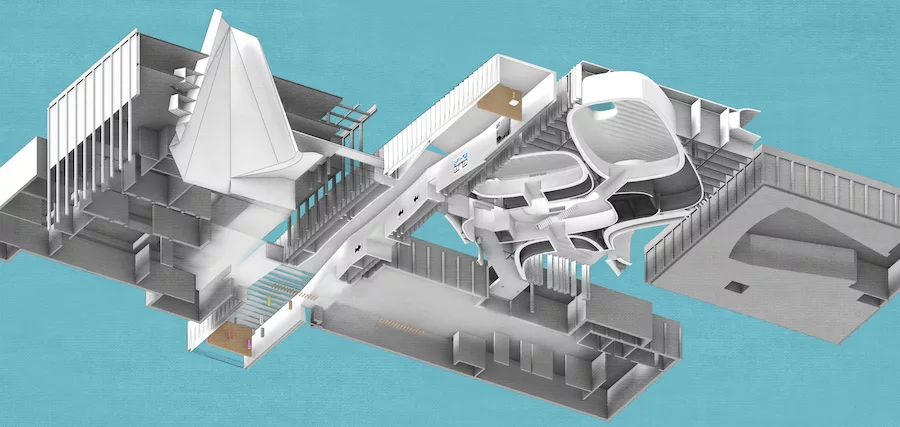
“Re(in)novating LACMA” by Reiser + Umemoto, New York City
Reiser + Umemoto’s aim was “to create a coherent, retroactive masterplan that builds off the campus’ prior successes and seeks to engage and reinvigorate the full breadth of LACMA’s collection.” The three-pronged approach includes adding new elements in and around the original 1965 buildings, binding them into a new whole. The Cone sits within and atop the Ahmanson; The Bar, an elevated gallery building, transects the campus from north to south, offering an appropriately scaled Wilshire entrance and new gallery space; The Cluster replaces the 1986 building with a series of interior pod-shaped galleries, as well as exterior exhibition space on a reimagined plaza level. “The architects found a way to make the plaza into a connective tissue and strategically make the existing buildings work as an ensemble,” said the jury, which also commended the clear circulation that employed new interstitial spaces to move people through the building’s interior spaces.

“Re(in)novating LACMA” by Reiser + Umemoto, New York City

“Tabula LACMA” by Barkow Leibinger, Berlin
This “reconstitution” is an unusual hybrid of old and new, as it maintains the scale and context of the original LACMA buildings by reconstructing them with modern, sustainable materials, then interconnecting them with a new plinth form punctured by courtyards. Barkow Leibinger—working with landscape designer Lillian Montalvo—stresses this would “provide spaces for art, delight, and public encounter.” The jury thought this flexible, spacious design addressed the changing role of museums by including a good amount of shopping, cafés, and event venues that urbanize the spaces and engender a lively environment. “There’s a powerful idea of using the area around the pavilions to create a whole new programmed space,” according to the jurors. They enjoyed the rediscovery of the inner plaza and could “imagine these would be great spaces to be in, as well as fun to discover.”
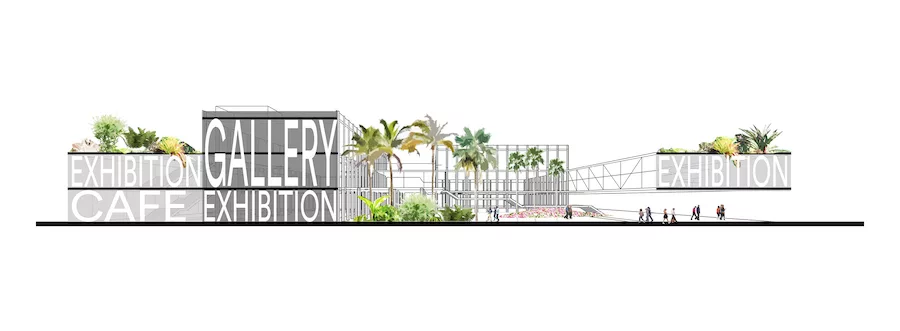
“Tabula LACMA” by Barkow Leibinger, Berlin

“Reimagining/Restructuring” by Kaya Design, London
Replacing the 1986 building, Kaya Design proposes “to preserve the best elements of the past while creating a more contemporary, multi-use alternative space.” An elevated volume that respects the scale of the existing structures has solid walls on three sides for curatorial flexibility, then opens to the north with an all-glass façade. Circulation into the entrance is through a gentle ramp/walkway leading into the lobby that directs visitors to the other buildings on other floors—the ramps equalizing the importance of all adjacent floors. The new structure is reserved for exhibition space on six above-grade levels, including the interior of the spiral element. “This design achieves a considerable service to the campus, making the east campus more coherent than it’s ever been,” said the jury. “The biological form of the spiral—as ancient as seashells and hurricanes—gives value to the floors it connects.”

“Reimagining/Restructuring” by Kaya Design, London
After a month-long "protest competition," the Citizens' Brigade to Save LACMA has released six finalist designs for alternatives to Swiss architect Peter Zumthor's contentious scheme for the Los Angeles County Museum of Art.
United around their opposition to the museum's planned structure, which has long been the focus of inflamed public controversy, the group invited concepts that "correct major shortcomings" of Zumthor's design. “Our call for ideas was to open and make public what has been a closed process, and to present alternatives that inspire and show a way forward for a LACMA that is improved, fresh, and practical, not reduced and compromised,” said says architecture critic (and frequent contributor to RECORD) Joseph Giovannini, co-chair of the Brigade.
“This collection of six designs represents the ideas the jury found most compelling,” added writer and curator Greg Goldin, another co-chair of Brigade. “We are not proposing any one of them be built as-is, but that the public, the museum board, and the County Board of Supervisors view them as inspirations to consider alternatives that truly capture people’s eyes, hearts, and minds, and showcase the collections in a practical and architecturally stimulating environment that embodies—rather than usurps—LACMA’s purpose and spirit.” The finalist firms will each receive $1,500.
Members of the public can review the designs and cast their vote for two "people's choice" winners, which will take home an additional $500 prize, at www.saveLACMA.org.
Scroll through the slideshow above to see all the designs, and read more about the competition and opposition to Zumthor's design.
Looking for quick answers on architecture and design topics?
Try Ask RECORD, our new smart AI search tool.
Ask RECORD →
Looking for a reprint of this article?
From high-res PDFs to custom plaques, order your copy today!
-North-Harwood-Street-View--Michael-Maltzan-Architecture-and-MRC-min.webp?height=200&t=1689196942&width=200 "1) North Harwood Street View © Michael Maltzan Architecture and MRC-min.jpg")