Mental Health Pavilion at El Camino Hospital by WRNS Studio
Mountain View, California
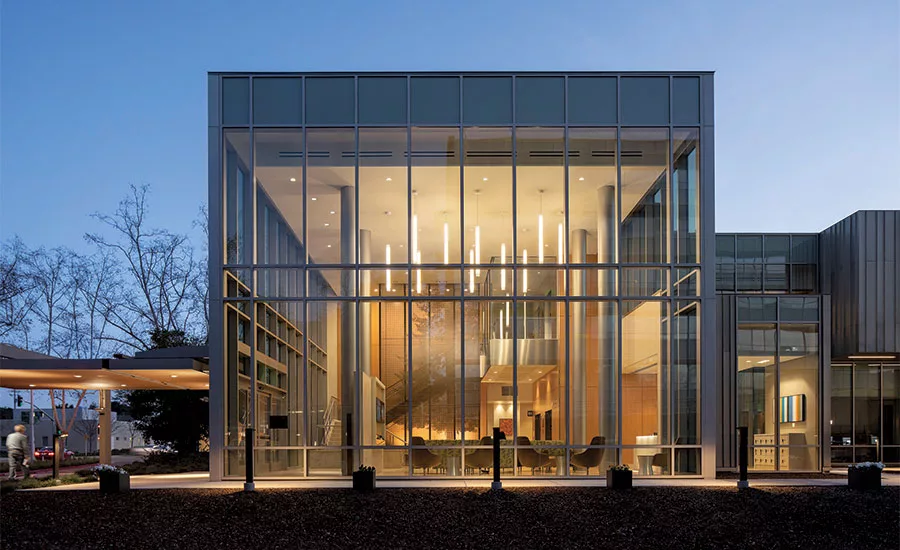
A tall, transparent lobby welcomes patients and visitors as they approach the Taube Pavilion. Photo © Jeremy Bittermann
Architects & Firms
The term “psych ward” may be obsolete, but mental-health institutions are notorious for being grim environments. These buildings, designed for patients who are in danger of self-harm, need to focus on safety. But it is possible to create a secure environment that also feels welcoming. The recently completed Taube Pavilion, the new home of the Scrivner Center for Mental Health & Addiction Services at El Camino Hospital in the Silicon Valley town of Mountain View, California, couples architectural ambitions with the latest thinking in psychiatric patient care. “We didn’t want it to feel like an archetypical hospital experience, with a corridor that runs on forever and no natural light,” says architect Tim Morshead, partner at San Francisco–based WRNS Studio. The firm’s design for the two-level, 55,000-square foot building emphasizes flexible use and outdoor access.

The building’s glass and board-formed-concrete skin adds to its warmth. Photo © Jeremy Bittermann, click to enlarge.
In replacing its outdated 1961 psychiatric building, the hospital wanted to increase its capacity from 25 beds in private and shared accommodations to 36 private rooms, and have the space to provide specialized care to perinatal women and other small groups of patients.
In addition, it wished to expand and centralize its outpatient services. To accommodate these programs and their security needs, the building is designed as two separate facilities, co-located so that patients can transition easily from inpatient to outpatient care. The inpatient unit is located on the ground floor for easy access to outdoor spaces, while outpatient services are on the second floor.
1
2
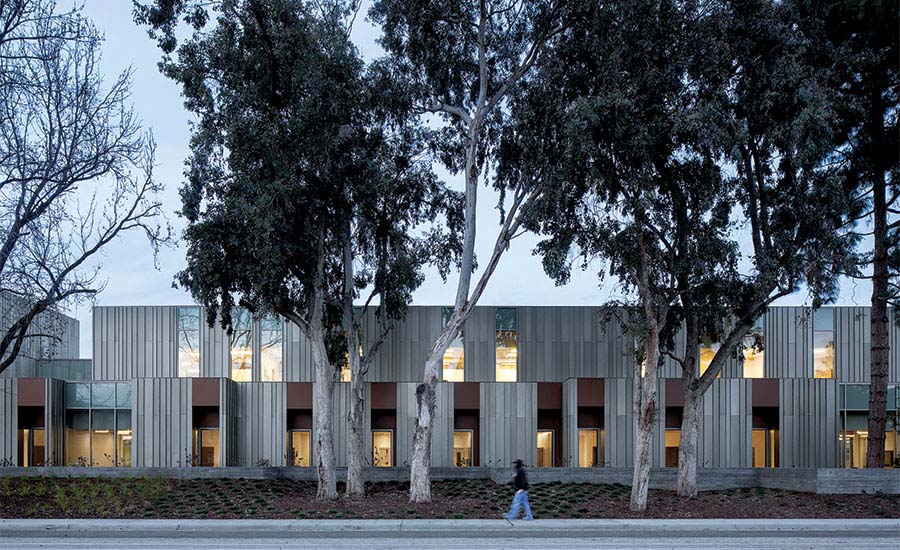
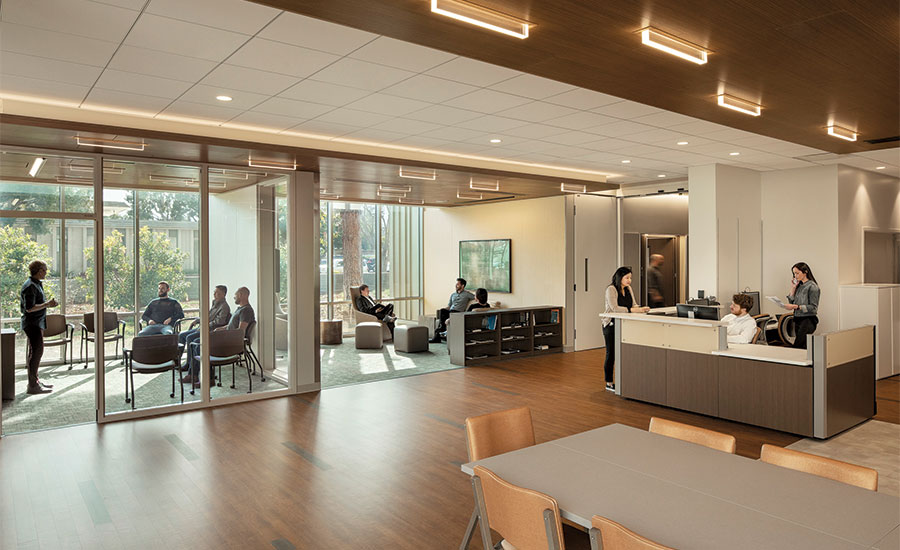
The facade’s organic striping (1) is echoed by the linear formats of the flooring and lights in a patient lounge (2). Photos © Jeremy Bittermann
Because the hospital had to provide continuous service during construction, the architects designed an L-shaped building around the old facility (soon to be demolished and replaced by a secure ⅓-acre recreation yard). They conceived of the new structure as a collection of volumes in a parklike setting, which aligned well with the hospital’s approach of caring for small groups of patients. “It’s an interesting hybrid of a mat-building and a long bar,” says Morshead. “It’s a low-spreading, cellular structure that fills the space, but the organization is also incredibly clear.” And this strategy obviated the long, straight stretches of rooms found in a traditional hospital.
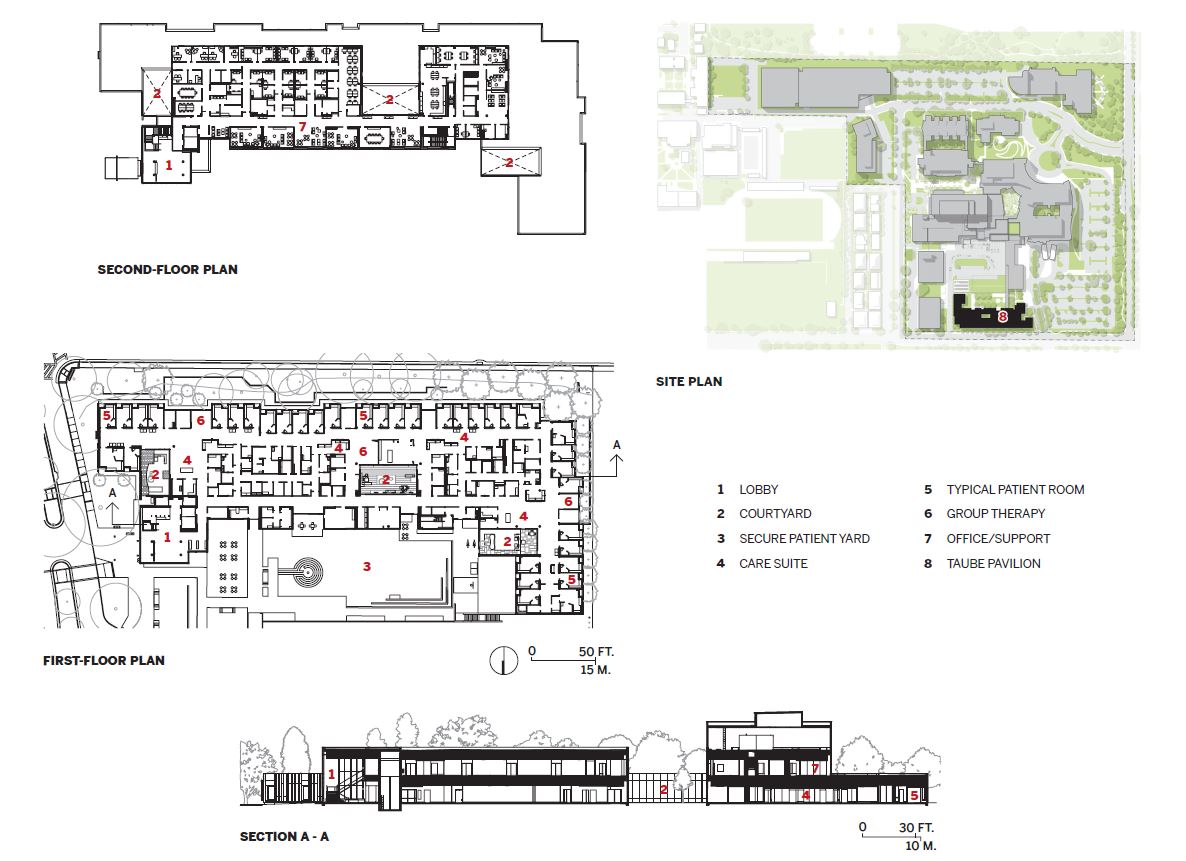
The first-level inpatient unit is the more complicated part of the building: it is organized around three internal courtyards and divided into four “neighborhoods” that can expand or contract depending on the type of patients at any time, giving the hospital more flexibility. For example, the 12-room unit for those with the most intensive care needs can expand to 16 or 24 rooms. Adhering to the “onstage/offstage” model of hospital care, in which there are separate circulation routes for patients and employees, the floor is designed to allow staff to supply and maintain each neighborhood without disrupting the patients in place.
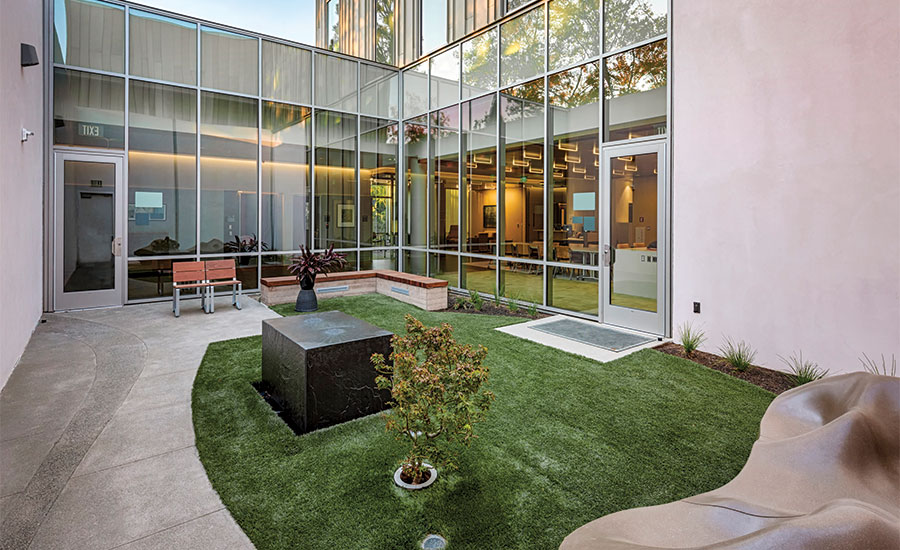
Social spaces are supplemented by tranquil courtyards. Photo © Jeremy Bittermann
Instead of putting the facility’s 36 private rooms along double-loaded corridors, the architects organized them around the south and west perimeters, next to an exceptionally wide hallway that ranges from 12 to 14 feet wide, rather than the minimum standard width of 8 feet. “We wanted to make it part of the living space, for a more open plan,” says Morshead. Seating areas along the corridor allow patients to spend time on their own or meet with visitors, who are not allowed into their private rooms. Three glass-walled courtyards outfitted with seating, communal tables, and water features allow patients to go outside unaccompanied but remain in view of staff. A palette of muted, dark finishes, including wood on ceilings and faux-wood vinyl tile on the floor, as well as cove lighting throughout, also helps to dispel a clinical atmosphere on the inpatient floor. For safety reasons, the interiors had to be designed to make ligatures impossible; in lieu of pendant lighting, the architects placed glowing acrylic bars (which they dubbed “sticks of butter”) in low relief on the lounge ceilings. The door to each patient room is cleverly highlighted with a band of recessed linear lighting.
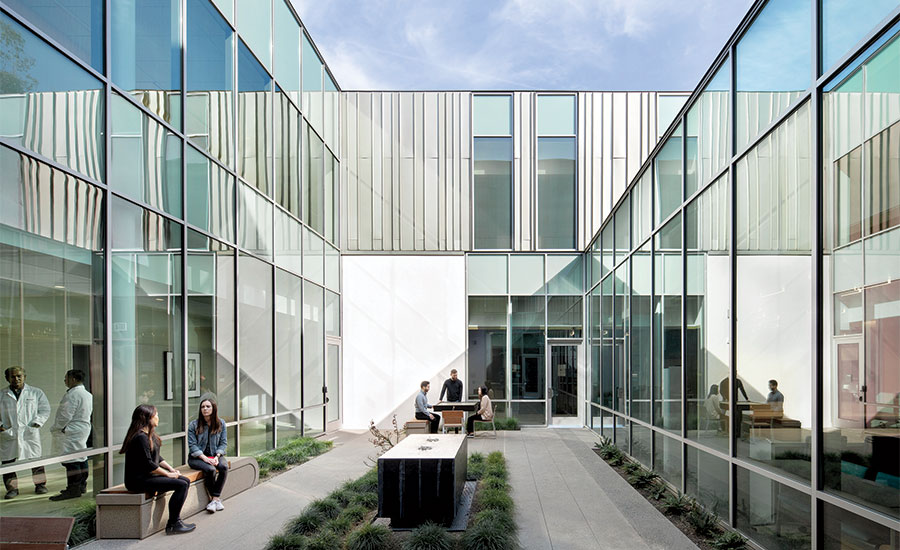
One of three courtyards, this glass-walled space allows patients to benefit from fresh air whenever they like, while staff can still monitor them visually from within. Photo © Jeremy Bittermann
To help destigmatize mental-health care, the lobby is a prominent glass-walled double-height volume. It welcomes people to its outpatient programs, including support for youth, seniors, and addiction treatment, as well as visitors to the inpatient unit. (Those in need of urgent psychiatric care are typically admitted through the emergency department, and come in through private side entrances.)
The architects also tried to counter the impression of a locked-down facility on the exterior. Originally, they wanted the building to blend in with the trees by cladding it with greenish zinc panels, which they’d used to good effect at Boeddeker Park in San Francisco (record, April 2017). But since zinc was not on the state health-care regulator’s approved list of materials, the architects went with anodized aluminum standing-seam panels, selecting them in a light champagne hue for their intrinsic color variation. “This is not a cheap wall. Not that many health-care folks are going to make this kind of investment,” says Bryan Shiles, founding partner at WRNS Studio. “I think the money that was allocated to this project speaks to how the hospital management are great stewards of place.” Their new building, with its pixilated facade, has a quiet shimmer that corresponds to the calming interiors within.
Click plans to enlarge
Credits
Architect:
John Ruffo, FAIA, LEED AP, RIBA – Partner in Charge
Bryan Shiles, FAIA – Design Partner
Tim Morshead, AIA, LEED AP – Partner
Kyle Elliott, NCARB – Partner
Pauline Souza, FAIA, LEED Fellow – Partner, Director of Sustainability
Crispin Lazarit, AIA, LEED AP, BD+C, CSI CDT & CCCA, EDAC – Project Director
Andy Adams, AIA, LEED AP, BD+C – Project Manager
Lynn Soleski, AIA, LEED AP – Project Manager
Beth Radovanovich, AIA, ACHA, LEED AP – Medical Planner
Dale Diener, AIA, LEED AP – Project Architect
David Wilson, LEED AP, CSI CDT & CCCA – Project Architect
Mel Figueroa – Project Coordinator
Mikki Asada – Project Designer
Kevin Jen – Project Designer
Josh Riek – Project Designer
Mi Ju Kang – Project Designer
Kevin Jen – Project Designer
Alexander Arizala – Project Designer
Francesca Martin – Interior Designer
Lily Weeks, Associate AIA – Interior Designer
Stephanie Herbert – Interior Designer
George Ruiz – Project Administrator
Engineers:
Thornton Tomasetti (structural); Interface Engineering (m/e/p); Sandis (civil)
General Contractor:
XL Construction
Consultants:
BFS (landscape architect); RGD (acoustics); Francesca Martin, Stephanie Herbert (interior designers)
Client:
El Camino Health
Size:
55,000 square feet
Cost:
Withheld
Completion Date:
November 2019
Sources
Metal Panels:
Morin
Rainscreen:
Swisspearl
Curtain Wall:
Kawneer
Glazing:
Vitro Architectural Glass
Roof:
Johns Manville
Doors:
Horton Automatics; Curries; VT Industries; Adams Rite; Nanawall; Cookson
Hardware:
Sargent; Assa Abloy
Ceilings:
Armstrong
Demountable Partitions:
National; Georgia-Pacific; USG
Casework:
Wilsonart
Paints & Stains:
Benjamin Moore
Flooring:
Milliken; Mohawk
Tile:
LAMINAM; Daltile; Florim
Lighting:
Litecontrol; Dado; Delray; Kenall; USAI; Eaton; Erco
Looking for quick answers on architecture and design topics?
Try Ask RECORD, our new smart AI search tool.
Ask RECORD →
Looking for a reprint of this article?
From high-res PDFs to custom plaques, order your copy today!