Architectural Record
search
cart
facebook twitter linkedin youtube
  • Sign In
  • Subscribe
  • Sign Out
  • My Account
Architectural Record
  • NEWS
    • Latest News
    • Awards
    • Interviews
    • Obituaries
    • Podcasts
      • Design:Ed Podcast
      • Sponsored Podcasts
  • OPINION
    • Book Reviews / Excerpts
    • Exhibition Reviews
    • Forum
  • EXCLUSIVES
    • Videos
    • Design Vanguard
    • Top 300 Firms
    • Sponsored Content
    • Sponsored eBooks
    • From the Archives
  • CONTINUING ED
    • Editorial Continuing Ed
    • CE Center
    • CE Academies
  • PROJECTS
    • Buildings By Type
    • Reuse & Renovation
    • Museums & Arts Centers
    • Colleges & Universities
    • Multifamily Housing
    • Interiors
    • Lighting
    • Kitchen & Bath
  • HOUSES
    • Record Houses
    • House of the Month
    • Featured Houses
  • PRODUCTS
    • Products by Category
    • Record Products of the Year
    • Latest Products
  • EVENTS
    • Dates & Events
    • Record on the Road
    • Innovation Conference
    • Sustainability in Practice
    • Women In Architecture
    • Webinars
    • Ad Excellence Awards
    • Submit an Event
  • CONNECT
    • Ask RECORD AI
    • Newsletters
    • Contact
    • Advertise
    • Editorial Calendar
    • Store
    • Customer Service
  • SUBMIT
    • Submission Guidelines
    • RECORD Competitions
  • MAGAZINE
    • Subscribe
    • My Account
    • Digital Edition
    • Current Issue
    • Firm Pass
    • Historic Archive
Architecture NewsClimate Change & SustainabilityArchitectural Technology

Profession Must Zero in on Carbon to Meet 2030 Climate Goals
By Joann Gonchar, FAIA
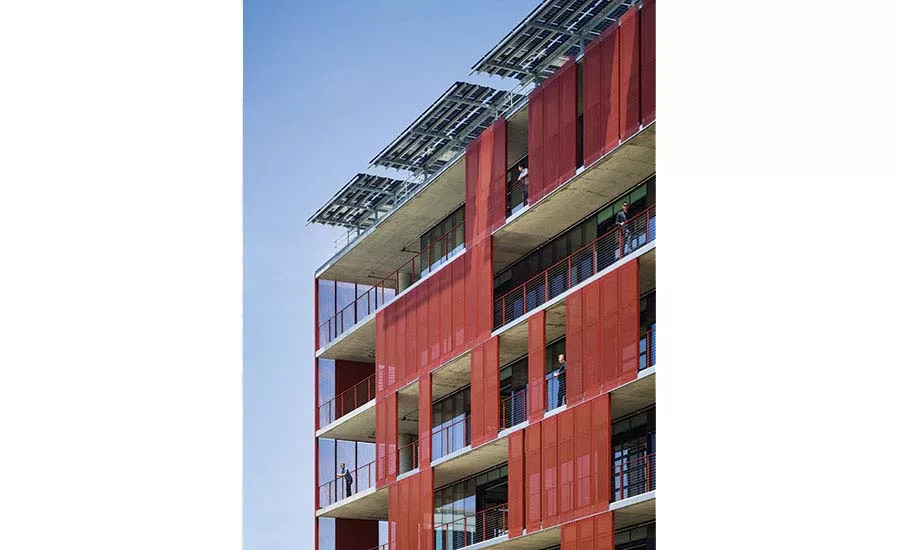
Makers Quarter Block D Office Building.

BNIM’s Makers Quarter Block D office building in San Diego relies on tightly coordinated efficiency measures and renewable energy to meet its net zero target. Photo © Nick Merrick, Hall+Merrick

November 30, 2020

You can’t improve what you don’t measure: that’s the idea behind the AIA 2030 Commitment, a voluntary program that asks design firms to track their progress toward creating carbon-neutral buildings. This fall, the AIA released data from participants for 2019 that showed continued advancement since the program’s inception in 2009, and over the previous year, with more firms participating and showing better energy performance.

But, at same time, the report left significant room for improvement: only 311 of 682 signatory firms even submitted data, and only 27 of those (up from 16 of 549 total participants in 2018) met the commitment’s performance thresholds. “With the climate crisis escalating, more needs to be done,” said the report’s authors, in an understatement.

READ MORE ABOUT

• Sustainable Architecture

• Climate Change

The commitment supports the goals set by architect Ed Mazria’s nonprofit, Architecture 2030. In 2006, Mazria challenged the AEC industry to meet efficiency targets on a schedule that grows more stringent over time, to reach carbon neutrality by 2030 in all new buildings and major renovations. Firms that sign the AIA pledge agree to disclose the predicted energy use intensity (EUI)—calculated on the basis of a building’s size—of all their current work.

For 2019, the 311 reporting companies—among them, many of the profession’s largest firms—disclosed data for 20,000 active projects, representing 3.3 billion square feet in more than 100 countries, from the earliest phases of design to construction. The data indicate savings equivalent to 20.2 million metric tons of carbon dioxide emissions and an overall 49 percent EUI reduction—a modest improvement over 2018’s 46 percent reduction, but still far short of the 70 percent target. For 2020, the commitment’s reduction goals rachet up to 80 percent.

The experience of VMDO, a 74-person firm with offices in Charlottesville, Virginia, and Washington, D.C., illustrates the difficulties in trying to meet the 2030 targets. Despite having designed several net zero energy K–12 schools (each count as a 100 percent EUI reduction), the firm’s average EUI reduction for its entire portfolio has yet to reach the program’s target over its three years of participation. Some building types are difficult, explains Michelle Amt, director of sustainability, such as college residence halls, which tend to be vertical, with little roof area for solar panels relative to enclosed space. “We will have to dig into these typologies and step up our research,” she says. According to Tate Walker, cochair of the 2030 Commitment working group, and sustainability director at OPN Architects, in Madison, Wisconsin, “The commitment isn’t for your most high-profile work, or for when clients ask for it. It applies across the board.”

That is a tough target. Even BNIM, the Kansas City, Missouri, firm long known for its environmental work and an early 2030 signatory, only met (and surpassed) the reduction goals for the first time in 2019. Associate principal Jeremy Knoll recently analyzed the firm’s last decade of data and found that the target EUI as designed tended to be compromised as projects moved toward construction, because of cost-cutting. As a remedy, staff are learning more about funding mechanisms—such as power-purchase agreements and PACE (property assessed clean energy) programs. “Financing is outside the usual scope of an architect’s work,” says Knoll, “but when it comes to value engineering, we want the critical aspects of a project untouched.”

The working group and local AIA chapters are pushing to increase signatory firms and reporting. The group has also enhanced its platform, the Design Data Exchange (DDX), to streamline the reporting process. Other new features include a clearer outline of project phases and an option to track carbon embodied in materials.

Looking for quick answers on architecture and design topics?
Try Ask RECORD, our new smart AI search tool.
Ask RECORD →

In addition, firms can now count off-site renewable energy toward targeted goals—especially significant for complex projects and those in dense settings. Vincent Martinez, COO of Architecture 2030, predicts that, with more renewable-energy options, the program’s numbers will improve markedly. Since 2005, he notes, carbon dioxide emissions from buildings are down 21 percent in the U.S., even as 47 billion square feet of space was added—because of better design, efficiency retrofits, and tighter codes.

Walker is optimistic that the industry will achieve carbon neutrality by 2030. Though progress has been slow and incremental, technology is catching up, he says, pointing out that photovoltaics cost a fraction of what they did five years ago, and LEDs have cut lighting loads in half. “We have all the technical solutions,” he says; “the last and hardest piece is cultural change.” Can the design industry meet the challenge? The clock is ticking.

Share This Story

Looking for a reprint of this article?
From high-res PDFs to custom plaques, order your copy today!

Joann gonchar

Joann Gonchar, FAIA, LEED AP, is deputy editor at Architectural Record. She joined RECORD in 2006, after working for eight years at its sister publication, Engineering News-Record. Before starting her career as a journalist, Joann worked for several architecture firms and spent three years in Kobe, Japan, with the firm Team Zoo, Atelier Iruka. She earned a Master of Architecture degree from the University of Pennsylvania and a Bachelor of Arts from Brown University. She is licensed to practice architecture in New York State.

Post a comment to this article

Report Abusive Comment

Subscription Center
  • Create an Account
  • Start a Subscription
  • Manage My Account
  • Sign Up for Newsletters
  • Visit Customer Service
  • Update Preferences

More Videos

Sponsored Content

Sponsored Content is a special paid section where industry companies provide high quality, objective, non-commercial content around topics of interest to the Architectural Record audience. All Sponsored Content is supplied by the advertising company and any opinions expressed in this article are those of the author and not necessarily reflect the views of Architectural Record or its parent company, BNP Media. Interested in participating in our Sponsored Content section? Contact your local rep!

close
  • TAMLYN XtremeTrim Exterior Trim
    Sponsored byTamlyn

    Designing Cleaner Panel Facades: Why Exterior Trim Details Matter

  • Building with Vapor Barriers
    Sponsored byReef Industries, Inc.

    Vapor Barriers Help Control Moisture in Tighter Building Designs

  • Duct Interior with Prodeq System
    Sponsored byHenry, a Carlisle Company

    Designing Resilient Water Containment Systems

DESIGN:ED Podcast
Listen to Architectural Record’s DESIGN:ED Podcast

Events

June 10, 2026

Rethinking Stormwater – The Power of Porous Paving

Credits: 1 AIA LU/HSW; 1 AIBD P-CE; 0.1 ICC CEU

Learn how porous paving systems support stormwater management, reduce heat island effects, and enhance sustainable site design performance.

June 11, 2026

Very Early Warning Fire Detection for Mission-Critical Facilities

Credits: 1 AIA LU/HSW; 1 AIBD P-CE; 0.1 ICC CEU

Examine advanced fire detection strategies that support uptime and enhance safety in data centers and other mission-critical facilities.

View All Submit An Event

Products

2026 Architect's Square Foot Costbook

2026 Architect's Square Foot Costbook

See More Products

Popular Stories

Coronado Bridge

The Architect’s Guide to San Diego

Practice Matters illustration

What’s in a (Firm’s) Name? Thinking About Succession and Legacy

Practice Matters illustration

By the Numbers: Counting America's Architects

Inward House

Inward House by VeeV Design Studio

Riverdale House by Studio Lau

Riverdale House by Studio Lau

Broader Sustainability of CMU - Free Webinar - May 21, 2026

Related Articles

  • UN Climate Buildings Report

    In Runup to COP26, Report Gauges Building Sector’s Progress on Climate Goals

    See More
  • HMTX Industries

    Continuing Education: Architects Zero in on Zero to Define Building Performance

    See More
  • Nueva-School-Science-and-Environmental-Center-01.jpeg

    Biden-Harris Administration Seeks Input on National Definition for Zero Emissions Buildings

    See More

Related Products

See More Products
  • 3dthinking.jpg

    3D Thinking in Design and Architecture: From Antiquity to the Future

  • GlobalData_logo_blue_header.png

    Construction in the US - Key Trends and Opportunities to 2023

See More Products

Events

View AllSubmit An Event
  • November 20, 2025

    A Roundtable Discussion: Designing to Meet Resilient Building Challenges with Stainless Steel

    NOW ON DEMANDCredits: 1 AIA LU/HSW; 1 AIBD P-CE; 0.1 ICC CEU; 0.1 IACET CEU; 1 PDHExplore innovative façade and material strategies that advance building resilience and sustainability through insights from experts in metals, fabrication, and engineering.
View AllSubmit An Event
×

The latest news and information

#1 Source for Architectural Design, News and Products

SUBSCRIBE
  • RESOURCES
    • Advertise
    • Contact Us
    • Submit
    • Store
  • ACCOUNT CENTER
    • Create an Account
    • Start a Subscription
    • Manage My Account
    • Sign Up for Newsletters
    • Visit Customer Service
    • Update Preferences
  • PRIVACY
    • PRIVACY POLICY
    • TERMS & CONDITIONS
    • DO NOT SELL MY PERSONAL INFORMATION
    • PRIVACY REQUEST
    • ACCESSIBILITY
  • SERVICES
    • Marketing Services
    • Reprints
    • Market Research
    • List Rental
    • Survey/Respondent Access
  • STAY CONNECTED
    • Linkedin
    • Facebook
    • Instagram
    • YouTube
    • X (Twitter)

Copyright ©2026. All Rights Reserved BNP Media, Inc. and BNP Media II, LLC.

Design, CMS, Hosting & Web Development :: ePublishing