Continuing Education: The Big Carbon Drawdown and Negative Emissions
Will removing carbon from the atmosphere save us? And will buildings play a role?

For the desert surrounding an airport in the Middle East, Martha Schwartz Partners proposes a greened landscape combined with high-tech carbon-removal strategies. Image © Martha Schwartz Partners
The climate clock is ticking. Scientists say that to avert the worst effects of the climate crisis, we need to keep the increase in average global temperatures under 1.5 degrees Celsius, as compared to preindustrial levels. And we need to act fast, slashing human-caused greenhouse emissions by almost half by 2030 and reaching net zero emissions by midcentury.
However, many of those same experts say that we are on a trajectory to overshoot these marks, especially if we rely solely on avoiding emissions. The United Nations authority on global-warming science, the Intergovernmental Panel on Climate Change, says that all its models for meeting the 1.5 threshold rely, to some extent, on technologies that actually take carbon out of the atmosphere—an approach called CDR, or carbon dioxide removal.
Still, advocates of CDR emphasize that it can’t be considered a substitute for drastically cutting emissions. Phasing out fossil fuels, expanding renewable energy, and accelerating efficiency measures, they maintain, remain absolutely essential, but these mitigation methods alone will be insufficient to prevent climate catastrophe. “It isn’t ‘either/or’ but ‘both/and,’ ” says Giana Amador, policy director and cofounder of Carbon180, a nonprofit that promotes carbon-removal strategy. “The climate math is telling us that we will have to remove 10 gigatons of carbon annually by 2050, in addition to reaching net zero,” she says.
What qualifies as CDR? Also referred to as carbon drawdown, or negative-emissions technologies, the term refers to a host of strategies, including those that are nature-based and well understood, such as reforestation, wetland restoration, and improved agricultural practices, as well as still-emerging methods like direct air capture (DAC)—a higher-tech, and still very expensive, solution that relies on fans and chemical processes to suck CO2 directly from the air.
All of these removal methods have different levels of permanence, or what is known in carbon-speak, as “durability”—the amount of time that the carbon is sequestered. The natural solutions tend to be relatively short-lived (plants eventually die and decay, releasing greenhouse gases), while some of the engineered ones, such as DAC, can be used to store carbon essentially forever, but it depends on how the collected CO2 is disposed of.
Carbon collected in this way can be used in the manufacture of a variety of products, including fuels and building materials. And, according to Carbon180, there is the potential for a nearly $6 billion global market for this so-called “waste carbon.” But the most durable end use for carbon captured via DAC, and the best one from a climate perspective, says Amador, is geologic storage—putting it underground in rock formations. Though some observers might worry about the potential for induced seismicity, groundwater contamination, and leakage with this method, Carbon180 says that these “are unlikely to occur and can be easily mitigated.”
Geologic storage is exactly what Swiss company Climeworks is doing at its most recently completed DAC facility—called Orca, in southwest Iceland. The $15 million plant, designed to pull 4,000 metric tons of carbon per year from the atmosphere, consists of eight modules the size of shipping containers holding the fans, filters, and other equipment. Once captured, the CO2 is injected far underground into the site’s ideally suited porous basalt. There it turns into rock in about two years, and is stored, in essence, forever.
Looking for quick answers on architecture and design topics?
Try Ask RECORD, our new smart AI search tool.
Ask RECORD →
Currently the world’s largest DAC facility, Orca has single-handedly increased global storage capacity by more than 40 percent, to 13,000 metric tons, according to energy publication E&E News. But, as E&E points out, that total is a tiny fraction of what DAC proponents say will be needed to make a dent in the concentration of CO2 in the atmosphere. It amounts to less than 1 percent of the annual emissions of a single coal-fired power plant.
Some environmentalists oppose DAC, because one use of the technology is to extract more petroleum from oil wells, thus increasing fossil-fuel production and consumption. The process is also energy-intensive (Orca has the advantage of being located next to an emissions-free geothermal plant to power it). But despite the controversy, the nascent carbon-removal method recently got a boost from the federal government. The $1 trillion infrastructure package signed by President Biden in November includes $3.5 billion to build four new DAC hubs, which would each pull a million tons of CO2 from the atmosphere annually. Those funds are on top of $18 million in grants from the U.S. Department of Energy to fund DAC research announced over the summer.
Meanwhile, in the corporate world, particularly in the tech sector, some companies are turning to carbon-removal methods to help them meet their own climate commitments. Microsoft, for instance—which aims to be carbon negative by 2030—purchased 1.3 million metric tons of CDR in fiscal year 2021. The majority of this portfolio consists of projects depending on nature-based solutions, like reforestation initiatives, with a relatively short durability of 100 years or less. However, more durable technologies are also included, such as biochar production (the process of heating biomass in the absence of oxygen to create a stable, carbon-rich solid that can be used to improve soil health). In addition, Microsoft established a $1 billion Climate Innovation Fund investing in newer highly engineered solutions with longer-term storage capabilities, including DAC.
With all the focus on negative emissions, architects and their colleagues in allied disciplines might wonder if there is a role for buildings and urban environments in the brave new carbon-removal world. Landscape architect and Harvard Graduate School of Design professor Martha Schwartz maintains that her profession is uniquely positioned to participate, since plants and soil serve as carbon sinks, while buildings are a major source of emissions (globally, buildings are responsible for nearly 40 percent of CO2). “Architecture puts carbon up [into the atmosphere], and we take it down,” she says. She points out that, especially when implemented at scale, landscapes are more than merely decorative; they can be performative, supporting vital processes, including producing food, managing waste, and mitigating the heat-island effect, in addition to storing CO2.
Such a working landscape is what Schwartz envisioned in a competition entry for a the zone surrounding an airport that her firm, Martha Schwartz Partners, created with Japanese architects Nikken Sekkei for a city in the Middle East (the location is confidential). The unbuilt scheme, shown in fantastical renderings, proposes a greened swath of desert to create parks for recreation and integrates renewable-energy generation, thermal-energy storage, waste-treatment facilities, and seawater greenhouses, among other strategies. Several decarbonization technologies are interwoven within the design, including DAC, the use of biochar, and enhanced weathering that involves spreading finely ground silicate rock onto the land to accelerate its CO2-absorbing properties. If implemented, the landscape would create what Schwartz calls a “virtuous cycle,” in which one process feeds another “to take design beyond sustainability to self-sufficiency,” she says.
Landscape architects may have a leg up in the domain of carbon removal, but some architecture firms are investigating how to incorporate negative-emissions technologies into buildings. At COP26, the United Nations environmental conference held in Glasgow last November, SOM presented a skyscraper concept called Urban Sequoia. The design combines low- and high-tech solutions with the goal of transforming the building industry from a carbon emitter into a carbon absorber, says Yasemin Kologlu, an SOM design principal. It depends on strategies such as modularity, prefabrication, and structural optimization to minimize the tower’s embodied carbon (the carbon emitted during the extraction and manufacture of building materials, and during construction).

SOM’s Urban Sequoia. Image © SOM, click to enlarge.
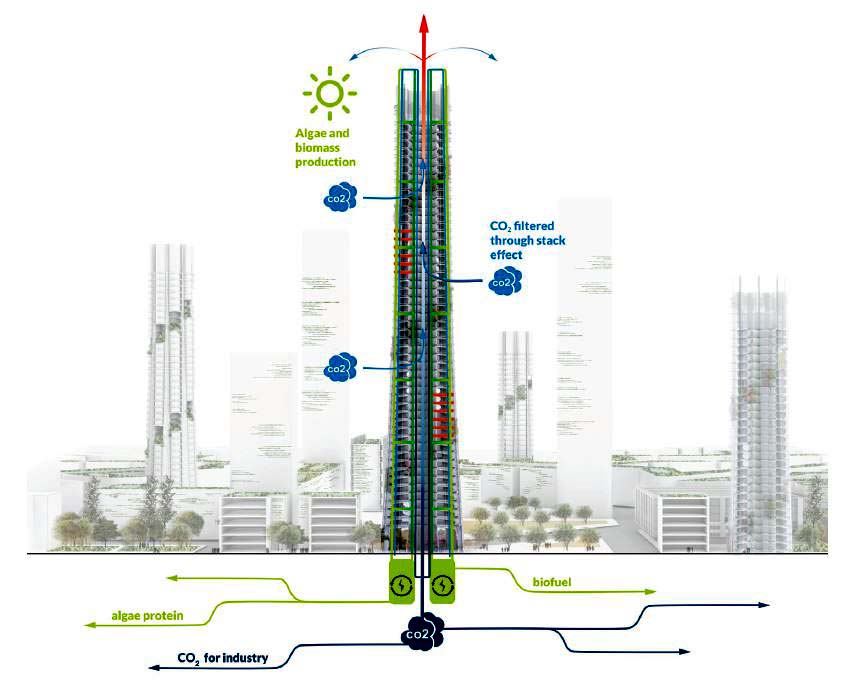
It would be built of materials and components with the capacity to store CO2, including timber and biobrick—a structural element “grown” from bacteria now being developed by researchers at the University of Colorado Boulder—and clad in facade panels incorporating algae. The algae would capture CO2 through photosynthesis that could be harvested for use in biofuels, pharmaceuticals, or food.
Click diagram to enlarge
Urban Sequoia incorporates CDR technologies such as algae-filled facades and DAC. Image © SOM
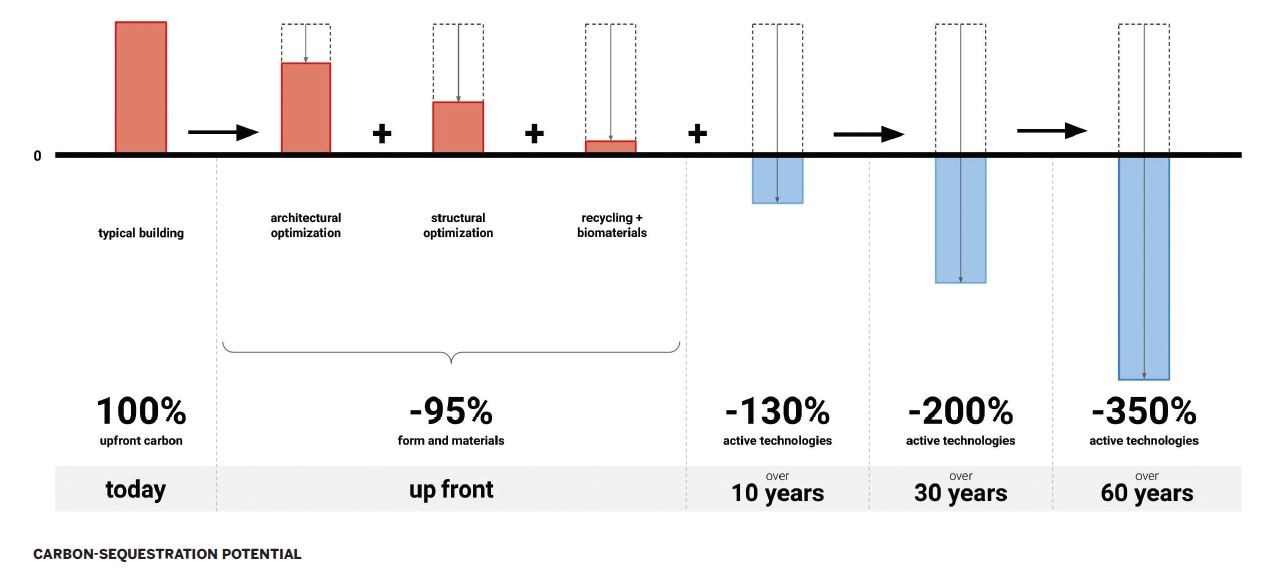
The Urban Sequoia scheme also includes DAC. Here the system draws carbon into the tower’s core via the stack effect, collecting it for distribution to a variety of industries. Taken together, the building’s passive and active strategies would give it a net-negative embodied-carbon footprint: Over 60 years, the tower would absorb up to 350 percent more CO2 than would be emitted during construction, according to SOM’s calculations.
Click chart to enlarge
Over 60 years, the tower would absorb 350 percent of its embodied carbon, says the firm. Image © SOM
Kologlu can’t predict when we might see an Urban Sequoia built. But it does seem far off, given that many of its solutions aren’t yet ready for prime time. However, more conventional buildings incorporating carbon-capturing equipment might soon be commonplace, since a handful of startups have entered this market. One company, CarbonQuest, diverts flue gas from boiler exhaust. It recently installed its technology at a 229-unit apartment building in Manhattan and sells the CO2 to a local building-product manufacturer who embeds it in concrete blocks.
Another startup, Noya, based in the San Francisco Bay Area, has developed a technology for retrofitting cooling towers. It plans to sell the collected CO2 to users such as food and beverage businesses, sharing the revenue with the building owner. Alternatively, it will store it underground to create carbon credits. This past summer it completed its first installation—at a creamery in San Leandro, California. Josh Santos, Noya’s cofounder and CEO, says the company will start scaling up early next year and already has a waitlist of 160 buildings in 15 cities.
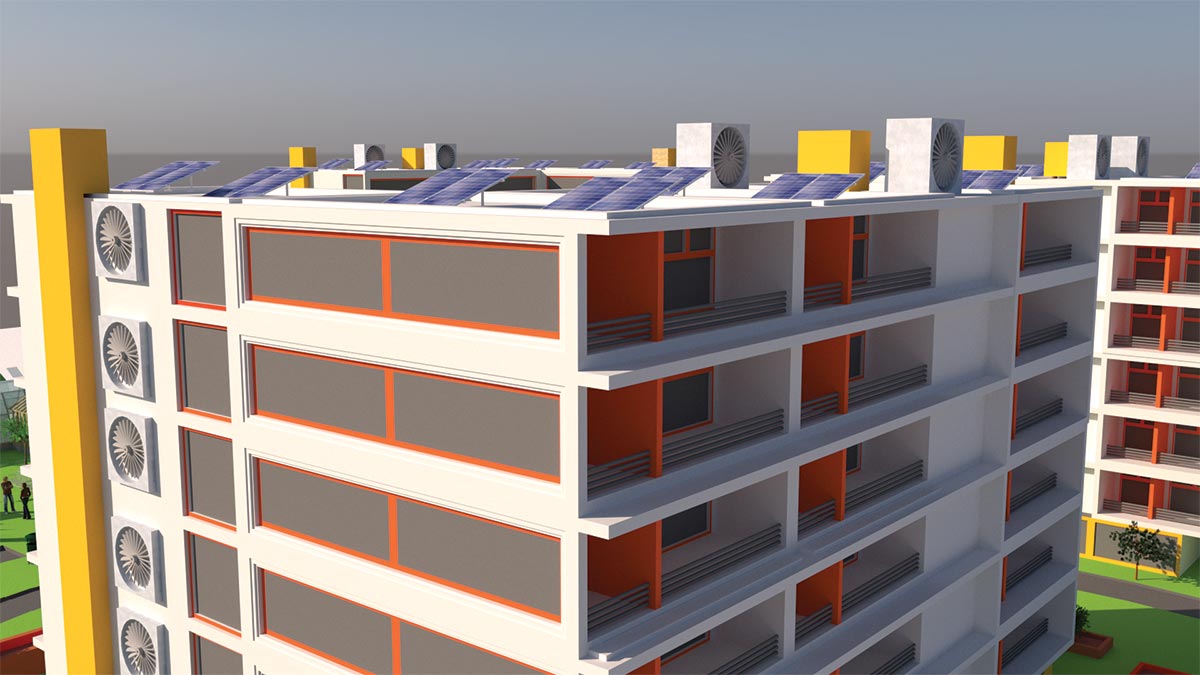
For its part, Carbon180 has begun to consider how local communities—not just technology developers, building owners, or industry—might benefit from, and have a say in, the implementation of carbon-removal technologies. It recently published a blog with renderings showing DAC incorporated into a variety of public spaces and building types, including affordable housing. Here it could provide a number of advantages, but a key one would be improving indoor air quality. The collected CO2 could then be used to boost yields in a rooftop greenhouse where residents could grow their own food. The blog also suggests policy tools, such as project labor agreements, that could help communities benefit economically from nearby industrial-scale carbon-removal development.
1

2
Community-centered DAC could include an installation on public housing (1) that would improve indoor air and supply CO2 to a rooftop greenhouse (2), says Carbon180. Images © Carbon180 / Samuel Orellana
Clearly, solving the climate crisis demands that we consider not only technical solutions, but also their financial and social implications. And we need to remember that removing carbon should not obscure mitigation. Even those banking on CDR’s widespread implementation say so. “Ceasing the spewing of CO2 into the sky is more important” than removing carbon, says Noya’s Santos. But we are no longer in a position to choose: “We have to do both,” he says, “and as quickly as we can.”
Continuing Education

To earn one AIA learning unit (LU), including one hour of health, safety, and welfare (HSW) credit, read the article above and Explainer: Carbon Removal, 2020 Institute for Carbon Removal Law and Policy, American University, Washington, D.C.
Then complete the quiz. Upon passing the quiz, you will receive a certificate of completion, and your credit will be automatically reported to the AIA. Additional information regarding credit-reporting and continuing-education requirements can be found at continuingeducation.bnpmedia.com.
Learning Objectives
- Explain what carbon dioxide removal (CDR) is and list the term’s synonyms.
- Discuss the importance of CDR methods and mitigation strategies for addressing global warming.
- Describe some CDR methods.
- Explain the concept of durability as it relates to CDR methods.
AIA/CES Course #K2203A
Looking for a reprint of this article?
From high-res PDFs to custom plaques, order your copy today!