The Future of Practice: Interview with Marilyn Moedinger of Runcible Studios
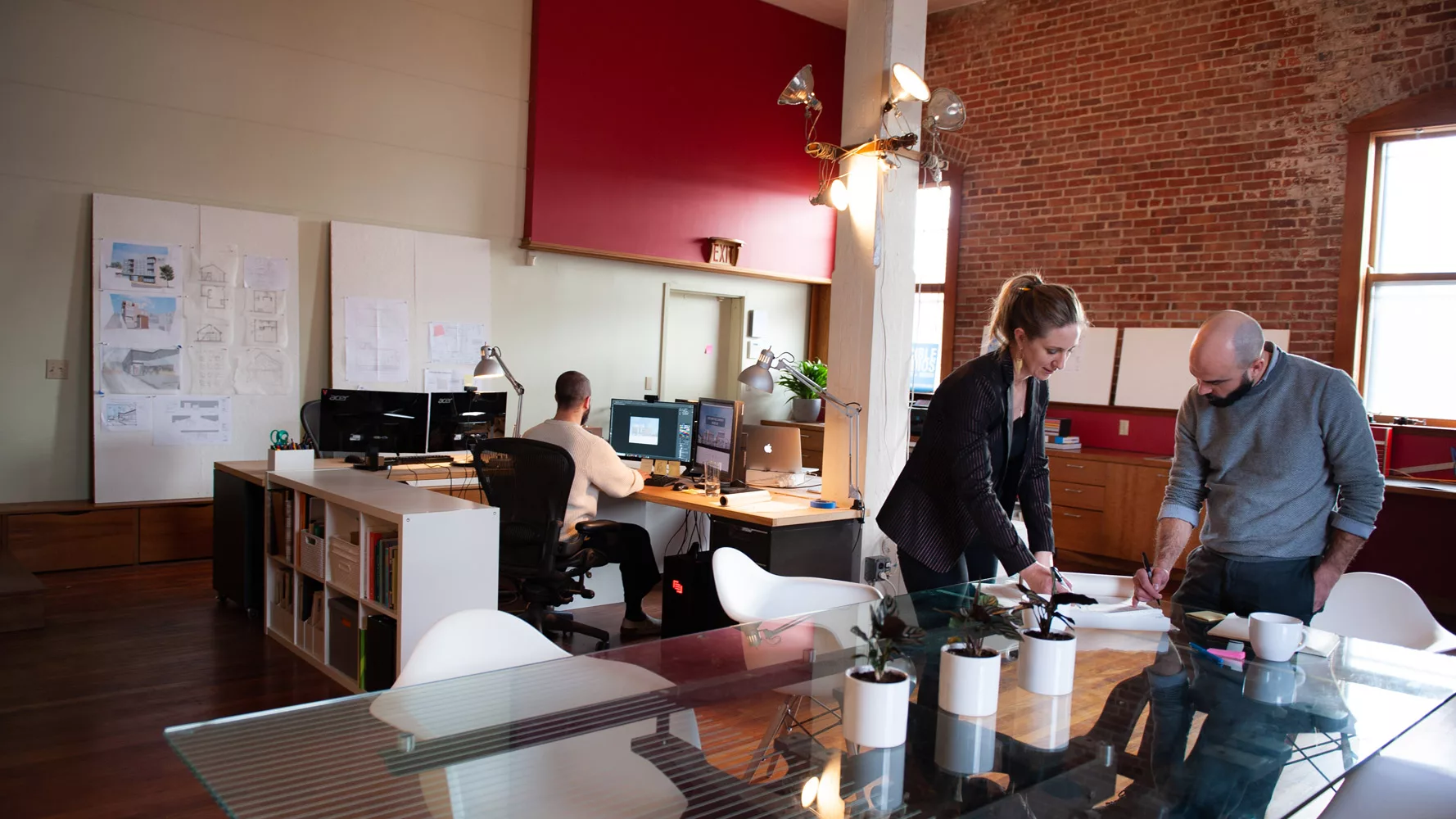
Moedinger and her team at the Runcible Studios office in Boston. Photo © Tiffany Knight
The recent unionization campaign led by the group Architectural Workers United has ignited a national conversation about the grueling aspects of architectural labor. While the debate about fair compensation and overwork has centered on large firms in major cities, more than 75 percent of architectural firms in the United States have less than ten employees. Where do smaller firms fit into the conversation?
As part of an ongoing interview series about the future of practice, RECORD is speaking to small firm-owners who are representative of the younger cohort of architects who are, both consciously and instinctively, trying to practice the business of architecture differently.
Marilyn Moedinger, 39, founded Runcible Studios in 2013, two years after receiving her Master’s in Architecture from the University of Virginia. Previously she worked as a contractor and project manager at a construction firm in Charlottesville, Virginia, as an architectural designer at the firm Utile in Boston, and at the Boston Architectural College, where she still teaches as an adjunct professor. In 2010 she received the SOM Prize in Architecture, a $50,000 research and travel fellowship sponsored by the SOM foundation, and published a book, Adventures in the Vernacular: Investigative Observations of Residential Climate Mediation, based on her fellowship travels.

Marilyn Moedinger. Photo © Carlie Febo
How did you come up as an architect and what made you decide to branch out on your own?
I graduated [with a Master’s] in 2010, so at the height of when there were no architecture jobs. It was a little bit of a slow start because it was tough times. I was 27 when I got my first architecture job [at Utile]. I then got a cool opportunity to be a full-time administrator at the Boston Architecture College. While I was there, my job was to team up groups of students with local nonprofits to do semester-long projects. We did 60 projects while I was there, each led by a local architect. But it was pretty clear to me that my skills and passion for architecture and practice was not going to go away. I left the BAC—I still teach, but I left the administration side and launched my practice.
I always joke that I started my business by accident. I started doing some odd jobs for people and one thing led to another and then I was like, “Oh I have to get insurance.” And then “I should probably have business cards and maybe a website.” And two years later I said “I should probably hire someone.” I didn't write a business plan on day one. But having solid business practices has always been a baseline for me. I said, “If I'm going to do this, I'm going to do it in a way that is sound from a business perspective.”
Did your experience in construction and administration help you as you started your business?
Looking for quick answers on architecture and design topics?
Try Ask RECORD, our new smart AI search tool.
Ask RECORD →
Absolutely, yes. I mean negotiating contracts, understanding what things cost, having conversations with clients about money. Those things come up in contracting like a zillion times a day. My office [in Charlottesville] was right next door to the comptroller’s office so there were all sorts of conversations happening that I got to overhear that were educational. My time in administration was helpful in terms of learning how to bring different groups of people together and how to operate in the more political environment of academia.

Kitchen by Runcible Studios in a private residence in Boston. Photo © Yorgos Efthymiadis
Lisa Sauvé spoke to me about how small firms tend to gather together and support each other’s projects. Has that been the case in your experience?
We partner with a lot of other small firms who might be two to three people and we will work together to go after certain projects. It’s easier than me having six people and that other person having six people. Instead, we pair up strategically to expand and contract for different types of projects. As small firms, we're all aware of each other. We understand what the challenges are when you're small and so you can plug in with each other faster. We're nimble, we run lean shops. That has a lot of advantages for clients and it has advantages for how we do things. We're not overhead heavy.
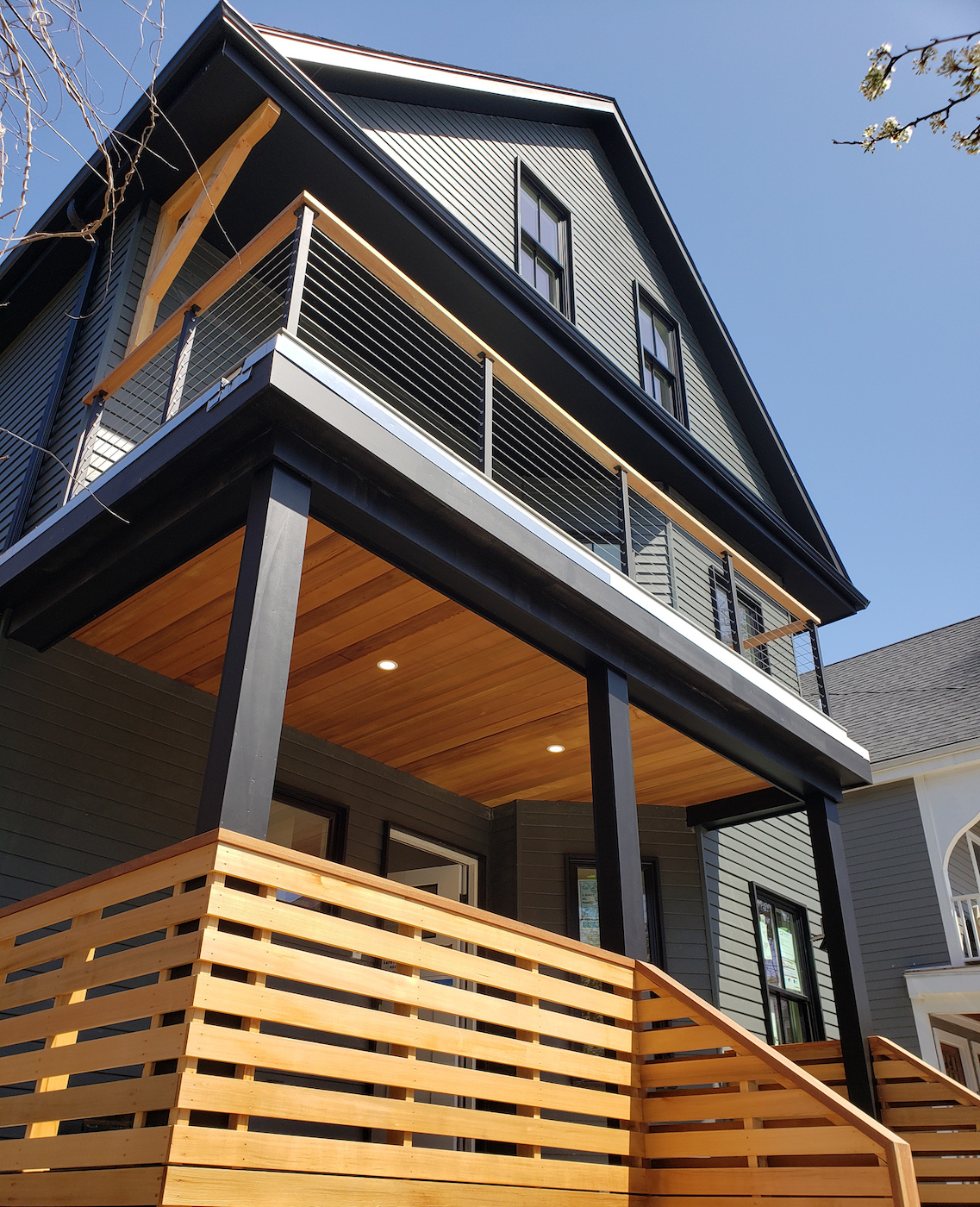
Private residence in Somerville, MA. Photo courtesy Runcible Studios
What kind of labor practices do you promote as a firm owner?
One cardinal rule is don't answer emails from anyone after 6:00 p.m. or before 8:00 a.m. on weekdays and never on the weekends. As a business owner, I work way more than 40 hours per week. That should not be surprising to anyone. But I do not expect my team to do that by any stretch. They do not have that same burden or responsibility. It is up to me to do what I can to guard their time. Keeping my staff to 40 hours a week is something I believe in very strongly. There are times when we have a deadline and we're pushing and we have to pull some nights here and there, but it's very rare for us. If we're doing that all the time, that's a management failure on my part. That means I didn't manage the team, or I didn't allow enough time or I didn't set the deadlines at the right interval. That's on me. We all crash into deadlines sometimes, but if that's the norm, then I'm doing something wrong.
How does your experience as an architect and a business owner inform your role as an educator?
When I teach studio, I tell my students, “Hey, so there is a lot of work. You have a lot of work to do in studio and you're gonna have some late nights.” School is not nine-to-five, but it's also not 7:00 a.m. to 3:00 a.m. There's a lot of pressure to get a lot of work done. My conversations that I have around this with students are often about learning time management skills. I think that a lot of architects have poor time management skills because of this idea that unless you're toiling all night, it's not real.
Since AWU launched its unionization campaign in New York, have you seen a shift in the conversation at the architecture school level?
We have active conversations about, how do you negotiate your salary? How do you understand if you're getting a fair offer? How do you understand if something is exploitative or just uncomfortable? It might be really hard and you might be confused trying to figure out how to do something at work, but that's not necessarily bad. When does it become bad?

Interior of Night Shift Brewery in Everett, MA. Photo © Randall Garnick
Something that has been prevalent in the conversation surrounding labor in architecture is this idea that architecture and architects tend to shy away from the business-side of the profession. As a business-owner and an architect, what has your experience been with this?
There’s a talk I used to give about “dirty words” in architecture and one of the dirty words is profit, and the other one is business, one of them might be sleep, the other one might be decaf… but profit is definitely one of them. Boston, for example, is a super academic town. We have six schools of architecture here. There's a zillion architects, and everyone teaches on the side. In my experience, for most or a lot of architects, it's a badge of honor not to know about business or to not bother yourself with it. There’s that idea that a real designer isn't interested in business.
75 percent of my students say they want to open their own firms. And what I say is, do you want to run a business? That should be the first question. And if you don't want to run a business, then you should not open a firm. If you want to be 100 percent architecting, work your way up at a bigger firm and be an architect at a bigger firm or partner with a business partner, but don't act like the business part isn't important. And don't kid yourself about how much you have to do.
I get asked all the time to talk about my business, which is cool! I love talking about my business, but I'm in business to be an architect and just because I am outspoken about business, or because I think that running a good business is baseline for opening a firm, doesn't mean I'm not interested in the bigger ideas. There's this idea that you have to pick a camp, you have to be the business kind or the design kind of architect. And I say let's be both.
Looking for a reprint of this article?
From high-res PDFs to custom plaques, order your copy today!