Architectural Record
search
cart
facebook twitter linkedin youtube
  • Sign In
  • Subscribe
  • Sign Out
  • My Account
Architectural Record
  • NEWS
    • Latest News
    • Awards
    • Interviews
    • Obituaries
    • Podcasts
      • Design:Ed Podcast
      • Sponsored Podcasts
  • OPINION
    • Book Reviews / Excerpts
    • Exhibition Reviews
    • Forum
  • EXCLUSIVES
    • Videos
    • Design Vanguard
    • Top 300 Firms
    • Sponsored Content
    • Sponsored eBooks
    • From the Archives
  • CONTINUING ED
    • Editorial Continuing Ed
    • CE Center
    • CE Academies
  • PROJECTS
    • Buildings By Type
    • Reuse & Renovation
    • Museums & Arts Centers
    • Colleges & Universities
    • Multifamily Housing
    • Interiors
    • Lighting
    • Kitchen & Bath
  • HOUSES
    • Record Houses
    • House of the Month
    • Featured Houses
  • PRODUCTS
    • Products by Category
    • Record Products of the Year
    • Latest Products
  • EVENTS
    • Dates & Events
    • Record on the Road
    • Innovation Conference
    • Sustainability in Practice
    • Women In Architecture
    • Webinars
    • Ad Excellence Awards
    • Submit an Event
  • CONNECT
    • Ask RECORD AI
    • Newsletters
    • Contact
    • Advertise
    • Editorial Calendar
    • Store
    • Customer Service
  • SUBMIT
    • Submission Guidelines
    • RECORD Competitions
  • MAGAZINE
    • Subscribe
    • My Account
    • Digital Edition
    • Current Issue
    • Firm Pass
    • Historic Archive
ProjectsBuildings by TypeLighting DesignWorkplace Design

At Its Studio, AHMM Sheds Light Into a Deep, Bunker-Like Space

Allford Hall Monaghan Morris creates a new London studio beneath its White Collar Factory building
By Chris Foges
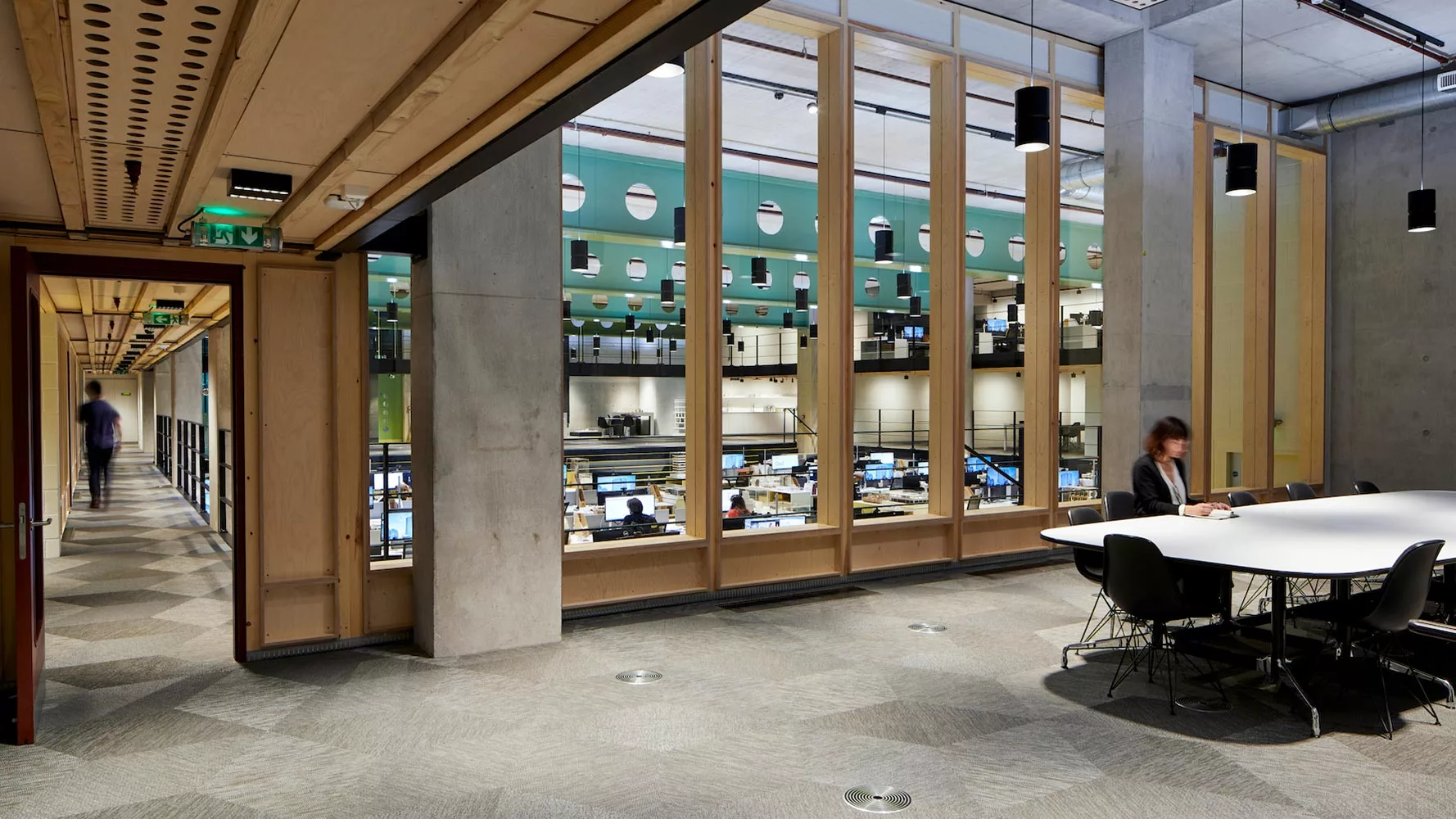
AHMM Studio at White Collar Factory.
AHMM Studio at White Collar Factory. Photo © Erco GMBH / Martina Ferrera
July 13, 2022

Architects & Firms

Allford Hall Monaghan Morris
✕
Image in modal.

When the architecture firm Allford Hall Monaghan Morris (AHMM) was looking for a second studio near its London base, it found an irresistible opportunity at White Collar Factory, a 16-story office tower designed by the practice. Its cavernous basement, which extends under an adjacent courtyard, was never intended as a workspace but had a powerful, robust character, room for a staff of 110, and lots of potential. There was only one catch: “It had everything we like in a building,” says practice partner Simon All­ford, “except windows.”

The lack of daylight and views has been addressed by a sophisticated lighting scheme that also supports AHMM’s vision of the studio as its “skunkworks”—a flexible setting for creative experiment—and chimes with the building’s industrial aesthetic.

Leaving the raw concrete shell exposed, the architects inserted steel mezzanines on two sides of the 26-foot-high space, linked by a bridge over the reception area, where a glazed elevator shaft provides a modicum of borrowed daylight. Under one mezzanine, painted concrete-block walls separate open-fronted bays. Below the other mezzanine, meeting rooms are constructed from a modular demountable plywood wall system, originally designed by AHMM for Google’s London headquarters.
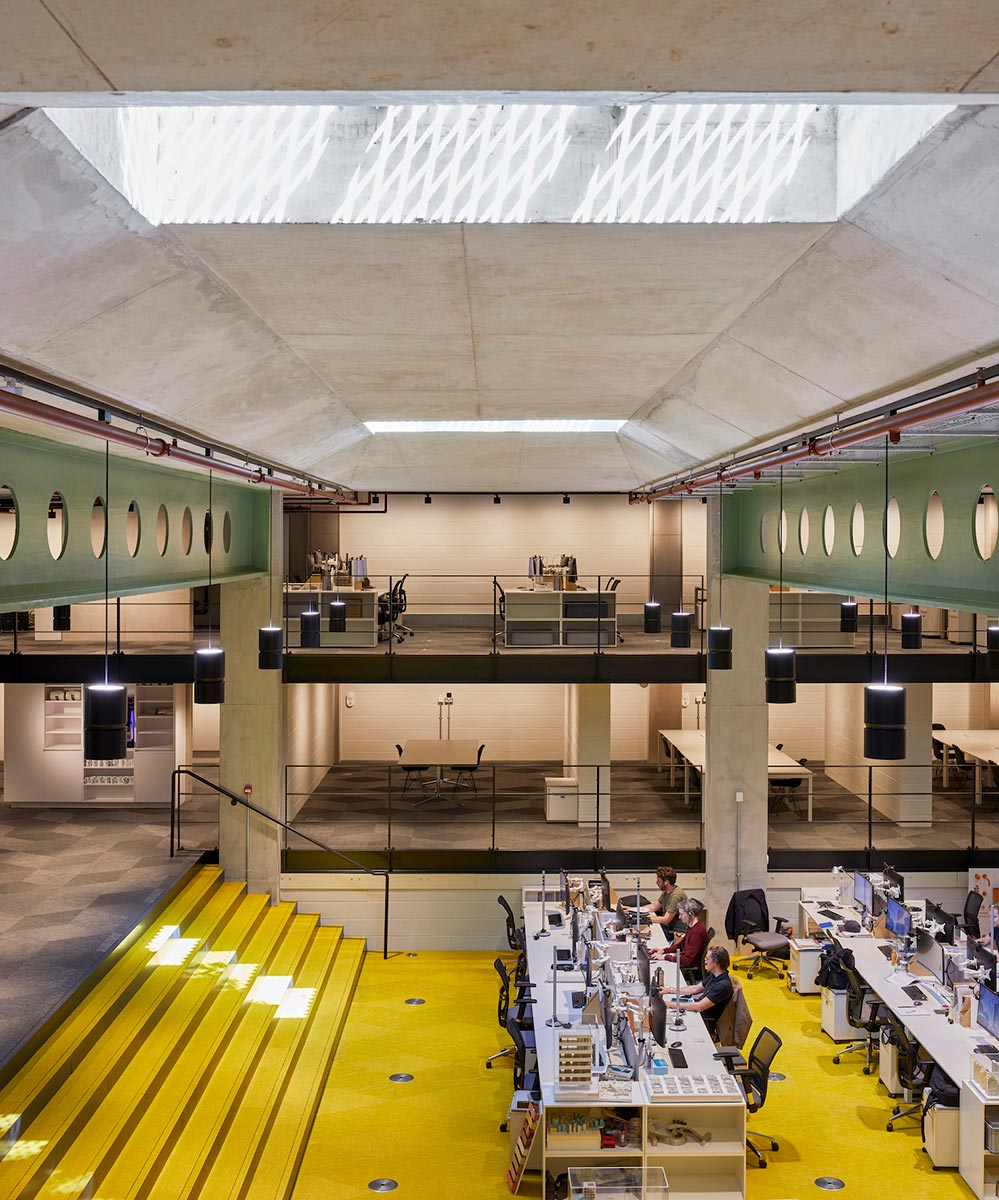
AHMM Studio at White Collar Factory.

Human-centric lighting, such as tunable-white pendants in the main hall, augments existing skylights to transform White Collar Factory’s deep basement into a vibrant hub for its architect. Photo © Erco GMBH / Martina Ferrera, click to enlarge.

In the middle, where the floor-level drops and four small skylights puncture the vaulted concrete ceiling, a generous double-height studio hums with activity. Overhead, a regular array of can-shaped pendants hangs between castellated steel beams, distinct in pistachio green. Designed for use in areas with high ceilings, the matte-black cylinders have a high lumen output from both ends. With strong light bouncing off the pale ceiling and a cornflower yellow carpet, the whole studio glows.

The skylights above the central space create an important connection to the outside world and some daylight—“even a tiny bit is vital,” says Allford—but not enough to regulate its occupants’ circadian rhythms, the 24-hour internal clock essential to healthy sleep and general well-being. To compensate, the quality of electric light adjusts to create natural-seeming variations: cool white in the early morning, brightening toward the middle of the day, and warming in the afternoon. The evolution is imperceptible, but, when the cycle is sped up, the change in ambience is striking.
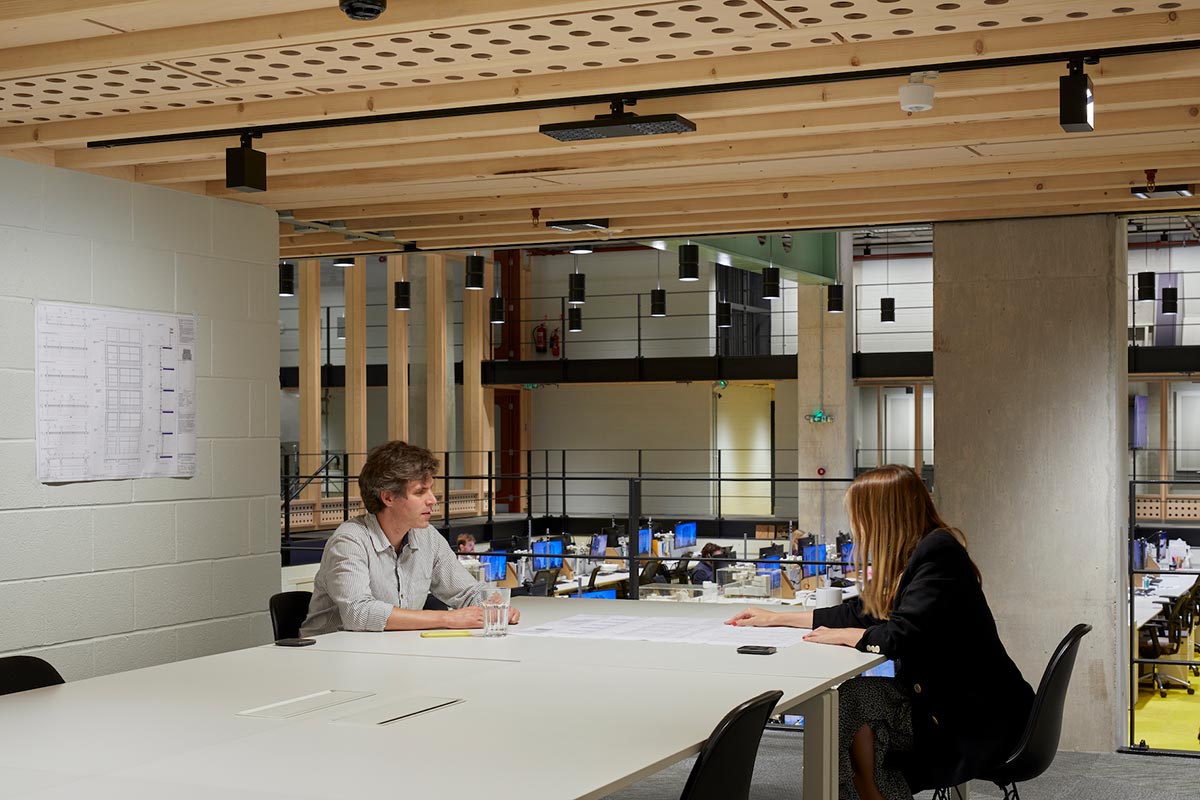
AHMM Studio at White Collar Factory.

Tiers of flexible work areas (top and above) flanking the central space are illuminated by modular track lighting that creates pleasing, effective environments for numerous activities. Photo © Erco GMBH / Martina Ferrera

That demonstration is one of dozens of scenes available at the touch of a button. The whole installation is controlled via Bluetooth from an app on a phone and tablet, so it can be managed from anywhere in the building and beyond.

The behavior of individual fixtures can be altered to support alternative desk configurations, or to suit the preferences of someone seated below. “London offices provide a standard 200 lux at desk level,” says Allford—“a kind of uniformity nobody actually wants.” There’s potential for dramatic effects too. Allford had in mind Eero Saarinen’s trick of taking clients into a darkened room and turning on a single light over a model. “There is theater in the presentation of architecture,” he says, “and lighting adds to the story.”

Looking for quick answers on architecture and design topics?
Try Ask RECORD, our new smart AI search tool.
Ask RECORD →

Adaptability was most important in the peripheral zones, where the intention was to make something akin to MIT’s demolished Building 20, a temporary structure built during World War II that inhabitants felt free to modify, liberating their creative work. One mezzanine is currently an incubator, allowing in a few fledgling architecture practices. Another might become a model shop. Track lighting was chosen to permit change of use in the time it takes to relocate a fixture or to plug in a new one. “It’s an expensive option,” says Allford, “but you can reinvent the character of spaces without replacing finishes.”

For these low-ceilinged areas, AHMM selected downlights with a shallow housing and wide beams. Anti-dazzle louvers disguise the source of light so that attention is focused on its effect. Track-mounted wall-washers enhance the apparent brightness of the room, since we register the illumination of vertical surfaces more strongly than light on a horizontal plane. The sunny sheen on blockwork partitions below the mezzanine is particularly effective, seeming to imply a source of daylight somewhere out of sight. Real windows might have been ideal, but, walking around the atmospheric basement brought to life by light, I didn’t miss them at all.

Back to Below the Surface Lighting Projects

Credits

Architect:
Allford Hall Monaghan Morris — Simon Allford, Stephen Taylor, Adam Burgess, Bryn Williams, Stephen Harker, design team

Engineer:
Akera Engineers (structural)

General Contractor:
Contrakt Limited

Consultants:
Sandy Brown (acoustics); BRCS (building inspection/fire); Erco (lighting)

Client:
Allford Hall Monaghan Morris

Owner:
Derwent London

Size:
16,000 square feet

Cost:
$2.5 million

Completion Date:
September 2020


Sources

Lighting:
ERCO Lighting (downlights, ambient and task lighting, and controls)

KEYWORDS: London

Share This Story

Looking for a reprint of this article?
From high-res PDFs to custom plaques, order your copy today!

Chris Foges is a writer and editor working in architecture and the built environment, based in London. He is contributing editor at the RIBA Journal and was formerly editor of Architecture Today magazine. His books include Imagination and The City Works.

Post a comment to this article

Report Abusive Comment

Subscription Center
  • Create an Account
  • Start a Subscription
  • Manage My Account
  • Sign Up for Newsletters
  • Visit Customer Service
  • Update Preferences

More Videos

Sponsored Content

Sponsored Content is a special paid section where industry companies provide high quality, objective, non-commercial content around topics of interest to the Architectural Record audience. All Sponsored Content is supplied by the advertising company and any opinions expressed in this article are those of the author and not necessarily reflect the views of Architectural Record or its parent company, BNP Media. Interested in participating in our Sponsored Content section? Contact your local rep!

close
  • TAMLYN XtremeTrim Exterior Trim
    Sponsored byTamlyn

    Designing Cleaner Panel Facades: Why Exterior Trim Details Matter

  • Building with Vapor Barriers
    Sponsored byReef Industries, Inc.

    Vapor Barriers Help Control Moisture in Tighter Building Designs

  • Duct Interior with Prodeq System
    Sponsored byHenry, a Carlisle Company

    Designing Resilient Water Containment Systems

DESIGN:ED Podcast
Listen to Architectural Record’s DESIGN:ED Podcast

Events

June 10, 2026

Rethinking Stormwater – The Power of Porous Paving

Credits: 1 AIA LU/HSW; 1 AIBD P-CE; 0.1 ICC CEU

Learn how porous paving systems support stormwater management, reduce heat island effects, and enhance sustainable site design performance.

June 11, 2026

Very Early Warning Fire Detection for Mission-Critical Facilities

Credits: 1 AIA LU/HSW; 1 AIBD P-CE; 0.1 ICC CEU

Examine advanced fire detection strategies that support uptime and enhance safety in data centers and other mission-critical facilities.

View All Submit An Event

Products

2026 Architect's Square Foot Costbook

2026 Architect's Square Foot Costbook

See More Products

Popular Stories

Coronado Bridge

The Architect’s Guide to San Diego

Practice Matters illustration

What’s in a (Firm’s) Name? Thinking About Succession and Legacy

Practice Matters illustration

By the Numbers: Counting America's Architects

Inward House

Inward House by VeeV Design Studio

Riverdale House by Studio Lau

Riverdale House by Studio Lau

Broader Sustainability of CMU - Free Webinar - May 21, 2026

Related Articles

  • Centre de Congres

    In Morocco, Ricardo Bofill Taller de Arquitectura Designs a Lecture Hall with a Deep-Green Auditorium at Its Core

    See More
  • Rosario Candela and The New York Apartment

    ‘Rosario Candela & The New York Apartment’ Sheds Light on the Life of the Italian-born Architect

    See More

Events

View AllSubmit An Event
  • May 13, 2026

    Steel and Wood Together? Really? How Mass Timber Turns This Combination Into a Winning Strategy

    NOW ON DEMANDCredits: 1 AIA LU/HSW; 1 AIBD P-CE; 0.1 ICC CEU; 1 PDHDiscover how combining mass timber and steel can optimize structural performance, fire safety, and carbon outcomes in modern building design.
View AllSubmit An Event
×

The latest news and information

#1 Source for Architectural Design, News and Products

SUBSCRIBE
  • RESOURCES
    • Advertise
    • Contact Us
    • Submit
    • Store
  • ACCOUNT CENTER
    • Create an Account
    • Start a Subscription
    • Manage My Account
    • Sign Up for Newsletters
    • Visit Customer Service
    • Update Preferences
  • PRIVACY
    • PRIVACY POLICY
    • TERMS & CONDITIONS
    • DO NOT SELL MY PERSONAL INFORMATION
    • PRIVACY REQUEST
    • ACCESSIBILITY
  • SERVICES
    • Marketing Services
    • Reprints
    • Market Research
    • List Rental
    • Survey/Respondent Access
  • STAY CONNECTED
    • Linkedin
    • Facebook
    • Instagram
    • YouTube
    • X (Twitter)

Copyright ©2026. All Rights Reserved BNP Media, Inc. and BNP Media II, LLC.

Design, CMS, Hosting & Web Development :: ePublishing