Architectural Record
search
cart
facebook twitter linkedin youtube
  • Sign In
  • Subscribe
  • Sign Out
  • My Account
Architectural Record
  • NEWS
    • Latest News
    • Awards
    • Interviews
    • Obituaries
    • Podcasts
      • Design:Ed Podcast
      • Sponsored Podcasts
  • OPINION
    • Book Reviews / Excerpts
    • Exhibition Reviews
    • Forum
  • EXCLUSIVES
    • Videos
    • Design Vanguard
    • Top 300 Firms
    • Sponsored Content
    • Sponsored eBooks
    • From the Archives
  • CONTINUING ED
    • Editorial Continuing Ed
    • CE Center
    • CE Academies
  • PROJECTS
    • Buildings By Type
    • Reuse & Renovation
    • Museums & Arts Centers
    • Colleges & Universities
    • Multifamily Housing
    • Interiors
    • Lighting
    • Kitchen & Bath
  • HOUSES
    • Record Houses
    • House of the Month
    • Featured Houses
  • PRODUCTS
    • Products by Category
    • Record Products of the Year
    • Latest Products
  • EVENTS
    • Dates & Events
    • Record on the Road
    • Innovation Conference
    • Sustainability in Practice
    • Women In Architecture
    • Webinars
    • Ad Excellence Awards
    • Submit an Event
  • CONNECT
    • Ask RECORD AI
    • Newsletters
    • Contact
    • Advertise
    • Editorial Calendar
    • Store
    • Customer Service
  • SUBMIT
    • Submission Guidelines
    • RECORD Competitions
  • MAGAZINE
    • Subscribe
    • My Account
    • Digital Edition
    • Current Issue
    • Firm Pass
    • Historic Archive
Climate Change & SustainabilityEditorial

September 2022 Editor's Letter: The End of Summer, Climate Change, & Heat Waves
By Cathleen McGuigan
Edit-Letter.jpg

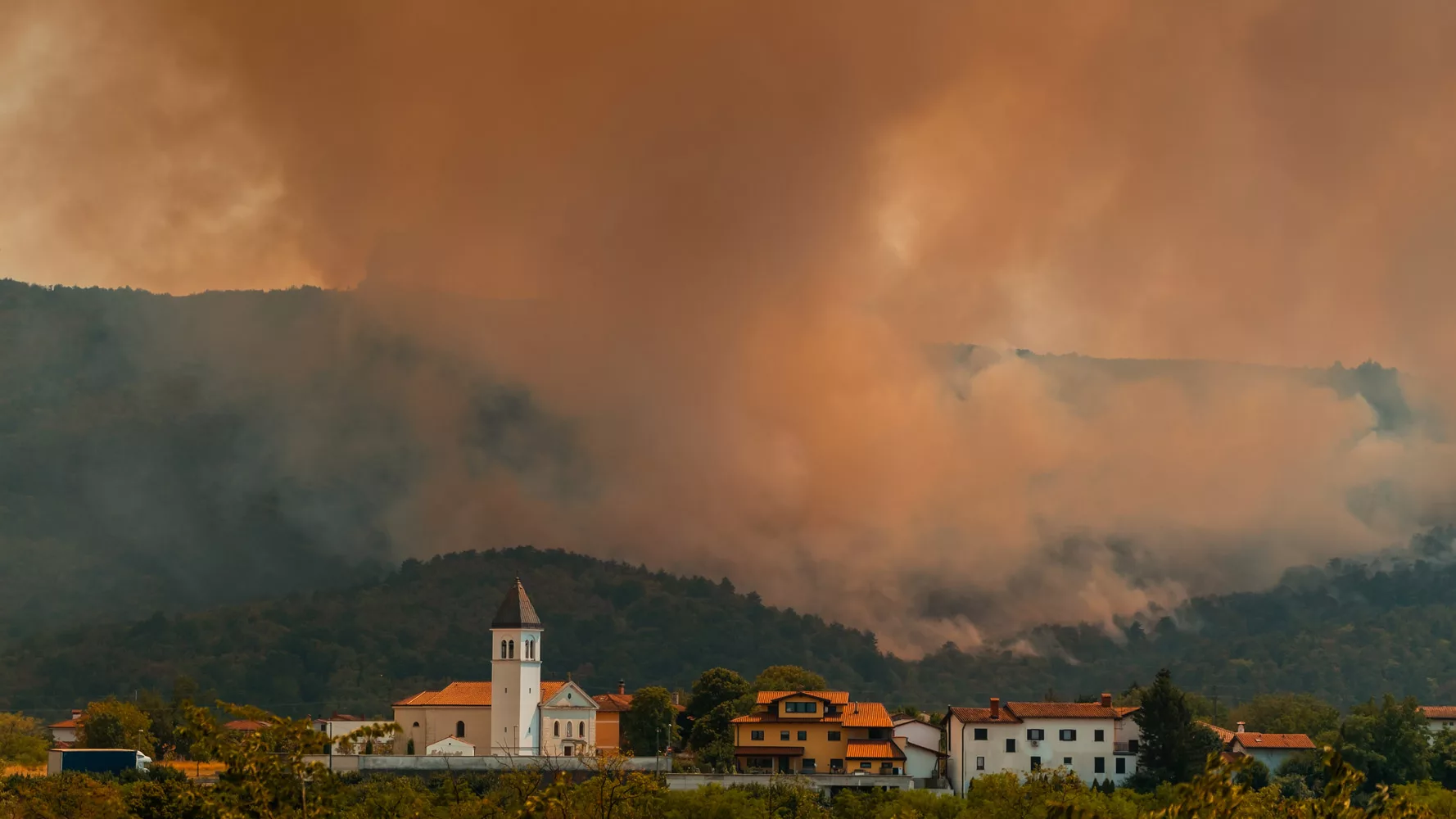
The largest ever wildfire in Slovenia's history burned in the Karst region from mid-July to the beginning of August this summer. Photo by D-Keine via Getty Images

September 16, 2022
✕
Image in modal.

No matter where you live or where you traveled in the Northern Hemisphere this summer, you were probably hot—very hot. Unexpectedly blazing temperatures hit everywhere from London to Paris to Shanghai—each reaching above 104 degrees Fahrenheit—to Boston (a cool 100 degrees by comparison). Fires have raged throughout Europe and a mega-drought persists in California.

The month of June had the warmest temperatures ever known over land masses, though we’ll have to wait for final statistics to learn if the entire summer of 2022 will break the all-time heat record set in 2020.

Cathleen McGuigan.

Cathleen McGuigan, editor-in-chief of Architectural Record. Photo © Jenna-Beth Lyde

And if this summer wasn’t hot enough, just wait: an alarming new report from the climate-focused nonprofit First Street Foundation analyzed hyperlocal conditions, according to the Axios news website, and predicts that, in 30 years, an extreme-heat belt in the U.S., stretching from Texas to Illinois, will produce temperatures reaching as high as 125 degrees Fahrenheit. That would affect at least 107 million Americans, including those living in Chicago, St. Louis, Tulsa, and other major cities. And, of course, the increased demand for air-conditioning will only worsen the cycle of carbon emissions that fuels global warming, unless we radically change how we generate electricity.

But the good news in the midst of this crisis is that Congress finally passed a major bill to tackle climate change, allocating the largest government investment to date—$370 billion—to help curb such emissions and fund green technology.

Not surprisingly, the bill passed entirely along party lines. But climate politics may well become bipartisan in the years ahead, with the rise of the next generation: a recent Pew poll, for example, shows that younger conservatives are more likely to support government action on the environment, such as requiring power companies to use more renewable energy.

One sector of the next generation is architecture students, and the demand is growing in design education for courses that address the climate crisis. In this issue of RECORD, we report on what educators at architecture schools across North America are doing to “radically decarbonize the curriculum,” as David J. Lewis, dean of the School of Constructed Environments at the Parsons School of Design, puts it. At some schools, studios require that students’ projects include a calculation of the carbon footprint. At the John H. Daniels Faculty of Architecture, Landscape, and Design at the University of Toronto, for example, all second year M.Arch. students were recently assigned a speculative project with a carbon budget of zero. After incorporating such elements as solar and geothermal energy sources to reduce operational energy, the students used a simplified life cycle assessment tool to measure the embodied carbon. In order to make the numbers work, assistant professor Sam Dufaux notes, they mostly “had to use carbon-sequestering materials, such as wood.”

Indeed, outside the studio, in the real world, specifying mass timber for buildings is rapidly increasing. In this month’s Continuing Education article, senior editor Joann Gonchar, FAIA, explores how architects are pushing the height of mass-timber structures as an alternative to concrete or steel construction. There are currently 139 such tall buildings complete or under construction globally, triple the number five years ago. Still, most mass-timber buildings are not aiming higher—they are aiming primarily to respond to urgent environmental concerns.

Looking for quick answers on architecture and design topics?
Try Ask RECORD, our new smart AI search tool.
Ask RECORD →

Yet exactly how timber is sourced, and how healthy that is for the environment, remains a topic for debate: the idea that “all wood is good” is not always true. Our lead news article reports on the evolution of responsible forestry in the Pacific Northwest. While the “timber wars” of the 1970s, when lumbermen and environmentalists were at loggerheads, have largely been resolved, leading architects who have pioneered the use of wood construction urge their colleagues to engage closely with lumber suppliers when sourcing for projects, to ensure best practices of cutting, replanting, and transporting from forests.

Also in the September issue is a remarkable building in which the Japanese architect Sou Fujimoto saw both the forest and the trees in his design for the House of Music in a wooded park in Budapest. A few leafy trees poke through openings in the huge, floating mushroom-shaped roof, delighting visitors. While the project may not address global warming specifically, it does something else significant, combining architecture with nature to make poetry.

KEYWORDS: embodied energy natural disasters

Share This Story

Looking for a reprint of this article?
From high-res PDFs to custom plaques, order your copy today!


Mcguigan

Cathleen McGuigan served as editor in chief of Architectural Record from 2011 to 2022.

Post a comment to this article

Report Abusive Comment

Subscription Center
  • Create an Account
  • Start a Subscription
  • Manage My Account
  • Sign Up for Newsletters
  • Visit Customer Service
  • Update Preferences

More Videos

Sponsored Content

Sponsored Content is a special paid section where industry companies provide high quality, objective, non-commercial content around topics of interest to the Architectural Record audience. All Sponsored Content is supplied by the advertising company and any opinions expressed in this article are those of the author and not necessarily reflect the views of Architectural Record or its parent company, BNP Media. Interested in participating in our Sponsored Content section? Contact your local rep!

close
  • TAMLYN XtremeTrim Exterior Trim
    Sponsored byTamlyn

    Designing Cleaner Panel Facades: Why Exterior Trim Details Matter

  • Building with Vapor Barriers
    Sponsored byReef Industries, Inc.

    Vapor Barriers Help Control Moisture in Tighter Building Designs

  • Duct Interior with Prodeq System
    Sponsored byHenry, a Carlisle Company

    Designing Resilient Water Containment Systems

DESIGN:ED Podcast
Listen to Architectural Record’s DESIGN:ED Podcast

Events

June 10, 2026

Rethinking Stormwater – The Power of Porous Paving

Credits: 1 AIA LU/HSW; 1 AIBD P-CE; 0.1 ICC CEU

Learn how porous paving systems support stormwater management, reduce heat island effects, and enhance sustainable site design performance.

June 11, 2026

Very Early Warning Fire Detection for Mission-Critical Facilities

Credits: 1 AIA LU/HSW; 1 AIBD P-CE; 0.1 ICC CEU

Examine advanced fire detection strategies that support uptime and enhance safety in data centers and other mission-critical facilities.

View All Submit An Event

Products

2026 Architect's Square Foot Costbook

2026 Architect's Square Foot Costbook

See More Products

Popular Stories

Practice Matters illustration

What’s in a (Firm’s) Name? Thinking About Succession and Legacy

Practice Matters illustration

By the Numbers: Counting America's Architects

House on a Hill

Design Vanguard 2026: Forma

Crane Cove, ONO

Design Vanguard 2026 Winners

House A on a Hill

Design Vanguard 2026: Santiago Valdivieso

Broader Sustainability of CMU - Free Webinar - May 21, 2026

Related Articles

  • Cathleen McGuigan

    April 2022 Editor's Letter: Ukraine, Climate Change, and The 2022 Pritzker Prize

    See More
  • Cathleen McGuigan

    June 2022 Editor's Letter: The Climate Crisis Meets Social Justice

    See More
  • Oct-Edit-Letter-1.jpg

    October 2022 Editor's Letter: The Housing Crisis Continues

    See More
×

The latest news and information

#1 Source for Architectural Design, News and Products

SUBSCRIBE
  • RESOURCES
    • Advertise
    • Contact Us
    • Submit
    • Store
  • ACCOUNT CENTER
    • Create an Account
    • Start a Subscription
    • Manage My Account
    • Sign Up for Newsletters
    • Visit Customer Service
    • Update Preferences
  • PRIVACY
    • PRIVACY POLICY
    • TERMS & CONDITIONS
    • DO NOT SELL MY PERSONAL INFORMATION
    • PRIVACY REQUEST
    • ACCESSIBILITY
  • SERVICES
    • Marketing Services
    • Reprints
    • Market Research
    • List Rental
    • Survey/Respondent Access
  • STAY CONNECTED
    • Linkedin
    • Facebook
    • Instagram
    • YouTube
    • X (Twitter)

Copyright ©2026. All Rights Reserved BNP Media, Inc. and BNP Media II, LLC.

Design, CMS, Hosting & Web Development :: ePublishing