Architectural Record
search
cart
facebook twitter linkedin youtube
  • Sign In
  • Subscribe
  • Sign Out
  • My Account
Architectural Record
  • NEWS
    • Latest News
    • Awards
    • Interviews
    • Obituaries
    • Podcasts
      • Design:Ed Podcast
      • Sponsored Podcasts
  • OPINION
    • Book Reviews / Excerpts
    • Exhibition Reviews
    • Forum
  • EXCLUSIVES
    • Videos
    • Design Vanguard
    • Top 300 Firms
    • Sponsored Content
    • Sponsored eBooks
    • From the Archives
  • CONTINUING ED
    • Editorial Continuing Ed
    • CE Center
    • CE Academies
  • PROJECTS
    • Buildings By Type
    • Reuse & Renovation
    • Museums & Arts Centers
    • Colleges & Universities
    • Multifamily Housing
    • Interiors
    • Lighting
    • Kitchen & Bath
  • HOUSES
    • Record Houses
    • House of the Month
    • Featured Houses
  • PRODUCTS
    • Products by Category
    • Record Products of the Year
    • Latest Products
  • EVENTS
    • Dates & Events
    • Record on the Road
    • Innovation Conference
    • Sustainability in Practice
    • Women In Architecture
    • Webinars
    • Ad Excellence Awards
    • Submit an Event
  • CONNECT
    • Ask RECORD AI
    • Newsletters
    • Contact
    • Advertise
    • Editorial Calendar
    • Store
    • Customer Service
  • SUBMIT
    • Submission Guidelines
    • RECORD Competitions
  • MAGAZINE
    • Subscribe
    • My Account
    • Digital Edition
    • Current Issue
    • Firm Pass
    • Historic Archive
Architecture NewsClimate Change & Sustainability

Congress Passes Legislation Focused on Resilience and Equity
By Justin R. Wolf
Breezy Point Post Sandy.jpg

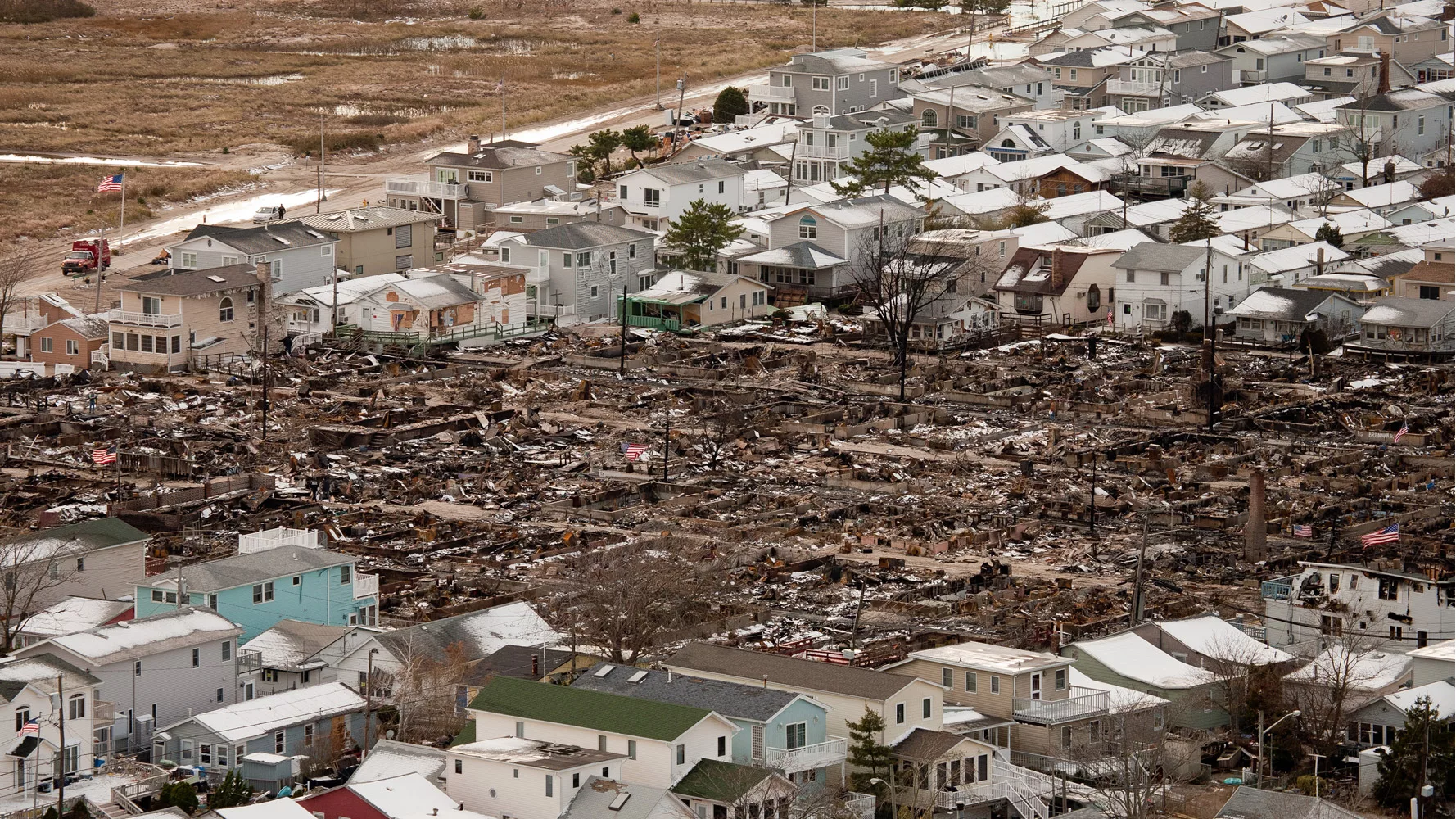
The CDRZ Act could help communities like Breezy Point, Queens, prepare for disasters. In 2012, the New York neighborhood was ravaged by fire as a result of Hurricane Sandy. Photo by Andrea Booher/FEMA

December 19, 2022

Earlier this month, Congress passed, with bipartisan support, legislation that will empower communities at heightened risk of natural disasters. Its goal is to help those places implement preventative measures and curb the impacts of future events. The Community Disaster Resilience Zones (CDRZ) Act amends the 1988 Stafford Act with a requirement that FEMA regularly update datasets that define natural hazard risk factors across the U.S., from flooding and extended droughts to wildfires and extreme heat, which will be leveraged to designate communities that are most in need. Notably, once signed into law, it will authorize the President to provide critical funding for pre-disaster planning.

Exactly how key measures of the Act will be implemented, or if federal criteria for what defines a community itself will be amended, are yet to be seen. Even so, many architects are applauding the bill’s passage as a watershed moment.

“It gives communities the ability to build capacity through pre-disaster mitigation adaptation, and ultimately, that’s the work of design professionals at the community level,” says Illya Azaroff, founder of Brooklyn-based resilience consulting firm +LAB. He also highlights the potential for architects to assist their own communities in developing public-private partnerships which could be used to fast-track infrastructure investments and consequently lessen those communities’ risk profiles. “That part is huge. We’re finally talking about people,” he says.

The Federal Emergency Management Agency (FEMA) has a reputation for showing up in the wake of natural disasters, notes Azaroff, rather than as a bulwark for at-risk communities who may lack the tools and wherewithal to adapt. And while the agency does maintain a National Risk Index, its data are derived from historic losses of real estate, infrastructure, and land mass, with minimal consideration given to matters of social and economic equity that can likewise determine a community’s risk assessment.

“It is abundantly clear that more must be done to help at-risk communities who, too often, bear the brunt of the impacts from climate change. The CDRZ Act will significantly help these communities receive the tools and resources they need to prepare their communities for the next major disaster,” says Emily Grandstaff-Rice, the recently inaugurated president of the American Institute of Architects.

Previously, the only significant pre-disaster mitigation program was FEMA’s BRIC (Building Resilient Infrastructure and Communities) program. “It's not enough money and it’s competitive to apply,” Azaroff says. “Although meaningful to the communities that get it, it's a drop in the bucket in comparison to what [CDRZ] designation might unlock funding for.”

When it comes to resiliency planning, rarely does conjecture lead to optimism. It’s often looked upon, somewhat cynically, as a zero-sum game. But the CDRZ Act could yield net positives. For example, the bill’s funding apparatus has enormous crossover potential with incentive programs that are baked into the Inflation Reduction Act (IRA), such as the scaling up of renewable energy resources like wind, solar, and geothermal, which are key to resiliency and equity efforts, especially at the local level. 

Looking for quick answers on architecture and design topics?
Try Ask RECORD, our new smart AI search tool.
Ask RECORD →

For some at-risk communities that pop the brightest on FEMA’s risk index map, the only real long-term resiliency strategy may be managed retreat. Low-risk cities, or so-called “Goldilocks” zones (not too hot, not too cold), could receive an influx of climate refugees within the next half century, placing an enormous strain on their infrastructure. Pre-disaster mitigation could take the form of upgrading and diversifying energy systems for such communities on the rise.

There is also the issue of how communities are categorized within FEMA’s Community Rating System (CRS), a voluntary program that encourages community floodplain management practices that exceed baseline requirements. As it stands, New York City is defined as one community, as are each of the eight Hawaiian Islands. But clearly each of these examples represents a vast composite of communities with diverse risk factors and resources. “Architects working in disaster resilience know that for many communities at repeated risk, financial or human capital may not be available,” says Grandstaff-Rice. To qualify as a Resilience Zone and obtain pre-disaster funding, smaller communities, public housing authorities and the like would benefit from the autonomy to advocate on their own behalf, based on the climate hazards knocking on their front door.  

The unknowns surrounding implementation of the CDRZ Act are numerous, but not insurmountable. This important step of equipping high-risk communities with a larger funding pipeline for pre-disaster mitigation, rather than post-disaster clean up, is undoubtedly cause for optimism.

KEYWORDS: natural disasters New York City resiliency

Share This Story

Looking for a reprint of this article?
From high-res PDFs to custom plaques, order your copy today!

Justin R. Wolf is a Minnesota-based writer who covers green building trends and energy policy.

Post a comment to this article

Report Abusive Comment

Subscription Center
  • Create an Account
  • Start a Subscription
  • Manage My Account
  • Sign Up for Newsletters
  • Visit Customer Service
  • Update Preferences

More Videos

Sponsored Content

Sponsored Content is a special paid section where industry companies provide high quality, objective, non-commercial content around topics of interest to the Architectural Record audience. All Sponsored Content is supplied by the advertising company and any opinions expressed in this article are those of the author and not necessarily reflect the views of Architectural Record or its parent company, BNP Media. Interested in participating in our Sponsored Content section? Contact your local rep!

close
  • cold storage facility
    Sponsored byCarlisle SynTec Systems

    How Architects Can Design More Continuous Cold Storage Envelopes

  • TAMLYN XtremeTrim Exterior Trim
    Sponsored byTamlyn

    Designing Cleaner Panel Facades: Why Exterior Trim Details Matter

  • Building with Vapor Barriers
    Sponsored byReef Industries, Inc.

    Vapor Barriers Help Control Moisture in Tighter Building Designs

DESIGN:ED Podcast
Listen to Architectural Record’s DESIGN:ED Podcast

Events

June 25, 2026

Designing Glass Railing Systems that Enhance Aesthetics and Meet Code

Credits: 1 AIA LU/HSW; 1 AIBD P-CE; 0.1 ICC CEU

Upon course completion, participants will possess a deeper understanding of glass railings to help ensure that safety, aesthetic, and performance objectives are achieved.

June 30, 2026

Generator Selection and Sizing for Outage-Ready Homes

Credits: 1 AIA LU/HSW; 1 AIBD P-CE; 0.1 ICC CEU

Explore how propane-powered systems and whole-home generators can improve energy resilience, reduce electrical loads, and lower long-term residential costs.

View All Submit An Event

Products

2026 Architect's Square Foot Costbook

2026 Architect's Square Foot Costbook

See More Products

Popular Stories

Lorcan O' Herilhy

California Architect Lorcan O’Herlihy Has Died, Age 66

Obama Presidential Center, Chicago

The Obama Presidential Center Opens on Chicago’s South Side

Spoonbill Ranch

Johnsen Schmaling Architects Integrates Spoonbill Ranch into a Pristine Landscape

Image of Bruce Springsteen Center for American Music

The CookFox-designed Bruce Springsteen Center for American Music Opens in New Jersey

Three Courtyards House

Design Vanguard 2026: Balsa Crosetto Piazzi

Designing Glass Railing Systems that Enhance Aesthetics and Meet Code - Free Webinar - June 25, 2026

Related Articles

  • LDF23 - Spirit of Place - Simone Brewster - Supported by Amorim - Credit Ed Reeve - 04.jpg

    London Design Festival Returns for 2023 Edition Focused on Environmental and Social Responsibility

    See More
  • Vietnamese–German University

    Outside of Ho Chi Minh City, Machado Silvetti Designs a Ground-Up University Campus Focused on STEM

    See More
  • AIA Passes Equity Resolution: Now What?

    See More

Related Products

See More Products
  • Architectural Record - January 2026

    Architectural Record January 2026 Issue

See More Products
×

The latest news and information

#1 Source for Architectural Design, News and Products

SUBSCRIBE
  • RESOURCES
    • Advertise
    • Contact Us
    • Submit
    • Store
  • ACCOUNT CENTER
    • Create an Account
    • Start a Subscription
    • Manage My Account
    • Sign Up for Newsletters
    • Visit Customer Service
    • Update Preferences
  • PRIVACY
    • PRIVACY POLICY
    • TERMS & CONDITIONS
    • DO NOT SELL MY PERSONAL INFORMATION
    • PRIVACY REQUEST
    • ACCESSIBILITY
  • SERVICES
    • Marketing Services
    • Reprints
    • Market Research
    • List Rental
    • Survey/Respondent Access
  • STAY CONNECTED
    • Linkedin
    • Facebook
    • Instagram
    • YouTube
    • X (Twitter)

Copyright ©2026. All Rights Reserved BNP Media, Inc. and BNP Media II, LLC.

Design, CMS, Hosting & Web Development :: ePublishing