Architectural Record
search
cart
facebook twitter linkedin youtube
  • Sign In
  • Subscribe
  • Sign Out
  • My Account
Architectural Record
  • NEWS
    • Latest News
    • Awards
    • Interviews
    • Obituaries
    • Podcasts
      • Design:Ed Podcast
      • Sponsored Podcasts
  • OPINION
    • Book Reviews / Excerpts
    • Exhibition Reviews
    • Forum
  • EXCLUSIVES
    • Videos
    • Design Vanguard
    • Top 300 Firms
    • Sponsored Content
    • Sponsored eBooks
    • From the Archives
  • CONTINUING ED
    • Editorial Continuing Ed
    • CE Center
    • CE Academies
  • PROJECTS
    • Buildings By Type
    • Reuse & Renovation
    • Museums & Arts Centers
    • Colleges & Universities
    • Multifamily Housing
    • Interiors
    • Lighting
    • Kitchen & Bath
  • HOUSES
    • Record Houses
    • House of the Month
    • Featured Houses
  • PRODUCTS
    • Products by Category
    • Record Products of the Year
    • Latest Products
  • EVENTS
    • Dates & Events
    • Record on the Road
    • Innovation Conference
    • Sustainability in Practice
    • Women In Architecture
    • Webinars
    • Ad Excellence Awards
    • Submit an Event
  • CONNECT
    • Ask RECORD AI
    • Newsletters
    • Contact
    • Advertise
    • Editorial Calendar
    • Store
    • Customer Service
  • SUBMIT
    • Submission Guidelines
    • RECORD Competitions
  • MAGAZINE
    • Subscribe
    • My Account
    • Digital Edition
    • Current Issue
    • Firm Pass
    • Historic Archive
ProjectsBuildings by TypeColleges & Universities

A Modulated Glass Facade Brings Together Wide-Ranging Uses at NYU

By Matthew Marani
John A. Paulson Center
The John A. Paulson Center. Photo © Connie Zhou / JBSA
March 8, 2023

Architects & Firms

Davis Brody Bond
KieranTimberlake
✕
Image in modal.

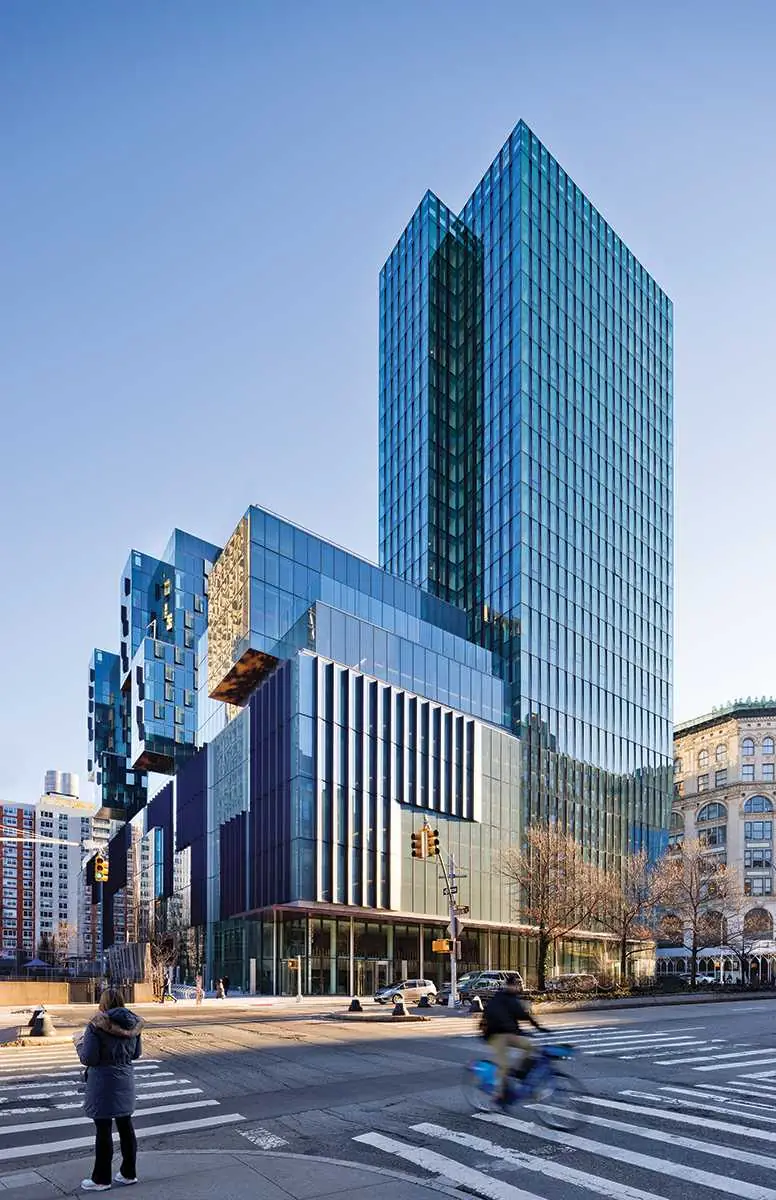
The John A. Paulson Center, designed by Davis Brody Bond and Kieran­Timberlake, is hard to miss. The 735,000-square-foot structure is the latest addition to New York University’s Washington Square Park–area campus in Manhattan, and commands a block-long site at the border of the SoHo and Greenwich Village historic districts.

It replaces the Coles Sports and Recreation Center, a squat, one-story concrete structure built in 1981. The project’s goals were to consolidate previously dispersed school programs in a single location and create much-needed student and faculty housing, along with classrooms, state-of-the-art athletic facilities, and performance spaces, including three theaters and a music-recital hall.
John A. Paulson Center.

The massing of the 735,000-square-foot building is organized as several volumes, according to program (above and top of page). Photo © Connie Zhou / JBSA, click to enlarge.

If that programmatic complexity sounds challenging, that’s because it is, and a great conundrum for the design team was how to bridge those many functions in a legible manner. The massing is formidable, though broken up into multiple segments: the Paulson Center includes a five-story academic podium enclosing the classrooms and the performance spaces, a dining hall, and other uses. Rising from that base is an 18-story tower containing 42 faculty apartments and a more than 400-bed student dormitory in three interconnected shorter volumes.

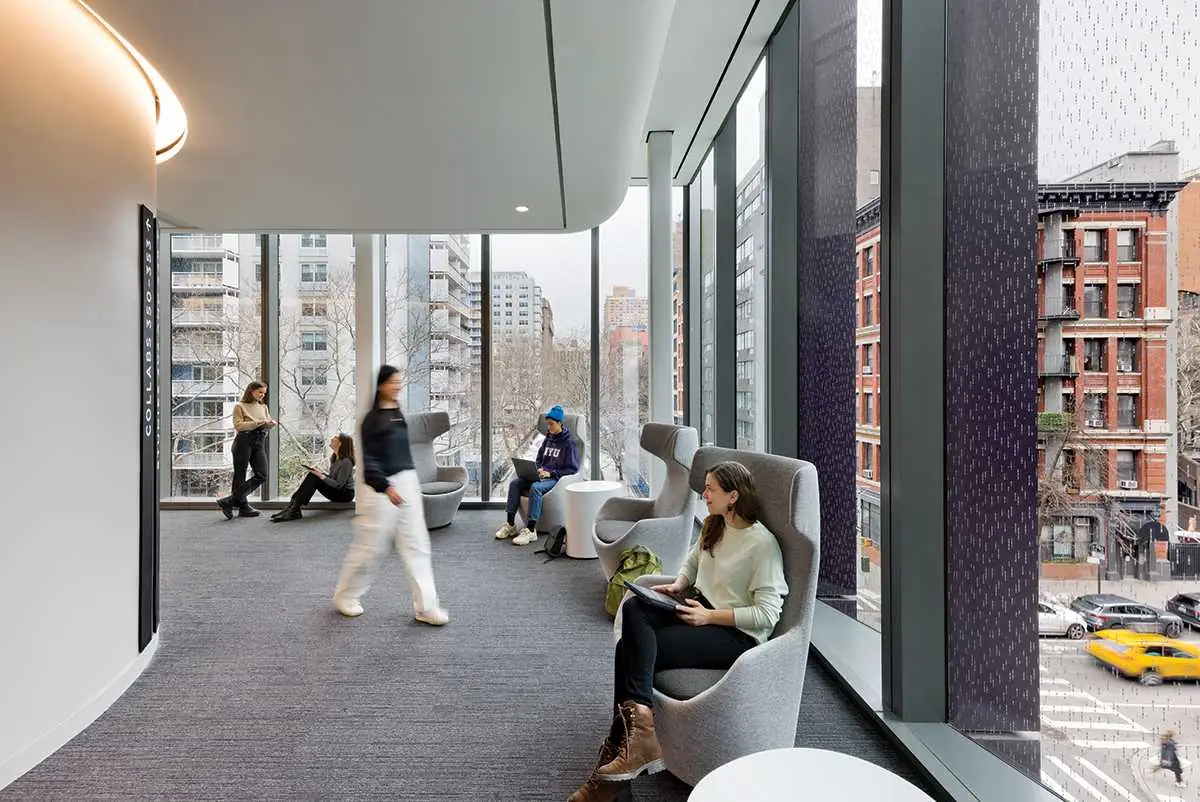
Early in the design process, the architects proposed moving primary circulation to the perimeter of the building and placing the programmatic elements within the interior. That organization “gives everyone access to natural light and views, no matter what space you are headed to, and an intuitive sense of where you are relative to the city and within the building,” says Richard Maimon, Kie­ranTimberlake partner.

John A. Paulson Center.

Pulling the program elements away from the perimeter allows for circulation and social spaces with views and access to daylight. Photo © Connie Zhou / JBSA

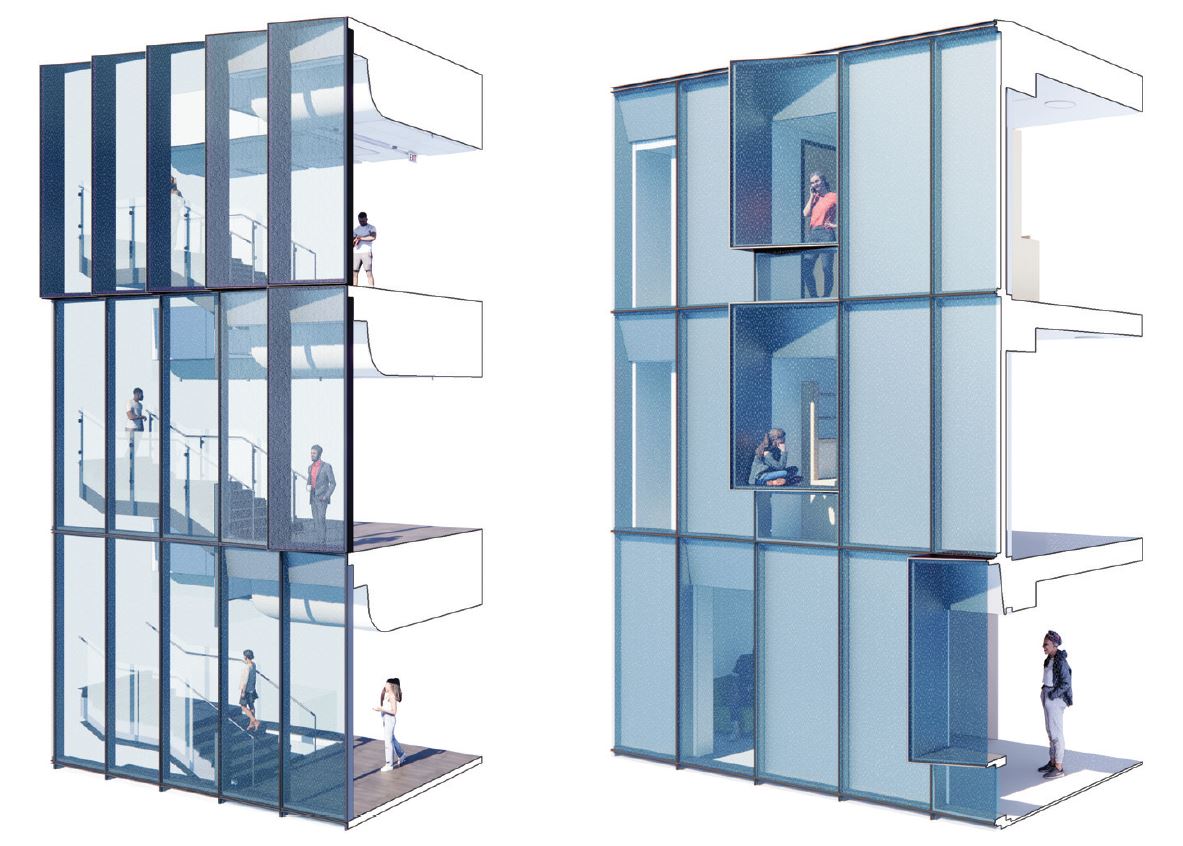
Expansive glazing was the primary means to achieve that level of transparency. With it came the challenges of heat gain and bird-strikes; the expertise of facade consultant Heintges proved critical in mitigating those problems. One solution was to arrange the facade units at some locations in a sawtooth configuration to reduce solar exposure across the podium. The resulting “wedge” modules, comprising angled glass and, to block solar gain from the south without impeding views, an opaque metal panel oriented 90 degrees to the slab edge. The strategy, which was also used to create niches like bay windows in the student-housing towers, provides scale, texture, and articulation that nod to the gridded elevations of the adjacent Brutalist Silver Towers, a late 1960s residential complex by I.M. Pei, and surrounding late 19th and early 20th-century terra-cotta and brick-clad structures.
John A. Paulson Center.

The skin includes wedge-shaped panels at the podium (above, left) and the bay windows for the dorms (above, right).

The insulated-glass units are treated with several different coatings. The podium, which is partially shaded by the surrounding buildings, relies on a low-E coating that maximizes visible-light transmittance, while the student and faculty towers, which have greater solar exposure, have a higher-performing coating applied to them that reduces ultraviolet and infrared light.

The problem of solar gain is also partly offset through the use of fritted glass, with an eye-catching design by Pentagram that varies in density across the facade, depending on orientation. Areas with more exposure, such as the southwest elevation, have a greater frit density. In addition, the frit also serves as a relatively cost-neutral means to reduce bird strikes and helps the building comply with 2020 city law requiring bird-friendly glazing. The 5 percent frit density results in a “threat factor” between 15 and 20, notes Heintges principal Jessica Young. A threat factor below 30 is considered bird-friendly.

Looking for quick answers on architecture and design topics?
Try Ask RECORD, our new smart AI search tool.
Ask RECORD →

The curtain wall units, fabricated by Per­ma­steelisa, all measure 4½ feet wide and vary from 10 feet to 20 feet tall. For the most part, the curtain wall systems are fastened to the floor above, at the slab edge, but, at the podium, the panels are directly held to the structural steel.

The Paulson Center opened its doors this spring semester. With its dynamic facade design, and sheer scale and programmatic complexity, it will shape this corner of Mercer and Houston streets for decades to come.

Credits

Architects:
Davis Brody Bond; KieranTimberlake

Consultants:
Heintges Consulting Architects Engineers (envelope); Langan Engineering and Environmental Services (civil); Bard, Rao + Athanas Consulting Engineers (m/e/p); Severud Associates (structural); Spacesmith (FF&E)

Construction Manager:
Turner Construction Company

Client:
New York University

Size:
735,000 square feet

Cost:
$1.2 billion

Completion Date:
January 2023


Sources

Curtain Wall:
Permasteelisa North America

Insulated Metal Panels:
Metl-Span

Glazing:
BGT with Interpane coatings


KEYWORDS: New York City

Share This Story

Looking for a reprint of this article?
From high-res PDFs to custom plaques, order your copy today!


Matthew marani

Matthew Marani is a senior editor at Architectural Record. Previously, he served as program manager at The Architect’s Newspaper and has several years of experience as a freelance writer specializing in urban planning, historic preservation, and architectural technology. Matthew is a born and raised New Yorker and holds an MSc in Architectural Conservation from the University of Edinburgh.

Post a comment to this article

Report Abusive Comment

Subscription Center
  • Create an Account
  • Start a Subscription
  • Manage My Account
  • Sign Up for Newsletters
  • Visit Customer Service
  • Update Preferences

More Videos

Sponsored Content

Sponsored Content is a special paid section where industry companies provide high quality, objective, non-commercial content around topics of interest to the Architectural Record audience. All Sponsored Content is supplied by the advertising company and any opinions expressed in this article are those of the author and not necessarily reflect the views of Architectural Record or its parent company, BNP Media. Interested in participating in our Sponsored Content section? Contact your local rep!

close
  • TAMLYN XtremeTrim Exterior Trim
    Sponsored byTamlyn

    Designing Cleaner Panel Facades: Why Exterior Trim Details Matter

  • Building with Vapor Barriers
    Sponsored byReef Industries, Inc.

    Vapor Barriers Help Control Moisture in Tighter Building Designs

  • Duct Interior with Prodeq System
    Sponsored byHenry, a Carlisle Company

    Designing Resilient Water Containment Systems

DESIGN:ED Podcast
Listen to Architectural Record’s DESIGN:ED Podcast

Events

June 10, 2026

Rethinking Stormwater – The Power of Porous Paving

Credits: 1 AIA LU/HSW; 1 AIBD P-CE; 0.1 ICC CEU

Learn how porous paving systems support stormwater management, reduce heat island effects, and enhance sustainable site design performance.

June 11, 2026

Very Early Warning Fire Detection for Mission-Critical Facilities

Credits: 1 AIA LU/HSW; 1 AIBD P-CE; 0.1 ICC CEU

Examine advanced fire detection strategies that support uptime and enhance safety in data centers and other mission-critical facilities.

View All Submit An Event

Products

2026 Architect's Square Foot Costbook

2026 Architect's Square Foot Costbook

See More Products

Popular Stories

Coronado Bridge

The Architect’s Guide to San Diego

Practice Matters illustration

What’s in a (Firm’s) Name? Thinking About Succession and Legacy

Practice Matters illustration

By the Numbers: Counting America's Architects

Inward House

Inward House by VeeV Design Studio

Riverdale House by Studio Lau

Riverdale House by Studio Lau

Broader Sustainability of CMU - Free Webinar - May 21, 2026

Related Articles

  • Twenty Two New York

    A Manhattan Boutique Hotel’s Restored Facade and Lacelike Gable Complement a Historic District

    See More
  • Exterior image of UWM Chemistry Building

    A New Chemistry Building at the University of Wisconsin-Milwaukee Champions Transparency

    See More
  • ECoRE

    Payette’s Engineering Facility at Penn State Strengthens Interdisciplinary Research

    See More

Related Products

See More Products
  • Architectural Record - August 2025

    Architectural Record August 2025 Issue

See More Products

Events

View AllSubmit An Event
  • June 16, 2026

    Focus on the Façade: Exploring Steel, Timber & Fire-Rated Curtain Walls and Channel Glass Systems

    Credits: 1 AIA LU/HSW; 1 AIBD P-CE; 0.1 ICC CEUExplore modern façade and glazing systems that enhance daylighting, fire safety, and thermal performance while expanding architectural design possibilities.
  • May 13, 2026

    Steel and Wood Together? Really? How Mass Timber Turns This Combination Into a Winning Strategy

    NOW ON DEMANDCredits: 1 AIA LU/HSW; 1 AIBD P-CE; 0.1 ICC CEU; 1 PDHDiscover how combining mass timber and steel can optimize structural performance, fire safety, and carbon outcomes in modern building design.
View AllSubmit An Event
×

The latest news and information

#1 Source for Architectural Design, News and Products

SUBSCRIBE
  • RESOURCES
    • Advertise
    • Contact Us
    • Submit
    • Store
  • ACCOUNT CENTER
    • Create an Account
    • Start a Subscription
    • Manage My Account
    • Sign Up for Newsletters
    • Visit Customer Service
    • Update Preferences
  • PRIVACY
    • PRIVACY POLICY
    • TERMS & CONDITIONS
    • DO NOT SELL MY PERSONAL INFORMATION
    • PRIVACY REQUEST
    • ACCESSIBILITY
  • SERVICES
    • Marketing Services
    • Reprints
    • Market Research
    • List Rental
    • Survey/Respondent Access
  • STAY CONNECTED
    • Linkedin
    • Facebook
    • Instagram
    • YouTube
    • X (Twitter)

Copyright ©2026. All Rights Reserved BNP Media, Inc. and BNP Media II, LLC.

Design, CMS, Hosting & Web Development :: ePublishing