Building Technology November 2025
Payette’s Engineering Facility at Penn State Strengthens Interdisciplinary Research
State College, Pennsylvania

Architects & Firms
Nationwide, students are enrolling in STEM-related higher-education programs in greater numbers than previously. At Penn State University, over 50 percent of the student body is matriculating through such courses of study. To accommodate this swelling population, Penn State, like other schools, is outlaying vast capital to build state-of-the-art facilities that will house laboratories and classrooms. The Engineering Collaborative Research and Education Building (ECoRE), designed by Boston-based Payette, is the latest addition to the campus. The project’s inventive and flexible layout is intended to encourage interdisciplinary collaboration, all while reducing the gargantuan energy load typical of this typology through its well-tuned building systems.
Payette’s relationship with Penn State goes back to 2018, when the university commissioned the firm to develop a two-phase master plan for the College of Engineering, within the southwest corner of the campus. In 2019, the school bid out phase one of the master plan, two of four buildings proposed by Payette. The firm joined the competition and was ultimately commissioned for both edifices—the Engineering Design and Innovation Building, located across a newly landscaped quad and completed in 2023, and ECoRE, which opened its doors fall 2024.
STEM-related projects comprise an overwhelming share of Payette’s body of work, and the firm draws on that expertise to maximize the lifespans of what are disproportionately large capital investments. “Many schools are now grappling with lab facilities built half a century ago, and the bones of these buildings are constrained and unable to support generational adaptability,” Payette principal Jeffrey DeGregorio explains. “Those with open spaces and higher floor-to-floor heights, which can be updated with the latest technologies, are more likely to stand the test of time.”
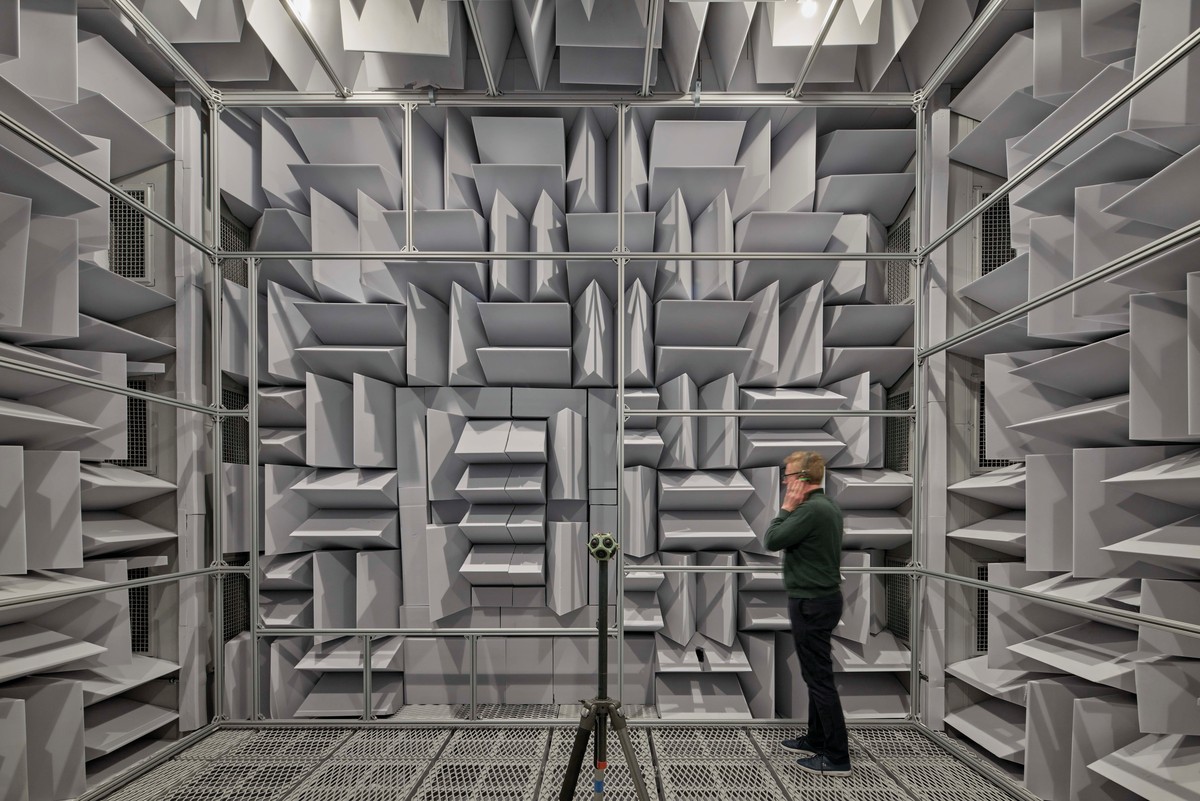
Social hubs and labs are within (above and top of page). Photo © Robert Benson, click to enlarge.
The 283,000-square-foot project is now the main hub for the College of Engineering, which counts some 11,000 students and 3,000 faculty. Five stories tall, with an L-shaped footprint, it is made up of a superstructure of steel framing and composite slabs (25 percent of the floor plates are poured-in-place concrete). The bulk of the building, with its labs, classrooms, and offices, is clad in reddish-brown brick, while its campus-facing bar is enveloped in glass and copper-anodized aluminum panels and fins.
The latter portion, oriented to the southeast, is called the Vertical Campus Commons, and it is the primary entrance and gathering space as well as means of circulation. Within, it contains a five-story atrium that reaches down to the basement level, ringed by daylit study and meeting areas. At the atrium’s center, a two-story volume enveloped in white oak panels hovers conspicuously—it is suspended by six hollow structural sections from two steel box girders at the roof level—to house a set of flexible classrooms. Its base, on the second floor, comprises a coffered ceiling formed of orthogonal ribs and triangular panels, with linear light fixtures.
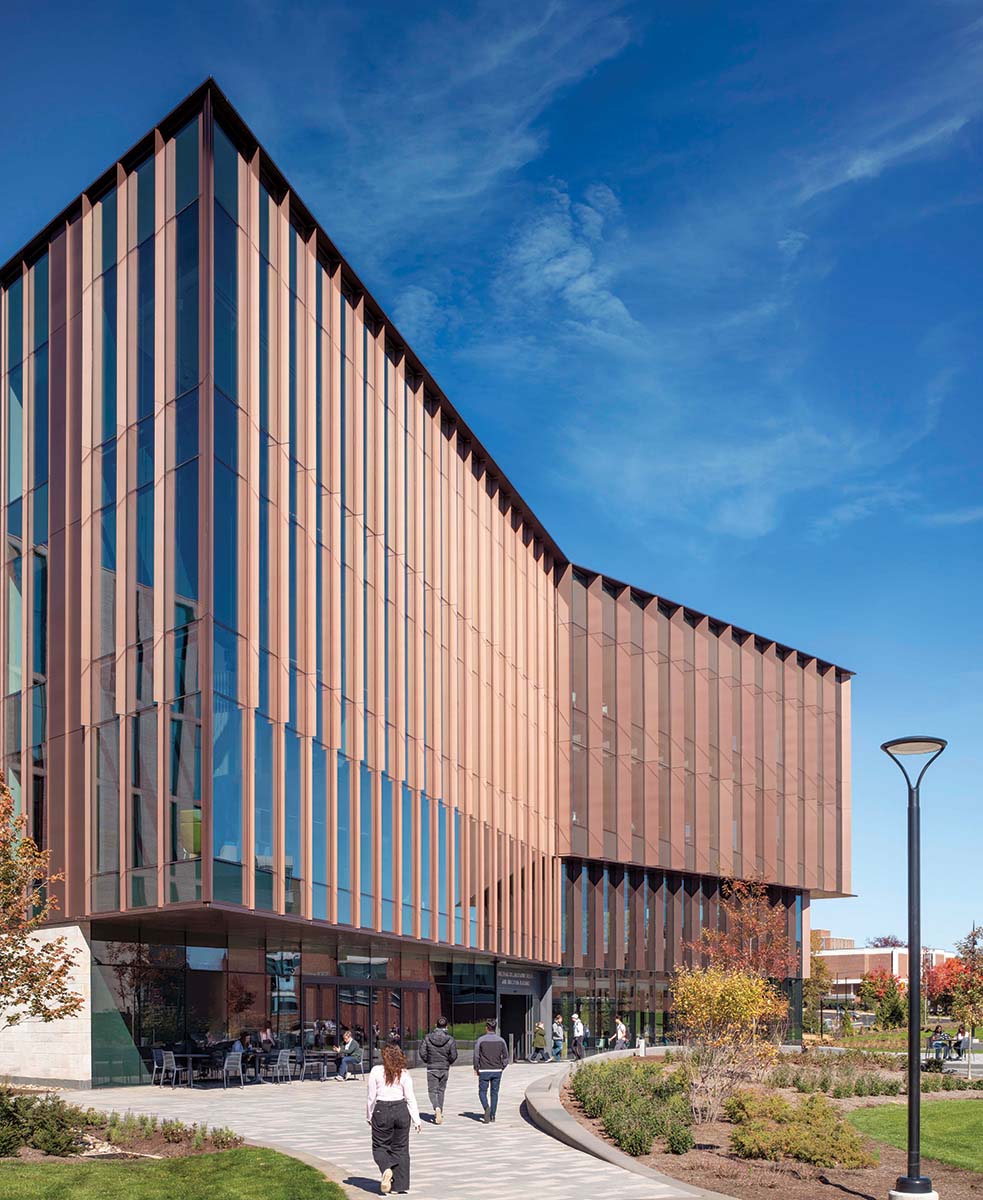
The entrance faces campus. Photo © Warren Jagger
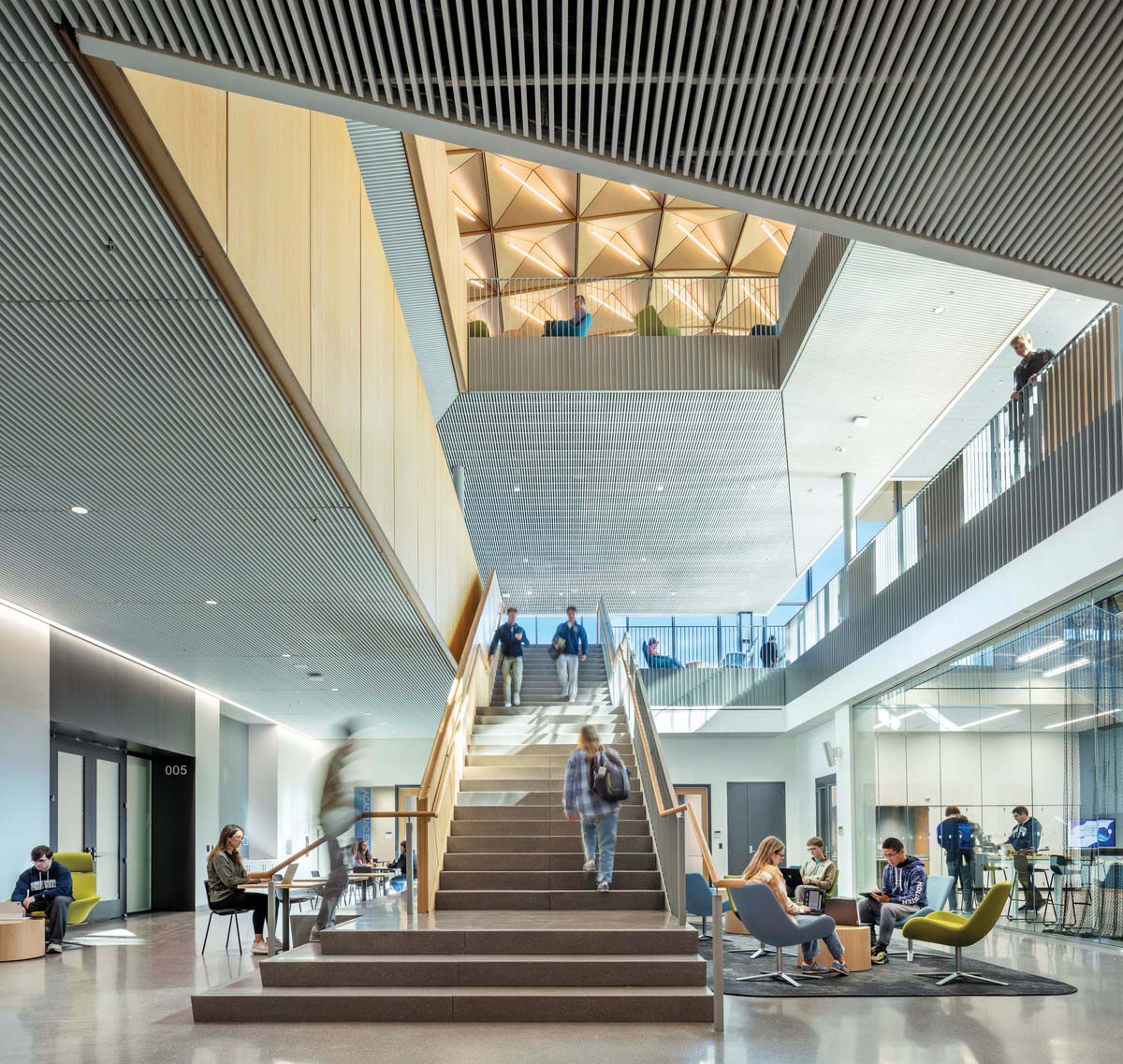
An atrium provides circulation. Photo © Warren Jagger
Fifty research bays are placed throughout the building. Low vibration in the basement makes it suitable for specialty labs such as wind tunnels, anechoic chambers, structural research, flight simulation, and, notably, a 27,000-cubic-foot facility for testing the ability of rotorcraft to deal with ice. Above grade, there are typically 10 labs per floor, each with 15-foot ceilings, forming the spine of ECoRE. While spaces are grouped thematically to support different programs, they are designed to promote interdepartmental use.
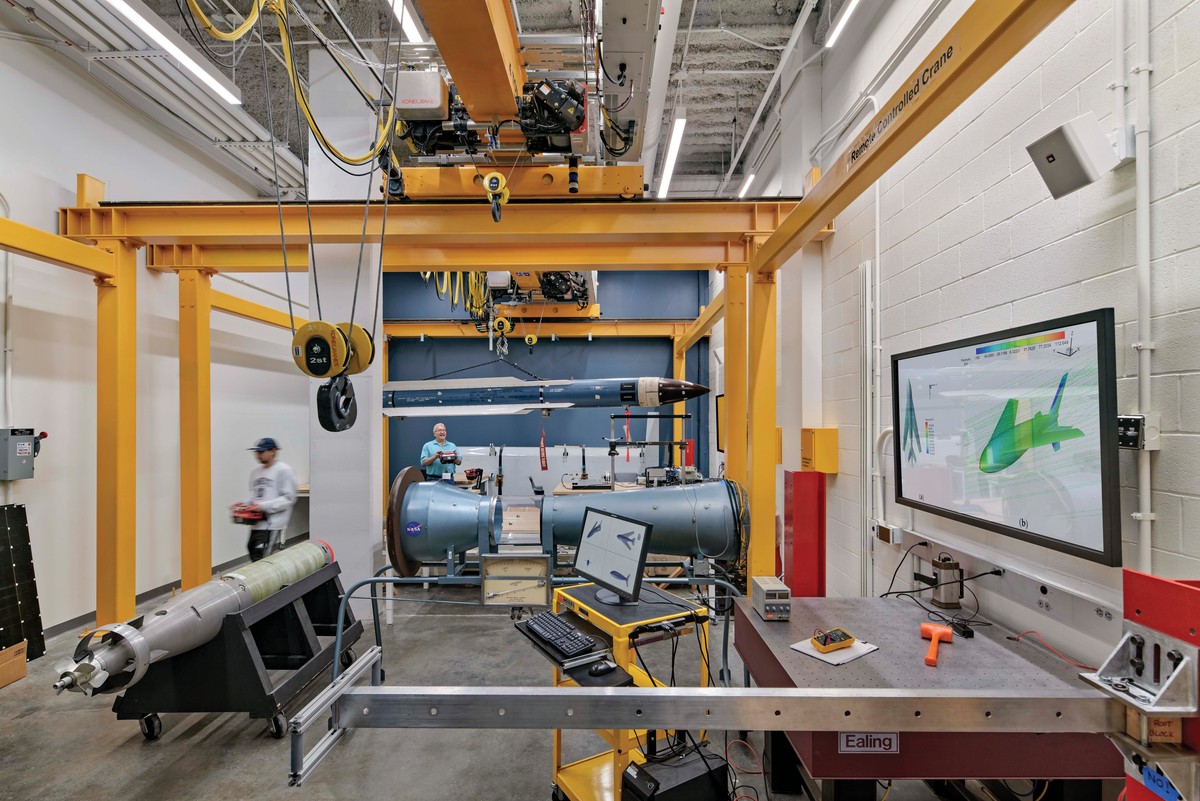
Specialty labs are in the basement. Photo © Robert Benson
“We embraced the premise of access and flexibility over time,” says Mark Oldham, a principal at Payette. “Today, a space used for civil engineering could easily be harnessed for robotics or acoustic engineering tomorrow.” To that effect, the labs are left open and spare, with exposed mechanical systems and few finishes. Overhead, the design team installed a flexible ceiling-grid system, where students and faculty can easily attach almost anything, be it lighting systems or lab equipment.
Looking for quick answers on architecture and design topics?
Try Ask RECORD, our new smart AI search tool.
Ask RECORD →
With the programmatic and spatial needs of faculty offices being far less demanding than that of labs and classrooms, the design team could make clever use of skip-stop floors on the north elevation. There, three-story wings of offices, each with 10-foot floor-to-floor heights, are paired with two levels of labs. Thirty-foot-tall lounges, daylit by large expanses of glazing, are placed at the intersections between the building corridors and the skip-stop staircases; this arrangement reduces the space needed for circulation and conveyance. The design team estimates that this shaved 20 percent off the structure’s square footage and decreased the facade’s surface area by 30 percent.
Lab facilities, with their complex equipment and mechanical systems, commonly use vast amounts of energy. But ECoRE counts an energy-use intensity of just 59 kBtu/sf, which is 68 percent less than the AIA 2030 baseline for this typology. Those savings were achieved by numerous strategies, including the recovery of waste heat to warm intake air and water; the transfer of conditioned air from low-intensity to high-intensity spaces; demand-controlled ventilation that responds to CO₂ levels and other inputs; and daylight and occupancy lighting sensors. Additionally, the building is connected to the campus-wide recycled-water system, reducing consumption by over 50 percent. As a result of these strategies, the structure is currently on track to receive LEED Gold certification.
The scale and complexity of a project like ECoRE could easily overwhelm students and researchers, and such facilities could feel impersonal and sterile. Yet Payette has delivered a thoughtfully conceived and high-performing building—one that successfully integrates welcoming communal spaces and dynamic programming throughout.

Image courtesy Payette
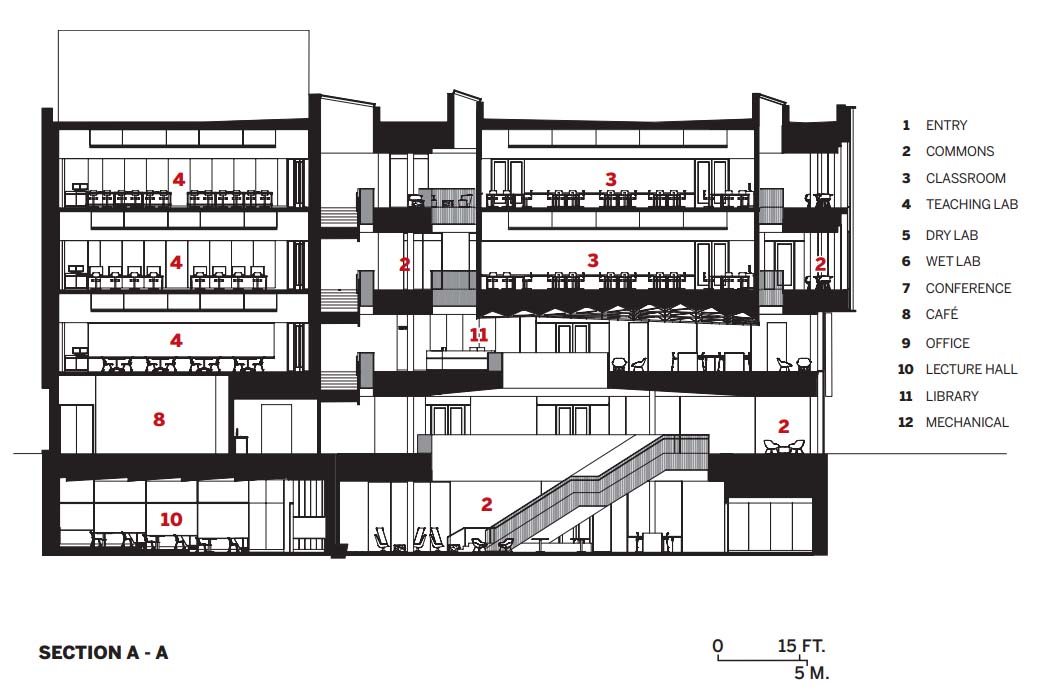
Image courtesy Payette
Credits
Architect:
Payette — Jeffrey DeGregorio, principal in charge; Mark Oldham, principal; Ryan Murphy, project architect; Philippe Généreux, project manager
Engineers:
Arup (m/e/p, structural); HRG (civil)
Consultants:
Studio NYL (facade); Lamar Johnson Collaborative (landscape, FF&E)
General Contractor:
Whiting-Turner
Client:
Penn State
Size:
283,100 square feet
Cost:
Withheld
Completion Date:
June 2024
Sources
Exterior Cladding:
Endicott (masonry); Metalwërks (metal panels); Tremco (moisture barrier)
Acoustical Ceilings:
Armstrong
Plumbing:
Sloan
Looking for a reprint of this article?
From high-res PDFs to custom plaques, order your copy today!