A New Chemistry Building at the University of Wisconsin-Milwaukee Champions Transparency
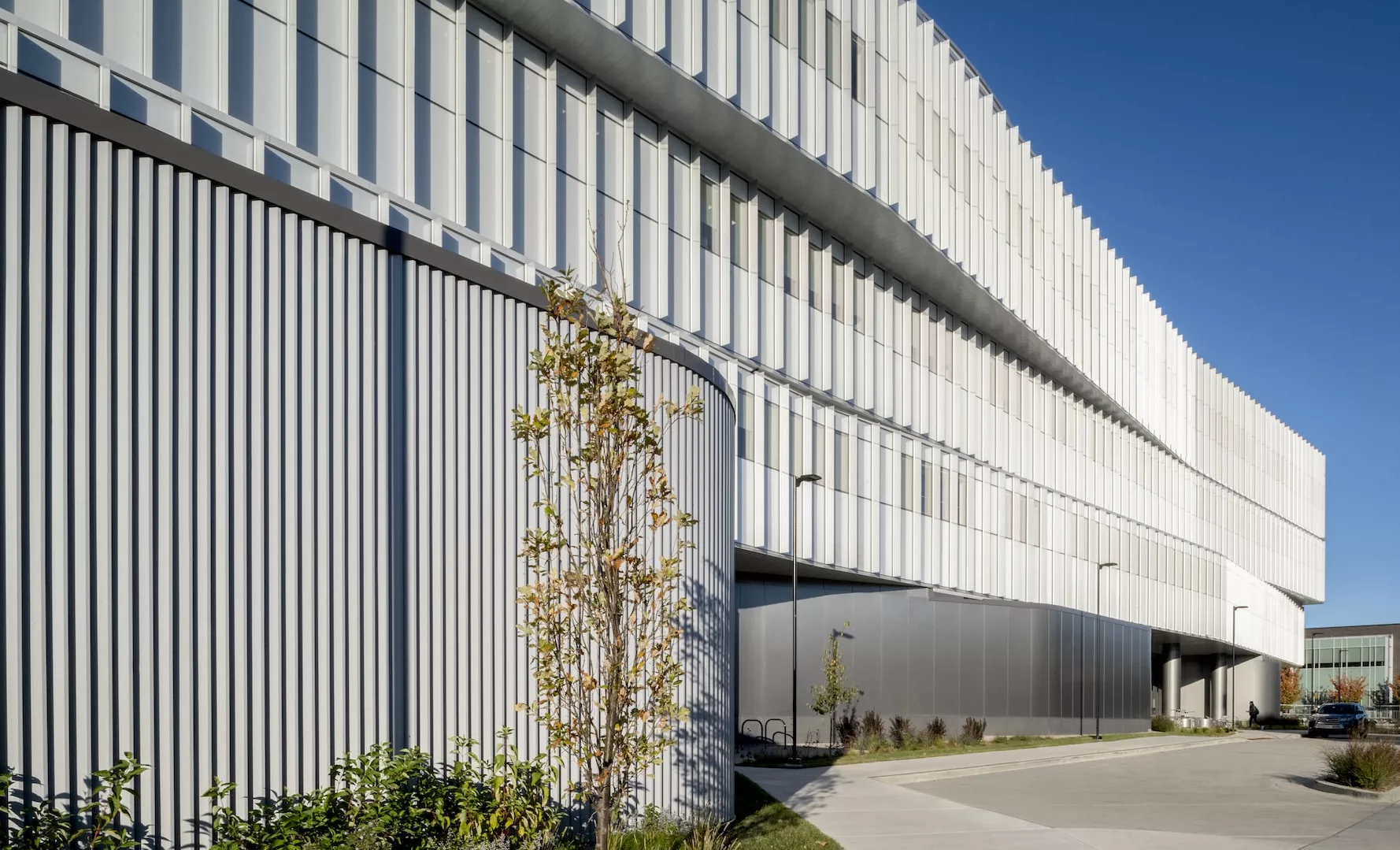
The CannonDesign and Kahler Slater-designed building houses the UWM Department of Chemistry and Biochemistry. Photo © Laura Peters/CannonDesign
Designing and building a research lab is a process full of technical complexity; even more so when that structure is also home to classrooms and serves as a gateway to a larger university campus. The University of Wisconsin-Milwaukee’s (UWM) Chemistry Building, designed by CannonDesign and local firm Kahler Slater does all of that. Completed in Fall 2024, it announces itself to the abutting Upper East Side neighborhood with a graceful, undulating aluminum-and-glass facade.
The 163,400 square-foot building replaces UWM’s existing chemistry facility dating from 1972. Now under demolition, that structure, like many from that era, had an inflexible program, low floor-to-floor heights, and a poorly performing, nearly windowless, exterior envelope. The university and the design team considered renovating it, but, with those myriad flaws in mind, decided such a remedial course would be a poor use of capital investment.

The ground floor includes an expansive lobby and a grand stair. Photo © Laura Peters/CannonDesign
“UWM is a top research university, and the school is trying to promote its science programs,” says CannonDesign vice president Michael Kmak. “The existing building couldn’t fulfill that goal and was failing to attract students and engage with the larger academic community; it also didn’t help that research and instruction were happening in the same rooms.”
The new four-story structure, topped by a mechanical penthouse, is, with its long, staggered, form, intended to resemble lattice proteins. Its street-facing, primary facade is positioned to the south, and students and faculty enter its 20-foot-tall ground floor though an off-centered portal. There, they encounter curving and amply daylit communal areas, and the hall’s two lecture auditoriums—both of which are fitted with wood-paneled ceilings and are expressed externally by protrusions from the building volume.

1

2
There are two lecture auditoriums (1); hallways feature seats and nooks for gathering (2). Photos © Laura Peters/CannonDesign
A grand stair leads to the second floor, where, like the levels above, classrooms and research labs alternate across the floorplate. The DNA-like massing of the structure also supports placemaking within, allowing room for alcoves and spheres of informal gathering. Underfoot, the floor palette ranges from porcelain tiles and stone and wood looks to vinyl sheets in the labs and carpet in classrooms and offices.
Chemistry buildings are often bunker-like, but here, the design team pushed for a high-level of transparency. That approach is exhibited at the building exterior, with rows of glazing studding the finned, enclosure system, and inside, in the form of expansive hallway windows providing a front-row seat to chemists and researchers at work—the 80 hood vents throughout the building are also visible to further this effect.
“The faculty were not initially eager to embrace this new format, which is not the norm,” notes Kahler Slater principal Koby Scheel. “Now that they’re in the building, we hear regularly how they love the connection to the outdoors and the quality of light in the labs.”
Looking for quick answers on architecture and design topics?
Try Ask RECORD, our new smart AI search tool.
Ask RECORD →

3

4
The classrooms and labs are abundantly daylit (3). There are 80 hood vents throughout the structure (4). Photos © Laura Peters/CannonDesign
The lab infrastructure is left exposed to both highlight the program and to permit straightforward maintenance and long-term flexibility. Designing and routing the complex web of ventilation, both for outtake and intake of various gases, plumbing for different grades of water, electrical work, and more, to support the building’s labs was a complicated affair. “It’s critical to understand all components associated with the infrastructure systems that will require access,” says Jason Atkisson, principal of Affiliated Engineers, which served as MEP engineer on the project.
Once the old chemistry facility comes down, it will be replaced by a new, landscaped quad linking various STEM-related programs on campus. Until then, UWM’s new $118 million Chemistry Building will welcome the next generation of students and faculty to Milwaukee.

The Chemistry Building serves as a gateway to the UWM campus. Photo © Laura Peters/CannonDesign
Looking for a reprint of this article?
From high-res PDFs to custom plaques, order your copy today!