DesignLAB Architects' Quinnipiac University Health and Wellness Center Considers the Body and Mind
Hamden, Connecticut
Architects & Firms
College campuses are reckoning with a mental-health crisis. According to an annual survey by the Healthy Minds Network, which examines collected data regarding mental health, service utilization, and related issues among undergraduate and graduate students from 373 campuses nationwide, more than 60 percent of students met criteria for one or more mental-health problems in 2020–21, nearly 50 per-cent more than 2013. Students are not only grappling with daily challenges like coursework and relationships, they are also confronting the issues of our time, including social injustice, mass violence, and the aftermath of the pandemic. The tolls are individual and collective, psychological and physical. The administrators of Quinnipiac University in Hamden, Connecticut, believes this requires holistic treatment, leading them to create a new center that brings together clinical care, counseling, and recreation under one roof in support of physical and mental well-being.
The university selected designLAB architects, a Boston-based firm with experience in civic, cultural, and educational work, to design the new 55,000-square-foot Health and Wellness Center as a home for campus health services, a space for a newly initiated healthy-living program to support cooking, nutrition, and lifestyle education, and a recreation-focused addition.
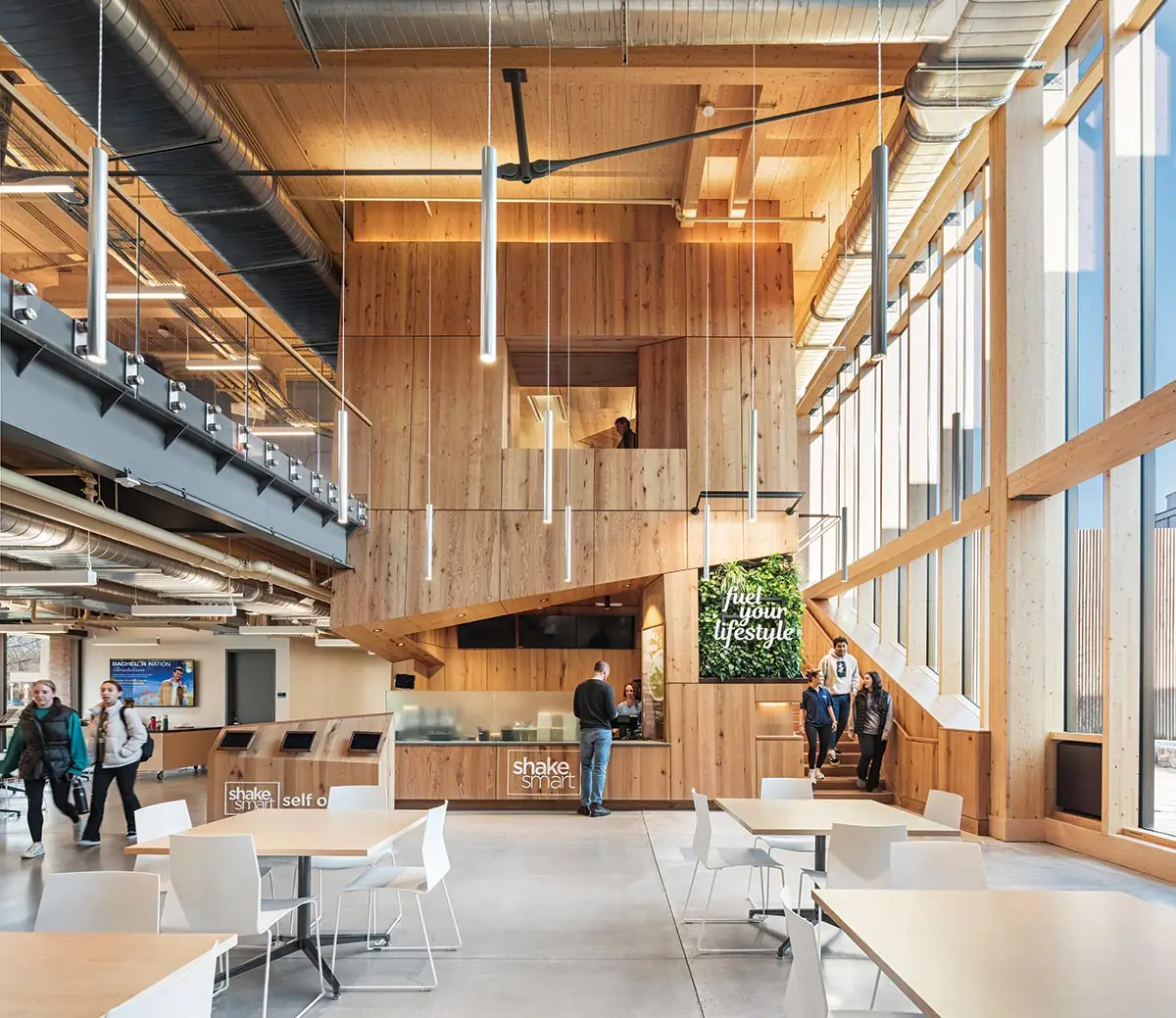
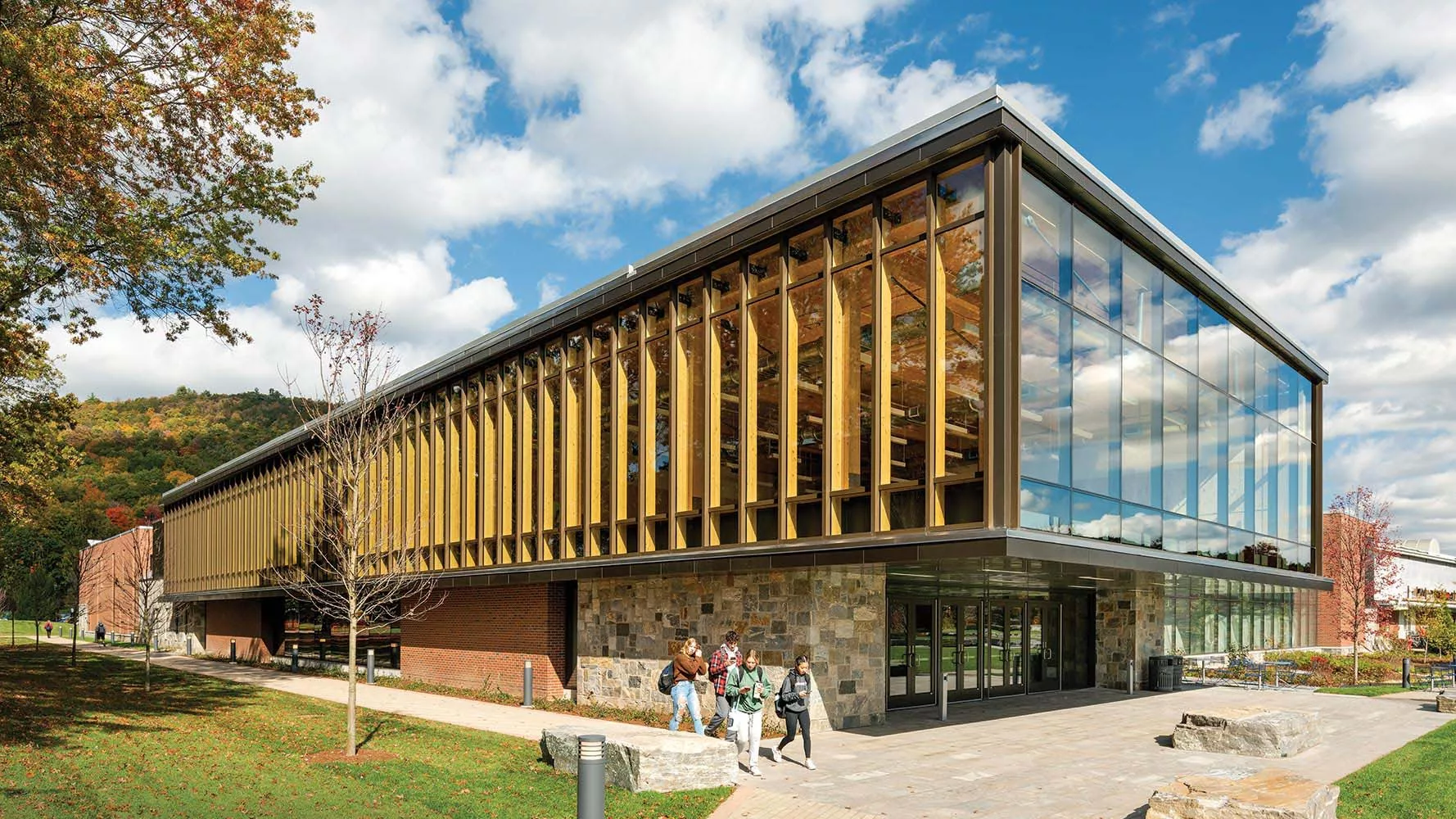
Timber, the main building material, combines with brick and local granite on the exterior (top of page) and reappears in the lobby (above). Photo © Anton Grassl, click to enlarge.
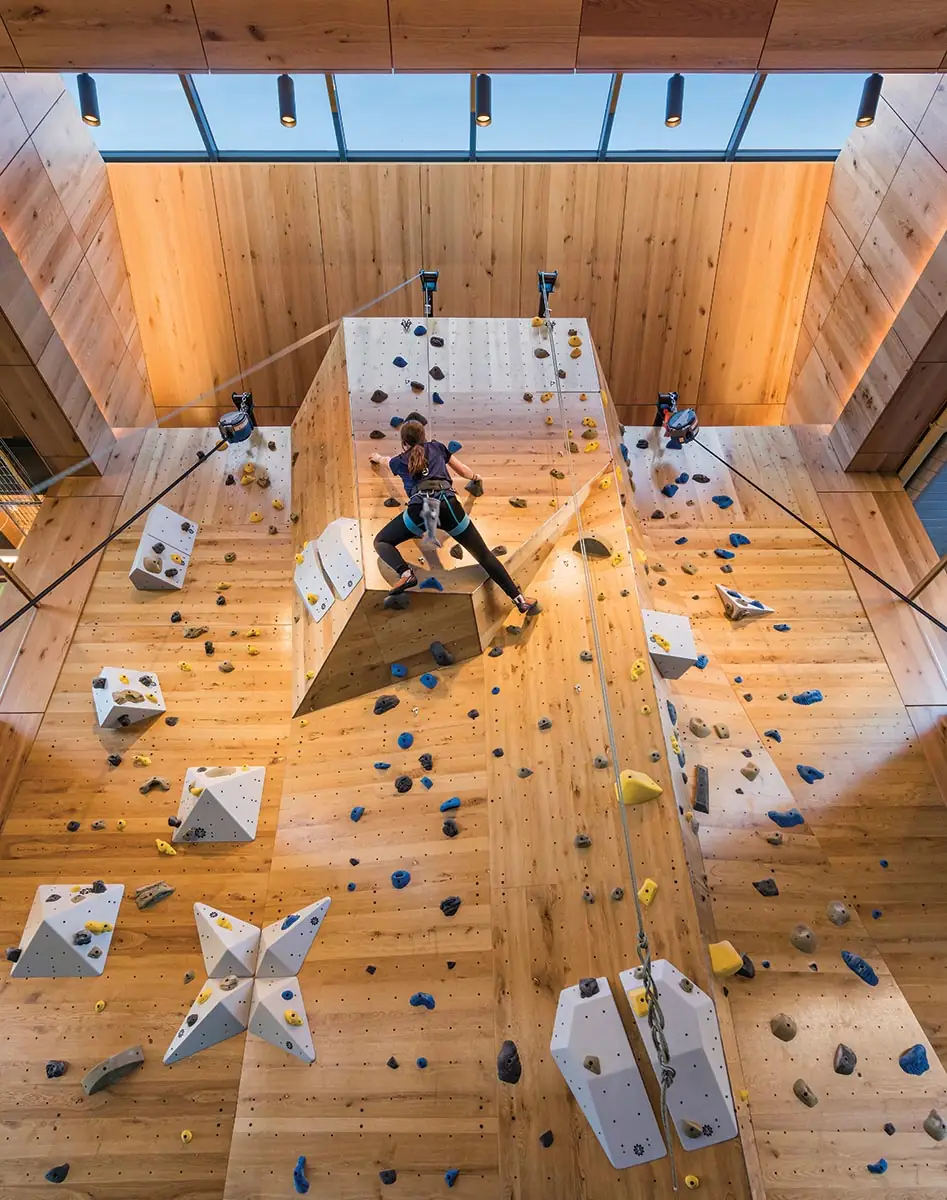
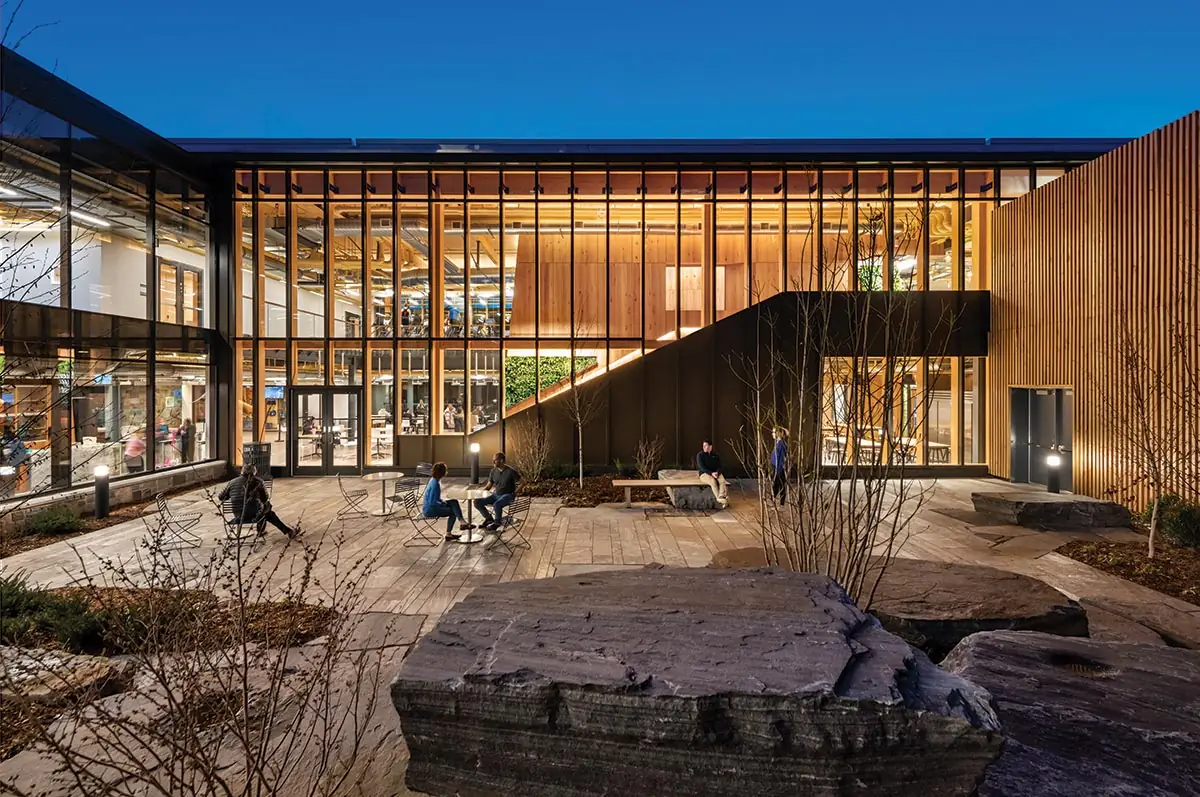
“It’s amazing how much was built with the ‘If you build it, they will come’ mentality,” says designLAB principal in charge Sam Batchelor. The social and emotional components of the building are, literally, at its core, and many of those elements were envisioned and added during the design process, including multiple flex spaces, a teaching kitchen, and a two-story climbing wall that reaches toward a skylit ceiling. On a recent tour of the building during the end-of-spring-semester crunch, a smoothie counter and surrounding tables were crowded with students visiting with each other or leaning over laptops; other students were sprawled on upholstered benches and at seating in conference rooms that can also be used for small gatherings and classes; an interior courtyard gives them a place to eat lunch in the fresh air on warm days. While not an obvious choice for a building in a Northeastern climate, the courtyard, Batchelor points out, lets students connect visually with the outdoors, even if they don’t want to be outside. (A new hiking and camping equipment-rental component encourages students to immerse themselves in nature more fully.)
Much of the building’s design is about regenerating a connection with the environment on a campus couched at the base of Sleeping Giant, a jagged traprock mountain named for its resemblance to a slumbering form. Nearby, brick-clad campus buildings cluster around a manicured quad dating back to Centerbrook Architects’ 1978 master plan for the 120-acre site, realized over the next decade. Located to the quad’s northeast, the Health and Wellness Center signals its nature-focused intentions with a facade composed of New England granite and brick, with a timber curtain wall on the south and west elevations. The building is L-shaped in plan, marking a prominent path from the main parking lot and reinforcing a new landscaped connection with residential buildings to the southeast. It links to a 1980s field house with varsity gyms, tennis courts, and a suspended running track.
According to the architects, students cite the university’s rural setting as a reason for attending the school, so designLAB sought to utilize wood throughout their scheme, even in the structure. The building is built primarily with cross-laminated timber (CLT)—the studio’s first time using it—with exposed beams that complement a CLT deck system and the pine curtain wall. The CLT is also used in concert with structural steel in places such as a double-height lobby and a large studio, where queen-post trusses allow smaller glulam members to span above them without columns, creating space to run large fresh-air handlers near the ceiling. The HVAC system uses chilled beams, a more efficient means of distributing heating and cooling that requires less ductwork than an airborne supply, keeping overhead space less cluttered. The building is designed to LEED Gold standards.
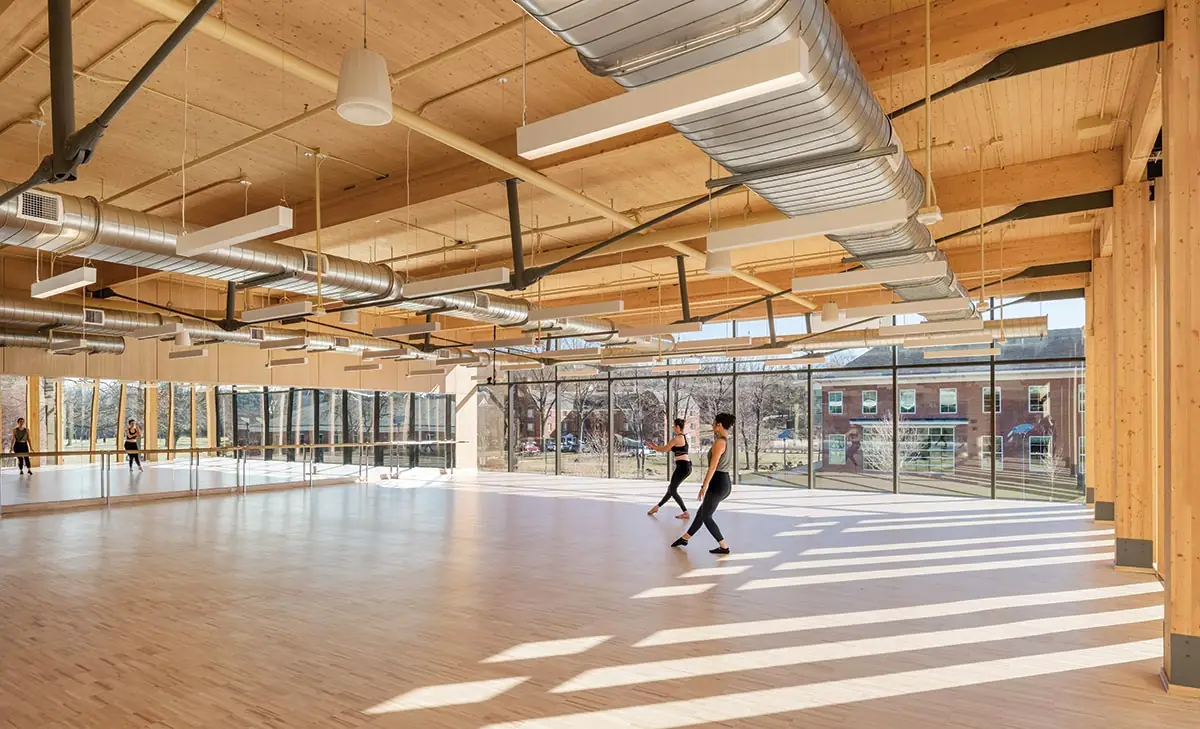
Queen-post trusses allow for fewer columns in large spaces, like the large studio. Photo © Anton Grassl
While the center represents an upgrade for the university’s athletic facilities—which now beckon even casual activity seekers with sunny, glass-walled spaces (buffered from passersby by a wide bioswale shielding the gym from a path to its south)—the real motivation for the expansion was to accommodate campus medical and mental-health programs. Placing these services within the northwest leg of the building serves a twofold purpose: it brings the two disciplines together with new educational and social programs that emphasize general wellness and nutrition, and in so doing creates a destigmatized, less clinical setting in which students can access them.
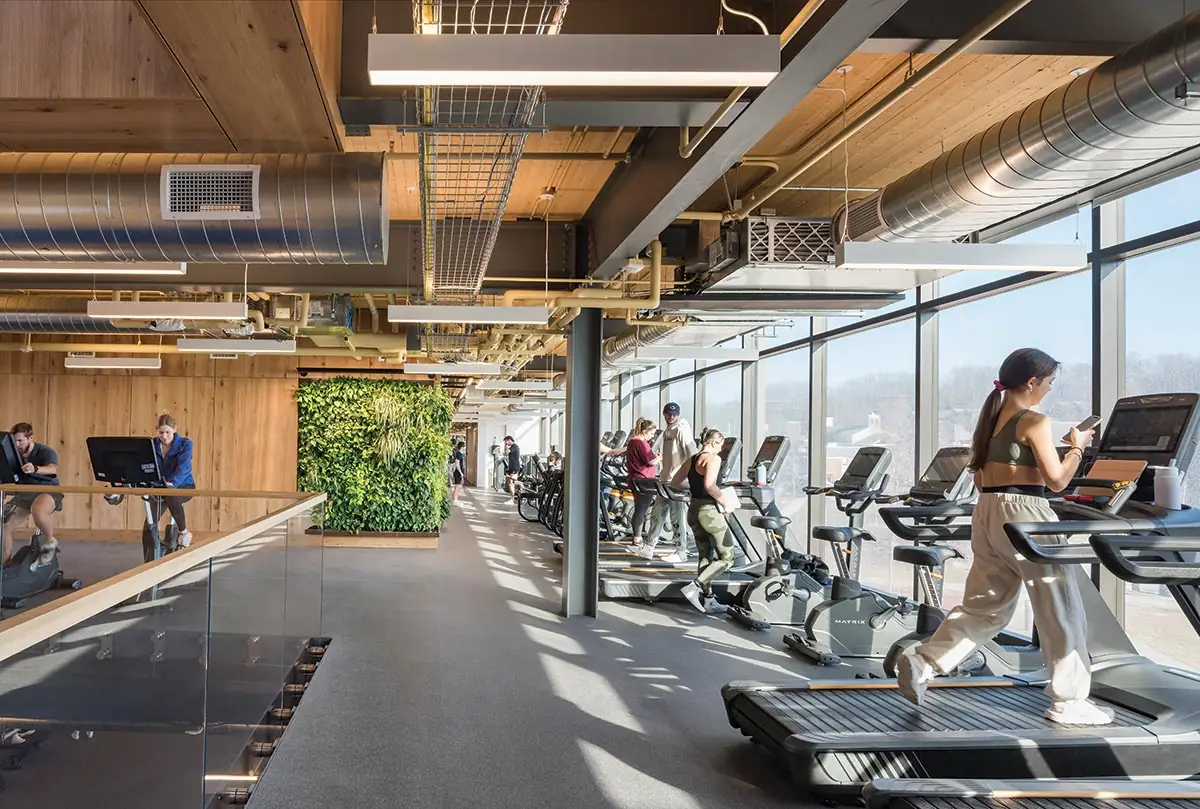
“We had a lot of conversations and dialogue about how visible or hidden entries to these spaces should be,” says Kelly Ard, firm partner and the project’s interior-environments lead. The team was able to create discreet areas that respect the privacy of those seeking counseling without implying that it should be hidden. A central circulating stair clad in oak leads students past a wall of leafy vegetation to the second-floor counseling center, which can also be accessed by a less prominent elevator or stair. Visitors to that floor could just as easily be attending a group activity in one of the flexible gathering spaces as going to a therapist. A door leads to a reception area and a suite of 10 counseling offices. In addition, says Ard, “We brought in the biophilia and natural materials, to stitch it all together and come up with a bigger conversation about the body and the environment.”
Looking for quick answers on architecture and design topics?
Try Ask RECORD, our new smart AI search tool.
Ask RECORD →
1
Biofilic strategies include a leafy green wall (1) and skylights above internal areas like the climbing wall (2). Photos © Anton Grassl
2
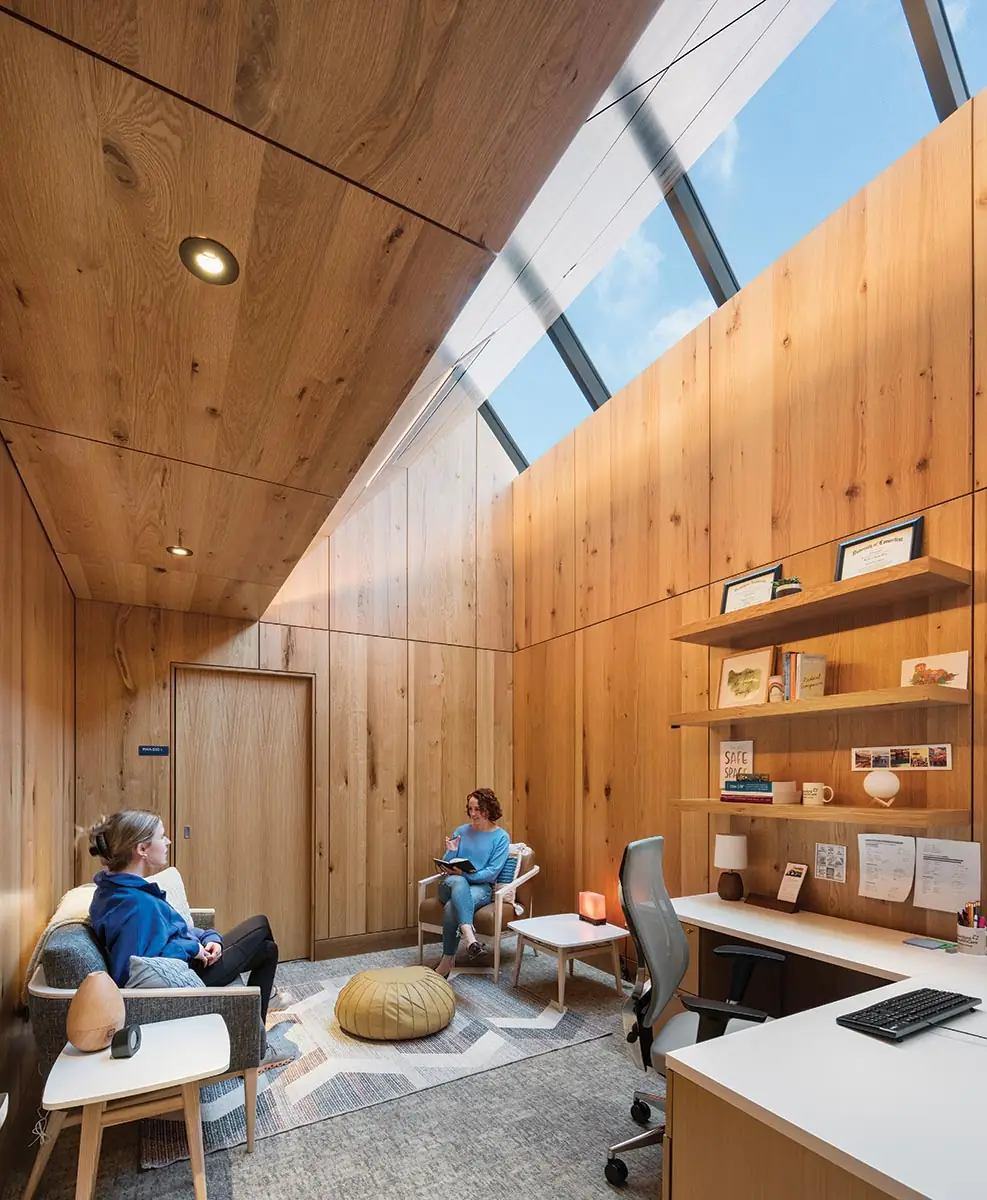
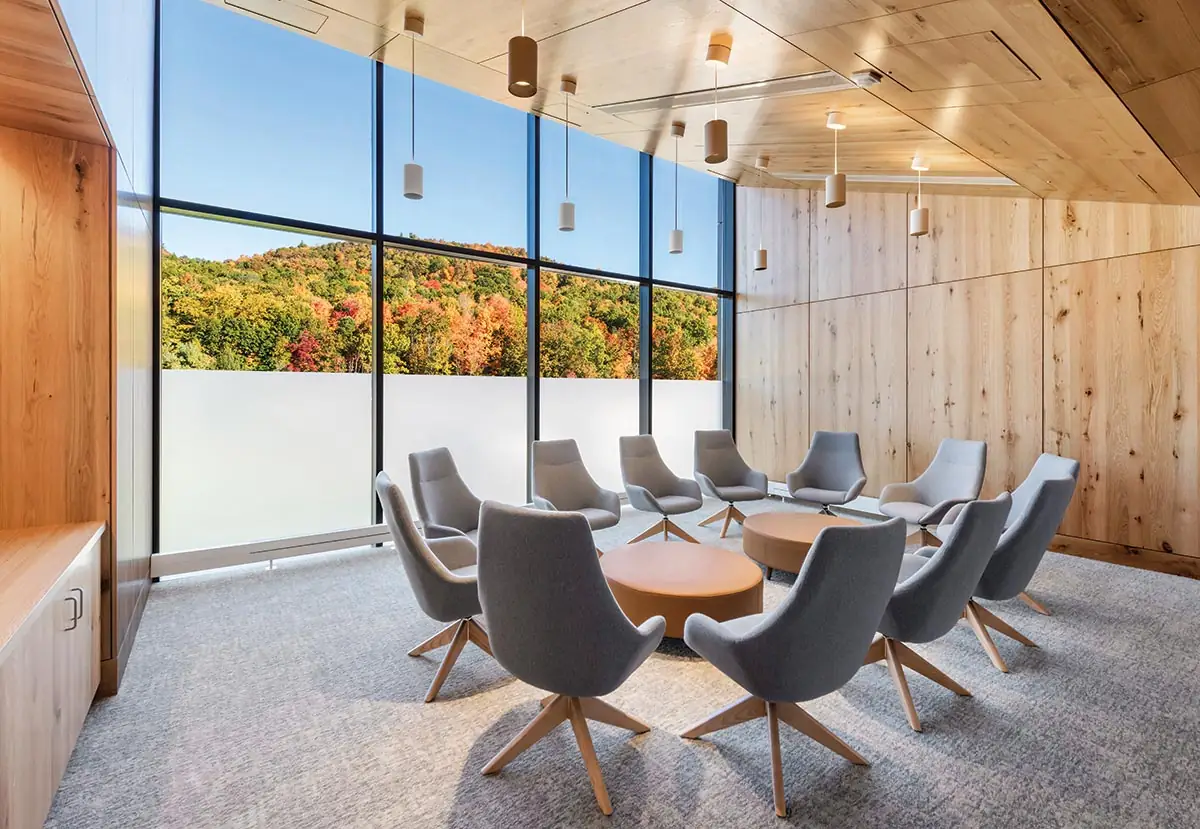
The offices, along with several other interior rooms in the packed program, don’t get daylight through the curtain wall, so the architects developed a language of “skyspaces,” essentially distinct volumes inserted into the structure that are wrapped in oak to differentiate them as inward-facing and contemplative. Counseling offices are included in one such volume, and, though the proposal that all would be rooms without views was initially met with hesitation, the architects’ solution—spaces illuminated softly by skylights set into sawtooth rooflines—was both equitable and in line with privacy goals. At the north end of the building, a large group-therapy room has a full view of Sleeping Giant, with strategically placed privacy film across the bottom of its large window to conceal the parking lot below. It is just one example of the prospect/refuge dichotomy the architects have emphasized in the new center. “There are big, sweeping spaces of ‘prospect,’ where you can see everything, but also spaces of ‘refuge’ that are intimate and you can feel safe and protected,” explains Batchelor.
3
4
Oak-clad counseling rooms (3 & 4) are daylit yet private through strategic glazing, while larger spaces open to a courtyard (5). Photos © Anton Grassl
5
The metrics of how the space is affecting student mental health since its opening this year is difficult to quantify, because it represents such a systemic change in the way wellness is approached on campus. During the building tour, two members of Quinnipiac’s administration emerged from a conference room to greet the architects and discuss the still-unfolding ways students are using the space. “I don’t want to minimize the work our counselors are doing, but when you step in, you feel you’re in a better place,” says Kerry Patton, associate dean of student affairs for health and wellness. “It’s serious, but in a good way.”
On the recreation side, student use has increased as much as 350 percent—from 3,500 daily users at the old gym to 12,000 students swiping their cards each week after the new center’s opening. The architects and university are planning a post-occupancy study to understand the effects of the new program more fully, but one thing is clear: the building is a physical manifestation that the stigma surrounding mental-health care is dropping away, and that academic institutions are recognizing their own vital place in whole-body wellness.
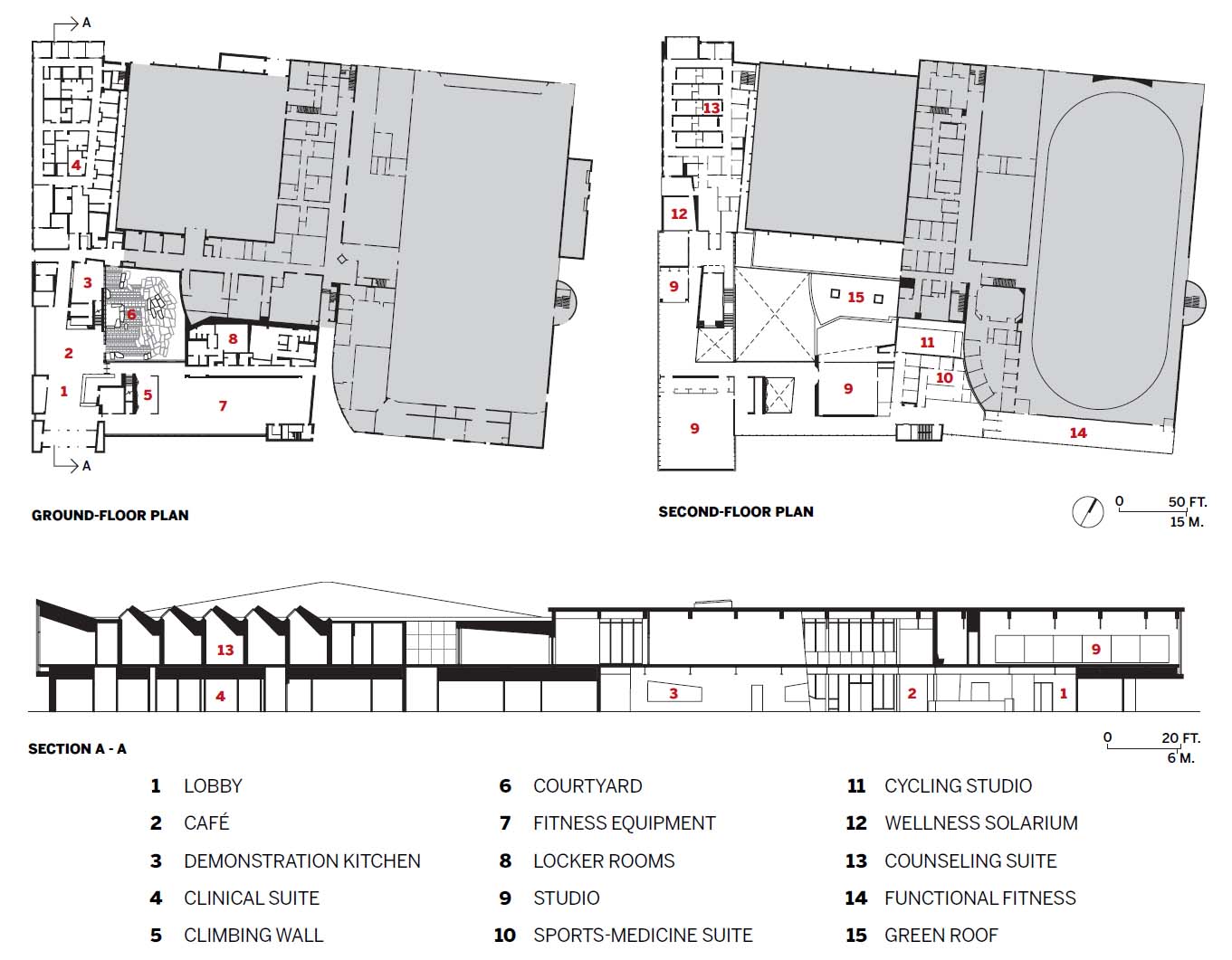
Click drawing to enlarge
5
Credits
Architect:
designLAB architects — Bob Miklos, partner emeritus; Sam Batchelor, principal in charge; Kelly Ard, interior-environments lead; Nicolo Guida, project manager; Nicholas Berube, project architect; Valeria Deneke Rivera, Laura Carless, Francesco Aloe, design team
Associate Architect:
S3 Design – Sal Canciello, principal in charge; Steve Fellmeth, project manager
Engineers:
Buro Happold (structural/m/e/p/fp); Nathan L. Jacobson & Associates (civil); Welti Geotechnical (geotechnical)
Consultants:
STIMSON Studio (landscape architect); Buro Happold (sustainability/lighting design); Cosentini (code); WJE (envelope)
General Contractor:
FIP Construction
Client:
Quinnipiac University
Size:
55,000 square feet
Construction Cost:
$37 million
Completion Date:
January 2023
Sources
Timber:
Nordic Structures
Cladding:
ALPOLIC, Unicel
Glass:
PRELCO, Guardian Glass
Skylights & Entries:
Oldcastle BuildingEnvelope (metal-framed)
Security Grilles:
Overhead Door
Surfaces:
Sherwin-Williams, Wilsonart
Looking for a reprint of this article?
From high-res PDFs to custom plaques, order your copy today!