Tribute: Fredric Jameson (1934–2024)
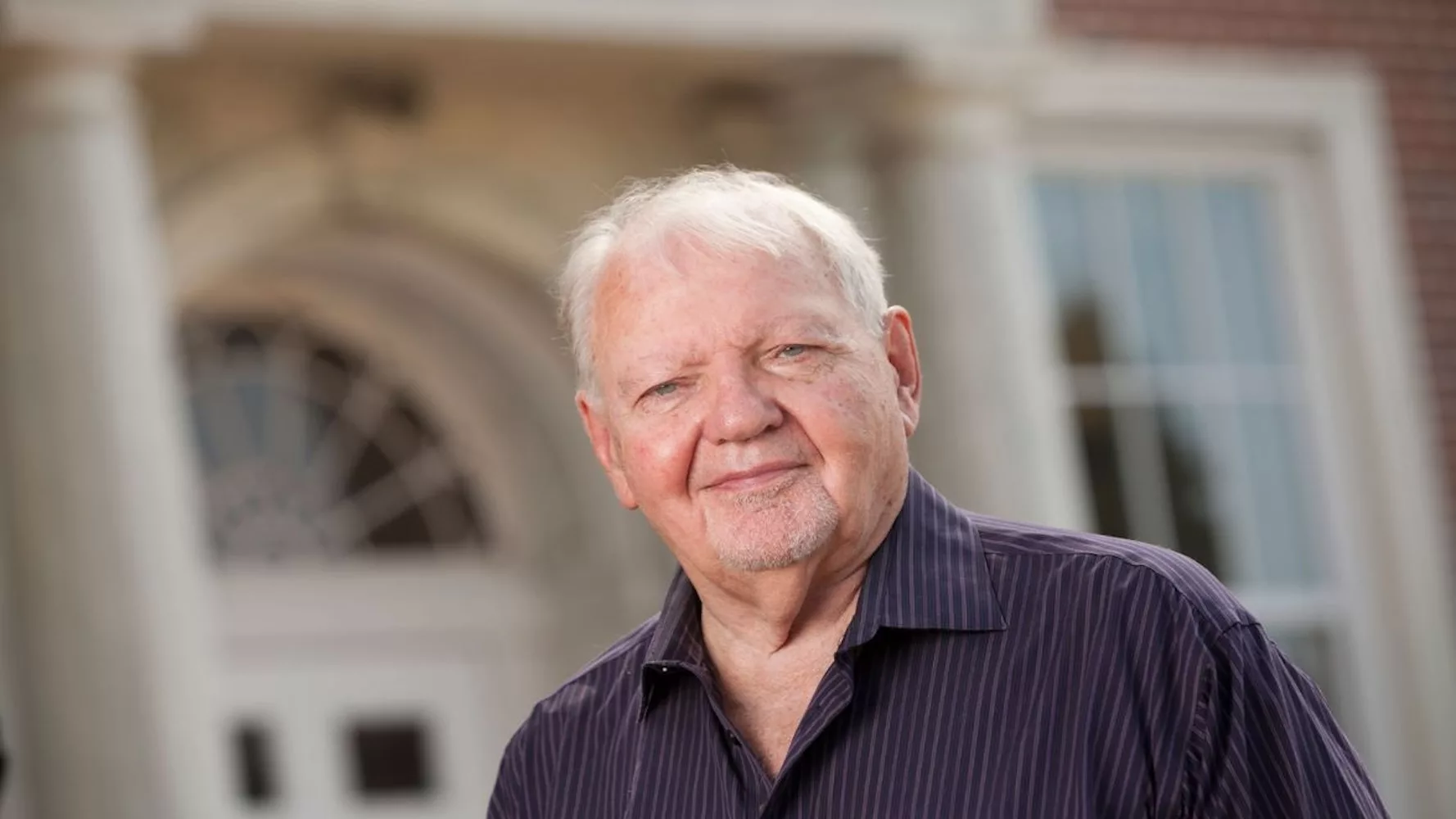
Fredric Jameson, regarded by many as the most important literary and cultural critic of his generation, died on September 22 at the age of 90. He has since been celebrated in a series of spontaneous online postings and in moving tributes in journals like the New Left Review and the London Review of Books, two publications where he was a frequent contributor, and in a lengthy New York Times obituary. Flags flew half-mast that week at Duke University, where Jameson taught since his arrival in 1985 to lead the renowned Graduate Program in Literature, and where he was still on faculty at the time of his death. Jameson was an intellectual giant with no equal among his peers and certainly not among the generations that followed, and his passing surely marks the end of an era.
Jameson wrote about literature, cinema, television, economics, politics, art, theater and, of course, Marxism, and influenced and was influenced by practitioners and critics in those and in many other fields. Jameson also wrote about architecture, and in my view—corroborated by his many assertions of the same—he was most influenced by and was most influential within, architecture, especially in the 1980s and 1990s, the decades during which architecture, architecture criticism, and architecture culture had its greatest global influence. These were the years when continental philosophy—theory—was introduced into the architecture academy, largely through the efforts of Peter Eisenman and his Institute of Architecture and Urban Studies in New York City. This was also perhaps the last period dominated by coherent schools of thought, ideologies or tendencies, as they were once called, all of which were vying for dominance in the wake of Modernism’s demise: Post-Modernism, High Tech, Deconstructivism, Critical Regionalism, Minimalism, Supermodernism, and later, Parametricism. And, of course, these were the years when “starchitects,” surfing the wave of globalization, jetted from one economic and cultural hub to the next in search of commissions that would soon be exhibited in shows at major museums and featured on the print pages of the world’s great magazines and newspapers, all of which, at that time, had a designated architecture critic.

Courtesy Verso Books
Jameson wrote about all of this—starchitects, the rise of theory, the debates over Modernism, the impact of economic globalization on architecture and the city—in his many essays focused on architecture and architects—on Manfredo Tafuri, Rem Koolhaas, Arata Isozaki, to name a few—but nowhere more systematically than in his most important and most widely read book, Postmodernism, or the Cultural Logic of Late Capitalism (1991). There Jameson laid out his theory of Postmodernism as a cultural dominant that corresponded to a new period of capitalistic, global economic development that many would later call neoliberal. And over and again, he insisted that architecture provided the best example not only of the new environments and spaces, or hyperspaces, as he called them, that were the product of this new Postmodern period—as with John Portman’s Bonaventure Hotel in Los Angeles—but also the most sophisticated examples of alternatives to Postmodern hyperspace, as Jameson proposed in his essay focused on Frank Gehry’s House in Santa Monica, California. In this latter essay, “Spatial Equivalents in the World System,” which is a masterful, “literary” close reading of the rooms, corridors, and interstitial spaces of the Gehry House, Jameson argued that Gehry invents an architectural grammar that figures or presages a new way of living in Postmodern hyperspace. Indeed, Jameson proposes that Gehry uses architecture—his own residence, in this case—to map the complex relationship between everyday life and the abstract existence of global capitalism. It sounds like a stretch, but in the performance that is Jameson’s reading, it is convincing and powerful.

Frank Gehry’s home in Santa Monica. Photo by James Kirkikis, Shutterstock
Jameson’s influence during this period was immense and continues to this day, though likely only among those who lived through and remember this overwrought and largely forgotten transition from the Modern period to our current situation, whatever we may call it today. Among the more influential concepts or arguments for architects and architecture developed by Jameson during this period was the assertion that Postmodernism was not a style (post-modern) but a new, historical period of capitalistic development that began in the 1960s and continued into the late 1990s. One salient feature of Postmodernism is defined by the emergence of spaces that are so disorienting that they foreclose our ability to locate ourselves within a larger whole, which thus inhibits our ability to navigate from one place to the next or to exit and to go “somewhere else.” Jameson means this literally—as with the confusion created in the hyperspace of the Bonaventure Hotel where inside and outside are collapsed into a hyperspatial totality without limits and where one is constantly lost—but also figuratively to mean that we no longer possess the ability to map and thus comprehend the totality of global capitalism itself, and thus reveal its outer limits: we ultimately find ourselves in places, spaces, and in a world so hermetically sealed that there seems to be nothing else, no outside, no possibility of an alternative. It is this feeling of absolute closure and lack of alternatives that leads Jameson to conclude in one of his more famous assertions, “that it is easier to imagine the end of the world than to imagine the end of capitalism.”

John Portman’s Westin Bonaventure Hotel, Los Angeles. Photo by Abe Curland, Shutterstock
Drawing on urban theorist Kevin Lynch’s book, The Image of the City (1960), Jameson, in response to this situation, calls for an aesthetic of “cognitive mapping,” one that would enable us to find alternatives to the dead ends of global capitalism. It is perhaps the device of the cognitive map that is Jameson’s greatest gift to architecture, architecture critics, and architecture culture. Not because it offers an answer or way out but rather because it offers motivation for continuing in spite of what appears to be no way out. In “Future City” (2003), a London Review of Books article on Rem Koolhaas’s Great Leap Forward (2002) and Guide to Shopping (2002), two books published as part of his Harvard Graduate School of Design Project for the City, Jameson writes about Koolhaas’s brilliant and unorthodox essay “Junkspace:”
“The problem to be solved is that of breaking out of this windless present of the Postmodern back into real historical time, and a history made by human beings. I think this writing [Junkspace] is a way of doing that or at least trying to. Its science-fictionality derives from the secret method of this genre: which in the absence of a future focuses on a single baleful tendency, one that it expands and expands until the tendency itself becomes apocalyptic and explodes the world in which we are trapped into innumerable shards and atoms.”
Like Manfredo Tafuri, who in Architecture and Utopia (1979), savagely critiques all naïve, avant-garde architecture that proposes alternatives to capitalist architecture, preferring instead to wait for revolution, and thus real, socialist architecture, and about which Jameson wrote perhaps his most brilliant essay on architecture, Koolhaas pushes the logic of a single baleful tendency to an extreme revealing, as a result, the inner and outer surfaces of global capitalism: cognitive mapping! What Jameson admires in these writers—that they stare totality in the face and keep on writing—we can now say about Jameson himself and his entire oeuvre: from the first published book, Sartre: The Origins of a Style (1961), to his forthcoming and presumably, last book, The Years of Theory: Lectures on Modern French Thought (2024), it is clear that the way into the future, into something other, different, and utopian, is possible only when one acknowledges what Jameson observes about Koolhaas’s “Junkspace:”
Looking for quick answers on architecture and design topics?
Try Ask RECORD, our new smart AI search tool.
Ask RECORD →
“It is the writing that is the battering ram, the delirious repetition that hammers away at this sameness running through all the forms of our existence.”
And so, it was the writing that was Jameson’s hammer, answer, practice, and cognitive map; the books, essays, and endless drafts and revisions that he used to batter against the endless sameness of global capitalism. Write on ...
Looking for a reprint of this article?
From high-res PDFs to custom plaques, order your copy today!
.webp?height=200&t=1720083531&width=200 "500KBofDavid Morton, by Matthew Gillis, photorgrapherIMG_8341-2 (1).jpg")