Books
In ‘Flux,’ Ila Berman and Andrew Kudless Take on the Parametric Project
Review: ‘Flux: Architecture in a Parametric Landscape’ by Andrew Kudless and Ila Berman
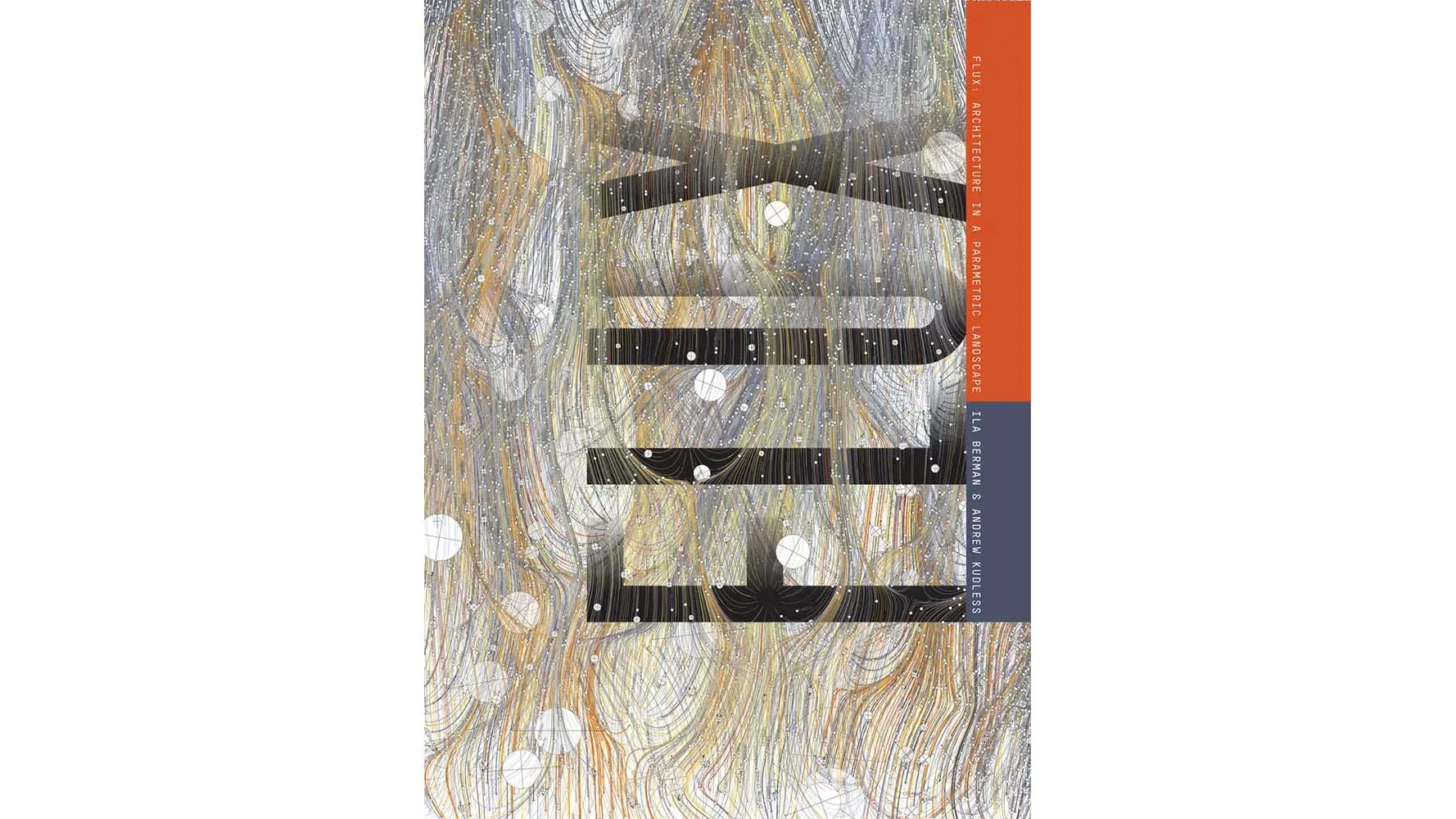
Flux, a new book written by Ila Berman and Andrew Kudless, inspects the architectural discipline as viewed from, and within, the parametric landscape. For me, attempting to review this book is a precarious task, if not because of the conflict of interest posed by having played a couple of cameos within it, then because of the sheer reckoning of being part of a generation that is now ready to be historicized. After 30 years of cultural production in this intellectual terrain, Flux takes on the parametric project—design mediated through computational and algorithmic protocols—as a collective one, with collaborators and competitors demonstrating how their work builds on each other’s, making incremental advances to produce new forms of knowledge.
Densely curated, with an endless menagerie of well-known projects, this somewhat encyclopedic collection is organized in accordance with constructed taxonomies, carefully blending their theoretical underpinnings with the instrumental role of technologies that lie just under the surface of their ideas. The partnership of Berman and Kudless, both longtime academics, is strategic, with Berman’s intellectual insight buttressed by her linguistic dexterity, and Kudless’s analytical precision supported by a forensic study of the very projects under scrutiny. To be clear, if Berman unpacks the material through her rhetorical mastery, Kudless has parametrically redrawn, or recoded, the projects he is inspecting, using the structure of their scripts as a foundation for untested transformations. To this end, the intellectual endeavor of this book is anything but passive: it creatively categorizes, forensically dissects, critically interrogates, strategically appropriates, and holistically participates, with the authors who, incidentally, were not engaged in this process of analysis. Architects of many eras are cited in each chapter, bringing thematic parity to key ideas over different historical periods; thus, though ideologically disparate, Kisho Kurokawa, Peter Eisenman, and EZCT are juxtaposed to demonstrate the evolutionary capacity of cellular organizations across different hands and minds. Grounding itself historically through early explorations by figures such as Frei Otto, Eladio Dieste, and Felix Candela, the book also shows how certain ideas are transformed through the computational dexterity of contemporary figures such as Gramazio Kohler, Achim Menges, and TheVeryMany.
Curated as eight thematic chapters, with an introductory text and a sequence of projects paired with analytical drawings, the chapters are self-consciously treated as provisional conceptual vessels. Each contains the “dominant logic or morphological traits” of a set of explorations, acknowledging that many operate between chapters, with accrued associative qualities that bind them to ideas beyond a closed set of categories. Accordingly, Jenny Sabin’s complex and interactive contribution to the book, ADA, is set within the chapter “Multi-Agent Networks,” and yet one can clearly extrapolate its connections to operations adopted within “Cellular Clusters,” “Woven Meshes,” or “Emergent Surfaces.”
If it took the featured architects some three decades to develop the installations, mock-ups, and buildings that form the research of this body of work, the protocols to which they have given birth have also become mainstays of conventional architectural practices today. Though the book does not explicitly make this claim, its timing and reflective view brackets a moment revisiting this thinking within a more experimental posture, from long before the institutionalization of its techniques. That these methods are commonplace today—and some even on the verge of obsolescence, with the advent of artificial intelligence—marks the unprecedented speed of contemporary culture. The book is timed precisely to record this historical passage, at the threshold of an accelerated history analogous to the incremental evolution of stop-motion techniques in 20th-century animations contrasted to the immediate output of contemporary generative models like Stable Diffusion.
In this sense, Flux might serve as a distant cousin to Archaeology of the Digital (2013), where Greg Lynn identified another series of architects of an even earlier period—Peter Eisenman, Frank Gehry, Shoei Yoh—who engaged the digital medium with innocence and speculative verve, though also with less precision. What stands out in the body of work presented in Flux is the clarity of its collective trajectory: the book is curated to tell a story, with a narrative that builds up ideas with techniques, elemental and raw in the beginning, gaining interactive complexity as it evolves through chapters. In this sense, the curatorial and analytical effort of this must be underlined as part of its critical contribution, if only because the projects contained within were certainly not conceived with that narrative in mind.
The consistency of the work also points to a salient characteristic of our contemporary condition; the omnipresence of the internet and the immediacy of communication has had the effect of collapsing time, geography, and culture in such a way that it makes the overlaps between the different projects not only possible, but inevitable. While this has also eliminated the singularity of architectural authorship—what for centuries has defined the allure of the architect’s “genius”—it has also exposed the degree to which the architect’s reading of others’ works (and in turn their influence) is part of a collective contract. In contrast, the narrative behind the Archaeology of the Digital is still woven around a set of architects whose design process invites the aura of mystification. Berman and Kudless’s carefully crafted genealogy effectively demythifies the protocols that produce apparent complexity, and in doing so also redefines the role of authorship in the digital age.
The birth of digital platforms has given rise to a significant shift in architectural practices, long defined by formal, spatial, and material disciplines, all visually based. The rule-based logics of parametrics instead produce algorithms and scripts as their prime contribution, feats that are nonvisual in the first instance, though with complex compositional consequences as their by-product. Berman and Kudless help to recenter this history, though never throwing the baby out with the bathwater; that is, theirs is not an argument against composition per se, but rather a demonstration of how these projects look beyond the rarefied object but invest in the multiplicities produced by this new paradigm. As insinuated by Berman and Kudless, “multiplicity” can be seen in many guises: in how one project relates to the next, in the mass-customization of elements, in the iterative capacity of the generative logics, and the compositional reach of a simple rule. Though linear as a narrative, the book sequentially layers these projects together, weaving commonalities strand by strand in what emerges as a rich array of interconnected themes under one cover.
Looking for quick answers on architecture and design topics?
Try Ask RECORD, our new smart AI search tool.
Ask RECORD →
Looking for a reprint of this article?
From high-res PDFs to custom plaques, order your copy today!