To Make ‘The Brutalist’ Monumental, the Filmmakers Approached Cinema as Architecture
Review: ‘The Brutalist,’ directed by Brady Corbet
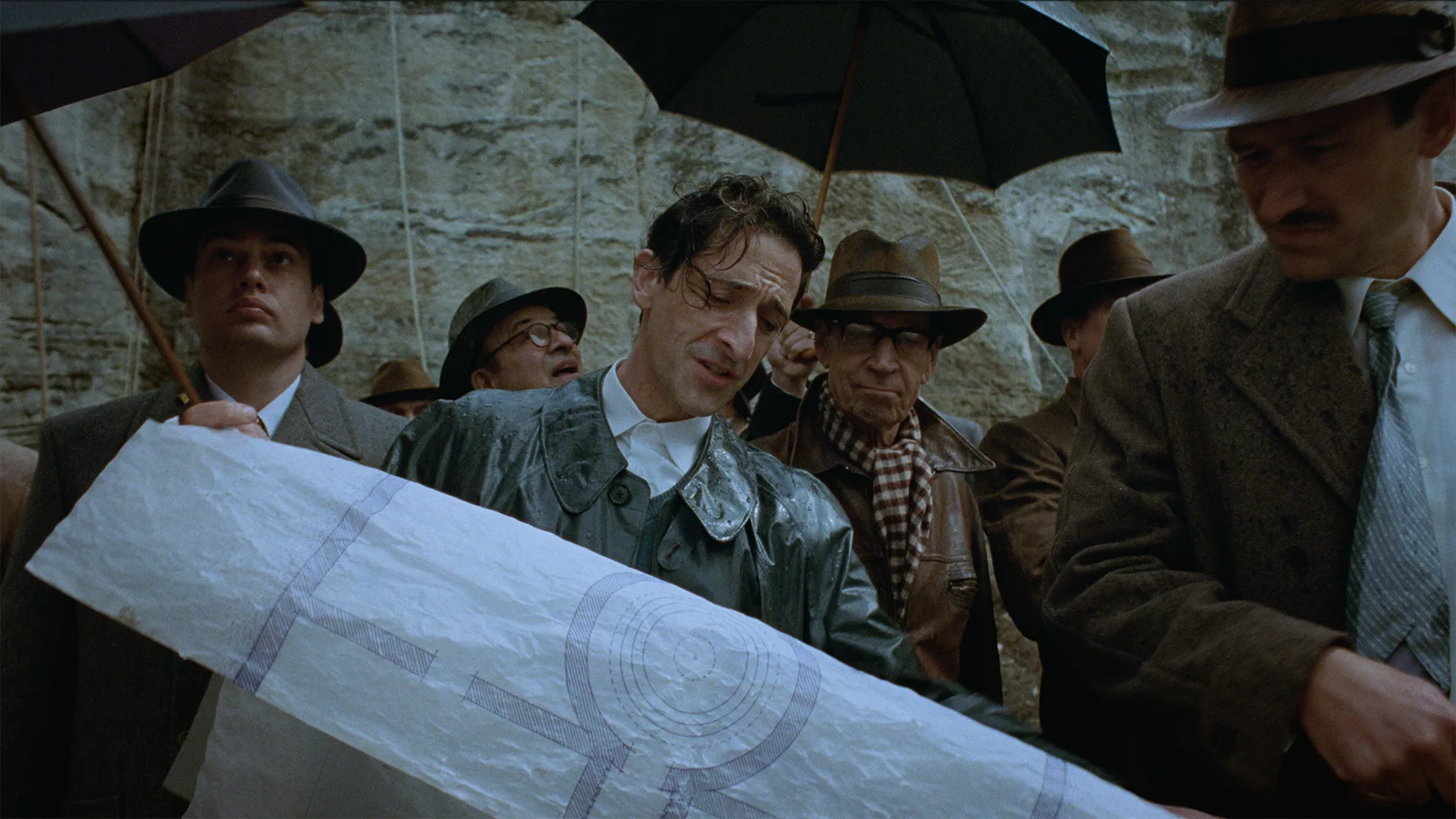
Protagnist László Tóth, played by Adrien Brody, is a Bauhaus-trained architect who escaped the Holocaust and struggles with his trauma and dislocation after settling in Philadelphia amid class and racial tension. Photo © Lol Crawley/A24
A hulking horizontal mass of gray concrete stands sentry on an eastern Pennsylvania hilltop, an imposing citadel in an otherwise bucolic expanse. Conceived by a local millionaire and designed by a Hungarian architect, the building is intended as a community center and church. Its facade is stark and unadorned; its interior spaces, many subterranean, are claustrophobic, even the ones with soaring ceilings. A cut in the roof projects a cruciform beam of light onto its marble altar, a flash of relief in this otherwise forbidding, severe piece of Brutalism.
This architectural fantasy, the Institute, is the physical center of gravity in The Brutalist, a 215-minute cinematic epic of midcentury America, the postwar immigrant experience, and the practice of architecture, directed and cowritten by Brady Corbet and opening nationwide next month. The film’s emotional core is László Tóth, played by Adrien Brody, a Bauhaus-trained architect who escaped the Holocaust and struggles with his trauma and dislocation after settling in Philadelphia amid class and racial tensions. He’s ultimately commissioned to build the Institute by Harrison Van Buren (Guy Pearce), a wealthy industrialist who becomes László’s problematic patron. László is eventually joined in the U.S. by Erzsébet (Felicity Jones), his wife and protector, and also a survivor of the camps. Told in two acts broken up with a rare intermission, and spanning the years 1947 to 1960, the film is big: in length, scope, and drama. But it’s also restrained, with quiet scenes of achievement and despair doing as much heavy lifting as bombastic moments of triumph and defeat.
Maximal and minimal, hopeful and cynical—the narrative impulses of The Brutalist map neatly onto the contradictory forces of Brutalism. That’s not accidental. In their seven years’ working on the film, Corbet and his team steadfastly committed to approaching The Brutalist as architecture. The film—as much about László’s struggling against an antagonistic society as it is his creating a building—needed to “reflect the Brutalist method” as much as possible, the director says, an edict that influenced every aspect of production.
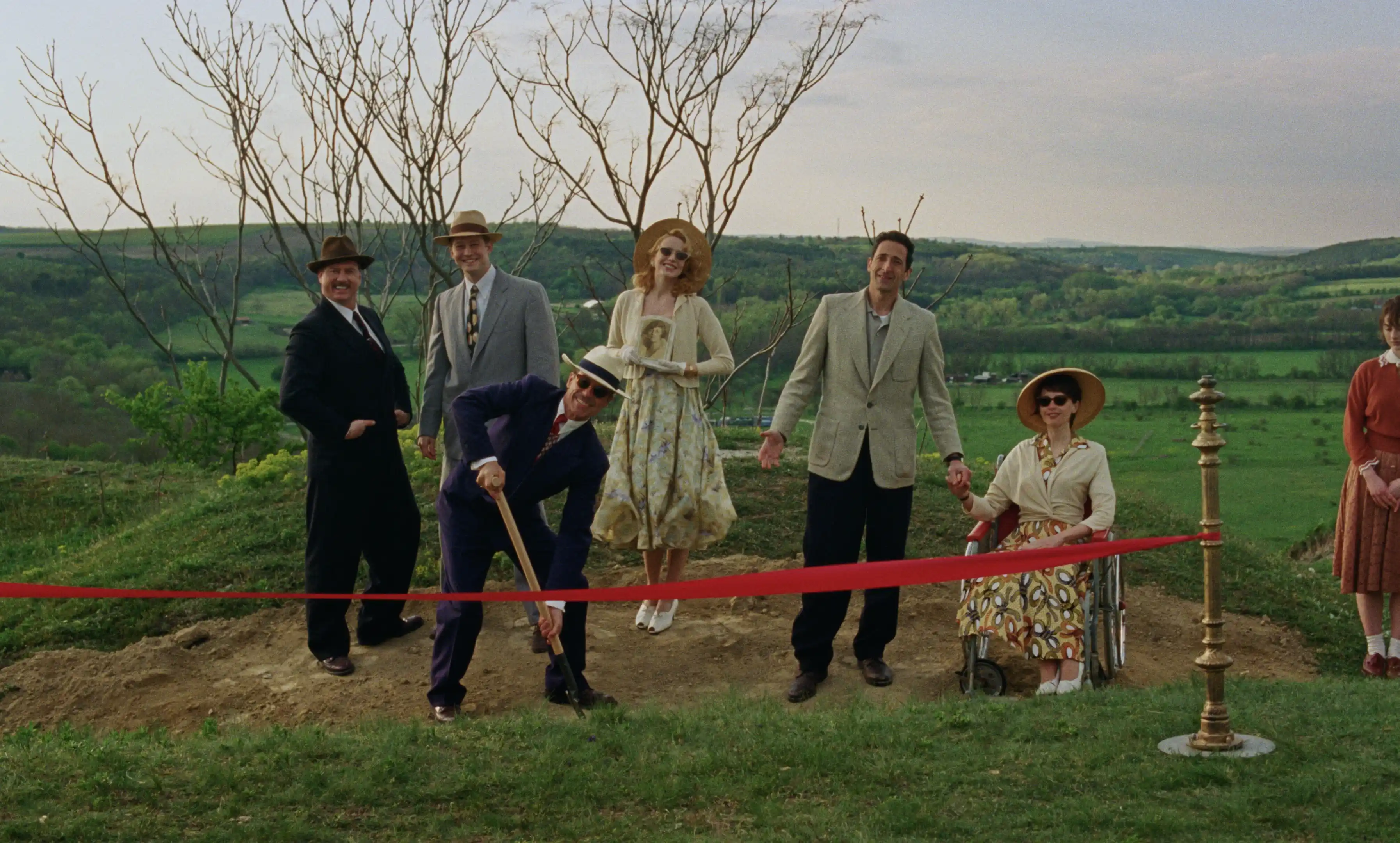
László Tóth standing with his wife, Erzsébet, (right) as his patron, Harrison Van Buren, breaks ground on the Institute (center), with his children (center) and a friend (left) look on. Photo © Lol Crawley/A24
Take the score. Corbet says he wanted composer Daniel Blumberg to create it out of “slabs of sound,” the way Brutalists used slabs of concrete. At times this manifests cacophonously: as László maneuvers from the deepest hold of a ship bringing him to America, an avant-garde orchestra discordantly tunes up, settles into a more methodically rhythmic yet menacingly off-kilter tempo, comes into alignment; then, as he emerges onto the deck and sees the Statue of Liberty, it exults, in a soaring, triumphal blast. Elsewhere, the music is more quietly “slabbed”—László sketching the Institute in solitude as a minor-key piano on top of a low-rumble brass note with metallic clinks and plinks and other dissonant thunks subtly lurk in the background. It’s an approach guided by layering tones and obsessing over materials. “We didn’t want excess ornamentation,” Blumberg says. “We were drawn to the piano for various reasons, one of which is the acoustic potential of a huge instrument with many hammers. But we were particularly drawn to the prepared piano, where you interfere with the strings by sticking objects inside, like screws.”

László Tóth designing the Institute. Photo © Lol Crawley/A24
Such physicality is also found in how cinematographer Lol Crawley shot the film. He used the archaic and unruly VistaVision system, created in 1954 but not used for an American feature since 1961, to generate a large, enveloping canvas. A VistaVision camera pulls 35mm film through its aperture horizontally rather than vertically—resulting in a more monolithic shooting experience—and uses twice as much stock, creating a richer, more sumptuous image with an increased field of view that gets us closer to the characters and deeper into their world. Editor Dávid Jancsó then shaped the footage, guided by Corbet’s production challenge. “The clean, geometric precision of Brutalist architecture influenced the cutting patterns, with long, unbroken shots interspersed with sharp, abrupt cuts, creating a rhythm that reflected the tensions in László’s life,” he says. All of this was useful in evoking the film’s period and forging an immersive and intimate viewing experience. And it was crucial to actualizing the concrete heart of the film.
Created by production designer Judy Becker, the Institute needed to exist as both a physical reality and a visual manifestation of László and Erzsébet’s Holocaust experience. We learn during an epilogue set at the 1980 Venice Architecture Biennale that László’s plans for the Institute—two bunker-like buildings connected via underground passageways—not only satisfied Harrison’s demand for a Christian space but also, subversively, monumentalized his and Erzsébet’s captivity as Eastern European Jews. This informed Becker’s research, which included concentration camps, chapels like Tadao Ando’s Church of the Light, the Harry Weese–designed metro stations in Washington, D.C., projects from the earthworks art movement, and eco-structures. And, while she says she deliberately avoided referencing any existing architecture, it’s hard to look at her building and not see Marcel Breuer’s influence: the Westchester Reform Temple and its Star of David–shaped roof, the shape of the Atlanta Central Library, the folded concrete of his St. John’s Abbey Church. Indeed, if there’s one real-life inspiration for László, it’s Breuer. Both Hungarian emigres; both trained at the Bauhaus; both makers of tubular furniture.

László (right) entering a Carrara marble quarry with Harrison (center) and his Italian contact (left). Photo © Lol Crawley/A24
“I designed the Institute in a way so whoever entered it would be going down a really steep set of stairs that narrowed at the base into a very low-ceilinged central hallway,” Becker says. “What I would think of as the barracks are on either side, and those became function rooms in the community center and were divided by sliding doors. When those doors were closed, the rooms were the same proportions as the ones that László and Erzsébet would have been imprisoned in.” Her Institute is, in its way, suffocating, but Becker also created moments of relief. The building itself has a raised section shaped like a cross, while the community rooms and church have very high ceilings. “And then, finally,” she adds, “when you exit the whole Institute, it opens up into a wide staircase and exits out into a beautiful view.”
Looking for quick answers on architecture and design topics?
Try Ask RECORD, our new smart AI search tool.
Ask RECORD →
Moviegoers see very little of this. The Institute is only completed three hours into the film, and even then it’s never fully operational. Yet we’re placed in built exteriors and interior sets enough to appreciate what’s happening. The layered cinematic volumes—score, cinematography, editing, production design—solidify into a space that’s alive and quintessentially Brutalist, inspiring both awe and dread, inside and out. And the Institute, in turn, serves as a narrative slab, one of many that form this monumental, ominous, confident film.
The Brutalist is a singular cinematic statement on the role architecture plays in our culture, one that treats the discipline more seriously and humanely than maybe any other film. It’s an achievement that could only have been reached by Corbet and his team’s embracing Brutalism, its methods, and all its contradictions—and by insisting on approaching cinema as architecture itself.
Looking for a reprint of this article?
From high-res PDFs to custom plaques, order your copy today!