RECORD Forum
Save the Roundhouse? A Case for Demolition
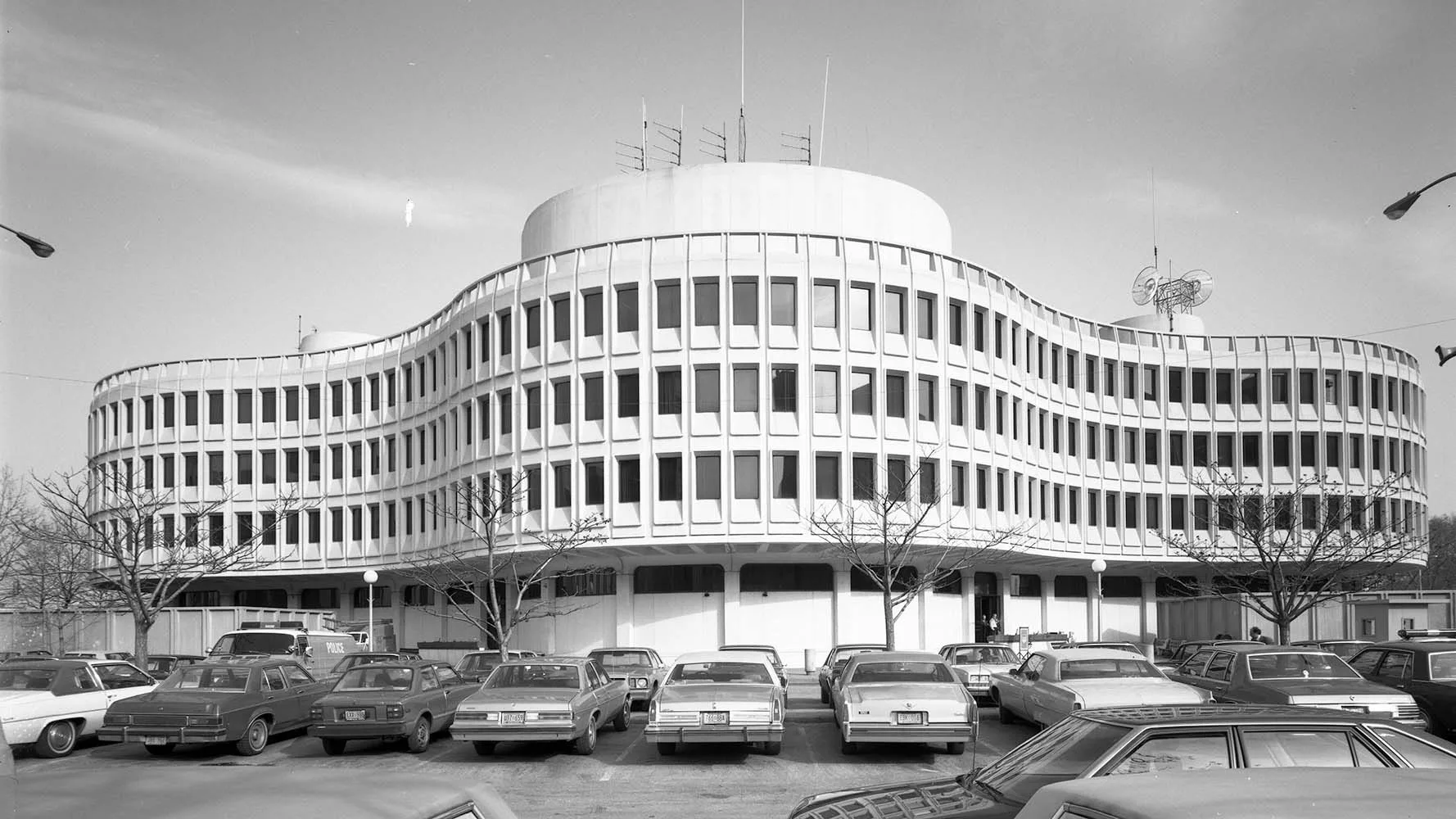
“When a traveler sees a tree-filled square with hundreds of men reclining on park benches or lined up for soup and salvation across the street, then he has arrived in Philadelphia.” Such was a 1952 description of Franklin Square, then Philadelphia’s Skid Row. Just about a decade later, the Roundhouse, the city’s police headquarters, designed by Geddes Brecher Qualls Cunningham (GBQC), would open across the street, with the express purpose of taming the park’s chaos. One block away, Metropolitan Hospital, another undulating building, opened in 1971 as the city’s charity hospital. As Philadelphia fought against white flight and the decline of manufacturing, this neighborhood served residents seen as less desirable.
It is hard to imagine this history when you stand in Franklin Square nowadays. You’ll hear the lilt of a carousel, the music from the miniature golf course, or the cheerful screams of children on the playground. One of William Penn’s original five squares, this public space is once again vibrant. But the effects of the prison and hospital, along with the nearby highway that bisects the city and the Ben Franklin Bridge leading to New Jersey, remain. While the rest of Center City has flourished, despite the city’s drop in population from 2 million to 1.5 million since 1950, this immediate neighborhood remains riven with parking lots and devoid of retail and housing.
It’s within this context that the city has been contemplating the fate of the Roundhouse. Its design, which resembles binoculars—or, perhaps, handcuffs—when viewed from above, won GBQC the AIA’s Gold Medal Award for Best Philadelphia Architecture in 1963. The structure pioneered the use of architecturally expressive precast concrete in the United States, incorporating roughly 1,000 precast units in its facade. It stands as a prime example of the midcentury Philadelphia school, which included works by Louis Kahn, Robert Venturi, Denise Scott Brown, and notable architect, educator, and GBQC cofounder Robert Geddes.
Yet, despite these bona fides—and its status as structurally sound—the building was recently denied inclusion in Philadelphia’s Register of Historic Places. While this move does not guarantee demolition of the 125,000-square-foot structure, it opens the door to it. The building sits adjacent to a 50,000-square-foot parking lot on a city-owned 2.7 acre lot site ripe for redevelopment.
Should that new development include the Roundhouse? One could argue that such a large site has plenty of space to both reuse the Roundhouse and construct new buildings. The Preservation Alliance for Greater Philadelphia has offered conceptual renderings by a local architecture firm that show how mixed-use towers could be built on the same site, with its generous FAR. If an enterprising developer sought a spot on the National Register of Historic Places for the Roundhouse, federal tax credits could help finance the project.
Yet preserving the Roundhouse really means preserving a facade. While GBQC intended the building to symbolize a more transparent police force, the completed project included a harsh concrete perimeter fence and achieved the opposite effect. To create any street-level connection would require chiseling away at the Roundhouse’s exterior. The interior, with its defunct jail cells and police processing areas, would require gutting. Still, keeping the building might be worth doing for reasons beyond architectural ones, as it can safely be assumed that adaptive reuse would entail less embodied carbon.
Finally, while the building is known for its legacy of racist and violent prison practices, a community-engagement process led by the previous mayoral administration found that local residents were open to reusing the building for affordable housing, educating the public on police brutality, and benefiting nearby Chinatown.
Looking for quick answers on architecture and design topics?
Try Ask RECORD, our new smart AI search tool.
Ask RECORD →
These are all valid reasons to reuse the Roundhouse. But Philadelphia does not have a great record of quickly turning historic buildings into new developments. A Beaux-Arts building by John Torrey Windrim in one of the most choice parts of the city has gone unused for a decade since its designation on the federal Register of Historic Places. A 1961 futuristic saucer-shaped visitors center in famed Love Park has sat empty since a multi-million dollar renovation was completed in 2019; the city’s RFP for a restaurant tenant in the space landed not a single response. And there’s been no movement on the site of a historically protected 1959 building that served as a city health clinic, even though it was sold in 2019.
To some, these years or decades of vacancy are worth it for the cause of preservation. To me, that stance does not fit the current moment—the housing-affordability crisis is at its worst ever, Philadelphia is once again losing population, and cities across the country are facing a glut of office buildings requiring adaptive reuse. Tricky sites like the Roundhouse will be the last pick. And, after years spent debating a potential new basketball stadium downtown, which ultimately did not come to fruition, there is a renewed push to transform the adjacent neighborhood of Market East, making this parcel additionally valuable right now.
The site has a tantalizing proximity to regional rail and subway connections, as well as highways, that make it ideal for affordable and market-rate housing. Its location two blocks east of Chinatown could provide vital space for retail and community facilities potentially displaced by the new stadium development. Given Franklin Square’s built-in audience of families, it is the perfect place to locate other family-oriented offerings, such as a school, health care, or a museum. It’s critical that the city not sell this parcel off to the highest bidder but leverage public ownership, to maximize positive social, economic, and environmental outcomes.
Ideally the city would offer an RFP for the site, leaving it to developers to decide whether the Roundhouse would enhance their proposal or not. But it should be noted that time and money are at stake here. To renovate the Round-house would require major subsidy—local, state, and federal taxpayer dollars—and potentially a decade where nothing gets built. At what price is this facade worth keeping?
Looking for a reprint of this article?
From high-res PDFs to custom plaques, order your copy today!