Newsmaker: 2025 Pritzker Prize Laureate Liu Jiakun
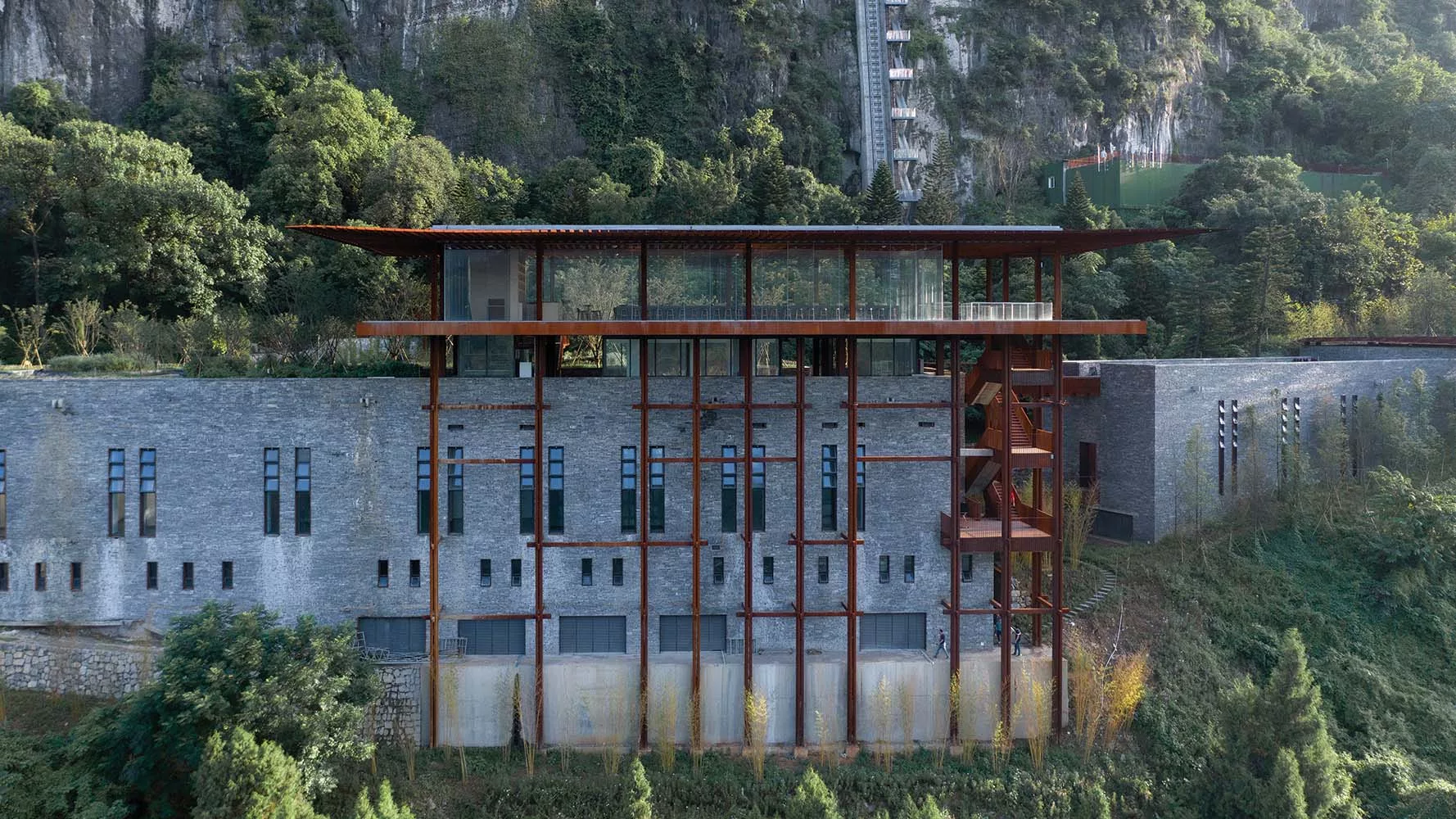
The second China-based architect to win the Pritzker Architecture Prize since its inception in 1979, Chengdu-based Liu Jiakun struggled to find his purpose at the start of his career but came to international attention in 2002 with a poetic design for a museum displaying Buddhist sculpture. Subsequently, he has produced a body of work that engages history, landscape, and the place of the individual in a communal society. He has designed large cultural complexes such as the Museum of Clocks at the Jianchuan Museum Cluster in Chengdu and the Shuijingfang Museum, also in Chengdu, which combines new concrete buildings with renovated wood-frame structures exhibiting wine-making operations. Many of his projects—such as the Museum of Clocks and West Village—provide spaces for contemplation or recreation separated from their hectic urban contexts. His smallest project, the Hu Huishan Memorial, is one of his most powerful. It stands as a testament to the importance of an individual life cut short in the Wenchuan Earthquake that rocked the Sichuan province in 2008. Debris from that disaster became material for Liu’s “rebirth bricks,” which he used in building projects afterward, an elegiac note reminding us that destruction can lay the foundation for creation.
Liu recently spoke with RECORD contributing editor Clifford A. Pearson about numerous topics, including the influence of literature on his work and the role of memory in design.

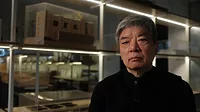
Liu Jiakun. Photo courtesy Tom Welsh / Hyatt Foundation, cick to enlarge.
I have admired your work since RECORD published the Luyeyuan Stone Sculpture Art Museum in 2006. Before that, in the 1980s, you spent a few years in Tibet and western China, writing and painting. Then, in the 1990s, you rededicated yourself to architecture and founded Jiakun Architects in 1999. Tell me about those periods.
I really devoted myself to architecture in the 1990s. That was also the time of reform and opening in China. At that time, cultural and artistic elements were ahead of architecture. Because it is dependent on economic activity, architecture often lags behind other artistic disciplines. In the early 2000s, when architecture was booming, the profession was discussing a lot of the issues that literature and art had addressed in the 1980s and ’90s. So there was a gap between my artistic training and my architectural practice.

Luyeyuan Stone Sculpture Art Museum. This, and all projects below, are located in Liu Jiakun’s hometown of Chengdu. Photo courtesy Bi Kejian
How does your engagement with literature affect your architecture?
I think literature is the foundation of everything, because language is important for everything. Literature and architecture are very different artistic categories, but some of the principles behind them are the same. I sometimes compare the two and develop different thoughts. Having these two abilities broadens my perspective and allows me to think more comprehensively.
Projects such as the Luyeyuan Sculpture Museum and West Village have a narrative approach that creates a sequence of experiences as people move through them. Is that something you do consciously?
It is mostly subconscious, coming from my experience as a writer. I am instinctive. I hope that architecture is not just making a simple object but creating something more complex.

West Village. Photo courtesy Arch-Exist
What writers have influenced your thinking?
After China opened, I read a lot of foreign literature. I particularly like Latin American writers such as Borges and García Márquez and writers from the American South like Carson McCullers. There were some Soviet authors too, such as Boris Pasternak, who was oppressed and led a tragic life but whose work reflected the real situation at the time. In more recent years, I have enjoyed Chinese authors such as Yu Hua.
Who are some architects who have influenced you?
I’ve been influenced by European masters like Le Corbusier, Mies van der Rohe, and Carlo Scarpa. In the United States, there’s Louis Kahn, and in Mexico, Luis Barragán. I also have paid attention to Japanese architects such as Arata Isozaki and Kazuyo Sejima.
Many of your projects address issues of time and memory, touching on difficult moments such as the Cultural Revolution and the Wenchuan Earthquake. How do you approach such subjects?
We usually start with history. But for me, history is abstract, indirect. Memory [though] is the history I have personally experienced. It’s more authentic and more specific. I try to inject this kind of memory in my work.
How did you deal with history in the Museum of Clocks, a project that looks back at the chaotic period from 1966 to 1976 known as the Cultural Revolution?

Museum of Clocks. Photo courtesy Arch-Exist
During the Cultural Revolution, I was still in my childhood. Of course, I have some memories of the atmosphere of the time and can feel it. I didn’t understand the politics much, but the environment of that time left a special impression on me.
Looking for quick answers on architecture and design topics?
Try Ask RECORD, our new smart AI search tool.
Ask RECORD →
How did the Sichuan earthquake in 2008 affect your work?
It had a huge impact on my work and my methodologies and the direction of my ideas and thoughts. Before the earthquake, I paid more attention to static architectural elements such as form and materials. Afterward, I started to pay more attention to the basic functions of architecture and to people’s lives.
You really connected with Hu Huishan’s parents after she died. Tell me about that.
Most projects are commissioned by a client. But the Hu Huishan Memorial and the Rebirth Bricks were ones that I did voluntarily and donated my work. They gave me a greater understanding of the responsibilities of the architect and what architecture can do for people. It was important to show that Hu Huishan was not just a number in a disaster, but an individual person. I did this to help comfort her parents.
Much of your work has been in Chengdu and Sichuan. How does it reflect those places?
Chengdu is my hometown, so it is the place I’m most familiar with and have the deepest understanding of. But I am also working now in places like Shanghai and Huangzhou.
How does your work respond to the local climate and environmental conditions?
I always look at local methods and traditional materials, because they have been tested for many years and are often cheap. Otherwise, they wouldn’t survive. It’s smart to learn from the people who have been there a long time.
Would you like to do projects in other countries, or do you believe your work belongs in China?
I would like to do projects in different places. Each place has different characteristics, but I think I can use my methodology to develop an understanding of those places and realize good works.
Some of your projects turn inward to create calm places separate from the busy urban context beyond them.
I want the cultural element and the business element to combine well. For example, at the Clock Museum, I used heavy redbrick for the interior, which is unchanging and historical and was typical of the Cultural Revolution. But, for the outside, I used a framing structure with columns, which provides space for businesses that change all the time. Inside the museum, light and shadow move around, like a clock in ancient times.
Looking for a reprint of this article?
From high-res PDFs to custom plaques, order your copy today!