Architects Gather at Serenbe for Seventh Annual Biophilic Leadership Summit
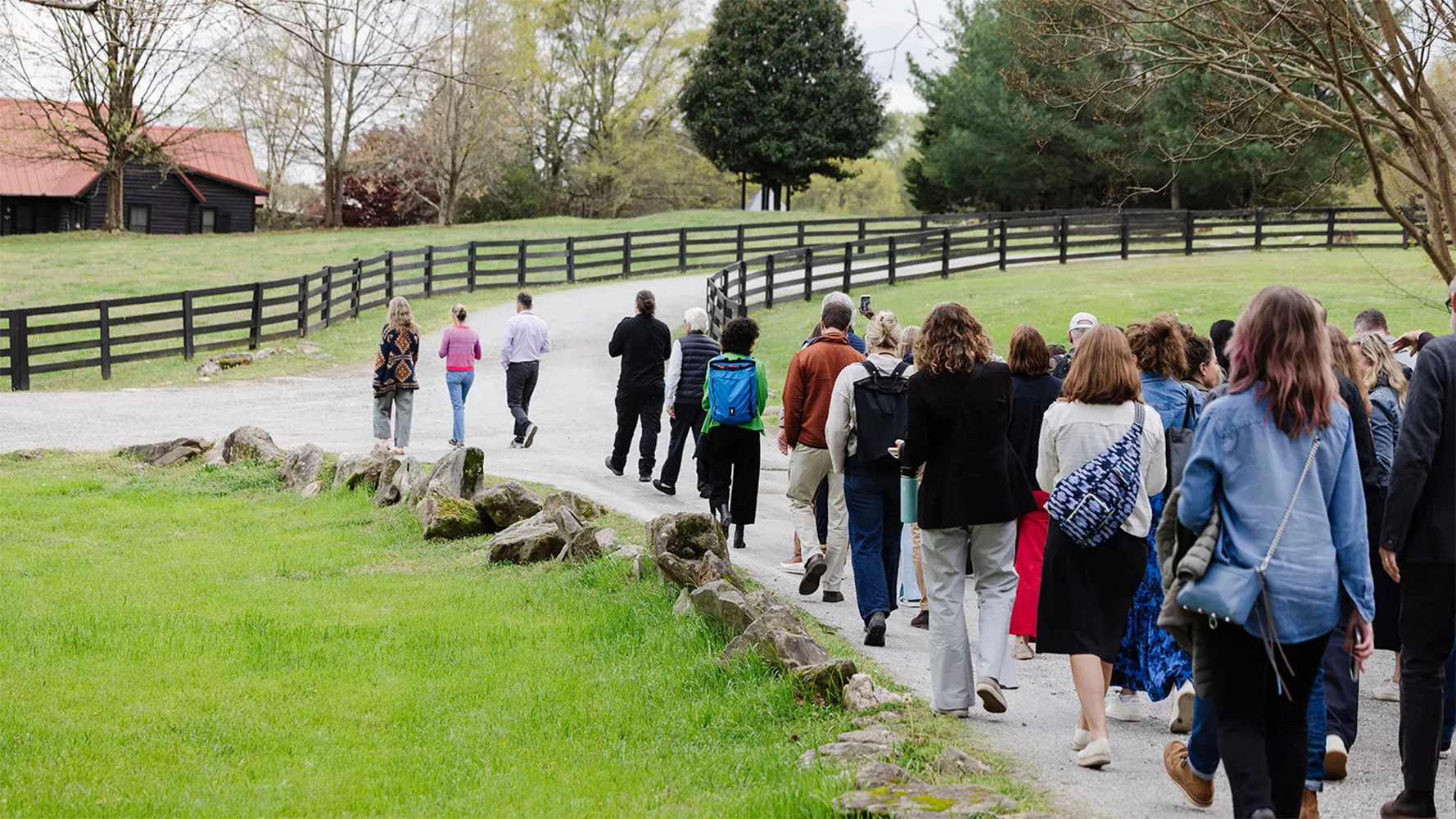
The seventh annual Biophilic Leadership Summit at Serenbe, Georgia. Photo © Foster Branding
Biophilic design is a buzzy, but fuzzy, concept, encompassing everything from the simple act of adorning a space with potted plants all the way to complex infrastructural interventions. In simplest terms, the design philosophy argues that incorporating natural elements and processes into the built environment improves human health, cognitive function, and emotional well-being. Architects and designers have increasingly embraced the idea, knowingly or not, as evidenced by trends ranging from verdant high-rises to the exposure of mass-timber structural elements. However, despite its growing popularity, biophilia’s elastic definition and uneven implementation have led critics to question whether its principles represent genuine innovation or merely a marketable veneer.
In late March, architects, urban planners, academic researchers, and wellness entrepreneurs gathered at Serenbe, a planned community in Chattahoochee Hills, Georgia, for the seventh annual Biophilic Leadership Summit, presented by the Biophilic Institute and Biophilic Cities. Nestled among the rolling woodlands just outside of Atlanta, Serenbe presents itself as an exemplar of community-scale biophilic design. It was founded in 2004 by former Atlanta restaurateur Steve Nygren, an energetic presence at the summit, and draws inspiration from New Urbanism's walkable neighborhoods and mixed-use development patterns, but differentiates itself through a focus on wellness, ecological preservation, and architectural diversity.

Serenbe founder Steve Nygren. Photo © Foster Branding
"People don't know what biophilic design means," Nygren admitted at the event's opening dinner, "but it's not something you can understand logically—you feel it." Rather than offer a concrete definition, he pointed to the "health, harmony, and happiness" of Serenbe community members, which currently number about 1,000, as living testaments to its power.
Of course, those attributes correlate with the privileges of wealth as well, which Serenbe also cultivates. With home prices starting in the mid six-figures and stretching toward the 3-million-dollar mark, the town stands in a long tradition of ground-up urban experiments, like Seaside, Florida, that have struggled to transcend their status as privileged enclaves for those who can afford to escape the challenges that plague the residents of existing cities. While certain qualities—a commitment to preserving 70 percent of its land as green space and a diversity of housing scales—represent meaningful departures from conventional suburban models, Serenbe’s framework raises uncomfortable questions about who benefits from biophilic design.

1

2
Serenbe's neighborhoods include carefully designed main streets (1) and an eclectic collection of residential architecture (2). Photos © J. Ashley
These tensions hung in the air during the summit, which drew an eclectic roster of speakers for three days of panels, presentations, and participatory experiences. The programming toggled between rigorous academic discourse and new-age wellness practices, with technical presentations on economics and materials science sharing the schedule with "focus activation meditation" and "forest therapy” sessions. Attendees could supplement their usual morning coffee with lion's mane–mushroom extracts (purported to enhance cognitive function) and evening cocktails were preceded by "wellness walks" along the community's meandering trails.

Summit attendees participate in a "forest therapy" session. Photo © Foster Branding

Architect Tye Farrow. Photo © Foster Branding
The presenting architects, perhaps best equipped to define and clarify biophilic design, offered varied framings. Tye Farrow anchored the concept at the intersection between architectural praxis and neuroscience and discussed his Toronto-based practice’s healthcare work, including Helmsley Cancer Center in Jerusalem. Thomas Robinson, founding principal of Lever Architecture, presented a theory of regenerative architecture within the context of the firm’s wide-ranging portfolio, and SHoP’s Chris Sharples proposed a high-performance approach to integrating nature in architectural design. Issues of equity and the design philosophy’s broader applications emerged most clearly in a data-driven presentation by Lawrence Frank, a professor of urban studies and planning at the University of California San Diego, who coined the term “walkability” in the 1990s. In his talk, Frank persuasively laid out the connections between human health and the built environment, focusing specifically on the challenges facing Los Angeles.
The most coherent framing of biophilic design came from ZGF Architects' presentation on the new, tree-lined main terminal at Oregon’s Portland International Airport. ZGF principal Rena Simon, joined by sustainability consultants Catie Ryan Balagtas and Bill Browning of Terrapin Bright Green, outlined the firm’s strategic and place-based approach to the ambitious project's biophilic elements, explaining how numerous site studies and informed design choices created an experience that relieves the stress incorporated with commercial air travel.
Looking for quick answers on architecture and design topics?
Try Ask RECORD, our new smart AI search tool.
Ask RECORD →

Catie Ryan Balagtas of Terrapin Bright Green and ZGF's Rena Simon. Photo © Foster Branding
The Summit’s tendency to prioritize innovation rhetoric over critical engagement was most apparent during the panel on AI, led by architect and researcher Tuwanda Green, visual effects and interactive gaming designer Zai Ortiz, and data scientist Jeffrey Smith. I expected some discussion of the technology's potential for data analysis in architectural design, but the panelists focused narrowly on their launch of BioPhilia.One, a large language model–powered generative design platform. The environmental impact of AI systems was left unaddressed, and the panelists seemed ill-prepared for critical audience questions—including one about AI's ability to do more than generate design imagery, and another about the ethical concerns around the technology.
The conference's setting at Serenbe offered both clarity and contradiction. Walking through its thoughtfully arranged neighborhoods during Nygren's guided tour on the last evening, one could glimpse the potential of biophilic community design. Yet the summit largely sidestepped the crucial question of how these principles can be meaningfully translated to existing urban or public contexts, where human-nature connection might deliver the most profound benefits. Systematic public divestment has left many civic success stories in the hands of ventures like Serenbe, which rely on the power of private capital. But there are architects, urban planners, and policy advocates working to implement biophilic interventions in the public realm—and hopefully drive the evolution of such experiments from privileged pastoral retreats into genuinely transformative models.
Looking for a reprint of this article?
From high-res PDFs to custom plaques, order your copy today!