RECORD Forum
Buyer’s Market: Public Housing Agencies Find Opportunities in Market-Rate Buildings
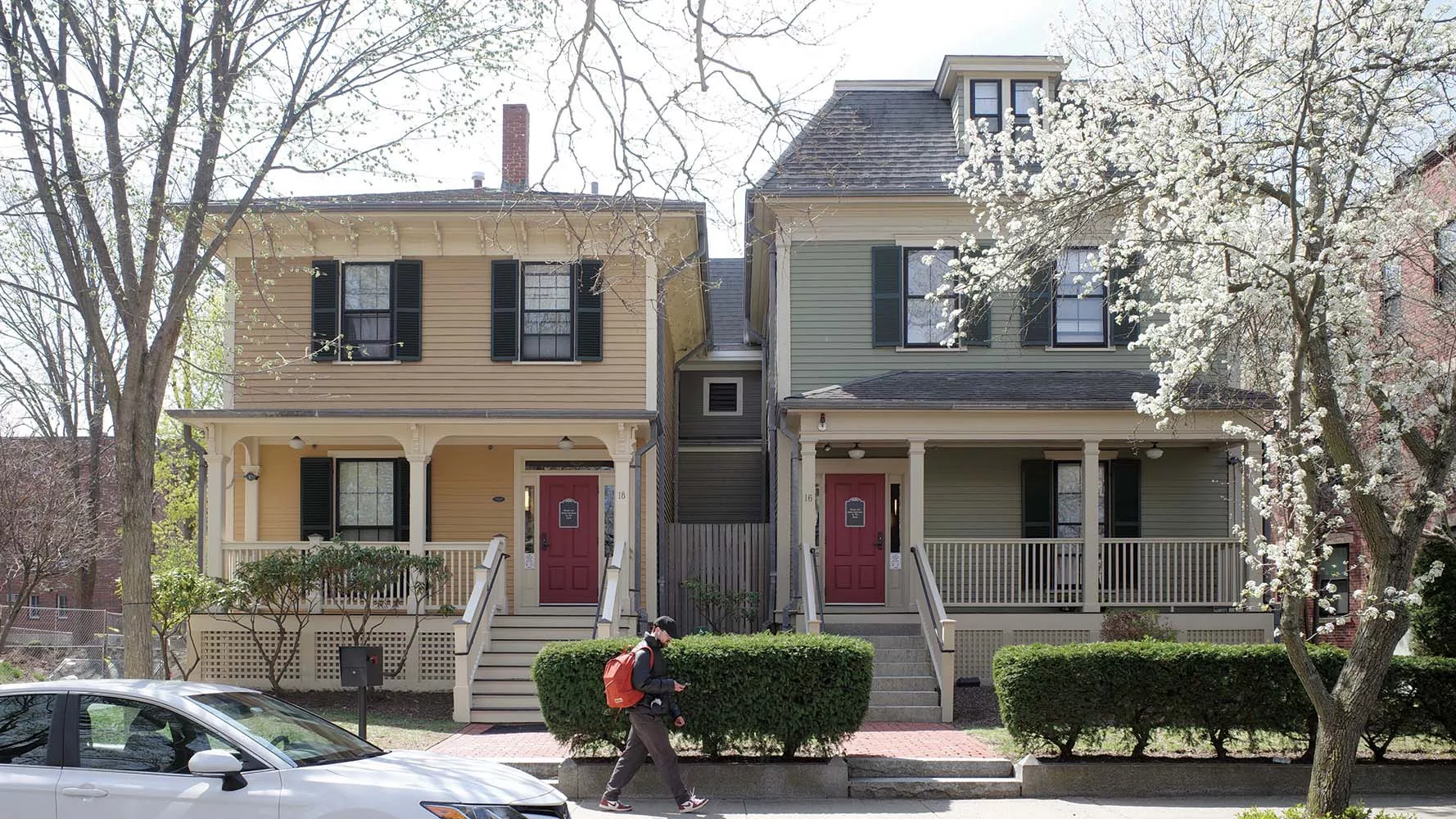
Seen from the brick-paved sidewalk across the street, the small buildings at 16 and 18 Wendell Street in Cambridge, Massachusetts, won’t raise any eyebrows. Their two frontal volumes—fraternal twins mirrored across a 5-foot gap—bear many of the architectural fixings of New England charm: projecting porches, ornate eave brackets, mansard roofs, and decorative shutters. These crisply maintained details attune the buildings to the aesthetics of their leafy neighborhood, which is home to Harvard Law School, affluent professors, and Senator Elizabeth Warren.
What makes 16-18 Wendell different, and worth pondering, is on the inside.
In July 2024, the Cambridge Housing Authority (CHA) purchased 16-18 Wendell Street from its previous owner, nearby Lesley University, and converted the buildings from student dormitories into permanent supportive housing for individuals transitioning from homelessness. After a light remodeling, including the addition of offices for on-site case workers, residents moved into 22 new single-room occupancy units last fall. Bedrooms are private, while bathrooms, kitchens, and lounge spaces are shared—an efficient spatial arrangement that enabled the CHA to provide more people with stable homes and avoid costly renovations. Of the 22 units, 16 are sized for couples—a rare accommodation in this type of housing.
As soaring land and construction costs, compounded by exclusionary zoning ordinances, restrictive building codes, and drawn-out permitting processes, continue to hinder affordable-housing development across the United States, the acquisition of existing buildings has emerged as an increasingly important tactic for housing agencies and nonprofits. Though purchase prices vary from city to city, buying existing units often costs nonprofit developers 30 to 50 percent less than they might ordinarily spend on new construction, in part because accepting public subsidy for ground-up affordable-housing projects entails adhering to a slew of strict code and labor standards that require immense up-front investment. Affordable housing developers, for instance, are often obligated to follow Passive House sustainability guidelines and pay prevailing wages for construction labor—realities that have made affordable housing costlier to build than market-rate housing in many cities.
For the CHA, acquisition is not a new strategy. The agency has purchased upward of 300 existing units since the late 1980s, though Cambridge’s astronomical property values have made good opportunities increasingly hard to come by. “Despite being in the market, we get very few workable options at a price point and in a condition that would allow us to acquire an existing building,” says Margaret Moran, the CHA’s deputy director. But, when the right building does come along, the upsides are unmistakable. The Wendell properties cost the CHA less than $400,000 per unit to bring online, far below the $600,000+ per-unit development costs that are typical for affordable housing in the area. And, because Lesley had recently refurbished the properties, CHA was able to move residents into their new homes within about four months of the purchase, outpacing typical development timelines by years.
Another advantage, particularly in urban centers, is scale. Patrick Bonck, an assistant vice president at the New York–based nonprofit developer Breaking Ground, told RECORD that buying existing buildings is often the only way to bring a substantial number of affordable units to high-cost neighborhoods. “To get 450–600 units in neighborhoods that generally have the highest property values is a win for New York City and equitable distribution of supportive and affordable housing,” he says. Breaking Ground recently acquired a 19-story dormitory and skilled-nursing facility at the edge of East Harlem, aiming to convert it into 434 units of low-income and permanent supportive housing by 2026.
While acquisition represents a long-standing approach for some entities, it marks a shift for others. In early 2025, the Austin Housing Finance Corporation (AHFC) partnered with local nonprofits to purchase a 384-unit multifamily complex on the north side of the Texas capital—AHFC’s largest acquisition to date and its eighth in under three years. The Philadelphia Housing Authority (PHA) has turned even more aggressively toward acquisition to help meet an ambitious goal of creating or preserving 30,000 affordable units citywide. Since last year, PHA has purchased an aging residential center for seniors, two recently built student housing complexes in University City, and numerous other apartment buildings in high-opportunity neighborhoods.
Looking for quick answers on architecture and design topics?
Try Ask RECORD, our new smart AI search tool.
Ask RECORD →
In some of these properties, existing owners had seen dwindling demand and increased vacancy for years before selling to PHA—enabling the authority to buy the units at a competitive price. In the apartment buildings it acquires, PHA does not evict any residents, electing instead to incrementally convert roughly 60 percent of units into voucher-subsidized affordable housing through normal attrition. The other 40 percent of units remain market rate, creating what PHA president and CEO Kelvin Jeremiah calls “balanced communities.”
Because Philadelphia generally has more inventory and lower land costs than cities like Cambridge, the financial benefits of acquisition are even starker. Jeremiah notes that, while ground-up development can cost $550,000 or more per unit, the per-unit price of existing ones averages out to about $225,000, even in the relatively new or recently renovated properties PHA usually seeks out. “For every one unit we can build,” he emphasizes, “we can buy two!”
Jeremiah highlights several factors as motivation for the shift toward acquisition, among them the power of community pushback to kill new-construction affordable housing, particularly in wealthier areas. Buildings that are already part of a neighborhood’s fabric, like PHA’s portfolio of recent acquisitions or 16-18 Wendell, are less likely to face opposition than the imposition of something new.
PHA president and CEO
Jeremiah notes that many Philadelphians’ misgivings about living near affordable housing reflect dated misconceptions about public housing. Citing the availability of gyms, bike storage, on-site parking, and recreation areas in many newly acquired buildings, Jeremiah argues that these are “high-quality properties, developments where anyone—regardless of their income—would want to live.” Perhaps most critically, the PHA’s embrace of acquisition affords low-income residents access to safe, walkable, and amenity-rich neighborhoods that would otherwise be prohibitively expensive.
As with any response to the ongoing housing crisis, acquisition is no panacea. States, housing agencies, and nonprofit developers should continue to push for new development on vacant or underused parcels in well-resourced communities—an approach that would be eased considerably by bold regulatory reform and investment in cost-cutting innovations like off-site construction. Under ideal conditions, such efforts can produce high-quality and well-designed units, increase the total housing supply, enhance neighborhood diversity and vitality, and improve health and social outcomes for residents.
In the many cities where the scale of the affordability crisis far outpaces the capacity of nonprofit developers to cut through red tape and build, acquisition presents an essential alternative to new construction—one that lowers costs for developers and housing agencies, reduces construction-related disruption for neighbors, and gives low-income residents a place to live within months rather than years.
For Jeremiah, weighing the prospect of an 18-month permitting process followed by another 18 months of ground-up construction makes the stakes clear: “Families who have urgent housing needs frankly cannot wait for three years.”
Looking for a reprint of this article?
From high-res PDFs to custom plaques, order your copy today!