HDR’s New Home for the Orange County Sanitation District is as Practical as the Agency Itself

Main lobby view of the new OCSan headquarters in Fountain Valley, California. Photo © Dan Schwalm
Architects & Firms
Orange County, California, has long been an outlier when it comes to water conservation given its long history of treating and reusing its wastewater, in contrast to neighboring Los Angeles County, which treats it and releases most of it into the Pacific Ocean. The new headquarters for the Orange County Sanitation District (OCSan), which opened earlier this year in the suburban city of Fountain Valley, reflects that ethos of common sense when it comes to embedding sustainable principles in its design.
Kate Diamond, civic design director at HDR, leveraged the firm’s’s multi-disciplinary roles—it was not only the architect, but also the structural, civil, and MEP engineers—to realize a fully integrated design approach. “The client really wanted a design that could give them great views to nature and to take a site that was previously 95 percent paved and turn it into an ecosystem,” Diamond says.

The main entrance faces out to a parking lot populated with photovoltaic canopies. Photo © Dan Schwalm
The headquarters also had to address a number of other client needs, such as consolidating nearly 300 staff who had been spread among other county buildings and trailers of varying quality, create a new boardroom for the department’s public meetings, and provide an operational base for staff who regularly access the sprawling campus of water testing laboratories and treatment facilities across busy Ellis Avenue to the south.
Unlike other district facilities, including the nearby water laboratory, which Diamond designed while at HMC Architects in 2009, the new OCSan building is regularly accessed by the public for tours, meetings, and student groups interested in learning about “where poop goes,” as Diamond says. The 109,000 square foot building is organized between a public-facing lobby on the west and two three-story office wings that sprawl to the east, cradling a courtyard and amenity space that affords daylight and landscape views.
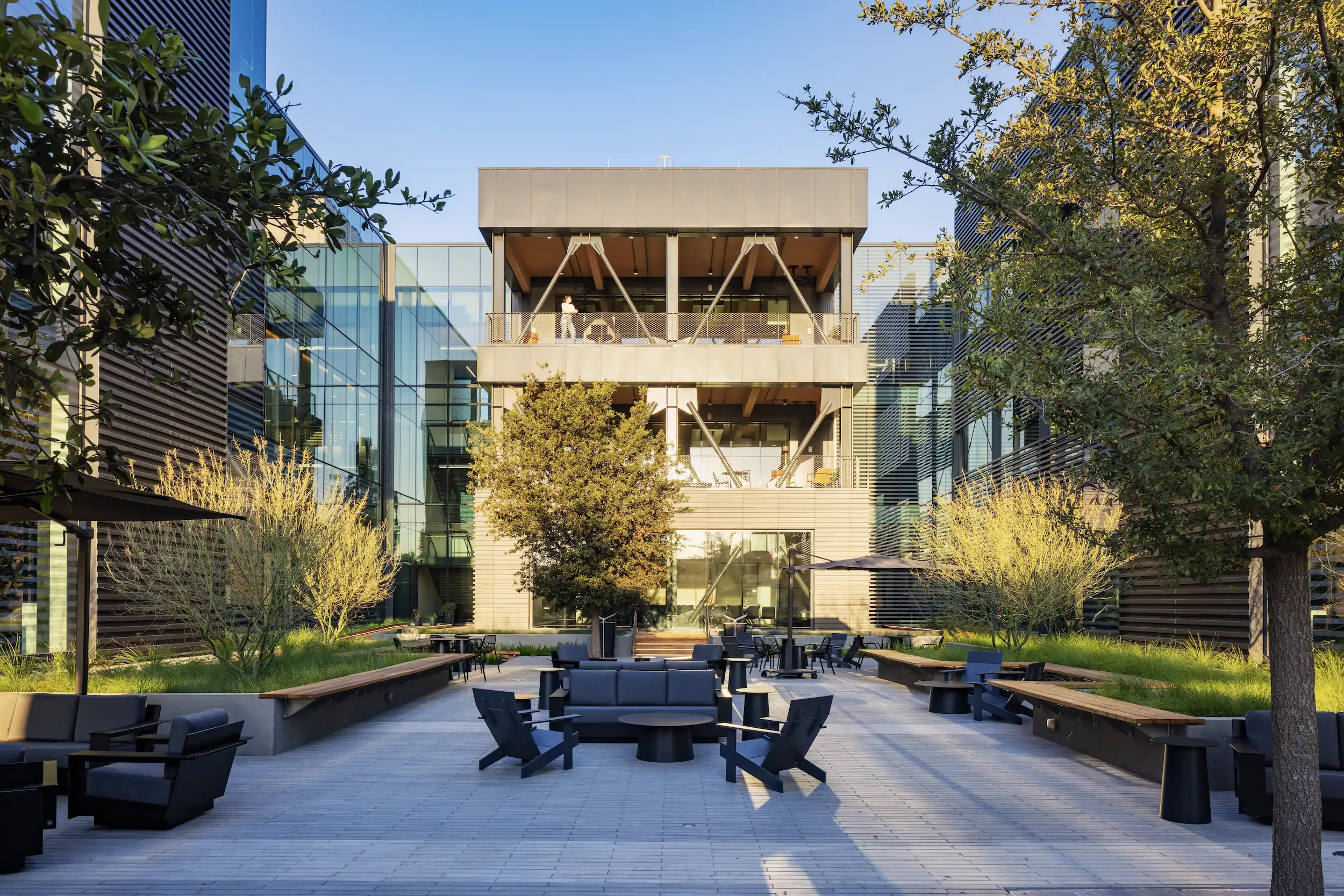
The complex features a spacious central courtyard flanked by two office wings.Photo © Dan Schwalm
The public entrance to the building, from the northwest corner, unfolds in layers from a parking lot covered in photovoltaic canopies to a terraced plaza and garden to a rectilinear portico canopy that acts as a public information display just outside of the main doors. Inside, the two-story lobby is spanned with a large mass-timber diagrid structure that supports a wood slat ceiling for acoustic dampening and integrated linear lighting, as well as accomodates large expanses of glazing that flood the space with daylight. The exposed concrete floor contains a radiant heating and cooling system. Immediately to the right of the lobby is the boardroom, separated with a folding wall that opens up the space for larger public events.
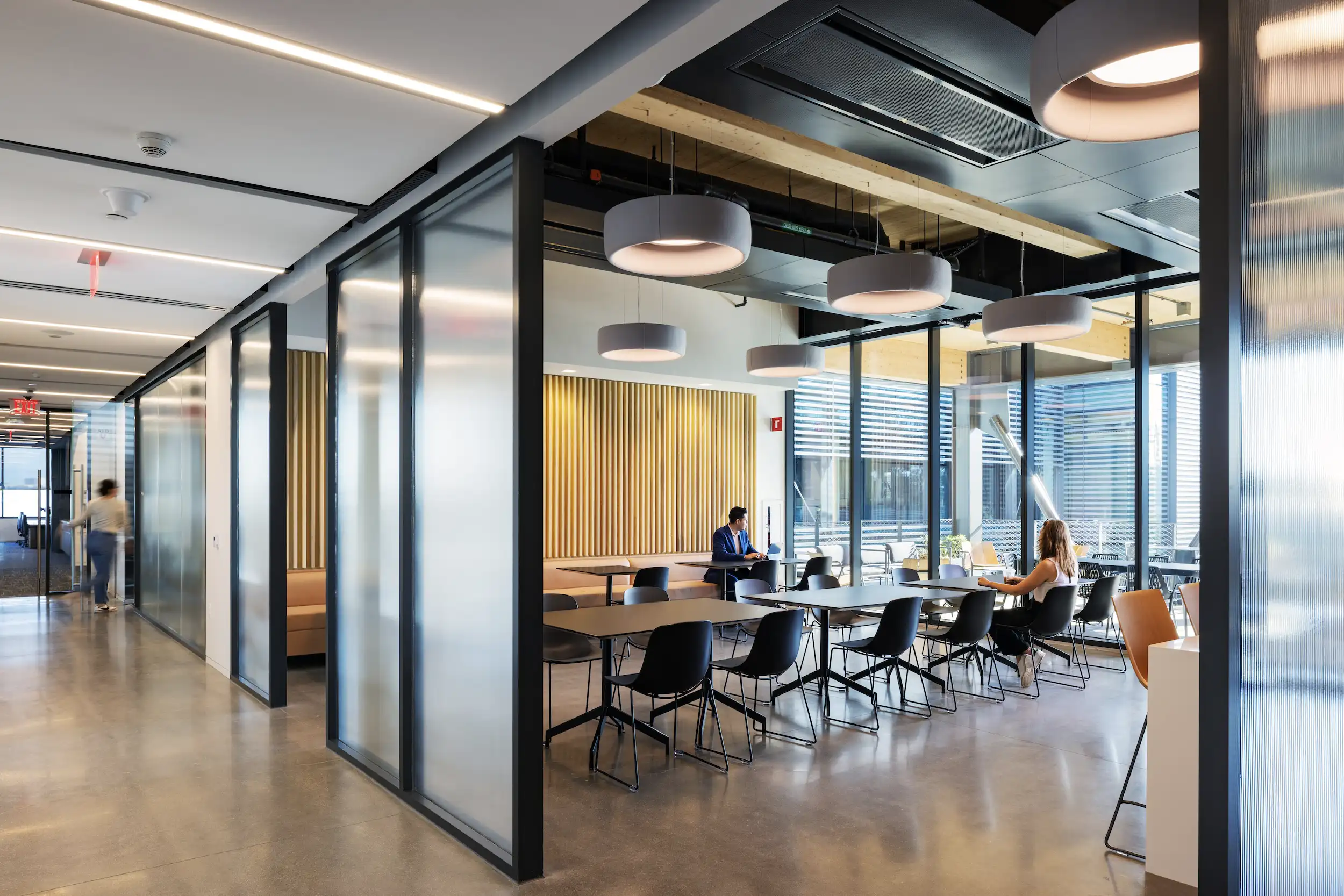
1

2
Abundant daylight floods both administrative (1) and public (2) areas at the headquarters. Photos © Dan Schwalm
The color palette throughout the building is muted, with bronze corrugated metal panels and painted structural elements contrasting with the lighter black spruce timber elements, white plasterboard walls, and glass partitions. In a nod to water, restrooms, conference rooms, and shared kitchens on the office floors are finished in a light blue. The color scheme extends to the walls and ceilings and even the chilled beam mechanical system. In the open office areas, HDR integrated mechanical, lighting, fire sprinklers, and acoustics into suspended panels that allowed the timber structure and ceilings to be fully revealed.
The building’s structure is a hybrid of mass timber, moment-frame steel (in the lobby), and braced-frame steel, which resulted in a lighter structure compared to steel-only and allowed the engineers to reduce the need for deeper foundations. The cheaper foundation also helped offset the additional costs related to timber. HDR carried two parallel designs through design development—hybrid timber-steel and fully steel. Diamond says it came down to a marginal difference when the costs came in and a state grant to incentivize timber use in buildings helped seal the deal.
Looking for quick answers on architecture and design topics?
Try Ask RECORD, our new smart AI search tool.
Ask RECORD →

3
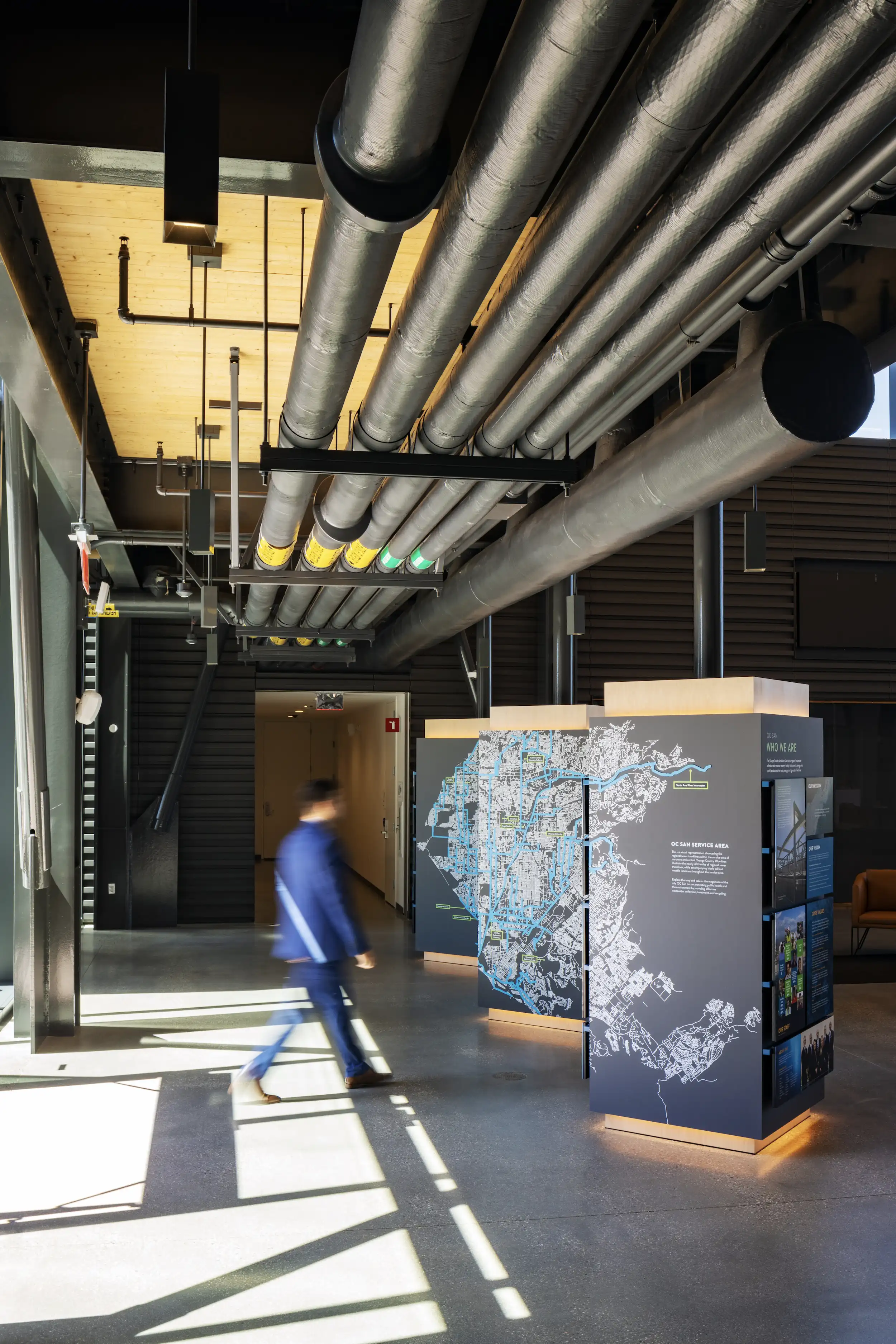
4
A footbridge spans over a terrace located off the lobby (3); educational exhibits are meant to engage with the community (4). Photos © Dan Schwalm
To reduce embodied carbon, the project’s timber fabricator, Timberlab, shipped everything by train from Oregon on a just-in-time delivery method to avoid the need for storage. Overall, HDR estimates the building reduce embodied carbon by 58 percent compared to a conventional steel building.
The exterior envelope is a combination of a glass curtain wall, terra-cotta rainscreen panels, and corrugated aluminum. The south elevation, along Ellis Avenue, features a large aluminum brise-soleil that provides solar shading for the curtain wall, improving daylight quality for the offices and meeting rooms inside.
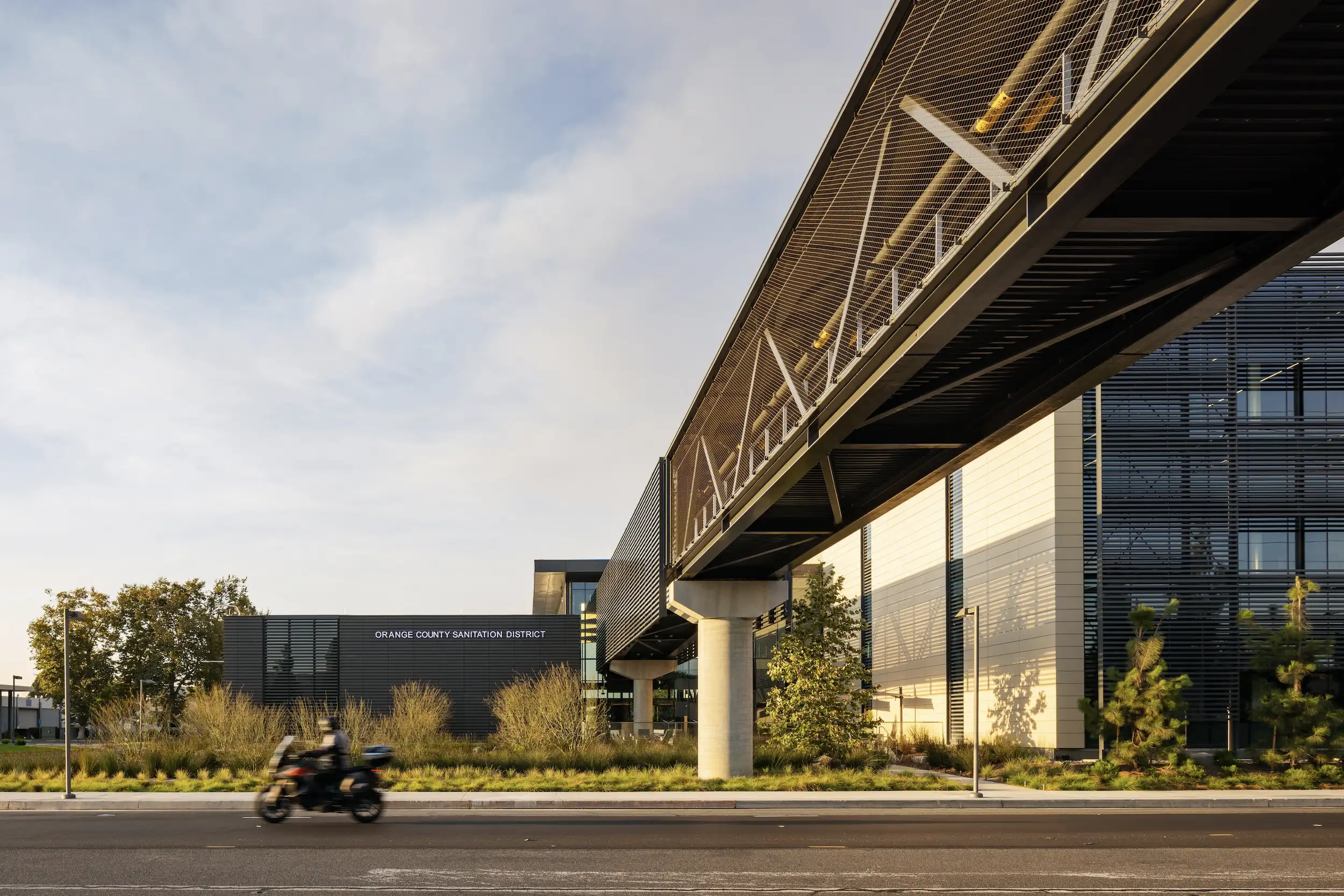
A pedestrian bridge safely carries county employees and tour groups over a busy street to the district water treatment plant. Photo © Dan Schwalm
Although not included in the original project definition, HDR proposed a 104-foot pedestrian bridge to connect the building across Ellis Avenue to the south campus. The move not only made the campus more easily accessible, saving staff time, but it allowed the new building to connect to an existing central plant to harvest waste heat for the building’s hot water. It aso enabled the new headquarters to benefit from an innovative waste-to-energy system that meets 60 percent of the building’s annual energy demands. The photovoltaics in the parking lot makes up the remaining 40 percent, which is setting the building up to achieve International Living Future’s Net Zero Energy certification.
For a project that did not include sustainability goals in the original brief, let alone a biophilic, human-centered design agenda, the new OCSan headquarters sets a benchmark for public buildings by capitalizing on the straight-forward practicality of the agency itself.
Click section diagram to enlarge

Click site plan to enlarge
.jpg)
Looking for a reprint of this article?
From high-res PDFs to custom plaques, order your copy today!

.webp?height=200&t=1759411598&width=200 "Vancouver_Art_Gallery_(39595096015).jpg")