With a New Outpost Designed by Diller Scofidio + Renfro, London’s V&A Museum Invites the Public into Its Storage
London
Architects & Firms
It’s no accident that the encyclopedic, universalizing museum flourished at the same time as the department store. It took empires, railroads, steamships, and the exponential expansion of commerce to achieve such a concentration of goods and objects in one single space. Both types of institutions required a place of display and a place of storage, and both turned to similar architectural solutions when exhibiting their wares, with top-lit atria giving access to lateral galleries. Who hasn’t felt the parallels between shopping and gallery-going, especially when visiting a place like London’s Victoria and Albert Museum (V&A), whose collections focus so strongly on fashion, design, and the domestic realm? But the parallels only go so far: while the department store seeks to shift its stock as fast as possible, the museum aims to preserve its holdings for perpetuity; and, while the retail sector has long opened its warehouses to customers (one immediately thinks of home-improvement outlets, or, of course, IKEA), only a handful of museums allow visitors a glimpse of their storage. With its just-completed East Storehouse project, the V&A has gone further than any before, since its reserve collections are now freely accessible to anyone who cares to walk in off the street.
One of the charges often leveled at encyclopedic museums is that they have far too much stuff, 99 percent of which is never visible. By opening up the reserve collections, the argument goes, you make these institutions less profligate and also less elitist, since the experience in the storage racks is visitor-driven rather than curator-mediated. At the V&A, whose holdings belong to the nation, the idea of opening up the reserves was first proposed in 2015, when the British government announced its intention to sell Blythe House, an enormous Edwardian building in Kensington that, from 1979 onward, served as storage for the British, Science, and Victoria & Albert museums. By that point, the V&A had already announced plans for an East London outpost at Stratford (designed by Irish office O’Donnell + Tuomey, the V&A East Museum is due to open next year), part of a $1.5 billion Olympic Games legacy scheme that includes new premises for the Sadler’s Wells dance theater and the London College of Fashion. As luck would have it, the V&A found suitable storage space just 10 minutes’ walk from its Stratford site, thereby allowing the museum to reinforce its commitment to this underprivileged sector of London.
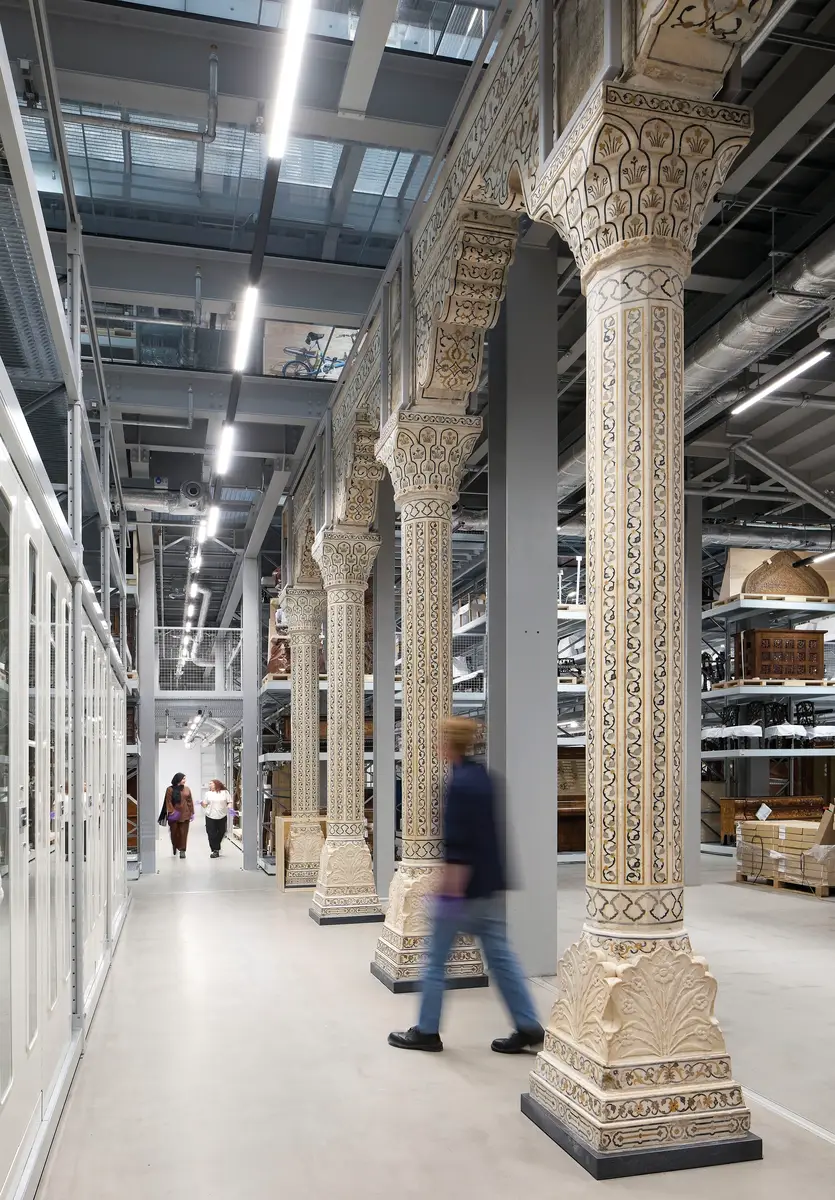
At nearly 40,000 pounds, a 17th-century colonnade from Agra is the heaviest of all the objects in the Storehouse collection. Photo © Hufton+Crow
Originally built by Allies and Morrison as the Olympic Media Centre, and afterward converted by Hawkins\Brown into a tech and startup hub called Here East, the enormous building in which the museum has leased space “was the blankest of blank canvases, a giant tin box,” says V&A deputy director Tim Reeve. Located in Here East’s southeastern corner, the windowless volume comprised two superimposed cuboids, each with a floor plate of 65,000 square feet. The V&A’s 2016–17 design competition asked entrants to fulfil three main goals: fit in all the holdings—over 250,000 objects, a 350,000-volume library, and nearly 1,000 archives—with space to spare; provide meaningful public access; and incorporate five architectural fragments that are too big for permanent display in the museum’s exhibition buildings. Representative of the Wunderkammer variety of the V&A’s collecting, these vestiges range from an elaborate Spanish Mudéjar ceiling from Torrijos and a Mughal marble colonnade from the Agra Fort to a Frankfurt kitchen, Frank Lloyd Wright’s plywood-lined office for Edgar J. Kaufmann, and a chunk of facade from Alison and Peter Smithson’s Robin Hood Gardens (a recently demolished social-housing project that stood in nearby Poplar). Of the six finalists, which included 6a, Haworth Tompkins, and Robbrecht en Daem, New Yorker Diller Scofidio + Renfro (DS+R) emerged victorious, with a scheme that plunges the visitor into the heart of the deliriously eclectic collections.
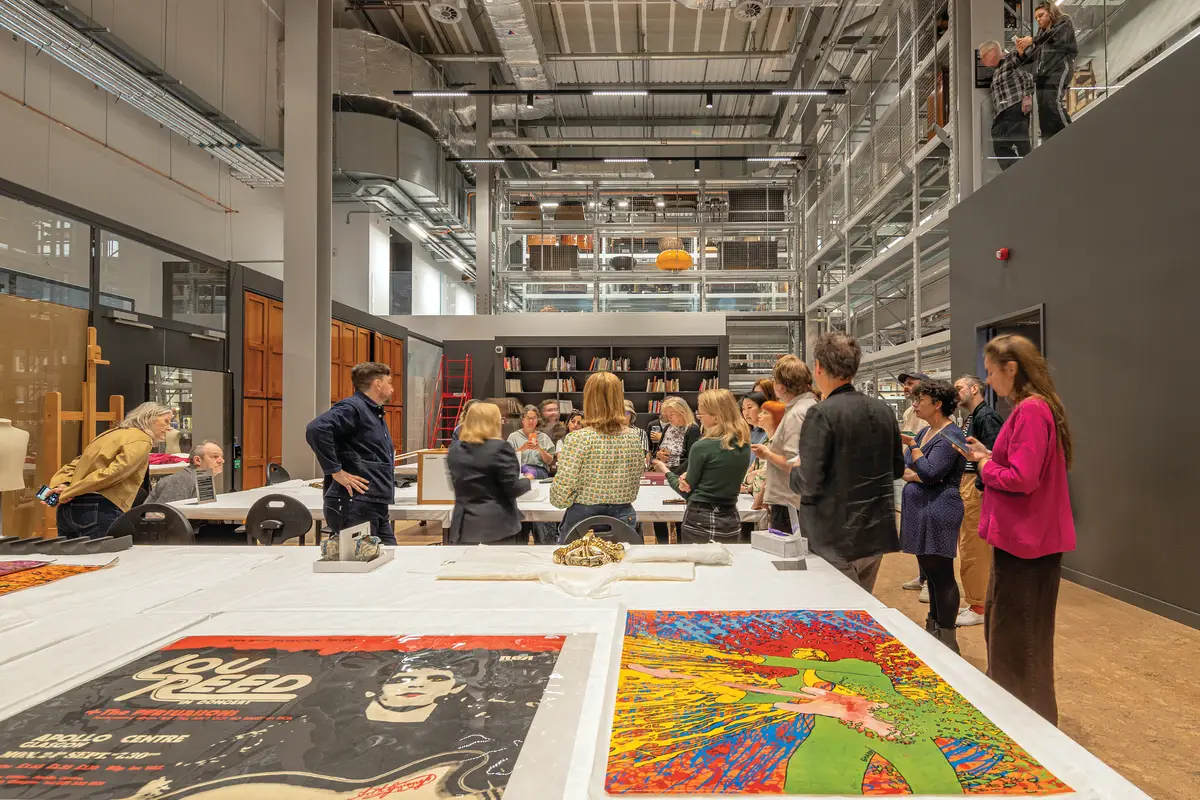
A textiles-study center allows access to items. Photo © Danica O. Kus
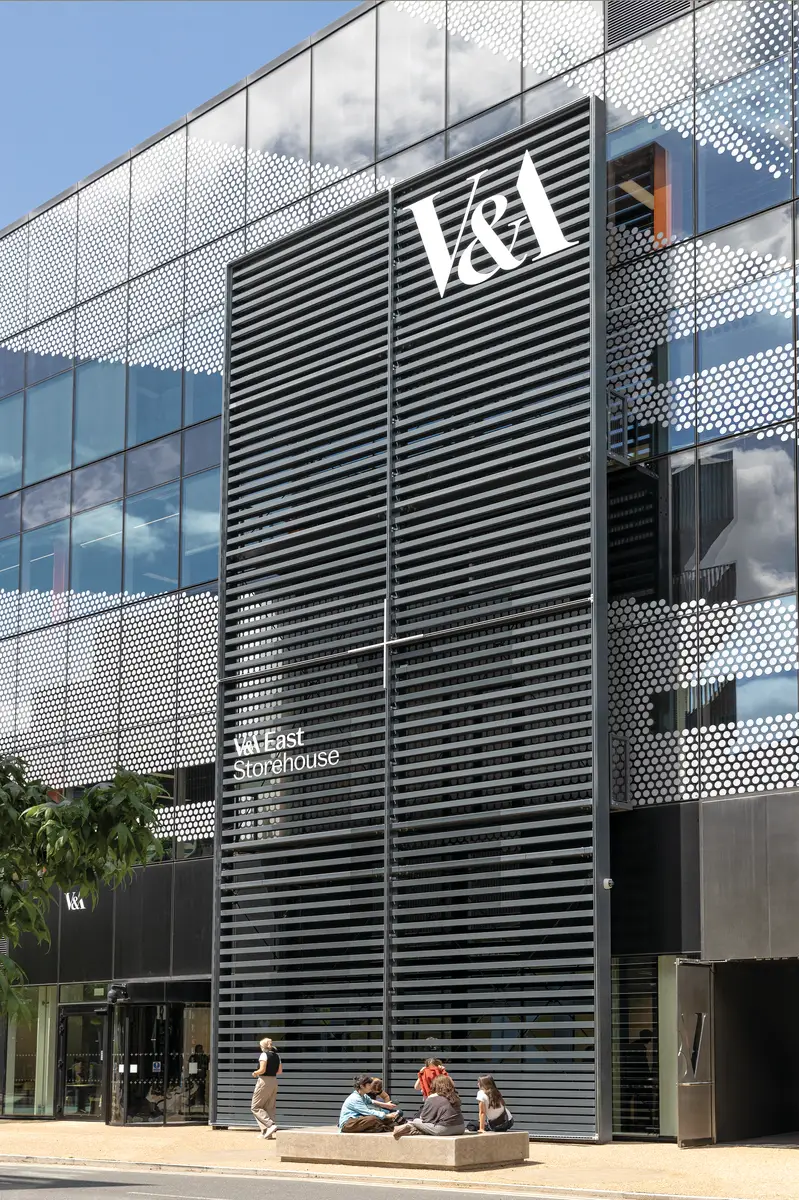
The entrance is signaled by low-key signage. Photo © Danica O. Kus
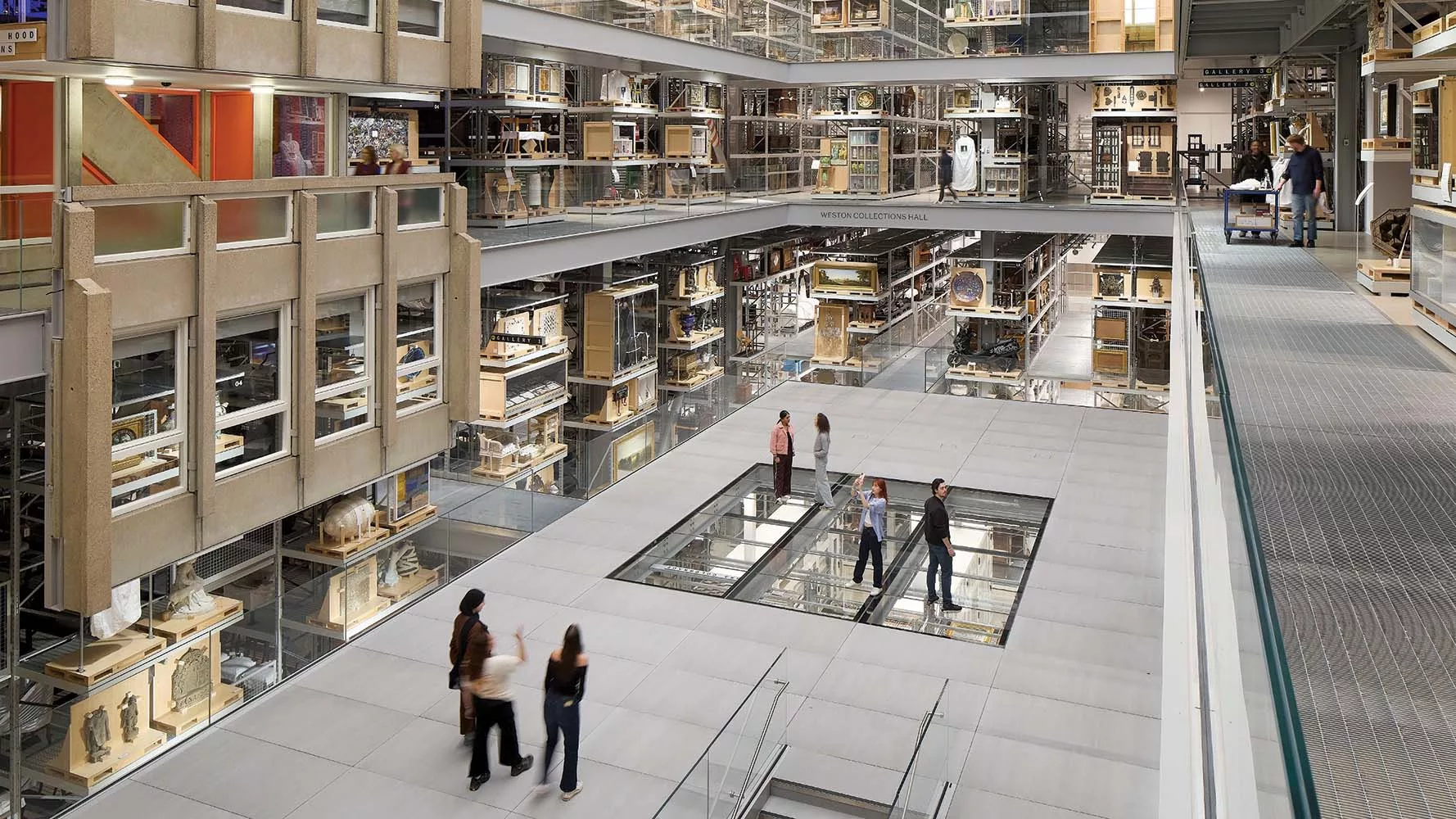
Unlike the other proposals, which allowed public access at the edges and kept the center closed off for the restricted stuff, DS+R’s brings visitors right into the middle of the space, where a giant atrium, cut through the original floor, allows them to apprehend the entire scope of the collections. By adding two new intermediary levels, DS+R brought surface area up to 172,000 square feet, with movable gates that allow the public to penetrate more or less deeply into the racks leading off the atrium’s walkways (restricted areas are pushed out to the edges). The drama of this approach is accentuated by what Reeve describes as “the slow reveal,” which begins out in the street, where the extremely discreet entrance is signaled by some very low-key signage. “It’s part of the modesty of the place,” says Liz Diller. “It’s not meant to be showy; it’s not meant to be an institution. It’s a working building to which the public is invited.” Once over the threshold, the bland but friendly entrance hall gives access to educational spaces to the left and a cafeteria to the right, while straight ahead a glass wall allows visitors their first glimpse of the collection racks. Tricky and expensive to realize, due to fire regulations, the glass is traversed at its center by a dark-steel stairway, which the public must climb to enter the climate-controlled Storehouse proper.

Rotating displays occupy shelf ends. Photo © Hufton+Crow
Once through the stair’s doors (like Alice through the looking glass), we immediately find ourselves among storage racks, which the curators have cheekily filled with portrait busts that act as a welcoming committee from across the ages. Another flight of stairs consummates our giddy ascent into the drama of the central atrium on level two—since forklift trucks operate at grade, visitors may only access the ground-level racks in the company of a curator, but a large glass panel in the atrium floor allows the activity below to be observed, as well as providing a tantalizing glimpse of the Agra Colonnade. Further architectural theater is provided by the Robin Hood Gardens fragment—so heavy it had to be installed right at the beginning of construction—which hangs clifflike off one side of the atrium and whose “streets in the sky” determined the width of the atrium’s decks. To complete the effect, DS+R wanted to open a skylight in the atrium’s roof, but conservators quashed that idea for fear of UV rays; instead, a vast luminous ceiling provides a simulacrum of daylight.
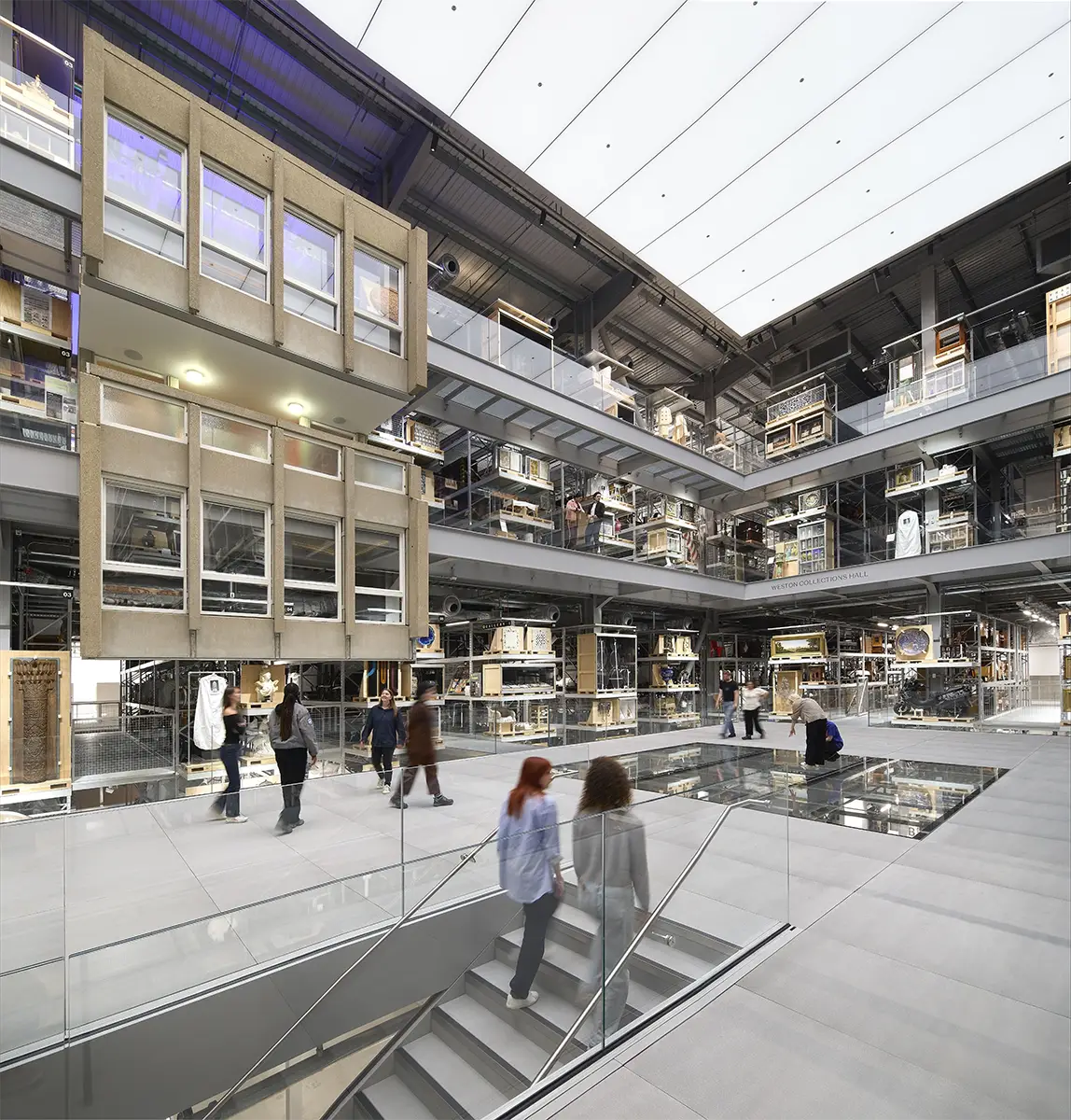
Among the large-scale architectural artifacts on display is a fragment from Robin Hood Gardens. Photo © Hufton+Crow
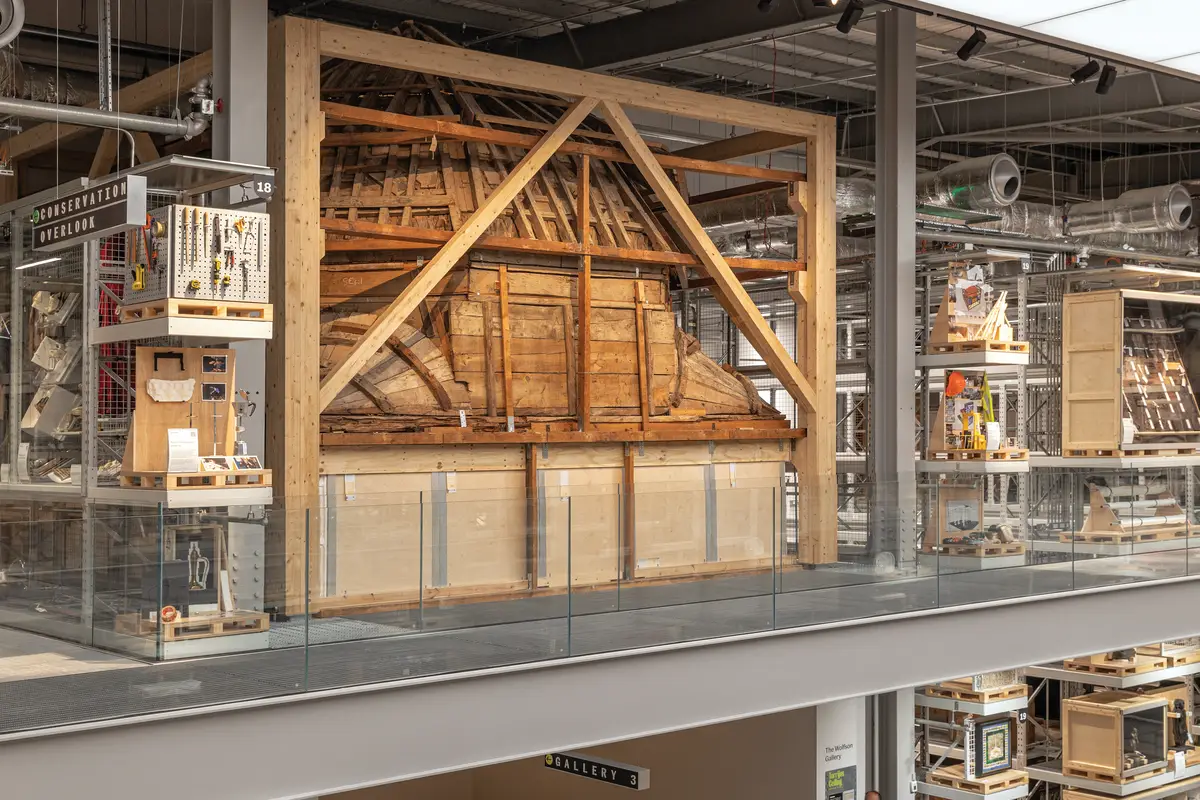
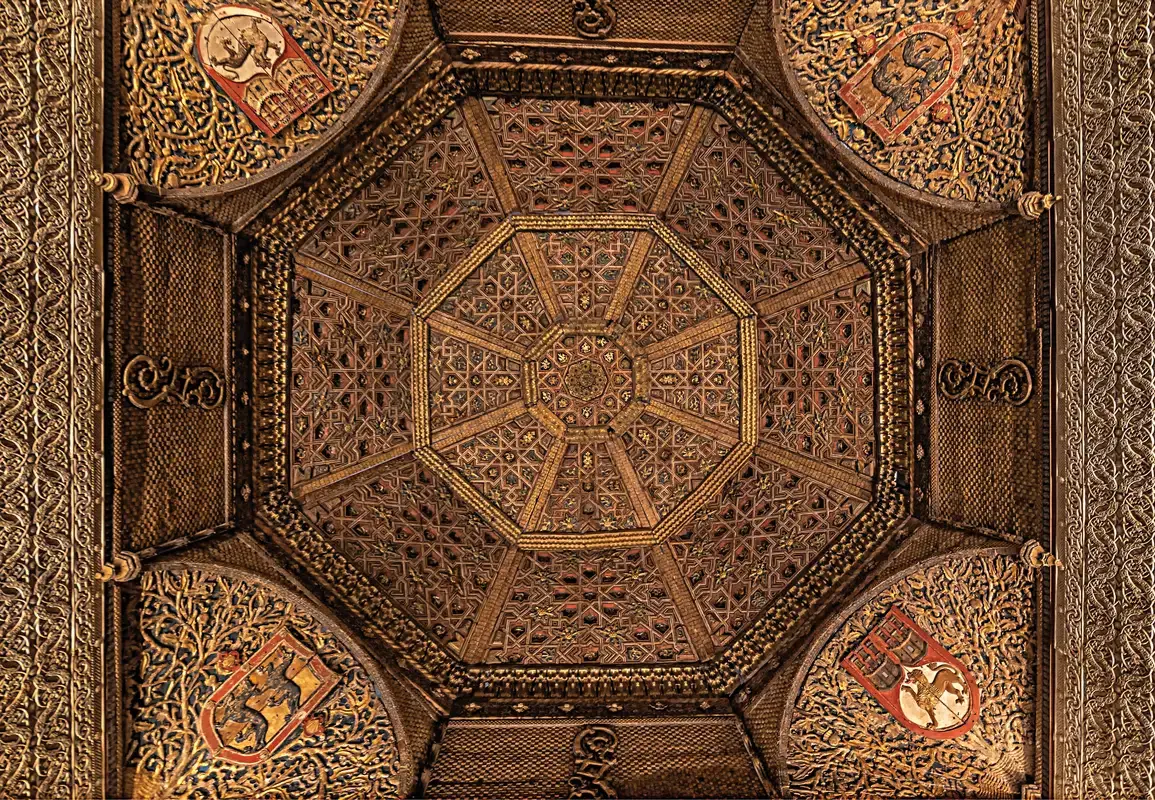
With its top-lit, hollow-out-the-middle approach, DS+R has inadvertently reproduced the classic museum/department-store model, only here the galleries leading off the atrium are made from commercially available steel floor grills and are filled with exactly the same adjustable pallet racking one would find in the warehouses of IKEA and Amazon (“hacked,” in the atrium, to allow displayed storage rather than just a view of shelf ends). Like the private fitting salons in the grand stores of yore, rooms are set aside for an order-an-object service, via which anyone can ask to see an artifact up close. Since part of Storehouse’s mission is to reveal and demystify the museum’s backstage activities, visitors can look down through glass into conservation workshops; a large gallery with a balcony allows theatrical cloth drops to be both displayed and restored. Even the Torrijos ceiling reveals its workings, since its outer surface, usually hidden, is here exposed. While other museums have experimented with displayed storage—notably New York’s Metropolitan Museum of Art; Vitra’s Schaudepot (Herzog & de Meuron), in Weil am Rhein, Germany; Rotterdam’s Boijmans Van Beuningen (MVRDV); and the Broad, by DS+R, in Los Angeles—none allows such extensive, unprotected access to its reserve collections as the V&A.
1
2
The Torrijos Ceiling (1 & 2) is installed with its outer surface visible. Photos © Danica O. Kus
Ultimately, the V&A East Storehouse is a project of shelves, ducts, and cables, with copious HVAC to ensure the right temperature and humidity, and dry sprinklers in far greater quantities than you’d usually find in a warehouse, because of the public’s presence. While all these innards are revealed, they are never overly dramatized or fetishized, and detailing—folded-steel stairs, glass handrails, mitered floor grills—remains sober and discreet. “It’s not trying to be heroic. It’s not trying to say ‘Look at me.’ It’s merely a platform for the stuff,” explains Diller. Though the V&A has not released a figure for construction cost, DS+R’s margin for maneuver was clearly limited, given that the entire project, including moving and digitizing the collections, came in at just over $85 million. In a culture where shopping is a major leisure activity, allowing the public into its warehouse IKEA-style is a canny move on the V&A’s part, one that is intended to entice new audiences. Driven by the lack of cash, DS+R’s low-tech lightness of touch serves that goal ideally.
Click plan to enlarge

Click section to enlarge

Credits
Design Architect:
Diller Scofidio + Renfro
Local Architect:
Austin-Smith:Lord
Consultants:
Arup UK (structure, services, lighting); ORSA (principal design advisors); Hoare Lee (AV); Gardiner & Theobald (cost); Studio Gardere (exhibition-competition phase); Beam Lighting Design (lighting); IDK (archival display); Fieldwork Facility (wayfinding, interpretation); We Not I (external signage)
Project Managers:
Colliers, Artelia
Owner:
Victoria and Albert Museum
Size:
172,000 square feet
Cost:
Withheld
Opening Date:
May 2025
Sources
Display and Storage Systems:
Solved, Link51, Bruynzeel, Polstore, Kardex
Wayfinding / Interpretation:
Standard8
Looking for quick answers on architecture and design topics?
Try Ask RECORD, our new smart AI search tool.
Ask RECORD →
Looking for a reprint of this article?
From high-res PDFs to custom plaques, order your copy today!