With Large-Scale Events in Mind, Trump Goes Full Steam Ahead in Revamping the White House Grounds

Interior rendering of the big, beautiful ballroom planned for the White House. The Trump administration says the $200 million expansion will fill a need for a large, formal event venue on the White House grounds.
There was no shortage of of hand-wringing over the 2020 redesign of the White House Rose Garden by Garden by Oehme, van Sweden that involved the removal of its flowering crabapple trees, a more muted planting scheme, infrastructural improvements, and the addition of a limestone path encircling the central lawn. But at the end of the day, what emerged from that Melania Trump-commissioned effort was still a garden.
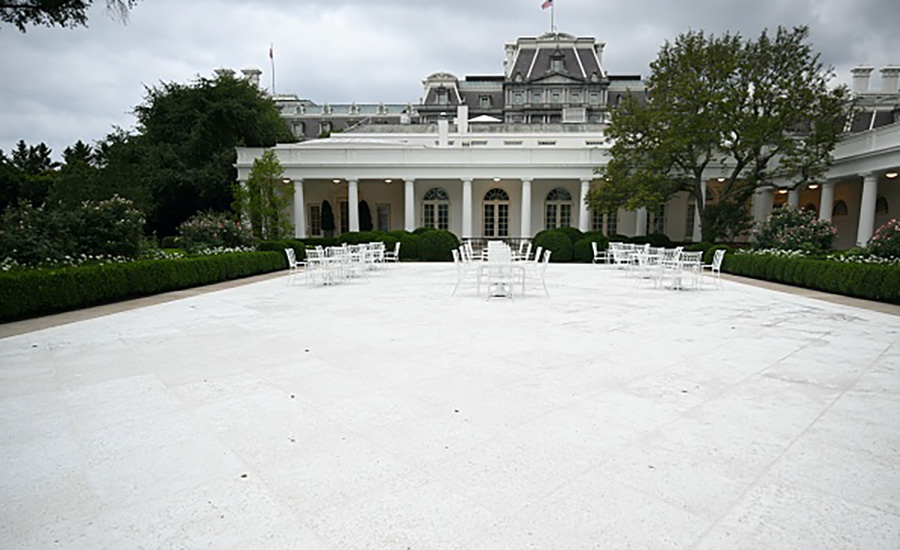
View of the newly paved patio at the White House Rose Garden on August 1. Photo by Jim Watson/AFP via Getty Images
This can’t be said about the Trump administration’s latest scheme to overhaul the beloved green space on the east side of the White House, which was created in its modern form during the administration of John F. Kennedy by socialite and self-taught horticulturalist Rachel “Bunny” Mellon, joined by landscape architect Perry Wheeler. (Earlier versions date back to 1913 when First Lady Ellen Axson Wilson brought on landscape architect George Burnap to create what was the first White House Rose Garden.)
The newest reworking of the garden does away with the landscape’s anchoring element, the central lawn, altogether, paving over a sizable patch of manicured turf with stone pavers arranged in a diamond pattern to create an events patio. Drainage gates along the periphery of the patio are shaped like American flags and the presidential seal can be found in all four corners. Some greenery has been spared, including the rose bushes and hedges bordering the new patio, but the White House Rose Garden as it has existed for decades has essentially been erased.
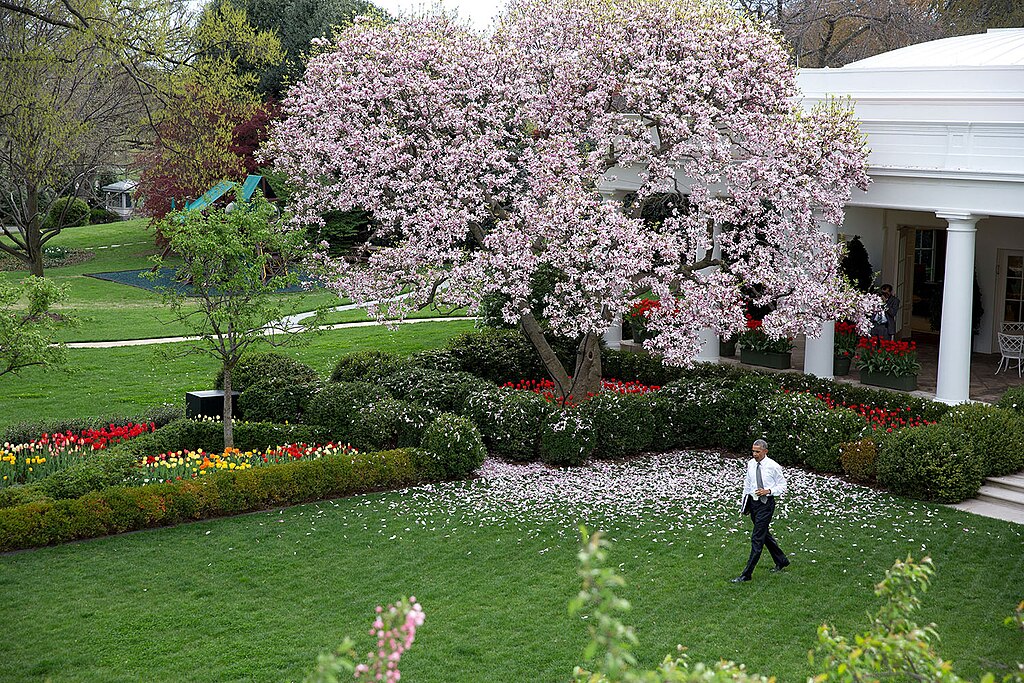
President Barack Obama walks through the White House Rose Garden in 2015. Photo by the White House, Wikimedia Commons/Public Domain
While the lawn-to-pavers swap-out at the Rose Garden continues to generate largely dismayed reactions, Trump also revealed plans to further generate event space at the presidential residence in the form of a 90,000-square-foot ballroom—again, Mar-a-Lago style. (An additional, ultra-gilded ballroom was added to that landmarked property by Trump in 2005.) The expansion would be nearly twice the size of the White House proper, which, not including the East and West Wings, has a total square footage of 55,000 feet.
According to a press release, the 650-seated-capacity venue would replace outdoor tents erected for large-scale events and would be “substantially separated” from the main building of the White House adjacent to the reconstructed East Wing. The largest existing space at the White House for formal events and receptions, the East Room, can accommodate roughly 200 guests.
.webp "white house rose garden")
The White House Rose Garden pictured in October 2020, following a renovation performed earlier that year. Photo by The White House, Wikimedia Commons/Public Domain
With an estimated price tag of $200 million, the “ornately designed and carefully crafted” facility, Trump insists, will be financed by himself and “patriot” donors, and not taxpayers. “It will be a great legacy project, he recently told reporters of the grand ballroom, which would be roughly the size of one-and-a-half football fields and is a feature that Trump says has long been missing at the White House. “I think it will be special.”
Washington, D.C.–based McCrery Architects has been enlisted to design the “exquisite” addition, joined by AECOM as project engineer. “I am honored that President Trump has entrusted me to help bring this beautiful and necessary renovation to the People’s House, while preserving the elegance of its classical design and historical importance,” said firm founder James McCrery, a former member of the U.S. Commission of Fine Arts (2019–2024) who at one point worked in the New York office of Peter Eisenman before dedicating himself to Classical architecture.
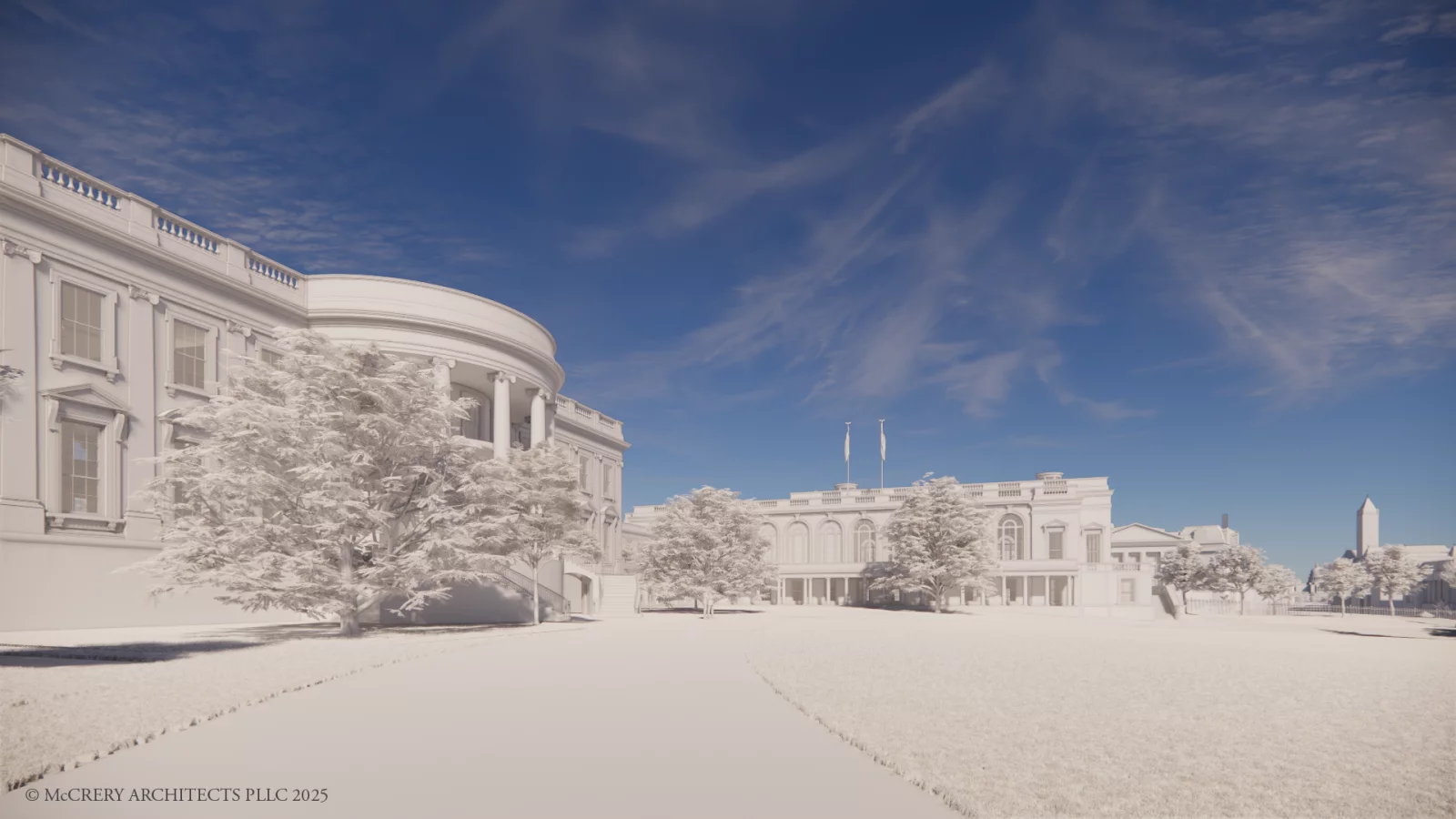
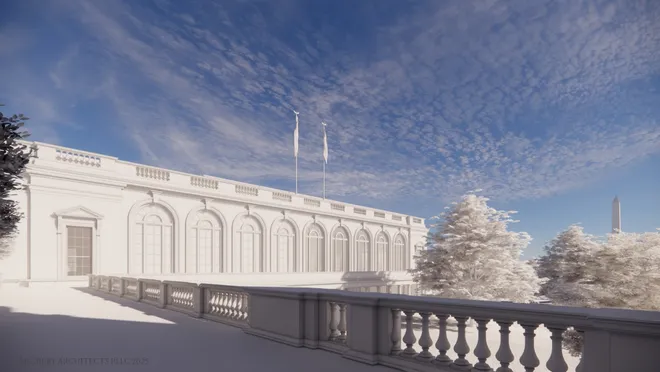
Exterior renderings of the planned grand ballroom at the White House. Images by McCrery Architects, courtesy The White House
Construction on the ballroom is slated to commence next month and be completed before the end of Trump's term in 2029. A recent New York Times article detailed the concerns of historic preservation experts with regard to such an ambitious—and seemingly rushed—undertaking being pushed forward without public review. (The White House—along with several other landmark structures and their grounds in Washington, D.C.—is exempt from the National Historic Preservation Act of 1966 and, as such, can skirt formal review processes for major alterations.) Former National Park Service director Jonathan Jarvis noted that the proposed project timeline is “optimistic” considering the hallowed location, where preservation and security concerns both come into play. It's “not just normal construction,” he said. White House Chief of Staff Susie Wiles relayed that Trump is “fully committed to working with the appropriate organizations to preserve the special history of the White House while building a beautiful ballroom.”
Like the Rose Garden redux, the ballroom has been met with sharp criticism, with many questioning the timing and scale of the expansion. A White House spokesperson shot back, noting: “President Trump is the best builder and developer in the entire world, and the American people can rest well knowing that this project is in his hands.”
Update: The American Institute of Architects has issued a two-page letter of recommendation to the Committee for the Preservation of the White House, an advisory committee established in 1964 via executive order by President Lyndon Johnson. It is made up of members appointed by the sitting president, joined by several ex officio members, and is chaired by the director of the National Park Service. The letter outlines five key recommendations, all in line with the AIA’s Framework for Design Excellence, to guide the execution of the planned expansion; together, these recommendations ensure a process that “ties each major decision to preservation, performance, safety, and access—safeguarding historic character while improving resilience and usability.”
“For over 100 years, AIA has embraced our role as a perpetual guardian of the White House’s architectural integrity,” reads the letter, which is co-signed by 2025 AIA president Evelyn Lee and interim CEO/EVP Stephen Ayers. “This responsibility guides our recommendations to ensure that any modification to this national treasure honors its historical and symbolic significance.”
Looking for quick answers on architecture and design topics?
Try Ask RECORD, our new smart AI search tool.
Ask RECORD →
Looking for a reprint of this article?
From high-res PDFs to custom plaques, order your copy today!


.webp?height=200&t=1756483260&width=200 "United_States_General_Services_Administration_Building_(53843649137).jpg")

