Arts & Culture 2025
EYRC Architects’ Gallery Expansion at Arizona’s Cocopah Museum Becomes a Lesson in Resourcefulness
Somerton, Arizona

Architects & Firms
The West Cocopah Indian Reservation, population 1,025, is the southwest of the American Southwest. Any farther south, or even farther west, is Mexico. Along the Colorado River, tucked below Yuma, Arizona—known as the sunniest place on Earth—the Cocopah Museum and Cultural Center inaugurated a new gallery space designed by Los Angeles–based firm Ehrlich Yanai Rhee Chaney Architects (formerly Ehrlich Architects).
This isn’t EYRC’s first project in the area. In 2013, it completed the John M. Roll United States Courthouse in Yuma. Having seen the courthouse and been drawn to its entry trellis mounted with a photovoltaic canopy, tribal leaders cold-called the firm in November 2020, during the pandemic, to design an expansion of their existing museum. Like so much during that time, the budget, scope, and schedule were uncertain, but the architects jumped at the opportunity to work on a small project with a large cultural impact.
In design, the expansion became a separate auxiliary building nestled in the set-back northwest corner of the museum, a plaster box built in 1996. The new 1,200-square-foot gallery, roughly the size of the existing exhibition hall, would provide a flexible space for rotating exhibitions that could also be used for community events. The museum to the south, tribal headquarters to the north, and cultural-resources department to the east form an open-air communal gathering space, with native Sonoran Desert cacti, shrubs, and trees that provide much-needed shade—an unexpectedly lush 1.5-acre garden for such an arid environment, where temperatures often soar to 120 degrees Fahrenheit. A planned photovoltaic trellis, like the courthouse’s, would later form a pathway in this courtyard; the tight budget precluded its construction for the time being. Nevertheless, the new gallery would act as a pavilion in a procession from the existing museum toward the community space. The design challenge for the architects was how to elevate essentially a shoebox gallery on a shoestring budget so that it could be a source of pride for the Cocopah community, all while contending with a harsh environment. They looked to traditional Cocopah structures for guidance.
1
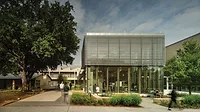
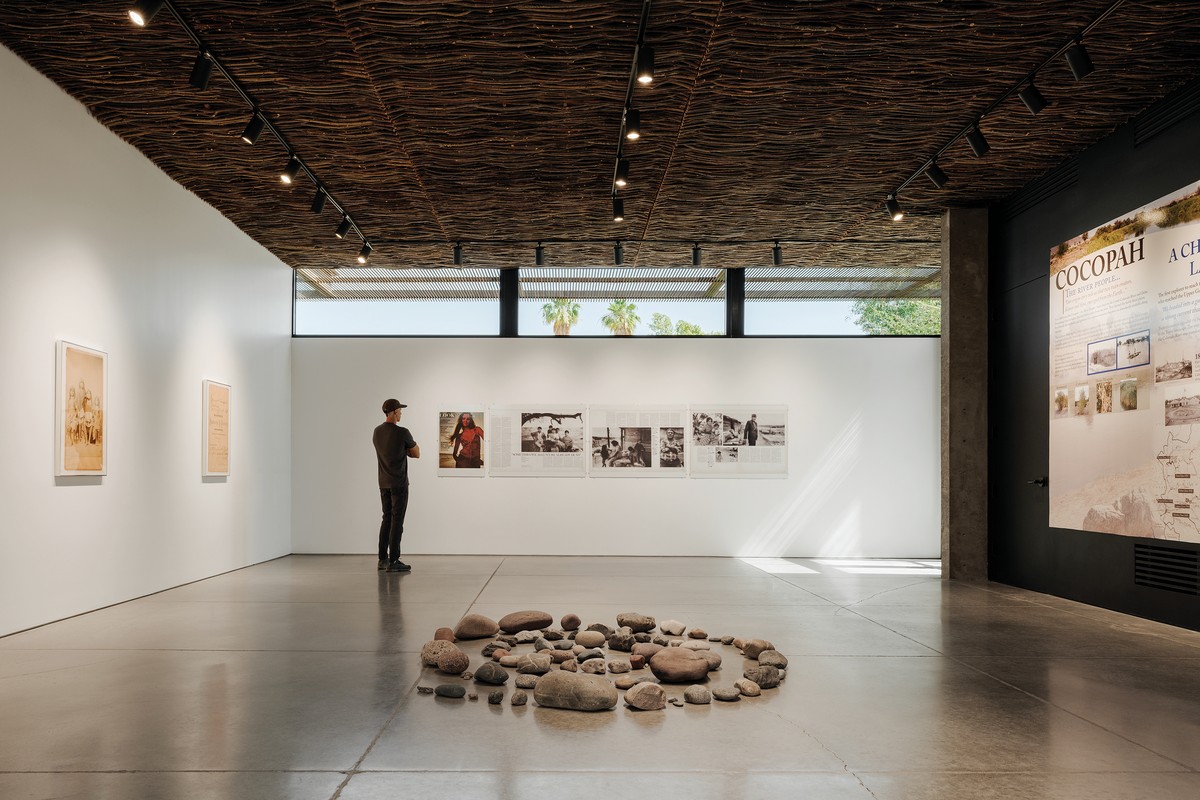
The flexible gallery space (1) doubles the exhibition space of the existing museum (2). Photos © Lance Gerber, click to enlarge.

2
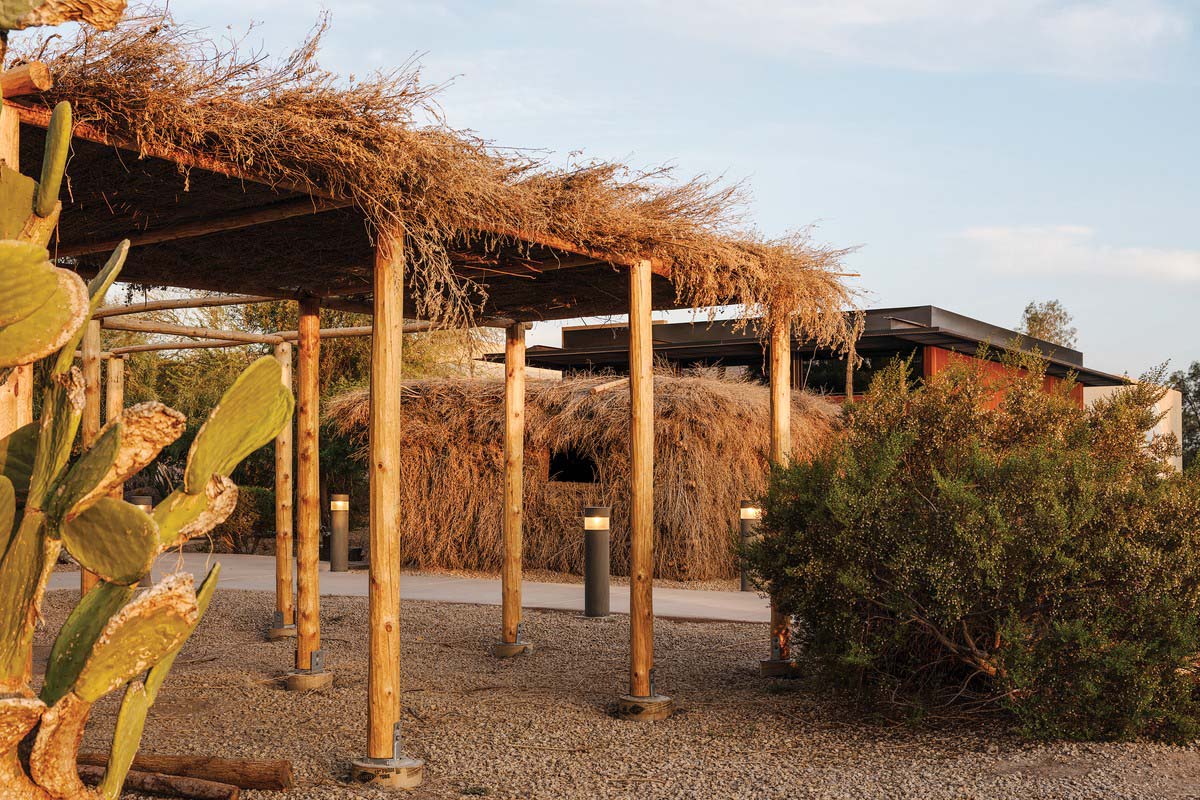
“We were trying to understand what Cocopah architecture is,” says Patricia Rhee, a partner at EYRC. The Cocopah—whose name for themselves, Xawiłł Kwñchawaay, means “Those Who Live on the Cloudy River”—built structures that “take cues from what they had, what came from the river, like willow thatch, and made the best of it,” Rhee says. “They took mud from the earth to build walls, and then they took reeds from the river to get the sun off them.” As recently as the 1960s, many families on the reservation lived in traditional arrow weed–thatched homes. In the garden, adjacent to the museum, the community built several replicas of traditional dwellings, called ramadas, as examples of these Indigenous construction methods.
3
An awning of rebar (top of page) echoes Indigenous ramada structures (3), while a concrete monolith forms the east facade (4). Photos © Lance Gerber

4
The new museum expansion echoes this material sensibility as well as these strategies for mitigating solar heat gain. Windows are limited to clerestory strips along the north and south facades to maximize wall space for displays and to minimize direct sunlight. The structure is crowned and shaded by a lightweight trellis constructed of exposed common reinforcing bars. The north, west, and south walls are weathering steel (a material that is widespread in the region), and the east facade is a thick concrete monolith. Rammed earth, the original concept, was prohibitively expensive, so the architects worked with what they could. The concrete is pigmented with a Davis Color to closely approximate the hue of the earth on the site. It was cast in place using oriented-strand boards. Between the pigment and the textural imprint of the boards, thrown into sharp relief by the harsh Arizona sun, the concrete recalls Cocopah architecture while maintaining a distinct material identity.
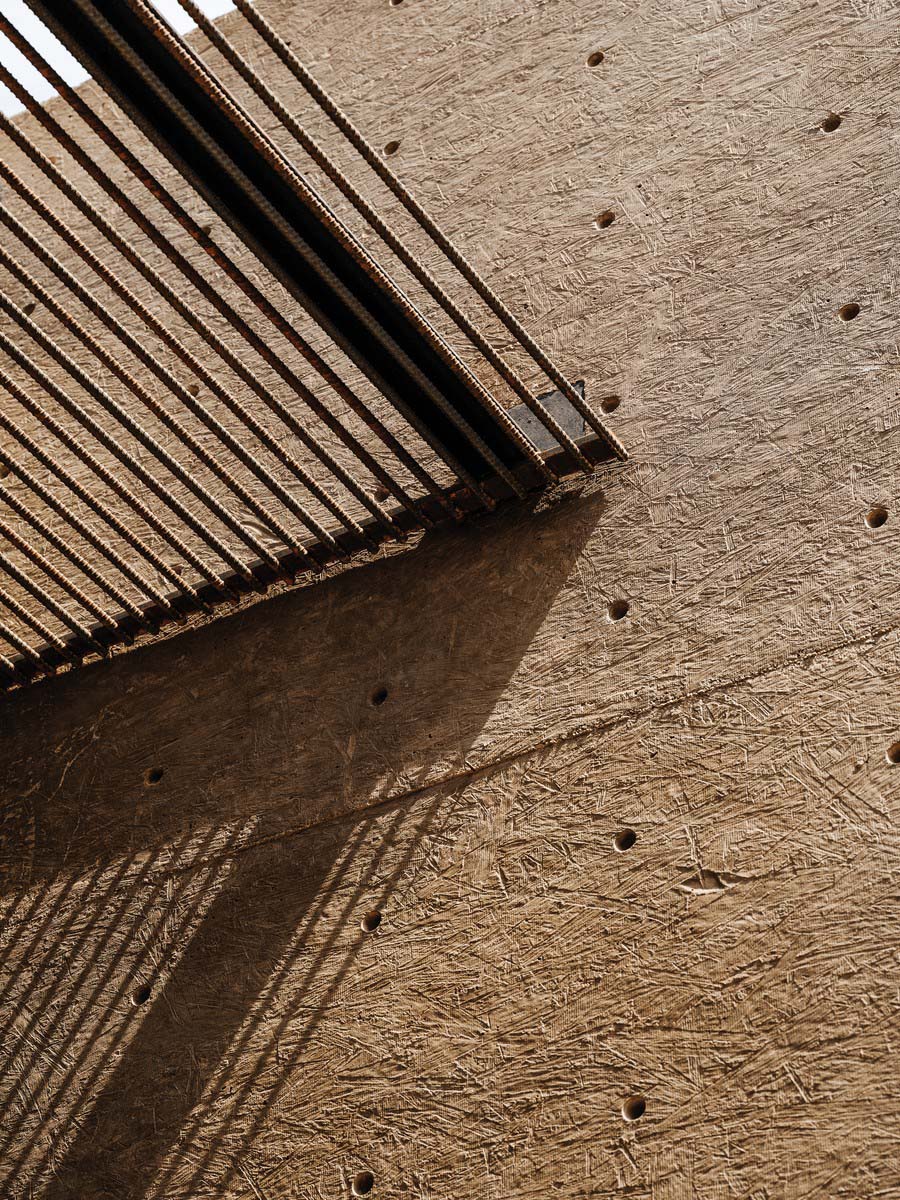
Rustic materials recall the handmade textures of Indigenous structures. Photo © Lance Gerber
“This is almost a sacred space for the Cocopah to show articles from their history,” Rhee says, “so we wanted to provide ample room and something special to identify with this specific community.” The interior is essentially one large room, with two small storage and mechanical closets. To save on costs, the simple 25-by-40-foot gallery could have been a spartan white box, but EYRC wanted to avoid this association with the Western ideal for exhibition spaces. Instead, it designed a woven-willow lattice ceiling to introduce a culturally specific handmade detail, crafted at The Willow Farm in Pescadero, California. The woven ceiling not only echoes the ramada structures outside but also serves as an acoustic damper. According to the architects, acoustic insulation between roof joists hidden above this lattice also helps maintain the interior climate.
EYRC’s website describes the firm’s design philosophy as “Multicultural Modernism.” When asked what this means, Rhee explains that, in designing the Cocopah Museum expansion, “it was about echoing the forms and the methodology of working with what you have,” which, she says, is, “ultimately, about being respectful.”

Courtesy Ehrlich Yanai Rhee Chaney Architects, click to enlarge.
Credits
Architect:
Ehrlich Yanai Rhee Chaney Architects — Patricia Rhee, partner in charge; George Racomura, project architect/manager; Joseph Varholick, project designer; Jonathan Martinez, Nicholas McMillan, design team
Engineers:
JOL Enterprises (electrical); Rouff Engineering (mechanical); Campbell Structural (structural); Jacobson Engineering (civil)
General Contractor:
Yuma Valley Contractors
Client:
Cocopah Nation
Size:
2,035 square feet
Cost:
$900,000
Completion Date:
September 2023
Sources
Cladding:
Western States Metal Roofing (metal panels); Arcadia (curtain wall); Dupont (moisture barrier)
Glazing:
Vitro
Roofing:
MuleHide
Interior Finishes:
Willow Farm
Looking for quick answers on architecture and design topics?
Try Ask RECORD, our new smart AI search tool.
Ask RECORD →
Looking for a reprint of this article?
From high-res PDFs to custom plaques, order your copy today!