Chicago’s Storied Shedd Aquarium Unveils Latest Phase of Ambitious Revamp Led by Valerio Dewalt Train

The Shedd Aquarium's new Wonder of Water exhibit, in the rotunda, features two curved habitats, one showcasing freshwater plant and animals and the other a saltwater ecosystem that includes live coral.
Architects & Firms
Ahead of its 100th birthday in 2030, Chicago’s revered Shedd Aquarium is undergoing a multi-phased transformation. The charge for Valerio Dewalt Train (VDT), the architecture firm leading the project, was to revamp the exhibit areas, enable the aquarium to better care for the animals in its collection, and rethink its circulation. What’s more, this would all need to be accomplished almost completely within the Shedd’s existing footprint within Chicago’s Museum Campus park on Lake Michigan—and while the aquarium remained open to the public, explains Joe Valerio, VDT’s founding principal.

The architects have created a two-story entry lobby with escalators that travel past a wavelike wall. Swirling overhead is a school of 1,600 ceramic fish. Photo © Steve Hall
The entire project is due for completion in the summer of 2027, but visitors are already taking advantage of many aspects of the ongoing renovation, including an improved arrival sequence. Though the route into and through the Shedd’s original Beaux Arts building had been straightforward—with a central octagonal rotunda and galleries arranged around it, spoke-and-hub style—the diagram had become compromised over the years, especially after expansions in 1991 and 2003. In addition, many visitors avoided the main entrance behind the west facade’s historic temple front at the top of an impressive set of stairs. Instead, they would approach from the south, via a small entrance intended for those with mobility issues or pushing strollers. It meant that a large portion of the public was arriving—unceremoniously—through the aquarium’s basement, points out Sheri Andrews, VDT principal.
VDT’s solution was to make the Shedd, which is one of the world’s largest and most visited aquariums, more accessible to all by redesigning the south entry into a new front door, completely reimagining it in the process. Now visitors move through a circular plaza and a glass-enclosed pavilion with a hovering elliptical roof. Opposite is a free-standing ticketing kiosk with its own glass elliptical enclosure. Surrounding the plaza, a ring-shaped trellis, which casts wavelike shadows on the ground, reinforces the sense of arrival.
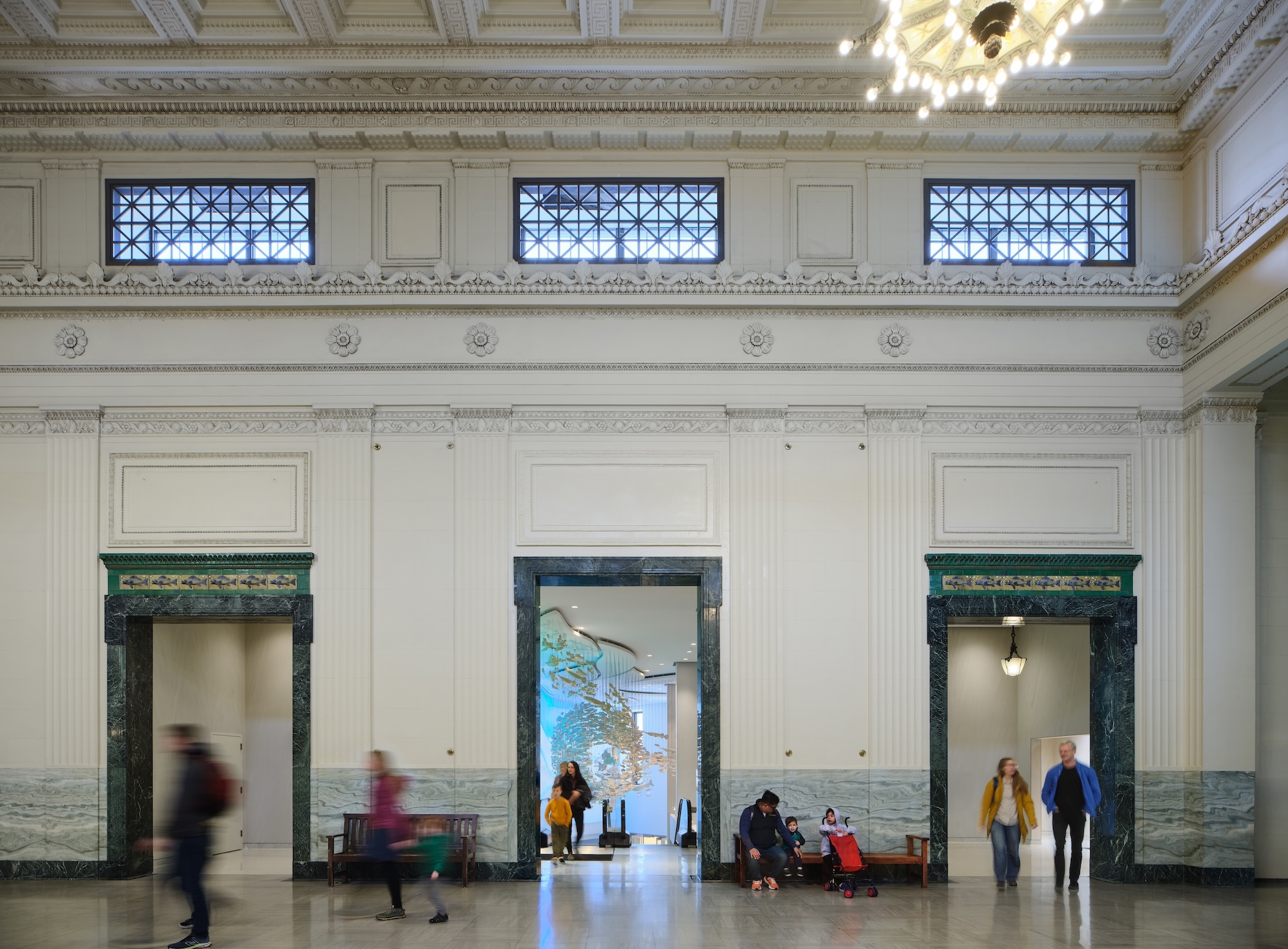
The escalators lead to the Grand Hall, the space just beyond the Beaux Arts building’s historic temple front. Photo © Steve Hall
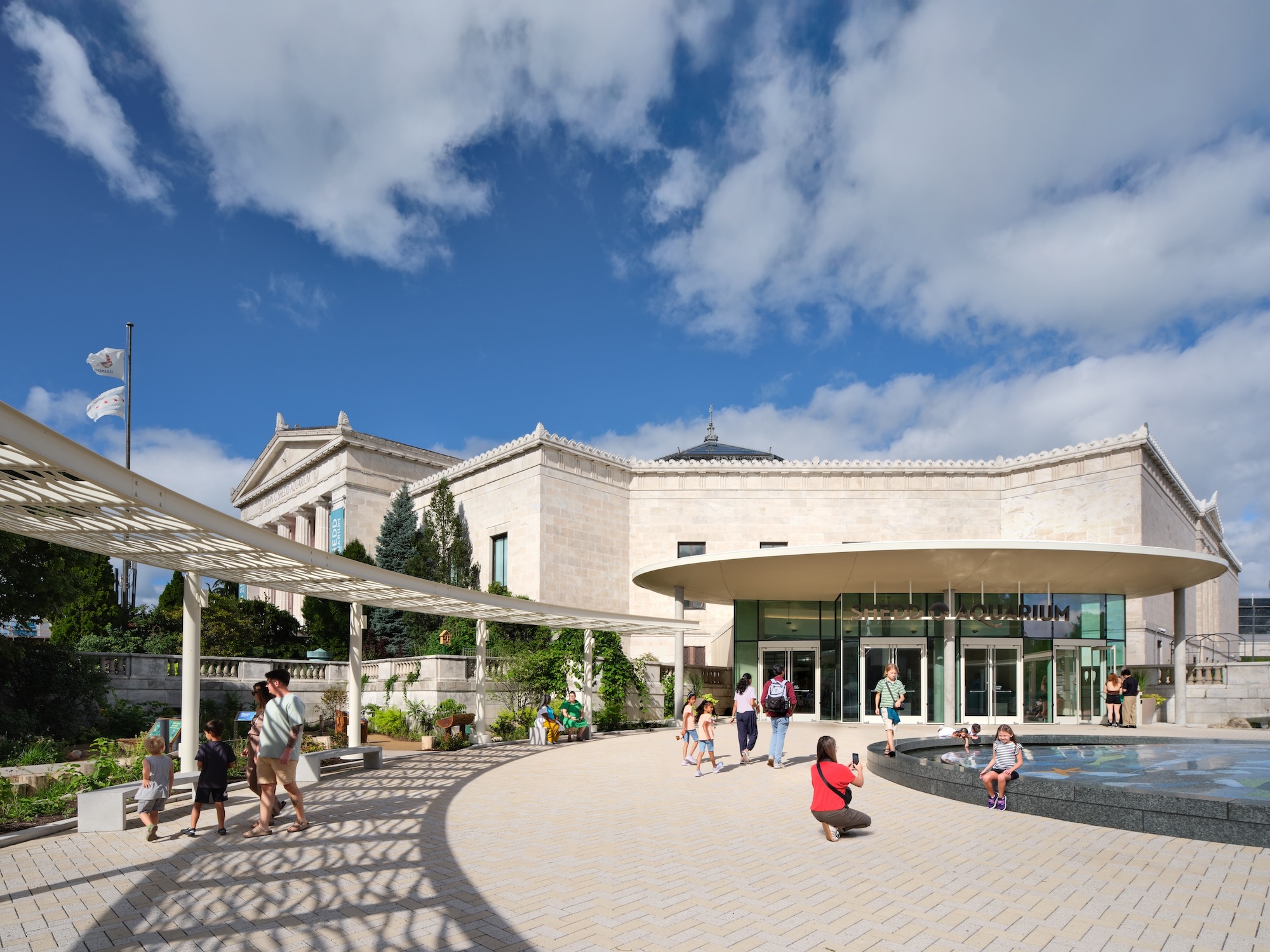
A trellis-encircled plaza and a glazed pavilion have helped transform an accessible entry into a new primary entrance. Photo © Kendall McCaugherty
Inside is a new double-height lobby with a set of escalators that travel past a sculptural wall referencing flowing water. Overhead is a permanent installation by artist David Franklin featuring a school of 1,600 cast-porcelain fish suspended from the ceiling. The graciously revamped sequence delivers people to the Grand Hall, the historic foyer which sits just behind the pedimented west facade. This tall, coffered space whose architectural details include whimsical aquatic motifs such as sea horses, scallop shells, and the trident of Poseidon, is where the building’s original architects, Graham, Anderson, Probst & White (a successor to Daniel Burnham’s firm) intended visitors to start their journey through the aquarium. Once restoration is complete, this room, says the Shedd, will become a gathering place, featuring live animal encounters, learning programs, and historical depictions of aquatic life and cultural connections to water from around the world.
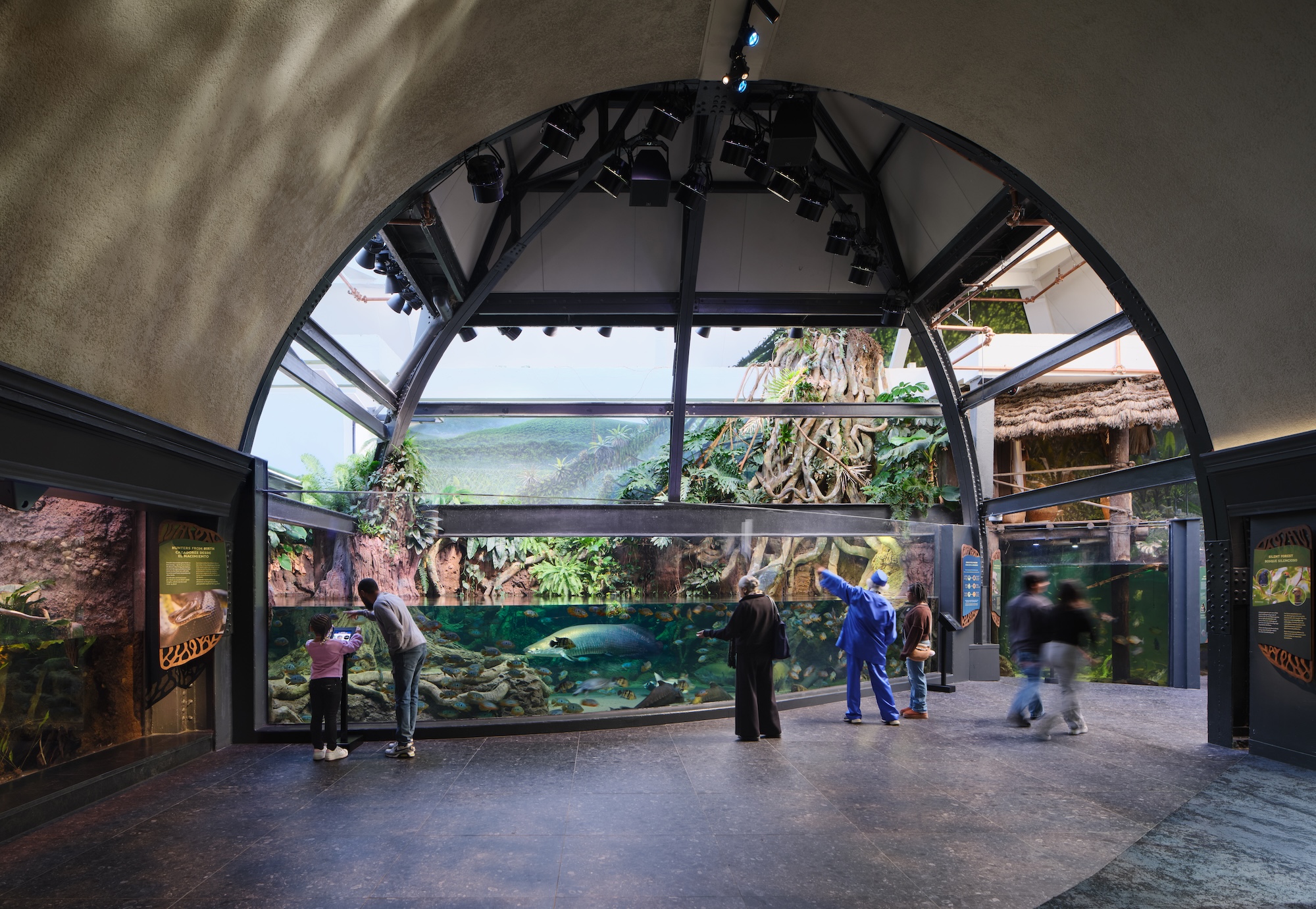
The Amazon Rising exhibit includes Arapaima, one of the largest freshwater fish species in the world. Photo © Steve Hall
Beyond the Grand Hall, is the rotunda with a new Wonder of Water display that replaces a 1970s tropical reef. The new exhibit showcases two habitats—one featuring freshwater plants and animals and the other a saltwater ecosystem that includes live coral—in ying and yang-shaped 11-foot-tall acrylic environments which visitors can walk in between and around.
Among the many new exhibits still to come are a Kelp Forest, a Caribbean Reef Tunnel, and a Changing Oceans gallery. Overall, says the Shedd, the new habitats, created with the exhibit design firm Thinc, will be more immersive and participatory, with some allowing visitors to feel that they are beneath the water’s surface. In creating these new attractions, the design team has almost doubled the volume of water in the historic galleries to more than 500,000 gallons. In some areas, the extra load, combined with a lakeshore site consisting primarily of fill, necessitated adding micropiles below the building, extending to bedrock.
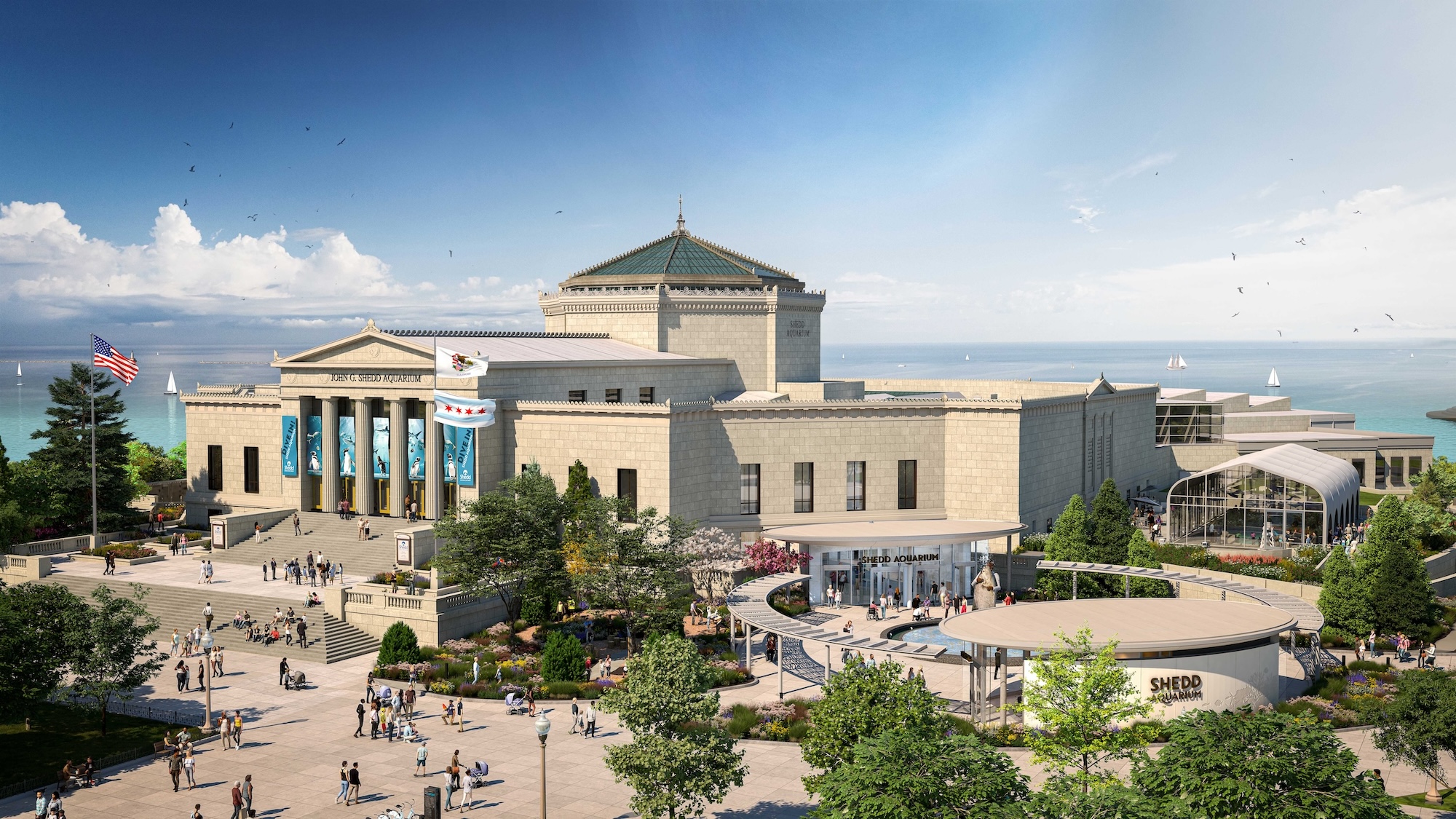
Shedd external aerial rendering. Image courtesy Shedd Aquarium
The aquarium and its habitats require considerable infrastructure for filtering and processing water, and for keeping the animals in the Shedd’s care healthy. This complex network of piping, equipment, and systems is nearly invisible to visitors—the result of meticulous coordination and logistical planning. The feat is all the more remarkable given that it constantly needs to be rerouted and changed as construction progresses, with the aquarium open all the while. “Every detail of the design and phasing had to work around the aquarium’s commitment to keep its doors open to the community,” says Andrews. “It’s a testament to the Shedd’s vision.”

Shedd main-level phasing plan, click to enlarge. Drawing courtesy Valerio Dewalt Train
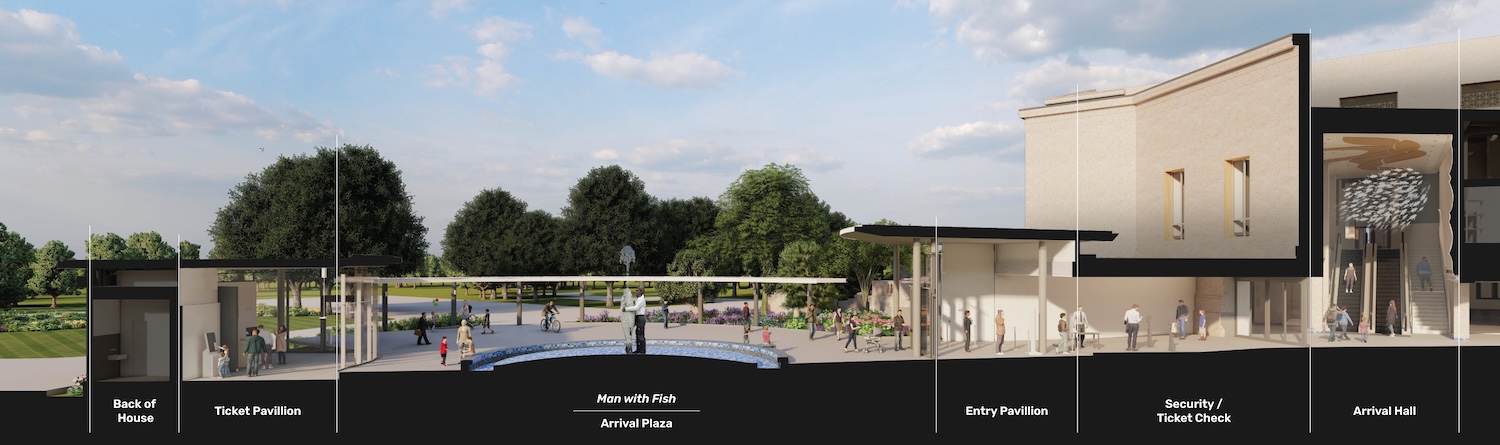
Shedd entry diagram, click to enlarge Drawing courtesy Valerio Dewalt Train
Looking for quick answers on architecture and design topics?
Try Ask RECORD, our new smart AI search tool.
Ask RECORD →
Looking for a reprint of this article?
From high-res PDFs to custom plaques, order your copy today!