Architectural Record
search
cart
facebook twitter linkedin youtube
  • Sign In
  • Subscribe
  • Sign Out
  • My Account
Architectural Record
  • NEWS
    • Latest News
    • Awards
    • Interviews
    • Obituaries
    • Podcasts
      • Design:Ed Podcast
      • Sponsored Podcasts
  • OPINION
    • Book Reviews / Excerpts
    • Exhibition Reviews
    • Forum
  • EXCLUSIVES
    • Videos
    • Design Vanguard
    • Top 300 Firms
    • Sponsored Content
    • Sponsored eBooks
    • From the Archives
  • CONTINUING ED
    • Editorial Continuing Ed
    • CE Center
    • CE Academies
  • PROJECTS
    • Buildings By Type
    • Reuse & Renovation
    • Museums & Arts Centers
    • Colleges & Universities
    • Multifamily Housing
    • Interiors
    • Lighting
    • Kitchen & Bath
  • HOUSES
    • Record Houses
    • House of the Month
    • Featured Houses
  • PRODUCTS
    • Products by Category
    • Record Products of the Year
    • Latest Products
  • EVENTS
    • Dates & Events
    • Record on the Road
    • Innovation Conference
    • Sustainability in Practice
    • Women In Architecture
    • Webinars
    • Ad Excellence Awards
    • Submit an Event
  • CONNECT
    • Ask RECORD AI
    • Newsletters
    • Contact
    • Advertise
    • Editorial Calendar
    • Store
    • Customer Service
  • SUBMIT
    • Submission Guidelines
    • RECORD Competitions
  • MAGAZINE
    • Subscribe
    • My Account
    • Digital Edition
    • Current Issue
    • Firm Pass
    • Historic Archive
Architecture News

LACMA Unveils Latest Zumthor Scheme
By Sarah Amelar
LACMA Unveils Latest Zumthor Scheme

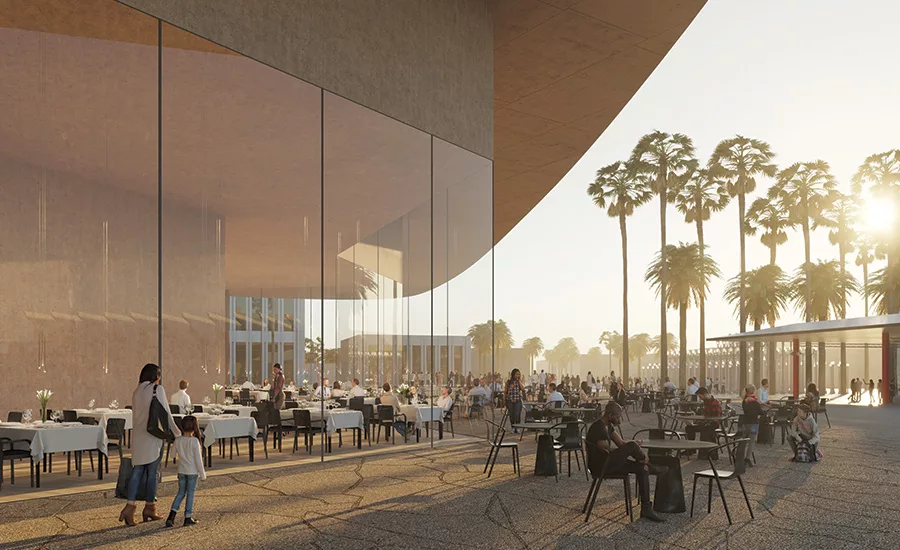
Peter Zumthor’s latest design for LACMA still bridges Wilshire Boulevard but has concrete surfaces and a greater variety of interior art and amenity spaces.

Image courtesy Atelier Peter Zumthor
LACMA Unveils Latest Zumthor Schem

Peter Zumthor’s latest design for LACMA still bridges Wilshire Boulevard but has concrete surfaces and a greater variety of interior art and amenity spaces.

Image courtesy Atelier Peter Zumthor

LACMA Unveils Latest Zumthor Scheme
LACMA Unveils Latest Zumthor Schem
May 1, 2017

Architects & Firms

Atelier Peter Zumthor & Partners

Soon after Michael Govan became director of the Los Angeles County Museum of Art (LACMA) in 2006, he called Swiss architect Peter Zumthor to begin reimagining the museum’s campus, with its awkward collection of buildings of various vintages (now seven in all). The exploration began in earnest in 2008, but the museum didn’t present a scheme publicly until 2013. The institution has since unveiled four more iterations—most recently on April 5, when Govan hosted an onstage discussion with the architect. Less than two months earlier, during a talk at New York’s Solomon R. Guggenheim Museum, Zumthor had hinted about significant design changes, and by April, a packed house at LACMA’s Bing Theater awaited the latest revelations.

The initial design, in 2013, proposed a black, amoeboid building, hovering (with supporting vertical elements) above the ground. It evoked the dark, oily character of the adjacent La Brea Tar Pits, an archeological site and museum with prehistoric remains. Zumthor’s 387,500-squarefoot structure was designed to replace four existing buildings: LACMA’s three original 1965 pavilions, by William Pereira, plus a 1986 addition by Hardy Holzman Pfeiffer Associates. (The museum says two estimates placed the cost of seismic and safety upgrades for those buildings at $300 million.)

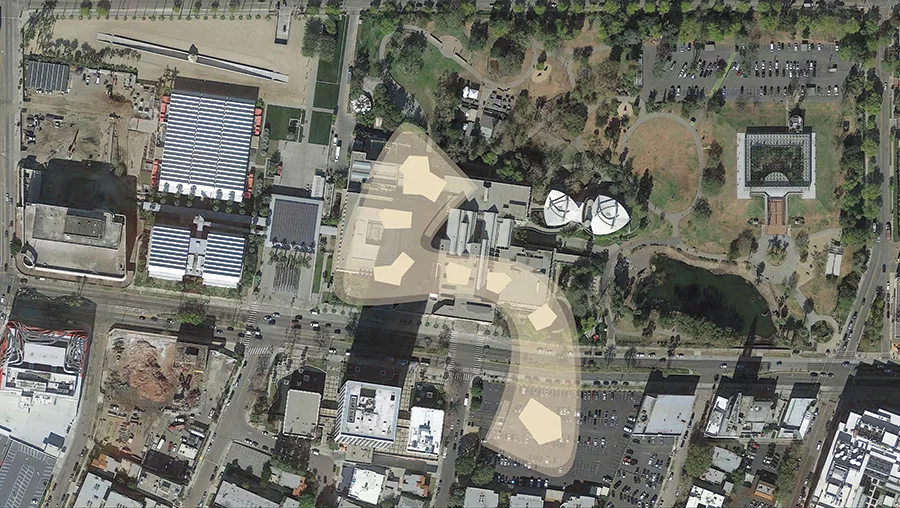
Critics and skeptical locals soon nicknamed Zumthor’s flat, curvy-edged project “the pancake,” “the blob,” or “the inkblot.” And there was a major glitch: the siting threatened the protected tar pits. To address that issue without losing square footage or galleries all on one floor—a priority for Govan—each subsequent scheme has bridged Wilshire Boulevard to a LACMA-owned parcel across the street. “We called [the original scheme] ‘the black flower,’ ” Zumthor explained from the Bing stage. “But then came the moment when we, more or less, had to cross Wilshire, and then [Michael] said, ‘You understand, an organic form cannot cross Wilshire Boulevard.’ So it had to develop urban energy.” Harder-edged versions followed, ultimately taking on a quirky S-configuration. But spanning a grand thoroughfare like Wilshire is controversial—particularly with forms resembling freeway overpasses.

And the newly unveiled version risks reinforcing that analogy with its striking muscularity and sand-colored concrete. While this $650 million scheme—for which, the museum says, it’s already secured commitments exceeding $300 million—doesn’t break radically from the previous iteration, its significant changes include greater definition of indoor spaces.

Now the exterior and interior surfaces are all exposed concrete: “real, elemental materials, not sheetrock,” said Zumthor. The main gallery level floats 20 to 30 feet above the ground, sandwiched between two massive horizontal plates: the floor plane and a deeply overhanging flat roof. Seven vertical elements— containing galleries and, at grade, a restaurant and other amenities—hold it all up.

Certain ideas have run through every iteration: the flow of a parklike ground plane beneath the building; continuous floor-to-ceiling perimeter windows; and an overall form that bends and looks back on itself and out to the city. “You always know where you are,” said Govan. Also, the project has from the start eschewed a traditional front or back (a formality that tends to relegate some artworks to lesser, rear positions). Similarly nonhierarchical, “the circulation should be like a city or park,” said Zumthor, “offering free choice and a sense of discovery, not a fixed path.”

In the variety of spaces, interior scales, and daylighting conditions, the new scheme goes well beyond its predecessors, creating four types of art venues: “meander” galleries, doubling as circulation zones, along the side-lit periphery; intimate cul-de-sac “pocket galleries”; “cluster galleries” toward the interior; and, within the vertical shafts, high-ceilinged, clerestory-lit “tower galleries”—together accommodating LACMA’s encyclopedic range of objects.

Looking for quick answers on architecture and design topics?
Try Ask RECORD, our new smart AI search tool.
Ask RECORD →

KEYWORDS: LACMA Los Angeles Peter Zumthor

Share This Story

Looking for a reprint of this article?
From high-res PDFs to custom plaques, order your copy today!

Sarah Amelar is a Los Angeles–based contributing editor at Architectural Record.

Post a comment to this article

Report Abusive Comment

Subscription Center
  • Create an Account
  • Start a Subscription
  • Manage My Account
  • Sign Up for Newsletters
  • Visit Customer Service
  • Update Preferences

More Videos

Sponsored Content

Sponsored Content is a special paid section where industry companies provide high quality, objective, non-commercial content around topics of interest to the Architectural Record audience. All Sponsored Content is supplied by the advertising company and any opinions expressed in this article are those of the author and not necessarily reflect the views of Architectural Record or its parent company, BNP Media. Interested in participating in our Sponsored Content section? Contact your local rep!

close
  • TAMLYN XtremeTrim Exterior Trim
    Sponsored byTamlyn

    Designing Cleaner Panel Facades: Why Exterior Trim Details Matter

  • Building with Vapor Barriers
    Sponsored byReef Industries, Inc.

    Vapor Barriers Help Control Moisture in Tighter Building Designs

  • Duct Interior with Prodeq System
    Sponsored byHenry, a Carlisle Company

    Designing Resilient Water Containment Systems

DESIGN:ED Podcast
Listen to Architectural Record’s DESIGN:ED Podcast

Events

June 10, 2026

Rethinking Stormwater – The Power of Porous Paving

Credits: 1 AIA LU/HSW; 1 AIBD P-CE; 0.1 ICC CEU

Learn how porous paving systems support stormwater management, reduce heat island effects, and enhance sustainable site design performance.

June 11, 2026

Very Early Warning Fire Detection for Mission-Critical Facilities

Credits: 1 AIA LU/HSW; 1 AIBD P-CE; 0.1 ICC CEU

Examine advanced fire detection strategies that support uptime and enhance safety in data centers and other mission-critical facilities.

View All Submit An Event

Products

2026 Architect's Square Foot Costbook

2026 Architect's Square Foot Costbook

See More Products

Popular Stories

Coronado Bridge

The Architect’s Guide to San Diego

Practice Matters illustration

What’s in a (Firm’s) Name? Thinking About Succession and Legacy

Practice Matters illustration

By the Numbers: Counting America's Architects

Inward House

Inward House by VeeV Design Studio

Riverdale House by Studio Lau

Riverdale House by Studio Lau

Broader Sustainability of CMU - Free Webinar - May 21, 2026

Related Articles

  • Shedd Aquarium phase 2 renovations

    Chicago’s Storied Shedd Aquarium Unveils Latest Phase of Ambitious Revamp Led by Valerio Dewalt Train

    See More
  • LACMA Director and Peter Zumthor Make the Case for Museum's Redesign

    See More
  • LACMA

    Zumthor at LACMA: Throwing a Curve Ball?

    See More
×

The latest news and information

#1 Source for Architectural Design, News and Products

SUBSCRIBE
  • RESOURCES
    • Advertise
    • Contact Us
    • Submit
    • Store
  • ACCOUNT CENTER
    • Create an Account
    • Start a Subscription
    • Manage My Account
    • Sign Up for Newsletters
    • Visit Customer Service
    • Update Preferences
  • PRIVACY
    • PRIVACY POLICY
    • TERMS & CONDITIONS
    • DO NOT SELL MY PERSONAL INFORMATION
    • PRIVACY REQUEST
    • ACCESSIBILITY
  • SERVICES
    • Marketing Services
    • Reprints
    • Market Research
    • List Rental
    • Survey/Respondent Access
  • STAY CONNECTED
    • Linkedin
    • Facebook
    • Instagram
    • YouTube
    • X (Twitter)

Copyright ©2026. All Rights Reserved BNP Media, Inc. and BNP Media II, LLC.

Design, CMS, Hosting & Web Development :: ePublishing