From the RECORD Archives: ‘The New White House’
The most well-known home office in the world was forever changed this week when a demolition crew, under order from the Trump administration, razed the entirety of the White House’s East Wing in preparation for the construction of a gilded banquet hall with a footprint that will dwarf that of the Executive Residence itself. (Much like the estimated square footage of the “big, beautiful ballroom,” the price tag for the project, initially announced by President Trump to be $200 million in private funding, keeps inching upward.) The administration sidestepped federal oversight in the move—namely approval from the National Capital Planning Commission (NCPC), currently closed due to the government shutdown, which is usually required prior to demolition. The administration, which has not yet submitted plans for the ballroom to the NCPC for review, has stated that approval is not needed for demolition work, just vertical construction. Former NCPC commissioner Bryan Green, however, has told the media that both demolition and construction are approved together.
Along with shock and anger over the destruction of the East Wing from preservationists, architects, historians, politicians, and ordinary citizens, comes a renewed interest in the history of the People’s House—and its myriad alterations over the decades. Some have been minor, like President Obama’s addition of a basketball hoop to an existing outdoor tennis court. Others have been more dramatic, such as the wholesale reconstruction of the presidential residence during the Truman administration. Trump’s yet-to-be-authorized addition of a 90,000-square-foot event facility safely falls into the latter category.
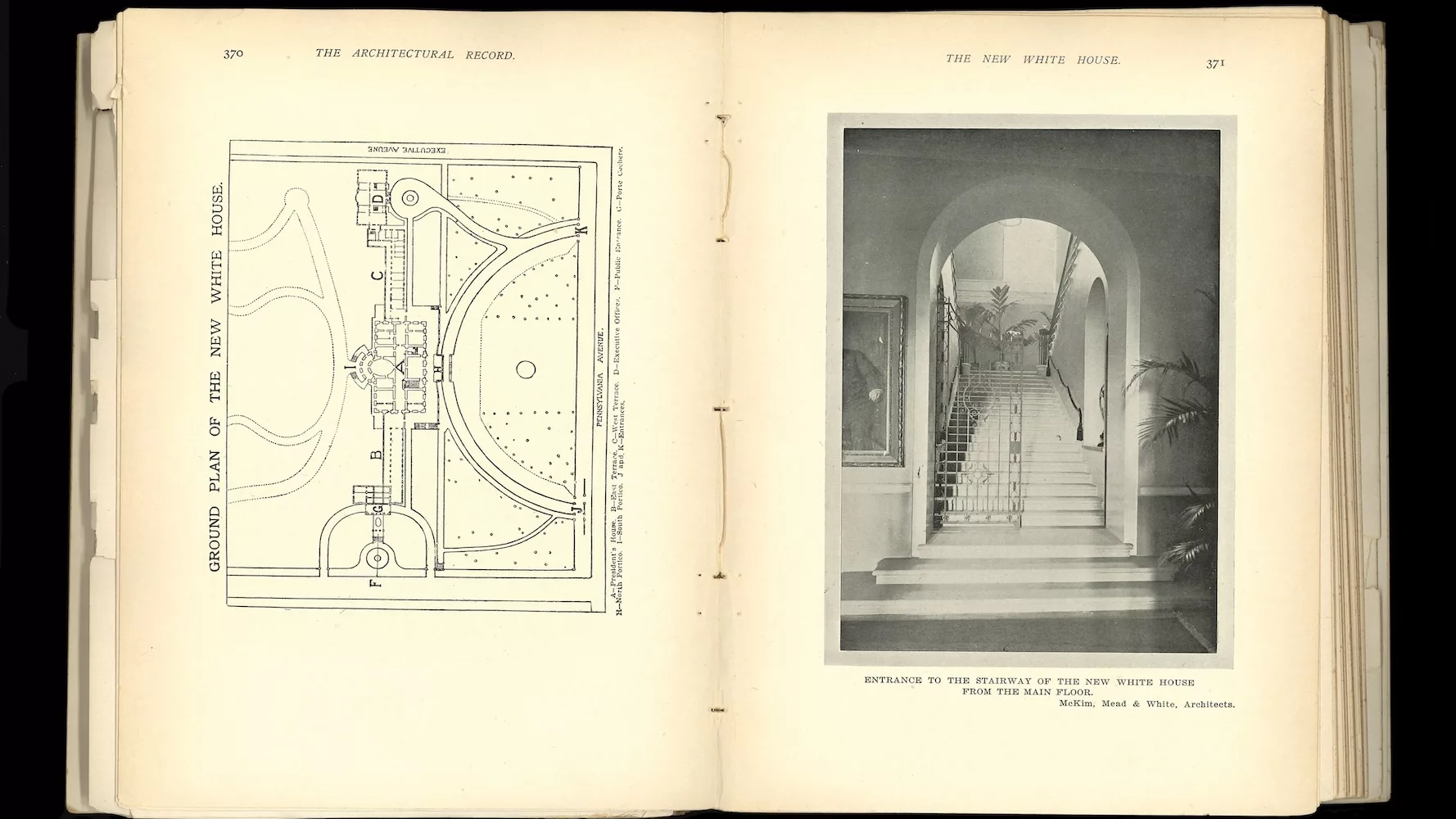
The modern East Wing that was demolished this week dates to 1942 when Franklin D. Roosevelt renovated and expanded upon a structure known as the East Terrace. That older, smaller structure was constructed as part of a major, McKim, Mead & White–helmed remodel during the presidency of FDR’s distant cousin, Theodore Roosevelt, in 1902. The original eastern addition housed the earlier Roosevelt’s coatroom, gallery, and a reception area to greet guests. After its wartime reconstruction decades later, a second floor was added, and the East Wing became well-known as a visitor’s hub and as the location of the First Lady’s offices. The adjacent East Colonnade, home to the White House’s movie theater, was also reduced to rubble as part of the demolition. Highly trafficked and blessed with its own rich history, the East Wing was an integral part of the White House.
RECORD first published the White House in 1903—a year after the arrival of the old East Terrace—in an expansive piece written by Montgomery Schuyler, a lauded New York arts and architecture critic as well as a frequent contributor to the magazine. The title of Schuyler’s article, “The New White House,” is an appropriate one: it was during the presidency of Theodore Roosevelt that “White House” evolved from an informal moniker to the official name of the executive mansion. Concludes Schuyler in his wide-ranging assessment of the residence: “The President’s house is at last, as it ought to be, the dwelling in the United States best adapted to dispense, with convenience and with dignity, the national hospitality.”
“The New White House”
By Montgomery Schuyler
Architectural Record, April 1903
© Architectural Record, April 1903
A dwelling-house, which, by the conditions of its erection, is to be inhabited only by leaseholds of four years, with one possible renewal in the case of each lessee, is not a house that one would expect to find very intelligently or affectionately “kept up.” Like “Life,” according to Omar Khayya,
Tis but a tent where takes his one day’s rest
A Sultan to the realms of death addressed
The Sultan rises, and the dark Ferrash
Strikes and prepares it for another guest.
© Architectural Record, April 1903
In this case “the dark Ferrash” is the new occupant of the tent or his consort, with such architectural advice as he may choose to invoke, subject to the Chairman of Appropriations in the House, whom he or she has to satisfy of the necessity or desirableness of the proposed outlay. From such conditions you would not expect a continuous tradition, in conformity with which renewals and such changes and modifications as might from time to time be needed should be made. The knowledge and the “taste” of the average mistress of the White House are those of the average American matron, the taste being, naturally, for the fashion of the time, whatever it may be. Hence the periodical clearing sales of such furniture and “objects” as, by the lapse of time, are discovered to have become junk, and the replacement of them by others concerning which that discovery is waiting to be made when the whirligig of time brings in his revenges.
© Architectural Record, April 1903
© Architectural Record, April 1903
“There is an inequality in the furniture of the whole house, owing to the unwilling and piecemeal manner in which Congress votes any moneys for its decoration, which destroys its effect as a comfortable dwelling. The oval rooms are carpeted with Gobelin tapestry, worked with national emblems, and are altogether in a more consistent style than the other parts of the house. It is to be hoped that Congress will not always consider the furniture of the President’s House as the scapegoat of all sumptuary and aristocratic sins, and that we shall soon be able to introduce strangers, not only to a comfortable and well-appointed, but to a properly served and neatly kept, President’s mansion.”
© Architectural Record, April 1903
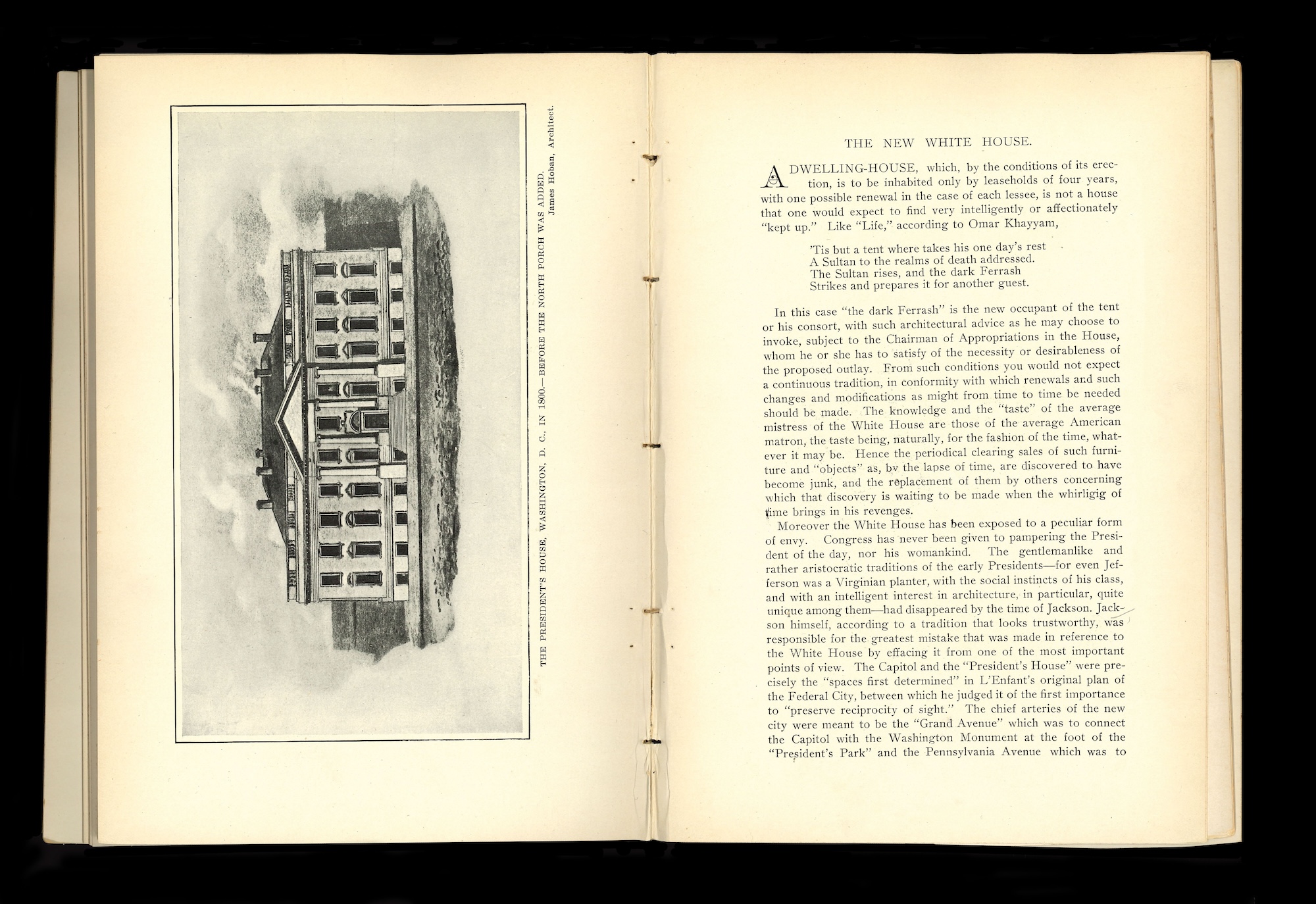
Everybody interested in the matter knows that James Hoban, the architect of the White House, was an Irishman who emigrated to South Carolina and practiced architecture with success in Charleston before he went to the site of the Federal City that was to be in 1792, with letters of recommendation to Washington from Henry Laurens and other Carolinians, being attracted by the architectural opportunities there opened. He won the competition for the President’s House without dispute, while Thornton and Hallet were dividing the honors and rewards for the design of the Capitol. Jefferson’s characteristic suggestion that the Capitol should follow some “model of antiquity,” while the President’s House should be a modern mansion was much more nearly carried out in the latter case than in the former. It is impossible to refer the Capitol to any specific model of antiquity, as the Virginia State House, in which Jefferson had his way, is distinctly referable not only to a Greco-Roman temple, but to the particular Roman temple, the Maison Carrée at Nimes, barring the change from Corinthian to Ionic, “on account of the expense.” But the White House, as it did not begin to be called until the middle of the 19th century, was undoubtedly a “modern mansion,” as it was projected in 1792. It was a specimen of British Georgian, with some important cis-Atlantic modifications, modifications which have been in great part the basis of the present restoration. The vague tradition, which everybody has heard, that Hoban’s model was the Dule of Leinster’s house in Dublin, survived long and died hard. But it definitely died when somebody became interested enough in the matter to send for photographs of the imputed prototype, when it was seen that the tradition was perfectly unbased. But I am told that there is a very striking resemblance between the White House and the vice-regal lodge in Phoenix Park in Dublin and the tradition may simply have been misplaced in crossing the Atlantic. Only, if the vice-regal lodge was built for the purpose which its title implies, it can scarcely have served as the model for the White House, since it was under construction at the same time, having necessarily been built after the act of Union, and that act took effect at the beginning of 1801, when the White House was already occupied.
© Architectural Record, April 1903
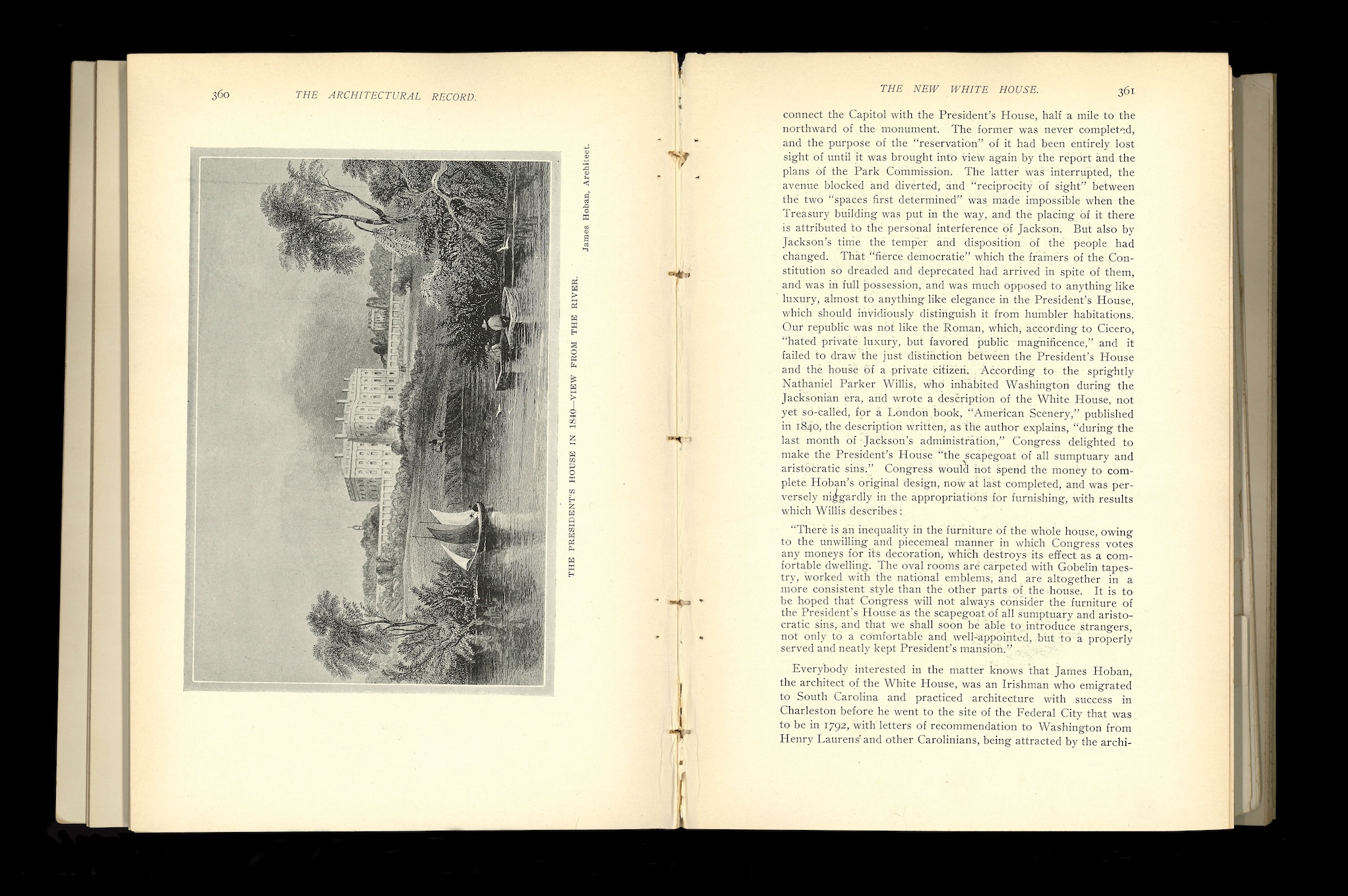
Hoban had charge of the restoration and completion of the White House after the British spoliation in 1814, which was as wanton here as at the Capitol itself, and added the wings which are really the most distinctive features of the design. It appears, from memoranda left by Hoban, that his project included a central building of three stories, as against the existing two, and the superposition over the wings of a full story above ground. It does not appear that he ever made any drawing showing these dispositions, and certainly no further steps were taken towards executing them. But it is remarkable and deplorable that the basement actually built, and which is shown in the print of 1840, up to which Willis wrote his text, should have disappeared by demolition, without any suspicion on the part of anybody concerned that it was, practically and architecturally, one of the most important parts of the design.
© Architectural Record, April 1903
© Architectural Record, April 1903
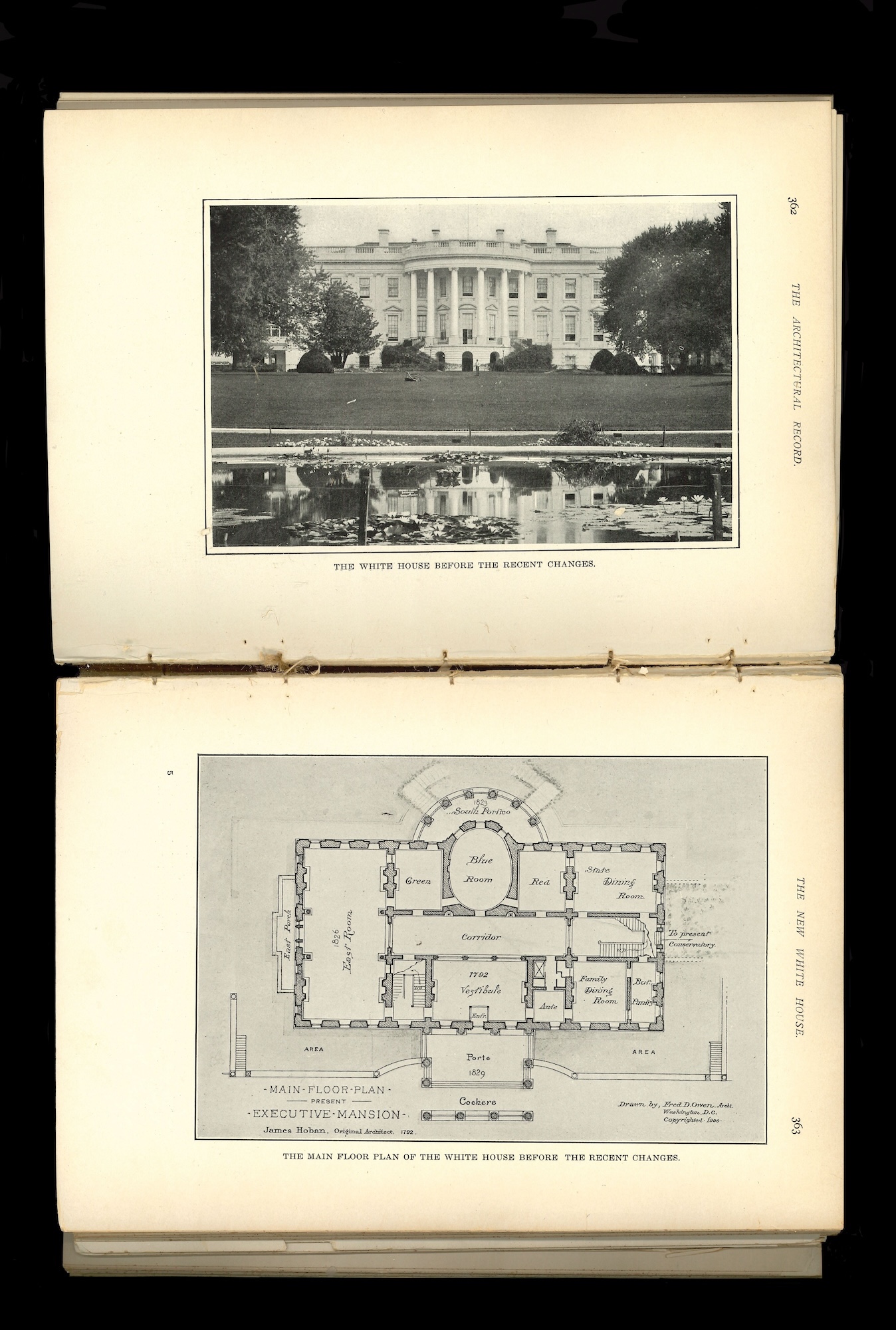
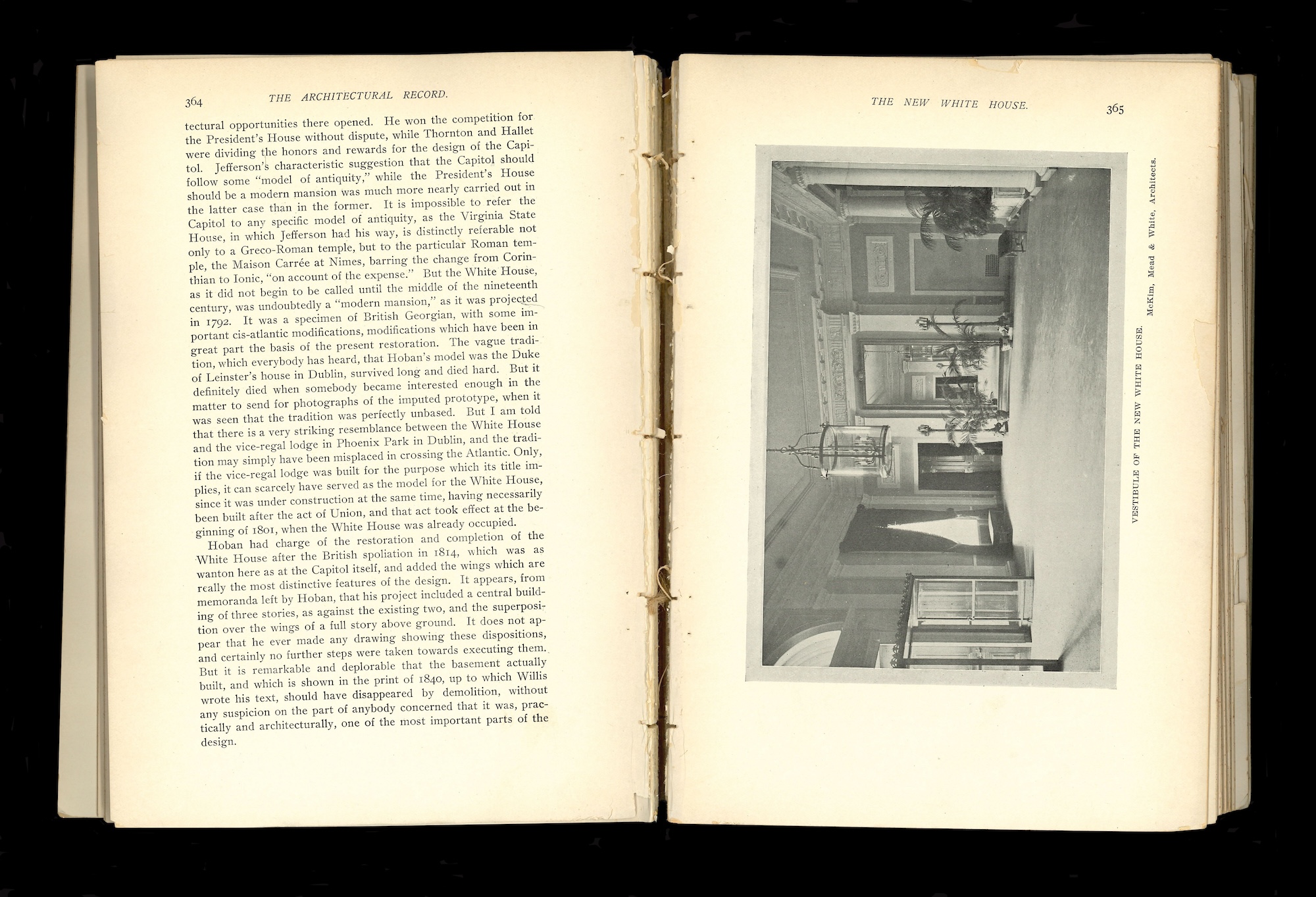
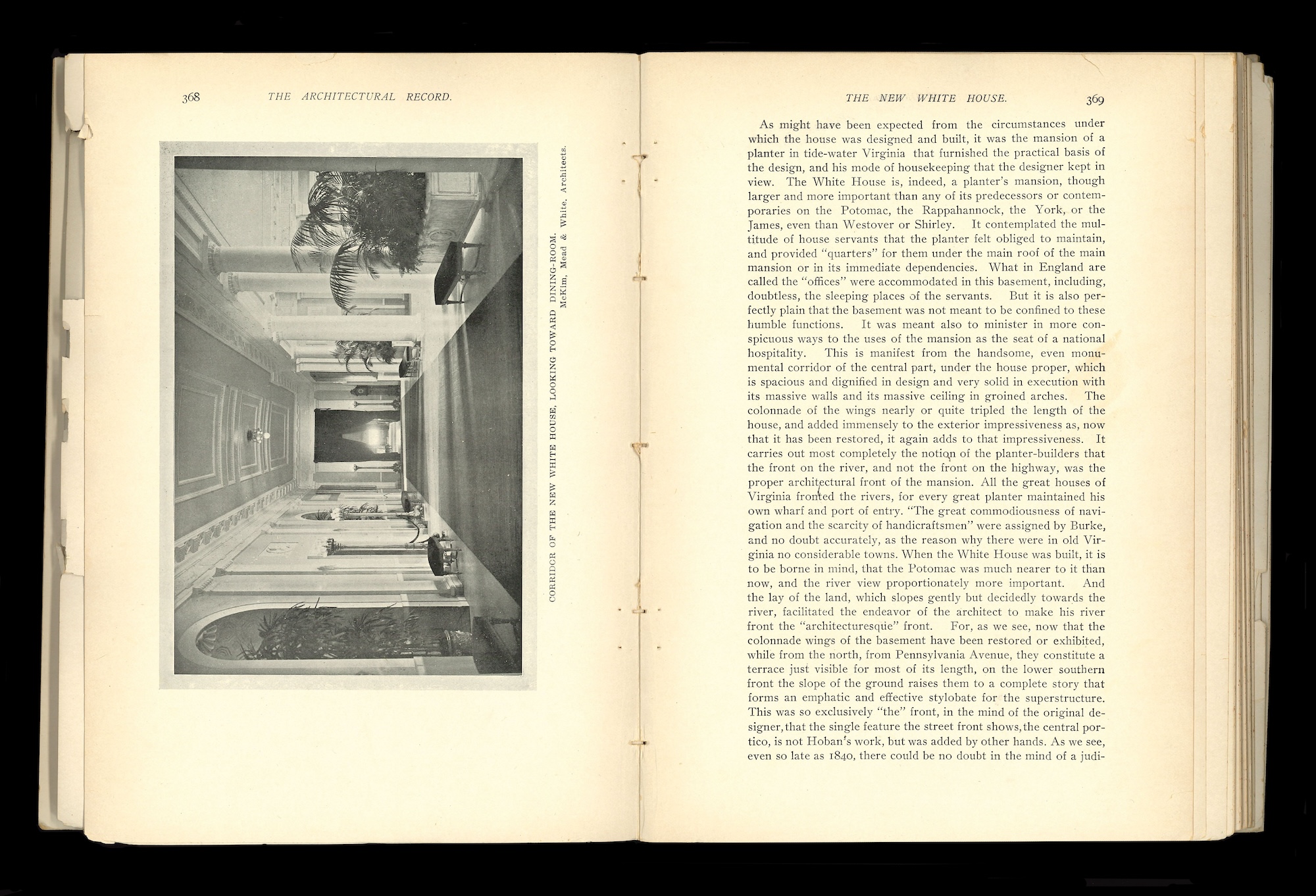
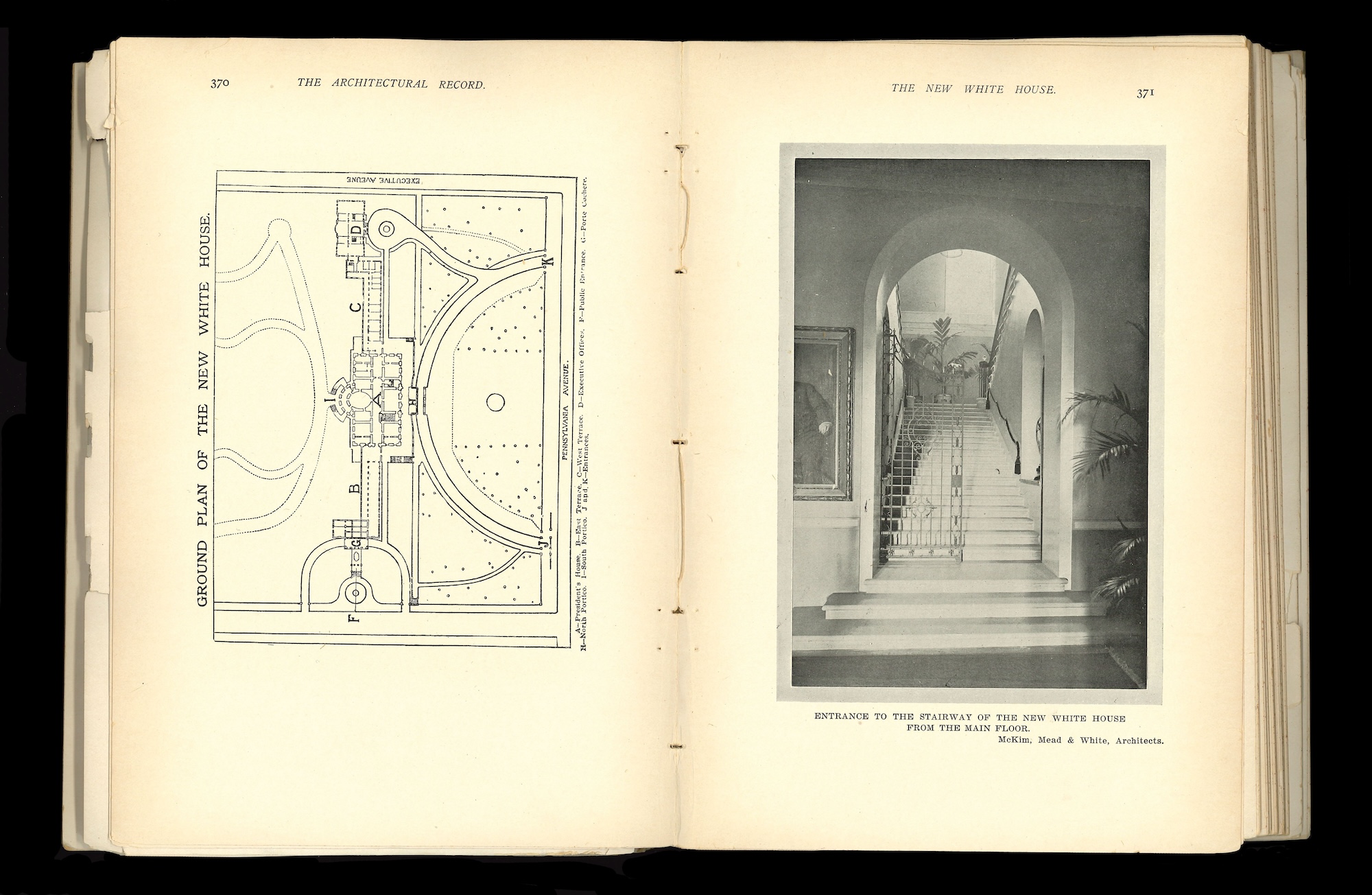
As might have been expected from the circumstances under which the house was designed and built, it was the mansion of a planter in tide-water Virginia that furnished the practical basis of the design, and his mode of housekeeping that the designer kept in view. The White House is, indeed, a planter’s mansion, though larger and more important than any of its predecessors or contemporaries on the Potomac, the Rappahannock, the York, or the James, even than Westover or Shirley. It contemplated the multitude of house servants that the planter felt obliged to maintain, and provided “quarters” for them under the main roof of the main mansion or in its immediate dependencies. What in England are called the “offices” were accommodated in this basement, including, doubtless, the sleeping places of the servants. But it is also perfectly plan that the basement was not meant to be confined to those humble functions. It was meant also to minister in more conspicuous ways to the uses of the mansion as the seat of a national hospitality. This is manifest from the handsome, even monumental corridor of the central part, under the house proper, which is spacious and dignified in design and very solid in execution with its massive walls and its massive ceiling in groined arches. The colonnade of the wings nearly or quite tripled the length of the house, and added immensely to the exterior impressiveness as, now that is has been restored, it again adds to that impressiveness. It carries out most completely the notion of the planter-builders that the front of the river, and not the front on the highway, was the proper architectural front of the mansion. All the great houses of Virginia had fronted the rivers, for every great planter maintained his own wharf and port of entry. “The great commodiousness of navigation and the scarcity of handicraftsmen” were assigned by Burke, and no doubt accurately, as the reason why there were in old Virginia no considerable towns. When the White House was built, it is to be borne in mind, that the Potomac was much nearer to it than now, and the river view proportionately more important. And the lay of the land, which slopes gently but decidedly toward the river, facilitated the endeavor of the architect to make his river front the “architecturesque” front. For, as we see, now that the colonnade wings of the basement have been restored or exhibited, while from the north, from Pennsylvania Avenue, they constitute a terrace just visible for most of its length, on the lower southern front the slope of the ground raises them to a complete story that forms an emphatic and effective stylobate for the superstructure. This was so exclusively “the” front, in the mind of the original designer, that the single feature the street front shows, the central portico, is not Hoban’s work, but was added by other hands. As we see, even so late as 1840, there could be no doubt in mind of a judicious illustrator, bent upon presenting the building to the utmost advantage, that the garden front and not the street front, was the front to “take.” Whereas, to the present generation, and since and even before the civil war, the mental image called up by the mention of the White House has been the vision of the subordinate front, the real “rear elevation” on Pennsylvania Avenue. This is a strange change in the public point of view, but it is easily explained. Successive occupants of the White House and their architectural advisers quite failed to appreciate either the uses or the beauties of the stretching wings of the basement and their fronting colonnades, on the true front, of hewn stone. The east wing toward the Treasury was demolished outright, it is said by the advice of Mr. Mullett, and for no apparent purpose beyond a conviction that its room was better than its company, and that to remove it was to effect a good riddance of bad rubbish. In that case it is not the lightest of the architectural offences that load his professional memory. On the other side, the west side, the colonnade was not destroyed, only so obscured and effaced that none of the recent occupants of White House has even known of its existence. This effacement was due to the desire of successive ladies of the White House for conservatories and more conservatories, adjoining the main building and one another. Moreover the gardening has been such as to add to the impression that the front which was the principal in the designer’s mind was not only subordinate but negligible. The planting has been so done that to-day there is not a good view of the garden front to be had from any point. It is a corollary of the architectural restoration of the White House that its immediate frame setting shall be a garden of the “formal” or “Italian” type, conforming to and proceeding from its own architectural indications, which shall mediate between it and the English or informal garden beyond. And through this outer landscape it will clearly become desirable to open vistas, by which “reciprocity of sight” may be preserved between the most interesting views of and from the White House on its river front.
© Architectural Record, April 1903
© Architectural Record, April 1903
It proceeds from the things we have been explaining that when Mr. McKim was chosen, with the unanimous assent of his profession, to take charge of the alterations that had clearly become necessary in the President’s House, he found, very likely to his own surprise, that his work here, as in the replanning of Washington, was a work not of innovation, but of restoration, and that the practical and the artistic requirements admirably and remarkably concurred. Hoban’s design doubtless exceeded the social requirements of the Washington of his time, and some of the things in his scheme that showed most providence had in the interval been ruthlessly lopped off as excrescences, which we now see that they were not but integral and necessary provision for the needs of the capitol that was to be. The capitol has for a century been growing up to his design, and the need of more room has become imperative. The strictly presidential business had come to an importance that made it impossible to be decently transacted in the President’s House, and the social pressure upon the mansion had equally outgrown its capacities. A presidential reception had come to be a crush, highly inconvenient and undignified to the verge of indecency—beyond the verge, for in the President’s House a lack of dignity is a lack of decency. The presidential business is now banished to an office at the eastern end of the “White Lot,” a one-story brick building of studied unpretentiousness, advertising, as it were, its provisional and temporary character, and attaining the only architectural success possible to its inconspicuousness and inoffensiveness. The completion of the building that is to contain the permanent presidential office may not be awaited with more patience than was possible before. And the new office is accessible from the White House under shelter of the colonnade.
Looking for quick answers on architecture and design topics?
Try Ask RECORD, our new smart AI search tool.
Ask RECORD →

© Architectural Record, April 1903
© Architectural Record, April 1903
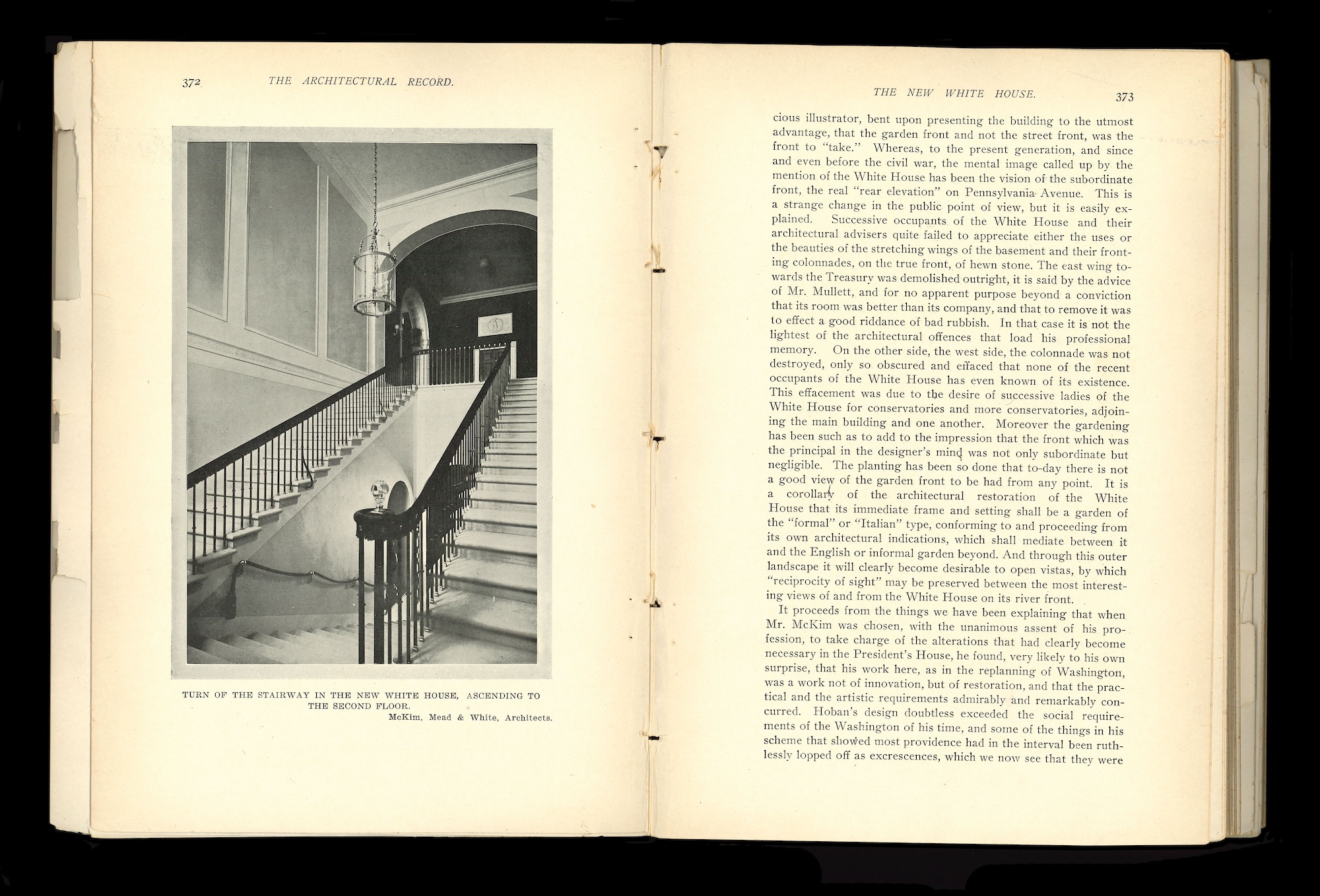
The enlargement of the social facilities of the mansion was of an even more urgent necessity than the banishment from it of the presidential business. The condition was quite intolerable, but for two generations nobody has apparently thought of relieving it by inquiring what the intention had been of the original architect. The basement had been treated like a subterranean garret, or devoted to the systems of communication and service of the house. When these had been buried or banished, the possibilities of the basement for the relief of the intolerable conditions became manifest. The coat rooms and dressing rooms had to be taken out of the already too circumscribed space of the main floor. The eastern wing of the basement, the eastern terrace, could be made really to “accommodate” them all. The north doorway under the portico is now reserved for the use of the presidential family. The guests at the receptions, under the new arrangement, arrive at and descend at the east end of the grounds, on Madison Place, opposite the Treasury, and the whole extent of this eastern wing is at their service for the disposition of their wraps. With proper attendance, it is hard to imagine any throng at a reception that cannot be taken care of without confusion. From this wing the guests make their way through the spacious arched corridor and up an easy stone staircase, arriving on the main floor suitably appareled and ready to be presented. This is the accommodation for the general mass of visitors, for “the line.” For the special guests, the guests “behind the line,” the entrance to the grounds is at the southwest corner, and they descend at the central oval room under the “Blue Room” and corresponding to it, an apartment, as is now seen highly suitable to the purpose and very much too good for the purposes from which it has been reclaimed. From this waiting the special guests mount by a separate staircase.
© Architectural Record, April 1903
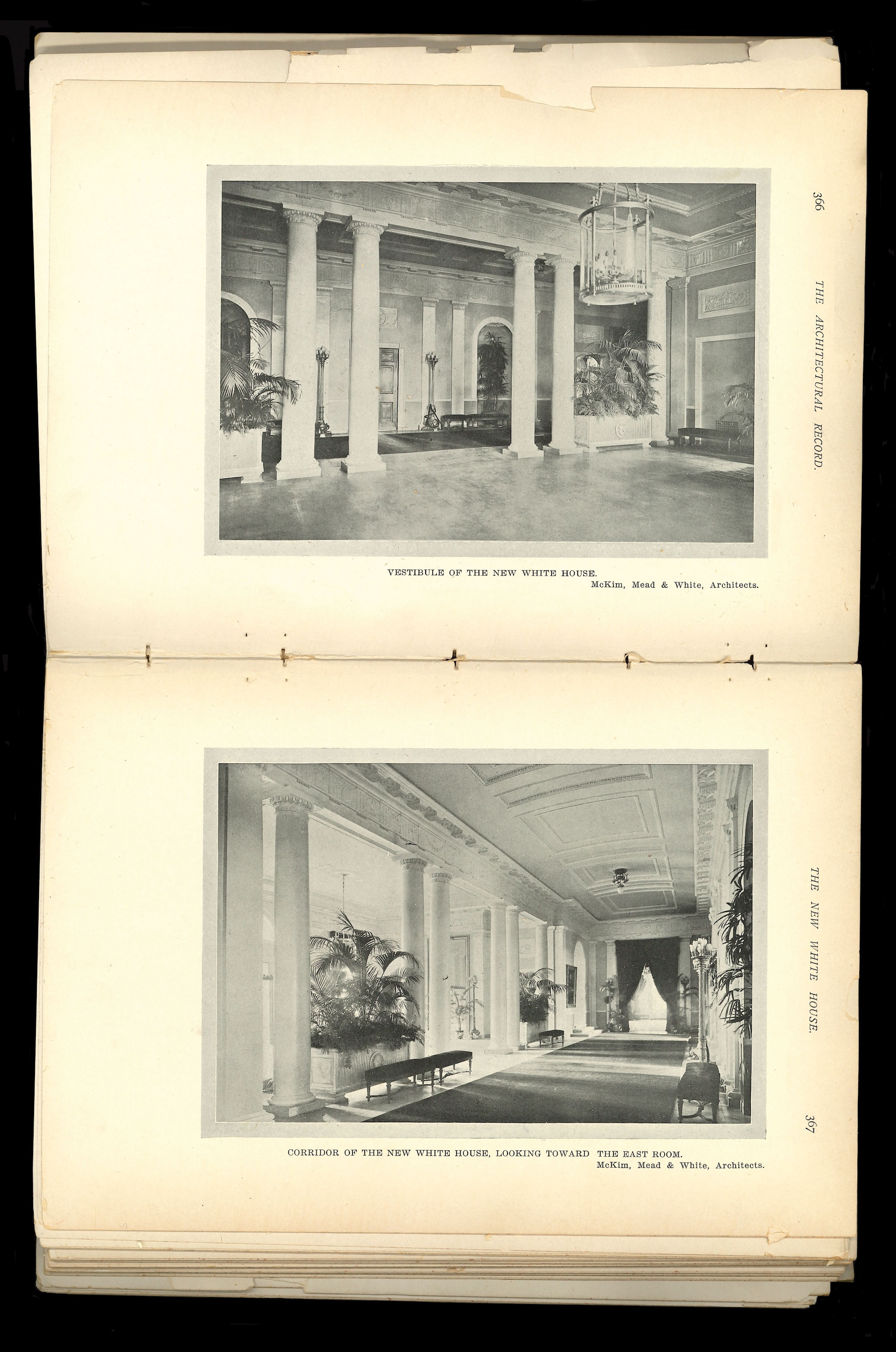
“Circulation” is thus abundantly provided, and the habitual attendants of receptions at the White House express great relief from the old and burdensome conditions, as well they may. Doubtless, the President’s House is now the best arranged and equipped mansion in the United States for the promiscuous hospitality, the dispensation of which is so largely the purpose of its existence. Upon the main floor, the increase of available space secured by the banishment of the waiting rooms and dressing rooms to the basement is very noticeable and welcome, adding greatly to the convenience and even more to the dignity of a public reception at the White House. The glass screen, which was put in in President Arthur’s time, which was supposedly so “artistic” and manifestly so incongruous, has very rightly been removed, and its place is occupied only by a row of coupled columns. The gain from the removal of the incongruity, though great, is less than the gain in the sense of spaciousness and liberality resulting from the enlargement of what was for such a house a contracted lobby into an ample and virtually an undivided hall, of which the forecourt is occupied, on the occasion of public reception, by the band. But the gains effected by these arrangements are by no means the only such gains in space resulting from the restoration of the basement wings, which extend the total frontage of the mansion to very nearly five hundred feet from something like a third of that extent. For the upper flat ceiling of the wings becomes the floors of wide terraces, on each side of the main floor and continuous with it. There are many nights in the Washington season when these terraces are available for promenade, and by the aid of marquees, they may be made even more largely available.
© Architectural Record, April 1903
All this work is, in spirit, and as nearly as possible in letter, a restoration, a return to the original scheme of the White House. It is at least what the original architect might be supposed to have done, if he had had modern means to work with, and the modern purposes of the house to fulfill. There is, indeed, no evidence that Hoban foresaw the pressure that has come and in his basement and his wings meant to provide for it. He was building “offices” or “quarters” for a great house, a Virginia planter’s mansion “to the n plus oneth,” and was principally allured, we may assume, by the architectural grandiosity which he foresaw would ensue to the garden front, the river front, from the basement which he projected as a stylobate of 500 feet in extent. It is the modern restorer who is entitled to the credit of perceiving that the execution of the original dispositions could be made to serve the new purposes and relieve the increased urgency of pressure and to do this with liberality and dignity as well as with convenience. This lucky discovery reconciles all the claims, historical, architectural, and practical, which threatened to conflict, and the conflict of which has prevented an earlier enlargement of the outgrown old house. It was really a stroke of genius. In applying it, Mr. McKim has been fortunate in securing the services as Superintendent of Mr. Glenn Brown, who has not only made a very careful study of Southern Colonial in general, but who, I suppose, knows more about the public architecture of Washington in particular than anybody else whosoever.
© Architectural Record, April 1903
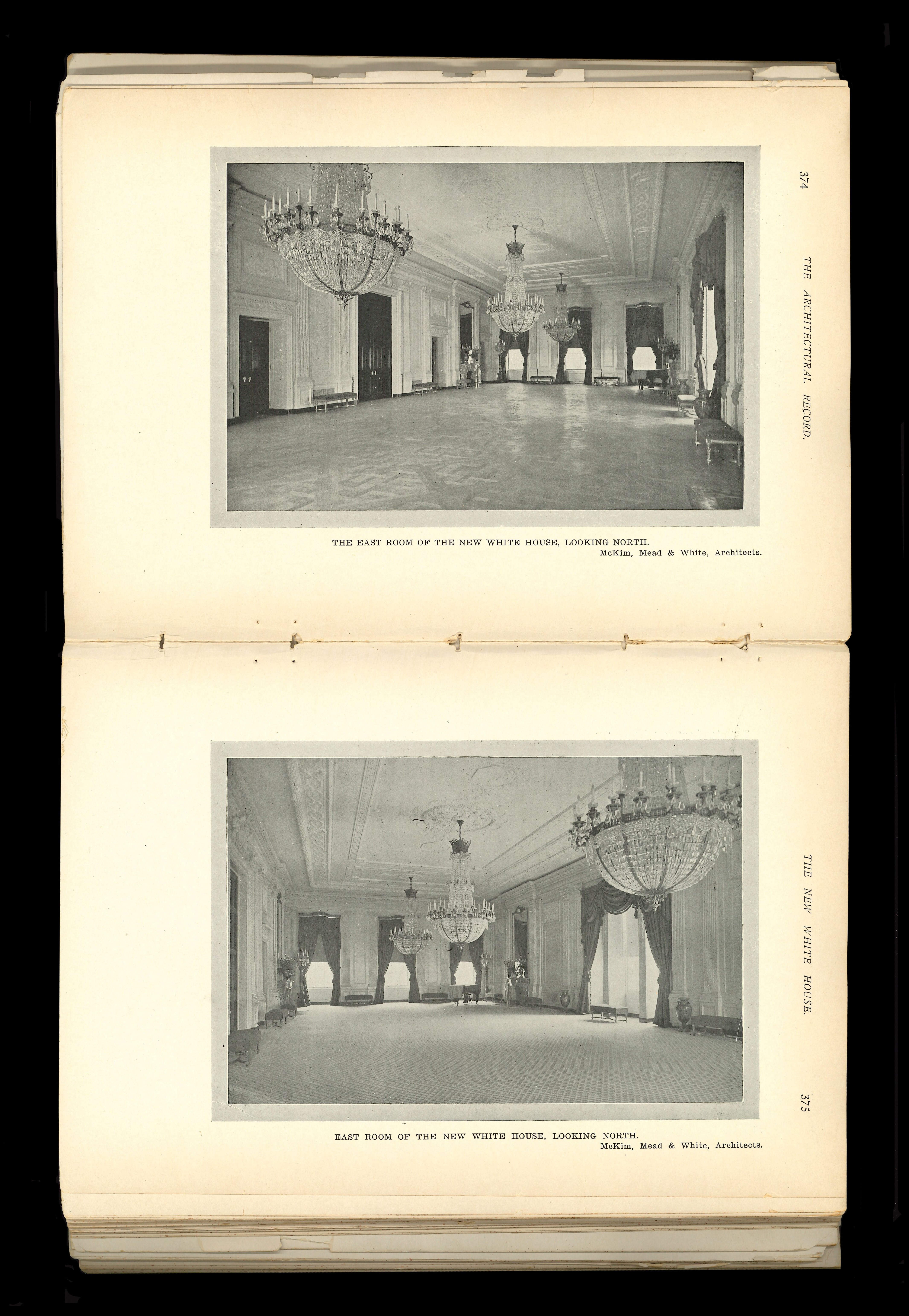
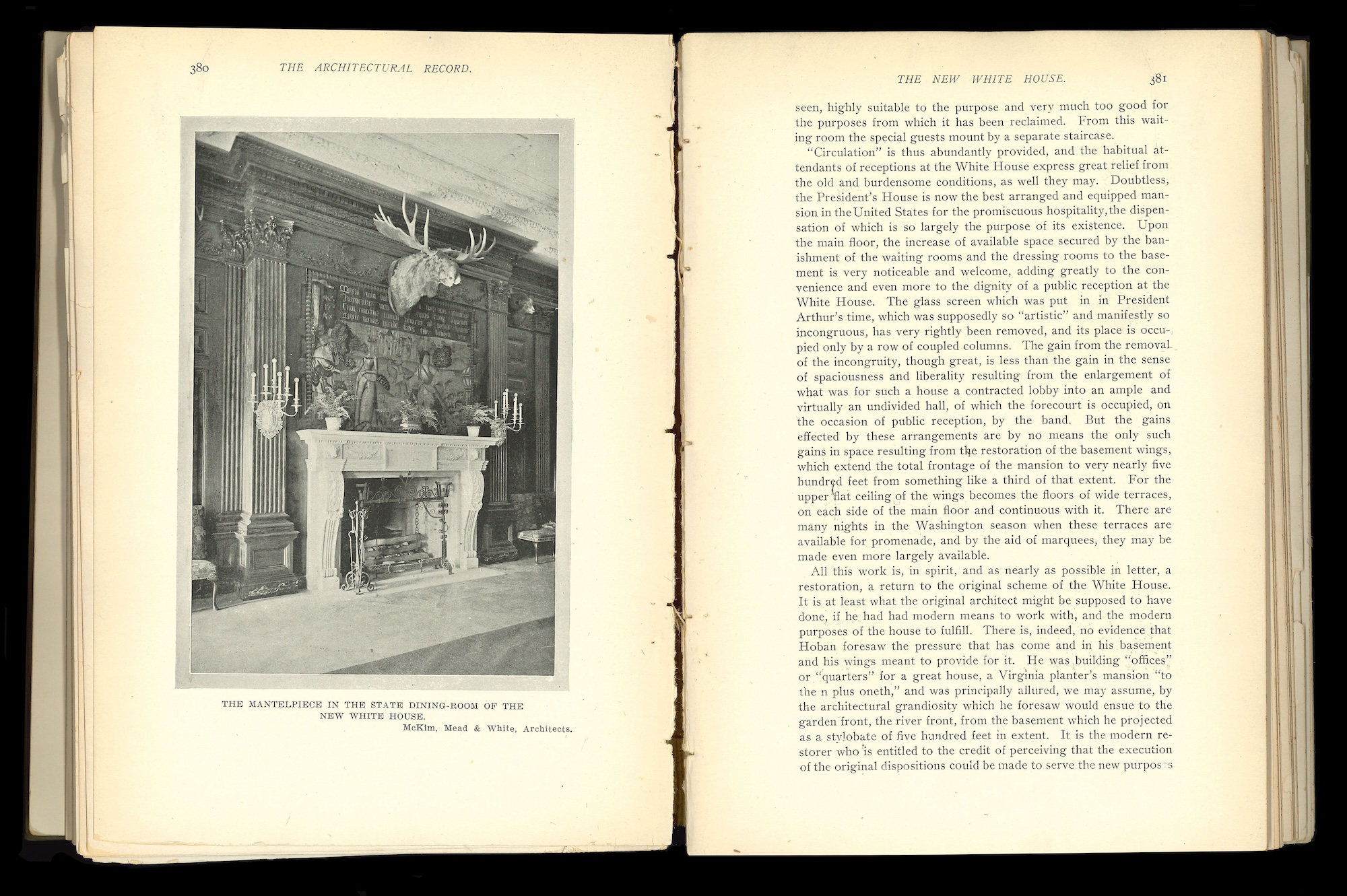
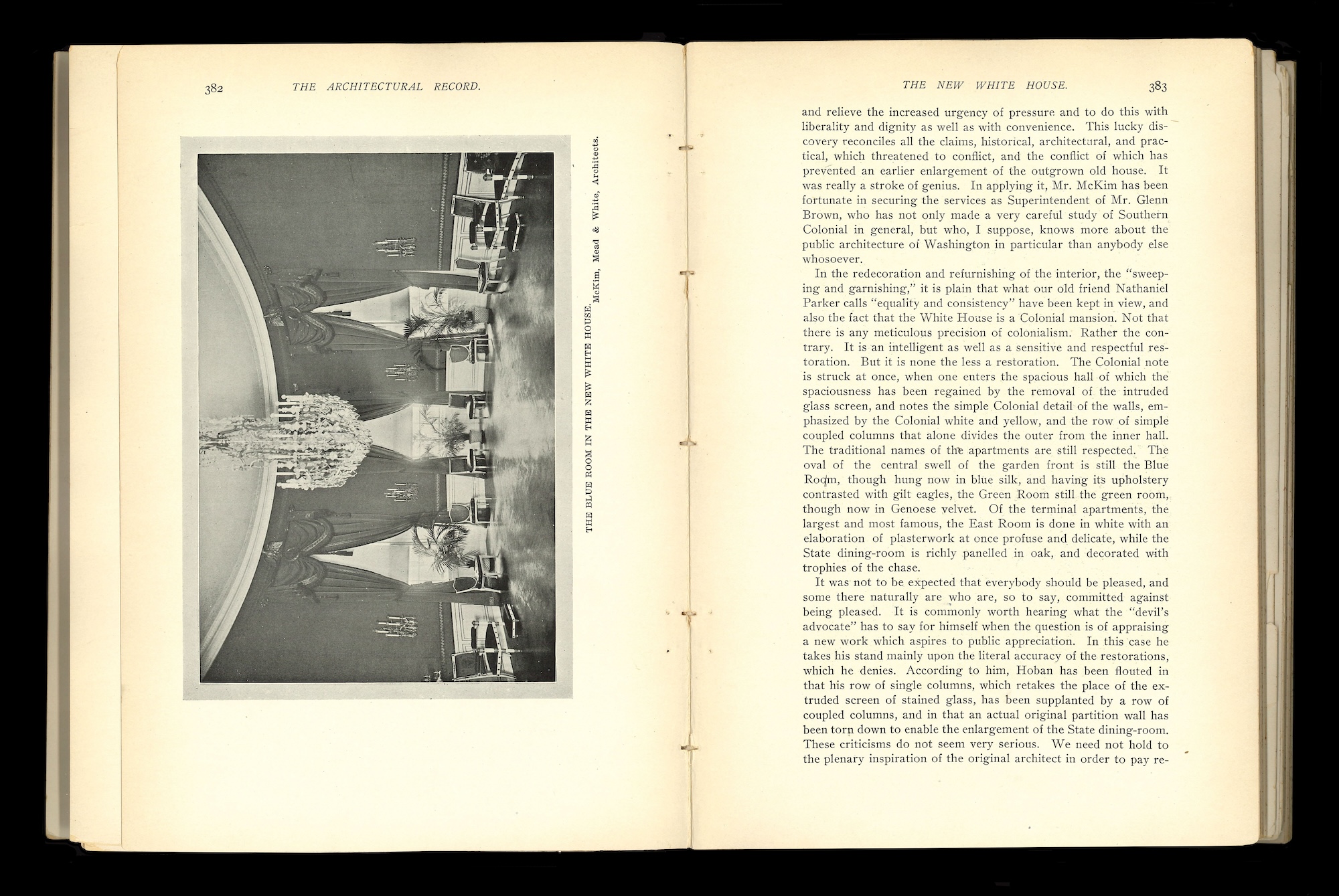
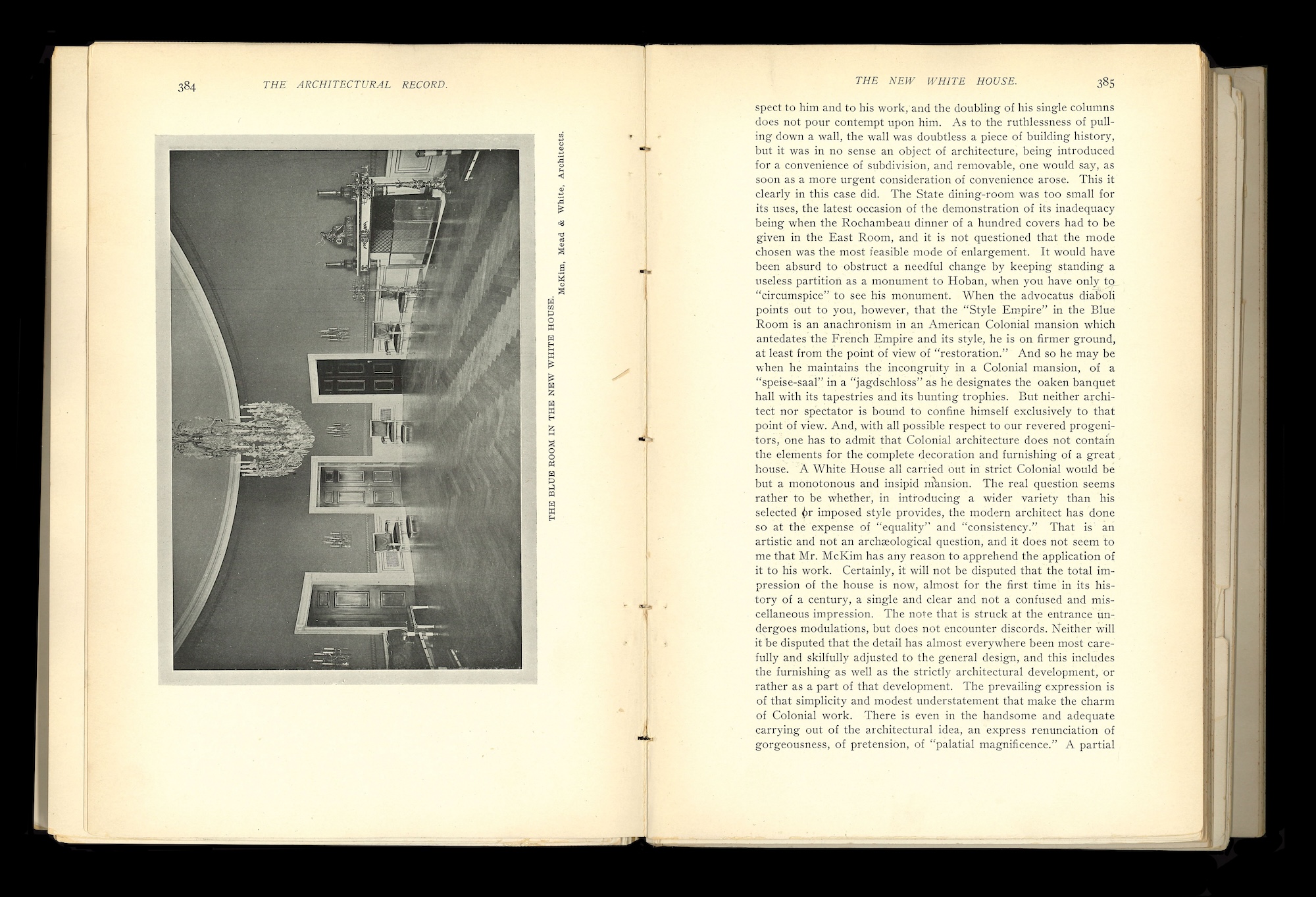
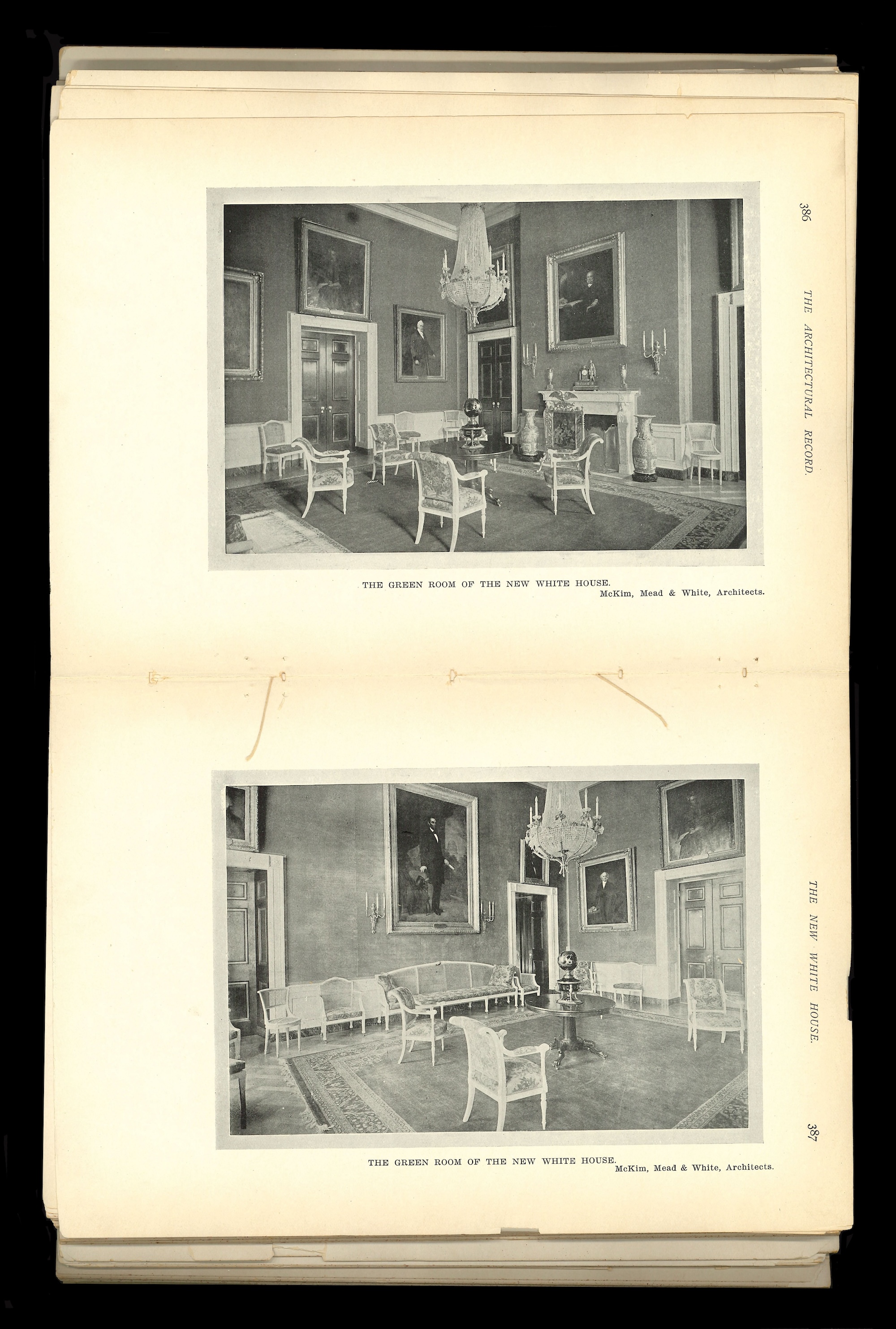
In the redecoration and refurnishing of the interior, the “sweeping and garnishing,” it is plain that what our old friend Nathanial Parker calls “equality and consistency” have been kept in view, and also the fact that the White House is a Colonial mansion. Not that there is any meticulous precision of colonialism. Rather the contrary. It is an intelligent as well as sensitive and respectful restoration. But it is none the less a restoration. The Colonial note is struck at once, when one enters the spacious hall of which the spaciousness has been regained by the removal of the intruded glass screen, and notes the simple Colonial detail of the walls, emphasized by the Colonial white and yellow, and the row of simple coupled columns that alone divides the outer from the inner hall. The traditional names of the apartments are still respected. The oval of the central swell of the garden front is still the Blue Room, though hung now in blue silk, and having its upholstery contrasted with gilt eagles, the Green Room still the green room, though now in Genoese velvet. Of the terminal apartments, the largest and most famous, the East Room is done in white with an elaboration of plasterwork at once profuse and delicate, while the State dining-room is richly paneled in oak, and decorated with trophies of the chase.

© Architectural Record, April 1903
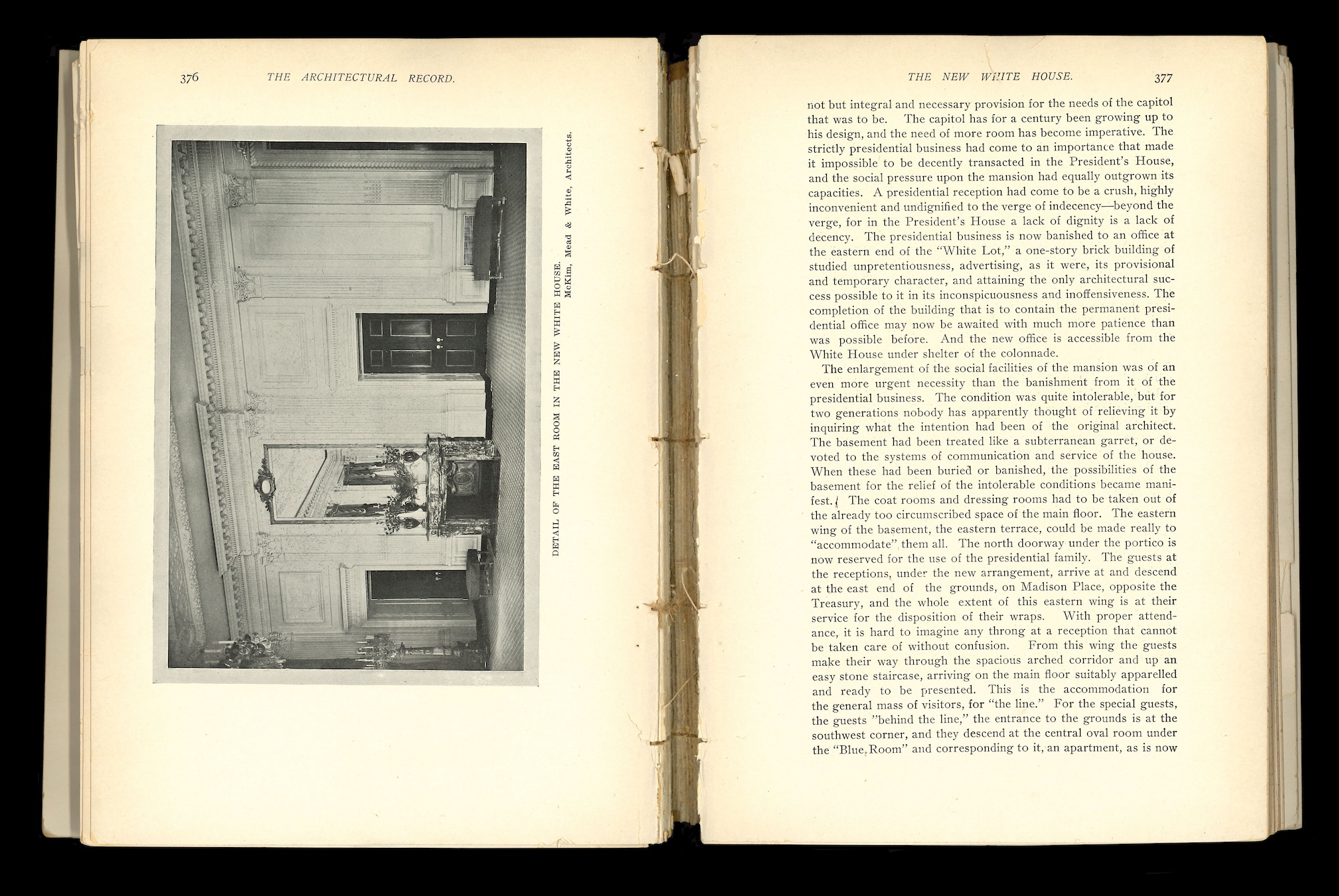
It was not to be expected that everybody should be pleased, and some there naturally are who are, so to say, committed against being pleased. It is commonly worth hearing what the “devil’s advocate” has to say for himself when the question is of appraising a new work which aspires to public appreciation. In this case, he takes his stand mainly upon the literal accuracy of the restorations, which he denies. According to him, Hoban has been flouted in that his row of single columns, which retakes the place of the extruded screen of stained glass, has been supplanted by a row of coupled columns, and in that an actual original partition wall has been torn down to enable the enlargement of the State dining-room. These criticisms do not seem very serious. We need not hold the plenary inspiration of the original architect in order to pay respect to him and to his work, and the doubling of his single columns does not pour contempt upon him. As to the ruthlessness of pulling down wall, the wall was doubtless a piece of building history, but it was in no sense an object of architecture, being introduced for a convenience of subdivision, and removable, one would say, as soon as a more urgent consideration of convenience arose. This it clearly in this case did. The State dining-room was too small for its uses, the latest occasion of the demonstration of its inadequacy being the Rochambeau dinner of a hundred covers had to be given in the East Room, and it is not questioned that the mode chosen was the most feasible mode of enlargement. It would have been absurd to obstruct a needful change by keeping standing a useless partition as a monument to Hoban, when you have only to “circumspice” to his monument. When the advocatus diaboli points out to you, however, that the “Style Empire” in the Blue Room is an anachronism in an American Colonial mansion which antedates the French Empire and its style, he is one firmer ground, at least from the point of view of “restoration.” And so he may be when he maintains the incongruity in a Colonial mansion, of a “speise-saal” in a “jagdschloss” as he designates the oaken banquet hall with its tapestries and its hunting trophies. But neither architect nor spectator is bound to confine himself exclusively to that point of view. And, with all possible respect to our revered progenitors, one has to admit that Colonial architecture does not contain the elements for the complete decoration and furnishing of a great house. A White House all carried out in strict Colonial would be a monotonous and insipid mansion. The real question seems rather to be whether, in introducing a wider variety than his selected or imposed style provides, the modern architect has done so at the expense of “equality” and “consistency.” That is an artistic and not an archaeological question, and it does not seem to me that Mr. McKim has any reason to apprehend the application of it to his work. Certainly, it will not be disputed that the total impression of the house is now, almost for the first time in its history of a century, a single and clear and not a confused and miscellaneous impression. The note that is struck at the entrance undergoes modulations, but does not encounter discords. Neither will it be disputed that the detail has almost everywhere been most carefully and skillfully adjusted to the general design, and this includes the furnishing as well as the strictly architectural development, or rather as a part of that development. The prevailing expression is of that simplicity and modest understatement that make the charm of Colonial work. There is even in the handsome and adequate carrying out of the architectural idea, an express renunciation of gorgeousness, of pretension, of “palatial magnificence.” A partial exception to this remark may be, perhaps, noted in the East Room, where, in the heavy mantels of dark polished marbles, the sumptuosity of the material seems to be rather unduly insisted on, to the detriment of the light and delicate detail of which the decoration elsewhere consists. It is the only exception I have noted to the rule of simplicity, and the attention it attracts in itself attests how uniformly the rule has been observed. But most of such opposition as the new work has encountered is also a tribute to the strictness with which the rule has been applied and denotes an unregenerate hankering, on the part of the opponents, for the fleshspots of “palatial magnificence.” “What,” they say, in effect, “all that money spent and nothing to show for it,” meaning no Mexican onyx or malachite, no inlays or incrustations, no scagliola, no barbaric pearl and gold in general. Meanwhile, the taste for palatial magnificence is being nourished in the Capitol by some decoration, representing, in paint, that Statuary Hall is lined with polished granite regardless of expense. There is nothing austere about this decoration, and the statesmen who resent the absence of fleshspots in the White House presumably think Uncle Sam is getting the worth of his money in these shams at the Capitol. There is no self-restraint upon the part of the decorator there, but manifest reason why restraint should be imposed upon him from without. And it is seriously disquieting to learn that upon the author of these exuberances, who is not even an architect by profession, it is seriously proposed to confer the designing of a new Congressional office building, and the power of awarding the design of the new municipal buildings of the district. But the White House, at least, is secure. We may be fairly sure that the original architect, could he revisit the scene of his labors, would be as delighted as surprised to see what has come of the development of his ideas, on the lines of the indications furnished by himself. The President’s house is at last, as it ought to be, the dwelling in the United States best adapted to dispense, with convenience and with dignity, the national hospitality.
Looking for a reprint of this article?
From high-res PDFs to custom plaques, order your copy today!