Architectural Record
search
cart
facebook twitter linkedin youtube
  • Sign In
  • Subscribe
  • Sign Out
  • My Account
Architectural Record
  • NEWS
    • Latest News
    • Awards
    • Interviews
    • Obituaries
    • Podcasts
      • Design:Ed Podcast
      • Sponsored Podcasts
  • OPINION
    • Book Reviews / Excerpts
    • Exhibition Reviews
    • Forum
  • EXCLUSIVES
    • Videos
    • Design Vanguard
    • Top 300 Firms
    • Sponsored Content
    • Sponsored eBooks
    • From the Archives
  • CONTINUING ED
    • Editorial Continuing Ed
    • CE Center
    • CE Academies
  • PROJECTS
    • Buildings By Type
    • Reuse & Renovation
    • Museums & Arts Centers
    • Colleges & Universities
    • Multifamily Housing
    • Interiors
    • Lighting
    • Kitchen & Bath
  • HOUSES
    • Record Houses
    • House of the Month
    • Featured Houses
  • PRODUCTS
    • Products by Category
    • Record Products of the Year
    • Latest Products
  • EVENTS
    • Dates & Events
    • Record on the Road
    • Innovation Conference
    • Sustainability in Practice
    • Women In Architecture
    • Webinars
    • Ad Excellence Awards
    • Submit an Event
  • CONNECT
    • Ask RECORD AI
    • Newsletters
    • Contact
    • Advertise
    • Editorial Calendar
    • Store
    • Customer Service
  • SUBMIT
    • Submission Guidelines
    • RECORD Competitions
  • MAGAZINE
    • Subscribe
    • My Account
    • Digital Edition
    • Current Issue
    • Firm Pass
    • Historic Archive
ExclusivesFrom the ArchivesBuildings by TypeTall Building Projects

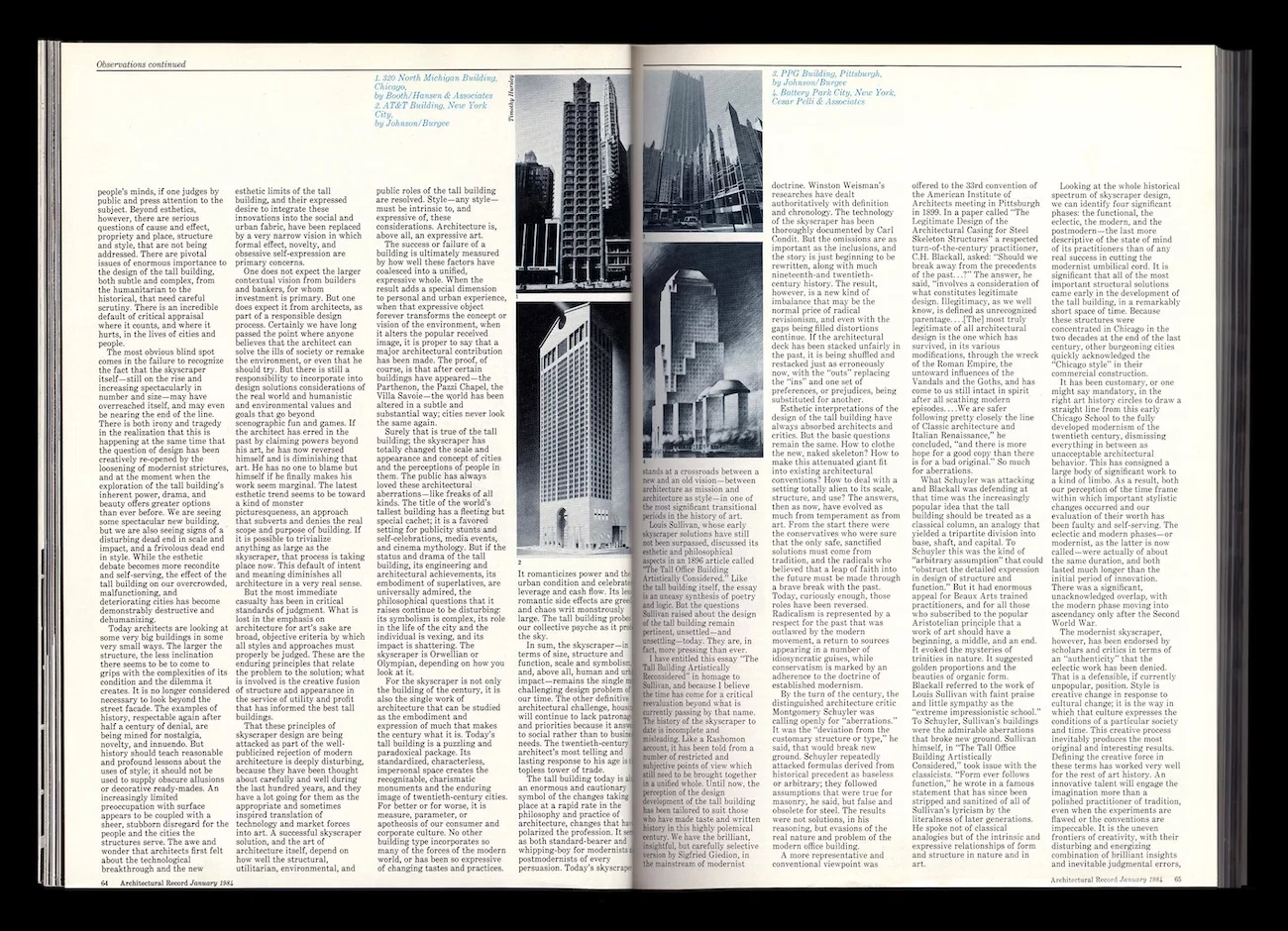
From the RECORD Archives: ‘The Tall Building Artistically Reconsidered: The Search for a Skyscraper Style’
By RECORD Editors
Architectural Record, January 1984
Image © Architectural Record, January 1984
May 12, 2026
✕
Image in modal.
Ada Louise Huxtable (1921–2013) achieved many firsts throughout her career: She became the first full-time architecture critic at an American newspaper when she began her career at the New York Times in 1963. She was awarded the first Pulitzer Prize for distinguished criticism (in any category) in 1970. And, in 1981, she was among the first cohort of MacArthur Fellows, who each receive a so-called genius grant, from which came her essay “The Tall Building Artistically Reconsidered.” In it, Huxtable meticulously unpacks the history of the skyscraper, dividing its evolution into four phases periods: the functional, eclectic, modern, and postmodern. She incisively assesses not only the typology and the design challenges it poses, but also 20th-century American architecture, commerce, and urban policy—for better and for worse. Huxtable’s essay, which was later expanded into a book of the same name, first appeared in the New Criterion in 1982 and was reprinted in RECORD’s January 1984 issue. Following is an excerpt.


“The Tall Building Artistically Reconsidered: The Search for a Skyscraper Style”
By Ada Louise Huxtable
Architectural Record, January 1984

Architectural Record, January 1984

Image © Architectural Record, January 1984


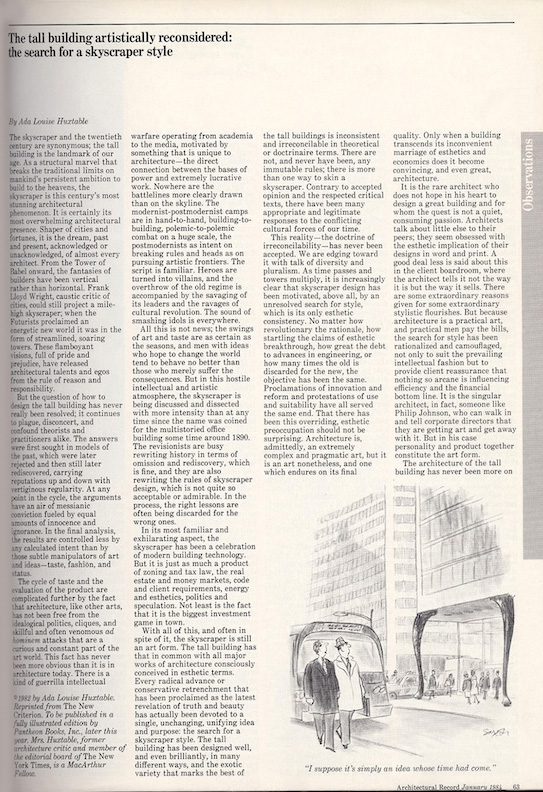
The skyscraper and the twentieth century are synonymous; the tall building is the landmark of our age. As a structural marvel that breaks the traditional limits on mankind’s persistent ambition to build to the heavens, the skyscraper is this century’s most stunning architectural phenomenon. It is certainly its most overwhelming architectural presence. Shaper of cities and fortunes, it is the dream, past and present, acknowledged or unacknowledged, of almost every architect. From the Tower of Babel onward, the fantasies of builders have been vertical rather than horizontal. Frank Lloyd Wright, caustic critic of cities, could project a mile-high skyscraper; when the Futurists proclaimed an energetic new world it was in the form of streamlined, soaring towers. These flamboyant visions, full of pride and prejudice, have released architectural talents and egos from the rule of reason and responsibility.

But the question of how to design the tall building has never really been resolved; it continues to plague, disconcert, and confound theorists and practioners alike. The answers were first sought in models of the past, which were later rejected and then still later rediscovered, carrying reputations up and down with vertiginous regularity. At any point in the cycle, the arguments have an air of messianic conviction fueled by equal amounts of innocence and ignorance. In the final analysis, the results are controlled less by any calculated intent than by those subtle manipulators of art and ideas—taste, fashion, and status.
Architectural Record, January 1984

Image © Architectural Record, January 1984
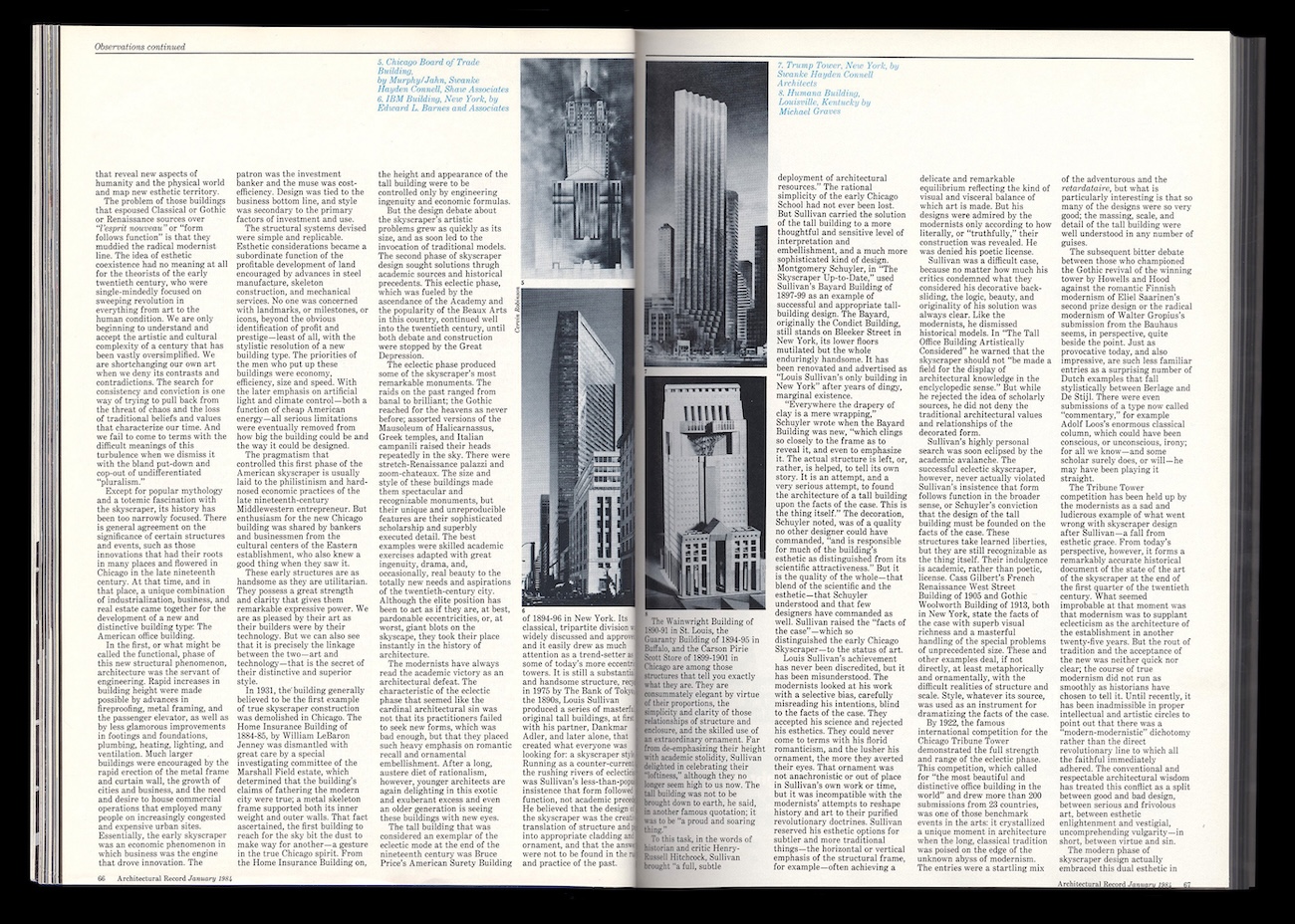
The cycle of taste and the evaluation of the product are complicated further by the fact that architecture, like other arts, has not been free from the ideological politics, cliques, and skillful and often venomous ad hominem attacks that are a curious and constant part of the art world. This fact has never been more obvious than it is in architecture today. There is a kind of guerrilla intellectual warfare operating from academia to the media, motivated by something that is unique to architecture—the direct connection between the bases of power and extremely lucrative work. Nowhere are the battlelines more clearly drawn than on the skyline. The modernist-postmodernist camps are in hand-to-hand, building-to-building, polemic-to-polemic combat on a huge scale, the postmodernists as intent on breaking rules and heads as on pursuing artistic frontiers. The script is familiar. Heroes are turned into villains, and the overthrow of the old regime is accompanied by the savaging of its leaders and the ravages of cultural revolution. The sound of smashing idols is everywhere.

All this is not news; the swings of art and taste are as certain as the seasons, and men with ideas who hope to change the world tend to behave no better than those who merely suffer the consequences. But in this hostile intellectual and artistic atmosphere, the skyscraper is being discussed and dissected with more intensity than any other time since the name was coined for the multistoried office building some time around 1890. The revisionists are busy rewriting history in terms of omission and rediscovery, which is fine, and they are also rewriting the rules of skyscraper design, which is not quite so acceptable or admirable. In the process, the right lessons are often being discarded for the wrong ones.

In its most familiar and exhilarating aspect, the skyscraper has been a celebration of modern building technology. But it is just as much a product of zoning and tax law, the real estate and money markets, code and client requirements, energy and esthetics, politics and speculation. Not least is the fact that it is the biggest investment game in town.

Architectural Record, January 1984

Image © Architectural Record, January 1984
With all of this, and often in spite of it, the skyscraper is still an art form. The tall building has that in common with all major works of architecture consciously conceived in esthetic terms. Every radical advance or conservative retrenchment that has been proclaimed as the latest revelation of truth and beauty has actually been devoted to a single, unchanging, unifying idea and purpose: the search for a skyscraper style. The tall building has been designed well, and even brilliantly, in many different ways, and the exotic variety that marks the best of the tall building is inconsistent and irreconcilable in theoretical or doctrinaire terms. There are not, and never have been, any immutable rules; there is more than one way to skin a skyscraper. Contrary to accepted opinion and the respected critical texts, there have been many appropriate and legitimate responses to the conflicting cultural forces of our time.

This reality—the doctrine of irreconcilability—has never been accepted. We are edging toward it with talk of diversity and pluralism. As time passes and towers multiply, it is increasingly clear that skyscraper design has been motivated, above all, by an unresolved search for style, which is its only esthetic consistency. No matter how revolutionary the rationale, how startling the claims of esthetic breakthrough, how great the debt to advances in engineering, or how many times the old is discarded for the new, the objective has been the same. Proclamations of innovation and reform and protestations of use and suitability have all served the same end. That there has been this overriding, esthetic preoccupation should not be surprising. Architecture is, admittedly, an extremely complex and pragmatic art, but it is an art nonetheless, and one which endures on its final quality. Only when a building transcends its inconvenient marriage of esthetics and economics does it become convincing, and even great, architecture.

Architectural Record, January 1984

Image © Architectural Record, January 1984
It is the rare architect who does not hope in his heart to design a great building and for whom the quest is not a quiet consuming passion. Architects talk about little else to their peers; they seem obsessed with the esthetic implication of their designs in word and print. A good deal less is said about this in the client boardroom, where the architect tells it not the way it is but the way it sells. There are some extraordinary reasons given for some extraordinary stylistic flourishes. But because architecture is a practical art, and practical men pay the bills, the search for style has been rationalized and camouflaged, not only to suit the prevailing intellectual fashion but to provide client reassurance that nothing so arcane is influencing efficiency and the financial bottom line. It is the singular architect, in fact, someone like Philip Johnson, who can walk in and tell corporate directors that they are getting art and get away with it. But in his case personality and product together constitute the art form.

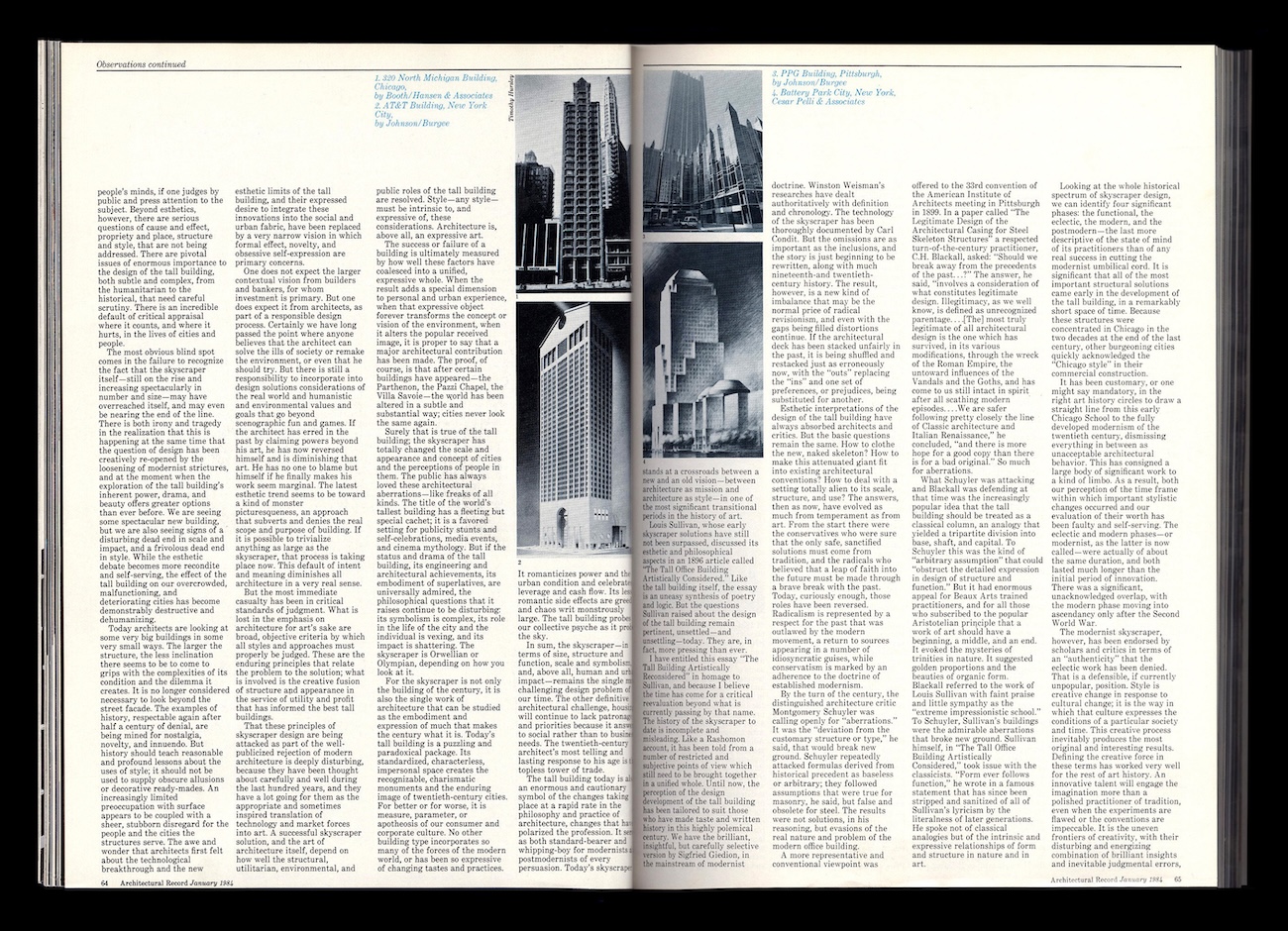
The architecture of the tall building has never been more on people’s minds, if one judges by public and press attention to the subject. Beyond esthetics, however, there are serious questions of cause and effect, propriety and place, structure and style, that are not being addressed. There are pivotal issues of enormous importance to the design of the tall building, both subtle and complex, from the humanitarian to the historical, that need careful scrutiny. There is an incredible default of critical appraisal where it counts, and where it hurts, in the lives of cities and people.

Architectural Record, January 1984

Image © Architectural Record, January 1984
The most obvious blind spot comes in the failure to recognize the fact that the skyscraper itself—still on the rise and increasing spectacularly in the number and size—may have overreached itself, and may even be nearing the end of the line. There is both irony and tragedy in the realization that this is happening at the same time that the question of design has been creatively re-opened by the loosening of modernist strictures, and at the moment when the exploration of the tall building’s inherent power, drama, and beauty offers greater options than ever before. We are seeing some spectacular new building, but we are also seeing signs of a disturbing dead end in scale and impact, and frivolous dead end in style. While the esthetic debate becomes more recondite and self-serving, the effect of the tall building on our overcrowded, malfunctioning, and deteriorating cities has become demonstrably destructive and dehumanizing.


Today architects are looking at some very big buildings in some very small ways. The larger the structure, the less inclination there seems to be to come to grips with the complexities of its condition and the dilemma it creates. It is no longer considered necessary to look beyond the street facade. The examples of history, respectable again after half a century of denial, are being mined for nostalgia, novelty, and innuendo. But history should teach reasonable and profound lessons about the uses of style; it should not be used to supply obscure allusions or decorative ready-mades. An increasingly limited preoccupation with surface appears to be coupled with a sheer, stubborn disregard for the people and cities the structures serve. The awe and wonder that architects first felt about the technological breakthrough and the new esthetic limits of the tall building, and their expressed desire to integrate these innovations into the social and urban fabric, have been replaced by a very narrow vision in which formal effect, novelty, and obsessive self-expression are primary concerns. 

Architectural Record, January 1984

Image © Architectural Record, January 1984
One does not expect the larger contextual vision from builders and bankers, for whom investment is primary. But one does expect it from architects, as part of a responsible design process. Certainly we have long passed the point where anyone believes that the architect can solve the ills of society or remake the environment, or even that he should try. But there is still a responsibility to incorporate into design solutions considerations of the real world and humanistic and environmental values and goals that go beyond scenographic fun and games. If the architect has erred in the past by claiming powers beyond his art, he has now reversed himself and is diminishing that art. He has no one to blame but himself if he finally makes his work seem marginal. The latest esthetic trend seems to be toward a kind of monster picturesqueness, an approach that subverts and denies the real scope and purpose of building. If it is possible to trivialize anything as large as the skyscraper, that process is taking place now. This default of intent and meaning diminishes all architecture in a very real sense.

But the most immediate casualty has been in critical standards of judgement. What is lost in the emphasis on architecture for art’s sake are broad, objective criteria by which all styles and approaches must properly be judged. These are the enduring principles that relate the problem to the solution; what is involved is the creative fusion of structure and appearance in the service of utility and profit that has informed the best tall buildings.

Architectural Record, January 1984

Image © Architectural Record, January 1984
That these principles of skyscraper design are being attacked as part of the well-publicized rejection of modern architecture is deeply disturbing, because they have been thought about carefully and well during the last hundred years, and they have a lot going for them as the appropriate and sometimes inspired translation of technology and market forces into art. A successful skyscraper solution, and the art of architecture itself, depend on how well the structural, utilitarian, environmental, and public roles of the tall building are resolved. Style—any style—must be intrinsic to, and expressive of, these considerations. Architecture is, above all, an expressive art.


The success or failure of a building is ultimately measured by how well these factors have coalesced into a unified, expressive whole. When the result adds a special dimension to personal and urban experience, when the expressive object forever transforms the concept or vision of the environment, when it alters the popular received image, it is proper to say that a major architectural contribution has been made. The proof, of course, is that after certain building have appeared—the Parthenon, the Pazzi Chapel, the Villa Savoie—the world has been altered in a subtle and substantial way; cities never look the same again.

Surely that is true of the tall building; the skyscraper has totally changed the scale and appearance and concept of cities and the perceptions of people in them. The public has always loved these architectural aberrations—like freaks of all kinds. The title of the world’s tallest building has a fleeting but special cachet; it is a favored setting for publicity stunts and self-celebrations, media events, and cinema mythology. But if the status and drama of the tall building, its engineering and architectural achievements, its embodiment of superlatives, are universally admired, the philosophical questions that it raises continue to be disturbing: its symbolism is complex, its role in the life of the city and the individual is vexing, and its impact shattering. The skyscraper is Orwellian or Olympian, depending on how you look at it.

Architectural Record, January 1984

Image © Architectural Record, January 1984
For the skyscraper is not only the building of the century, it is also the single work of architecture that can be studied as the embodiment and expression of much that makes the century what it is. Today’s tall building is a puzzling and paradoxical package. Its standardized, characterless, impersonal space creates the recognizable, charismatic monuments and the enduring image of twentieth-century cities. For better or for worse, it is measure, parameter, or apotheosis of our consumer and corporate culture. No other building type incorporates so many of the forces of the modern world, or has been so expressive of changing tastes and practices.

It romanticizes power and the urban condition and celebrates leverage and cash flow. Its lesser romantic side effects are green and chaos writ monstrously large. The tall building probes our collective psyche as it probes the sky.

In sum, the skyscraper—in terms of size, structure and function, scale and symbolism, and, above all, human and urban impact—remains the single most challenging design problem of our time. The other definitive architectural challenge, housing, will continue to lack patronage and priorities because it answers to social rather than to business needs. The twentieth-century architect’s most telling and lasting response to his age is the topless tower of trade.

Architectural Record, January 1984

Image © Architectural Record, January 1984

The tall building today is also an enormous and cautionary symbol of the changes taking place at a rapid rate in the philosophy and practice of architecture, changes that have polarized the profession. It serves as both standard-bearer and whipping-boy for modernists and postmodernists of every persuasion. Today’s skyscraper stands at a crossroads between a new and an old vision—between architecture as mission and architecture as style—in one of the most significant transitional periods in the history of art.

Louis Sullivan, whose early skyscraper solutions have still not been surpassed, discussed its esthetic and philosophical aspects in an 1896 article called “The Tall Office Building Artistically Considered.” Like the tall building itself, the essay is an uneasy synthesis of poetry and logic. But the questions Sullivan raised about the design of the tall building remain pertinent, unsettled—and unsettling—today. They are, in fact, more pressing than ever.
KEYWORDS: New York City

Share This Story

Looking for a reprint of this article?
From high-res PDFs to custom plaques, order your copy today!

Post a comment to this article

Report Abusive Comment

Subscription Center
  • Create an Account
  • Start a Subscription
  • Manage My Account
  • Sign Up for Newsletters
  • Visit Customer Service
  • Update Preferences

More Videos

Sponsored Content

Sponsored Content is a special paid section where industry companies provide high quality, objective, non-commercial content around topics of interest to the Architectural Record audience. All Sponsored Content is supplied by the advertising company and any opinions expressed in this article are those of the author and not necessarily reflect the views of Architectural Record or its parent company, BNP Media. Interested in participating in our Sponsored Content section? Contact your local rep!

close
  • cold storage facility
    Sponsored byCarlisle SynTec Systems

    How Architects Can Design More Continuous Cold Storage Envelopes

  • TAMLYN XtremeTrim Exterior Trim
    Sponsored byTamlyn

    Designing Cleaner Panel Facades: Why Exterior Trim Details Matter

  • Building with Vapor Barriers
    Sponsored byReef Industries, Inc.

    Vapor Barriers Help Control Moisture in Tighter Building Designs

DESIGN:ED Podcast
Listen to Architectural Record’s DESIGN:ED Podcast

Events

June 23, 2026

Enhancing Fire Resistance with Advanced PVC Solutions

Credits: 1 AIA LU/HSW; 1 AIBD P-CE; 0.1 ICC CEU; 1 IIBEC CEH

Evaluate advanced PVC solutions that improve fire resistance, support WUI compliance, and enhance resilience in residential and commercial building design.

June 25, 2026

Designing Glass Railing Systems that Enhance Aesthetics and Meet Code

Credits: 1 AIA LU/HSW; 1 AIBD P-CE; 0.1 ICC CEU

Upon course completion, participants will possess a deeper understanding of glass railings to help ensure that safety, aesthetic, and performance objectives are achieved.

View All Submit An Event

Products

2026 Architect's Square Foot Costbook

2026 Architect's Square Foot Costbook

See More Products

Popular Stories

Lorcan O' Herilhy

California Architect Lorcan O’Herlihy Has Died, Age 66

Obama Presidential Center, Chicago

The Obama Presidential Center Opens on Chicago’s South Side

Spoonbill Ranch

Johnsen Schmaling Architects Integrates Spoonbill Ranch into a Pristine Landscape

Image of Bruce Springsteen Center for American Music

The CookFox-designed Bruce Springsteen Center for American Music Opens in New Jersey

Three Courtyards House

Design Vanguard 2026: Balsa Crosetto Piazzi

Enhancing Fire Resistance with Advanced PVC Solutions - Free Webinar - June 23, 2026

Related Articles

  • Architectural Record, September 1925

    From the RECORD Archives: ‘The Steinway Building, New York: Warren & Wetmore, Architects’

    See More
  • USTA National Tennis Center, Architectural Record

    From the RECORD Archives: ‘The USTA National Tennis Center by David Kenneth Specter’

    See More
  • White House, Architectural Record, 1903

    From the RECORD Archives: ‘The New White House’

    See More

Related Products

See More Products
  • drawingfrommodel.jpg

    Drawing from the Model: Fundamentals of Digital Drawing, 3D Modeling, and Visual Programming in Architectural Design

See More Products
×

The latest news and information

#1 Source for Architectural Design, News and Products

SUBSCRIBE
  • RESOURCES
    • Advertise
    • Contact Us
    • Submit
    • Store
  • ACCOUNT CENTER
    • Create an Account
    • Start a Subscription
    • Manage My Account
    • Sign Up for Newsletters
    • Visit Customer Service
    • Update Preferences
  • PRIVACY
    • PRIVACY POLICY
    • TERMS & CONDITIONS
    • DO NOT SELL MY PERSONAL INFORMATION
    • PRIVACY REQUEST
    • ACCESSIBILITY
  • SERVICES
    • Marketing Services
    • Reprints
    • Market Research
    • List Rental
    • Survey/Respondent Access
  • STAY CONNECTED
    • Linkedin
    • Facebook
    • Instagram
    • YouTube
    • X (Twitter)

Copyright ©2026. All Rights Reserved BNP Media, Inc. and BNP Media II, LLC.

Design, CMS, Hosting & Web Development :: ePublishing