Building Technology November 2025
Patkau Architects Delivers a High-Performing Biomedical Building for the University of British Columbia
Vancouver, British Columbia

Architects & Firms
Biomedical engineering depends on cross-pollination—between medicine and engineering, research and application, academia and industry. As Canada’s first purpose-built school for this integrative discipline, the Gordon B. Shrum Building at the University of British Columbia in Vancouver creates an environment that is collaborative, adaptable, and humane while setting new standards for sustainability and accessibility in a laboratory building. Designed by Patkau Architects, with Architecture49 (A49) as laboratory architect, the building opened this spring at a construction cost of just $527 per square foot—remarkably economical for its type.
The school’s director, Peter Zandstra, “was insistent that the building focus wherever possible on creating spaces that support collaboration,” says Greg Boothroyd, a principal at Vancouver-based Patkau Architects. “We had to work very leanly and really focus on large-scale moves that would achieve his objectives.”
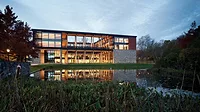
With a site fronting to the north on University Boulevard, a major campus thoroughfare, and to the south on a courtyard at the heart of the health-sciences precinct—the lines of each skewing at different angles—the building negotiates contrasting urban conditions and physical geometries. An early decision to preserve a row of mature London plane trees along the courtyard’s edge became a principal organizing metric, Boothroyd says, “and the idea of connecting back to this courtyard, to the trees, to daylight and nature became a theme for the building.” The decision shaped the building’s footprint, form, and character.

Trees line the site. Photo © Michael Elkan, click to enlarge.
Within an envelope of white brick and metal—tying into UBC’s campus palette, chosen to help brighten the city’s gray winters—the building consists of five stories, with an additional, below-grade level that compensates for the tight, tree-preserving footprint. Pragmatically stacked laboratories line the north elevation, parallel to the street, where floor-to-ceiling glass provides diffuse northern light. Offices line the south elevation, parallel to the trees, with leaf-filtered light and courtyard views. Connecting these zones and resolving their differing geometries are two multi-level atria that define lower and upper common spaces.
The lower common space extends between boulevard and courtyard, inviting the wider campus community through, and opens vertically between main and below-grade floors. These levels are where classrooms, makerspaces, and lecture theaters are located. (In an innovative, cost-free move, even the lecture theaters are configured to foster collaboration: in one, double rows on each tier allow students to turn to face each other across a shared worktop; in another, tiers of tables for six sit at 90 degrees to the presentation.) Daylight from the main floor’s courtyard window wall fills both levels of the atrium, and a wide stairway through the opening ties them together.

A staircase leads to the basement. Photo © Michael Elkan
The upper common space spans four floors, forming the social heart of the research levels, and the separation of office and lab zones brings people into the places between. Bridges from one side to the other humanize the atrium’s scale, while tables and seating along the solid balustrades support informal meetings and chance encounters. Glass partitions allow for borrowed daylight and visual connections between spaces as well as recurring views of the courtyard foliage.

Partitions are transparent. Photo © Tom Arban
Clear and efficient, the spatial organization is also symbolic. It embodies the school’s identity, making visible the idea of bridging disciplines and communities, linking science with people and nature, and fostering the connections and “unexpected collisions” that, Zandstra says, are essential to the culture of biomedical engineering.
Looking for quick answers on architecture and design topics?
Try Ask RECORD, our new smart AI search tool.
Ask RECORD →
The laboratories are the most programmatically demanding part of the building. To accommodate research’s constantly changing parameters—whether in mandates and grants, staffing, or equipment—the design adopts three watchwords, says Ana Coppinger, a lab-planning specialist in the Winnipeg, Manitoba, office of A49: “The key—and maybe you hear this overused today, but for good reason—is laboratories that are flexible, adaptable, and modular.”

Learning spaces are flexible. Photo © Tom Arban
Open labs along the perimeter provide for scalability, enabling projects to expand or contract without walls interrupting. At the project’s outset, Coppinger worked iteratively with the client to optimize the width of the laboratory bay at 11 feet 6 inches, which determined the three-bay structural span: “Ensuring that lab modules fit seamlessly within the building’s structural framework makes optimization of workflows, safety, and future adaptability possible,” she says. Standardized bench modules are plug-and-play: services are delivered from central cores above island ceiling panels, allowing equipment to be reconfigured as research evolves.
Laboratories are notoriously energy-hungry, with high air-change requirements and intensive equipment loads. Achieving a total energy-use intensity (TEUI) of 66 kBtu/sf, the Shrum Building pushes the envelope for the building type. (For context, UBC guidelines anticipate a TEUI in the range of 120 kBtu/sf for a high-intensity lab building, Coppinger says.) A key strategy in the achievement is a demand-based ventilation system. Instead of operating constantly at the air-change rates that would be needed for air quality and safety in any circumstance, the system modulates each zone according to real-time feedback. In the event of contamination or air-quality deterioration, the system ramps up. Equipment zoning was also considered: high-demand instruments like cold rooms and fume-hoods are enclosed in consolidated support labs, allowing the open labs to operate at potentially lower air-exchange rates while enhancing comfort and air quality lab-wide.
Daylighting further reduces the labs’ power draw. Vertical fins screen the north-facing glass, bouncing light into the interiors while limiting solar gains from northeast and northwest. Coppinger cites the north-facing full-height glazing as an example she’ll be encouraging future STEM projects to follow. In addition to the reduced energy demand, she says, “people spend long hours in these labs, and diffuse north daylight supports the intensive thinking they’re doing; it changes the whole environment.”
Another aspect of the building that explicitly supports users’ well-being is the integration of universal-design strategies. The project has achieved gold-level accessibility through the Rick Hansen Foundation’s certification program, incorporating such measures as high-contrast color choices for people with low vision, calm acoustics for those with hearing impairments, and a choice of active and quiet places to support the needs of neurodiverse users. “Well-ordered spaces with audio and visual diversity are architectural virtues,” says Tom Schroeder, an associate at Patkau Architects. “Looking at these qualitative values through certification allowed us to double down on them.”
The result is an inclusive and versatile environment that reflects the School of Biomedical Engineering’s commitment to improving human health—a building that supports both the advancement of science and the flourishing of those who practice it.

Image courtesy Patkau Architects

Image courtesy Patkau Architects

Image courtesy Patkau Architects

Image courtesy Patkau Architects
Credits
Architect:
Patkau Architects — John Patkau, founding principal; Greg Boothroyd, principal; Tom Schroeder, associate; Peter Suter, senior associate
Laboratory Architect:
Architecture49 — Kevin Humeniuk, principal; Ana Coppinger, senior lab planner
Landscape:
Hapa Collaborative
General Contractor:
Ventana Construction Corporation
Client:
UBC Property Trust
Size:
156,000 square feet
Cost:
$100 million
Completion Date:
April 2025
Sources
Exterior Cladding:
Glen-Gery (brick); Flynn (metal panels)
Built-Up Roofing:
Soprema
Fire-Control Doors:
TPG
Hardware:
Sargent
Plastic Laminate:
Wilsonart
Looking for a reprint of this article?
From high-res PDFs to custom plaques, order your copy today!