Building Technology November 2025
KieranTimberlake’s Partially Buried Scaife Hall Revitalizes a Neglected Corner of Carnegie Mellon’s Campus
Pittsburgh

Architects & Firms
“A cornerstone site for an engineering building? That’s unusual on a campus nowadays,” says architect Stephen Kieran of Scaife Hall, the first project by his firm, KieranTimberlake, at Carnegie Mellon University (CMU). The building, situated on the steep slopes of Pittsburgh’s Junction Hollow ravine, is the new home of the school’s mechanical engineering department and acts as a campus gateway at its southwest edge.

The cornerstone site abuts Baker-Porter and Hamerschlag halls. Photo © Hawkeye Aerial Photo, click to enlarge.
“We wanted to restore lost vitality. Over time, that part of campus had become back-of-house instead of front-of-house,” he adds. But building on such a prominent site also meant contending with CMU’s architectural heritage, including significant neighbors by fin de siècle architect Henry Hornbostel. Many structures at the university bear his signature brawny industrial classicism, which served as a potent analogy for the school’s focus on nurturing both the arts and the sciences. To the north, with its arched smokestack, is Hamerschlag Hall; to the east is the 1,000-foot-long Baker-Porter Hall, known for its linear hallway and daring stair of Guastavino tiles. (Notably, Hornbostel was the architect of the Queensborough and Hell Gate bridges in New York.)

1
Panel-clad Scaife Hall (1 & top of page) forms a quad with its neighbors (2). Photos © Sahar Coston-Hardy / ESTO
2
Scaife Hall replaces an earlier structure of the same name, designed by Altenhof & Brown and completed in 1962, which featured an attached sculptural auditorium wittily dubbed the “potato chip” for its saddle-shaped roof. “It was really tight, with crammed rooms that weren’t feasible to renovate,” says KieranTimberlake principal Brendan Miller.
The replacement is 85,000 square feet—double the area of the original—and includes a diverse program organized into three distinct volumes. “Mechanical engineering today is not the discipline that you and I learned about while in architecture school,” says Kieran. The field, he explains, now encompasses robotics (and organic “soft-botics”), biomechanics, wearable technology, machine learning, and much more—meaning spaces needed to accommodate a broad range of research and uses.
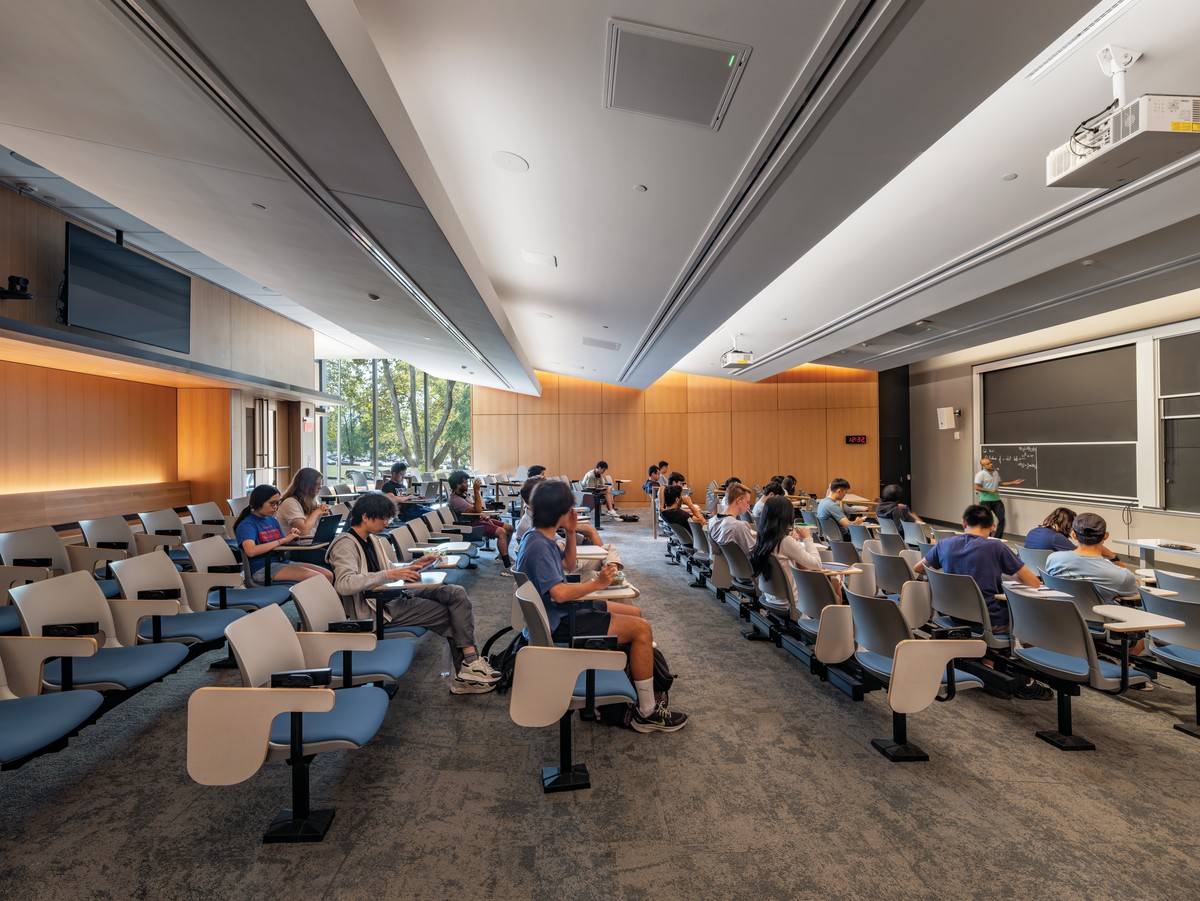
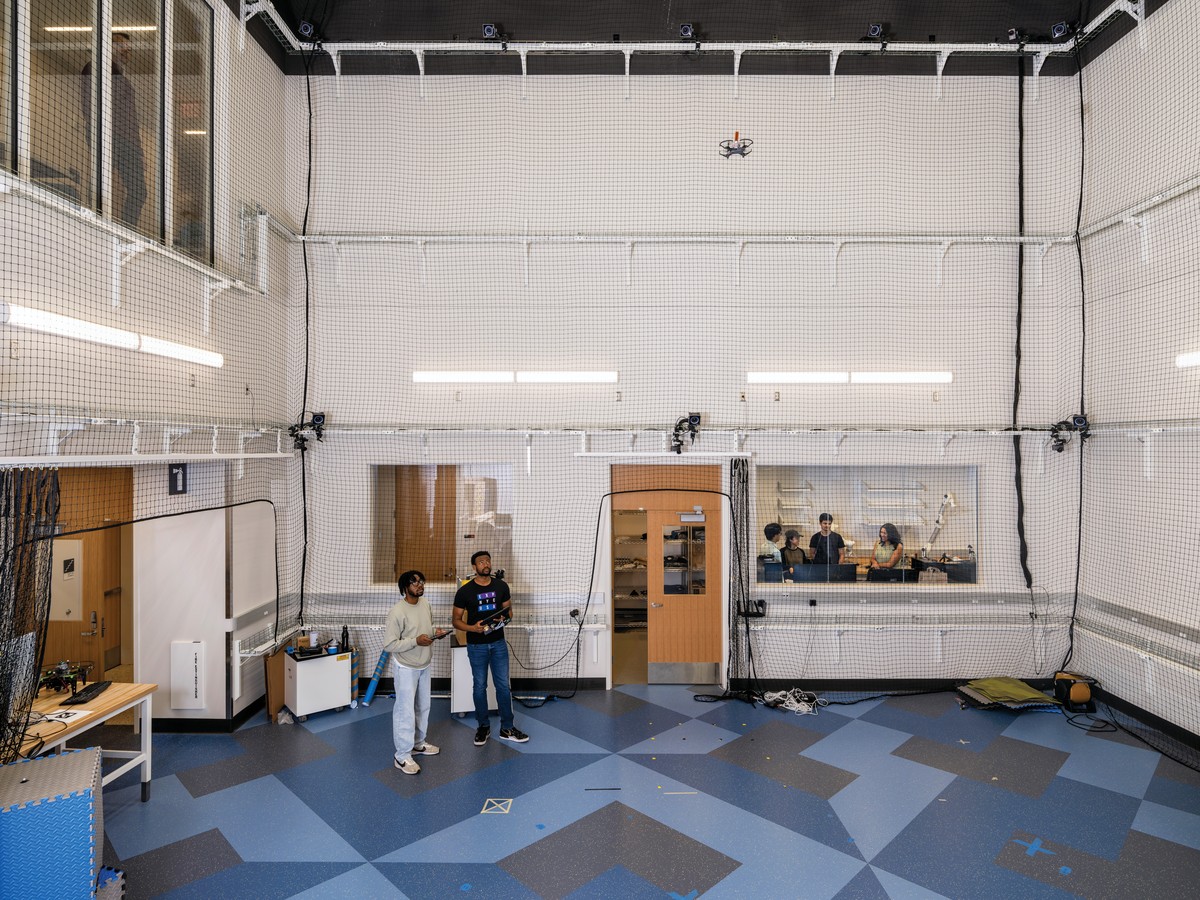
A two-story brick-clad volume, running parallel to the hill into which it is nestled and accounting for about half of Scaife’s total square footage, houses an open-plan area for doctoral researchers and their workstations and a double-height drone arena, as well as wet and dry laboratories, pressurized relative to neighboring spaces to prevent contamination. “Windows introduce daylight to the desk spaces, and then we buried the labs deep into the hillside,” Kieran explains. “That keeps them very stable in terms of temperature.” Above this plinth, a two-story bar, accommodating seminar rooms and offices, continues the visual patter of Baker-Porter’s lengthy elevation along Frew Street. This bar also hovers above the ground plane, allowing emergency-vehicle access beneath it and creating sight lines into campus from the street. Last, a four-story cubic tower, with the hall’s auditorium and faculty offices, stands sentry at the campus’s southwest corner. Kieran likens it to an acropolis, for the sciences.
3
4
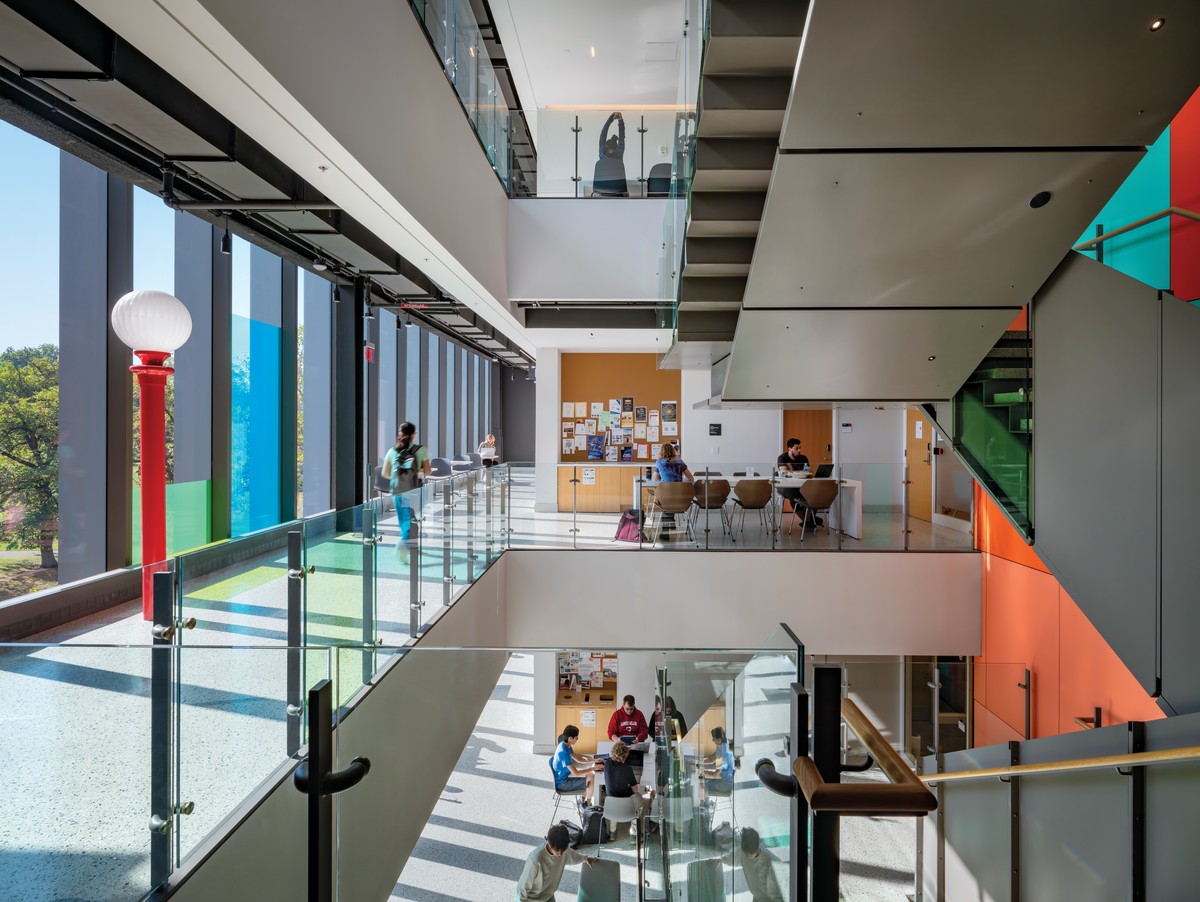
Scaife features an auditorium (3), a drone arena (4), and an airy primary stair (5). Photos © Sahar Coston-Hardy / ESTO, click to enlarge.
5
The configuration, says Miller, also forms a hardscaped quad (with great views of the University of Pittsburgh’s Cathedral of Learning) between Scaife and neighboring Hamerschlag, Roberts, ANSYS, and Baker-Porter halls—which together comprise the nucleus of engineering facilities. The quad is programmed with a café, housed in Scaife. “Students spend a lot of time here, and having that amenity allows them to really make it their own,” says Miller.
Given the dramatic site along a ravine, water runoff from the rest of campus flows toward Scaife. “A lot of static pressure builds up behind the walls,” Kieran says of the subterranean volume. To mitigate this, the architects designed an interstitial buffer between the interior walls of the plinth and a pile-and-lagging retaining wall, which includes an exterior drainage system with perforated pipes to mitigate any groundwater infiltration. Caissons—some as deep as 40 feet—anchor the building into bedrock. In addition to controlling runoff, detention structures, bioretention areas, and a green roof manage stormwater on-site.
Looking for quick answers on architecture and design topics?
Try Ask RECORD, our new smart AI search tool.
Ask RECORD →
As strong as Hornbostel’s architectural legacy is at CMU, his was not the only one that KieranTimberlake considered. “Many of the initial facade studies were informed by looking at Frew Street—in its entirety,” says Miller. Although Scaife’s rhythm of bays echoes that of Hornbostel’s buff-brick columned building just next door, with an eave of roughly the same height, the language of the building is contemporary; the “entirety” of Frew Street includes Hunt Library, a glazed box with vertical fins built around the time of the original Scaife Hall, up the road to the east.
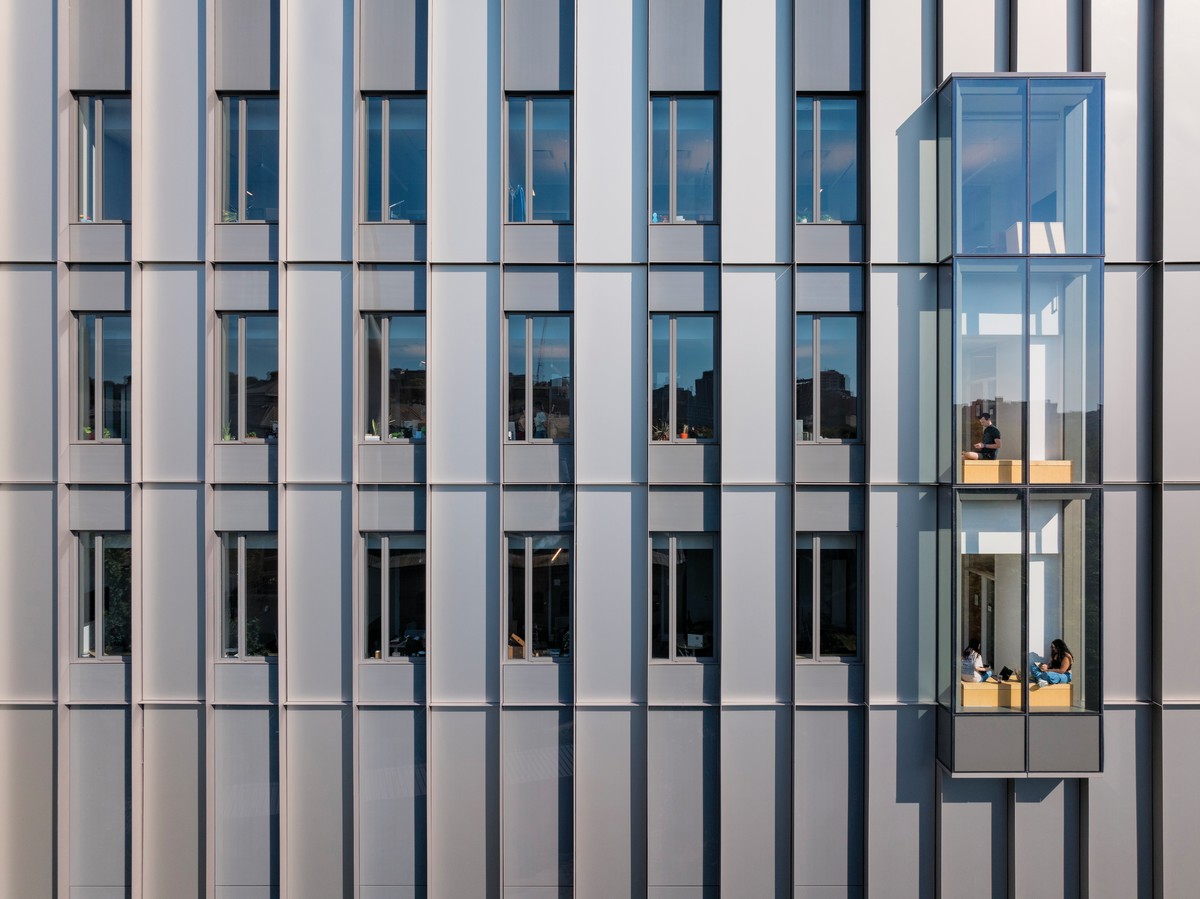
Scaife’s facade is largely balloon-framed of cold-formed metal, with a rainscreen cladding assembly. The rainscreen comprises panels of champagne-colored aluminum and (like Hunt) fins. In fenestrated bays, the spandrel panels are back-painted glass. This combination creates a delightfully subtle but discernable effect; depending on the time of day and the weather, the panels might mimic the coloration of neighboring components or take on a different cast. Specific areas of the facade—such as the north and east elevations of the cubic volume—make use of a unitized curtain wall system. The plinth is wrapped in a black brick, lessening the building’s visual impingement on the landscape.
Inside, a grand stair—set to a backdrop of panes in salmon, seafoam, and chartreuse—sits at the crux of the three volumes. “I’ve gotten tired of atriums and we’re using them less and less in our projects,” says Kieran of the seemingly omnipresent architectonic device. On a small site, such a move wasn’t feasible—but the stair’s polychromatic environs and its open nature are welcome in a building that manages to fit in so much. Here, on the above-ground levels, ample glazing keeps the interiors bright too.
“The school’s two most prominent programs are the arts and sciences—that dialogue is literally present in the physical form of the campus,” says Kieran. Despite designing the new home for the mechanical engineering department, the team did not lose sight of this legacy when planning Scaife Hall. Those who spend enough time there will spot curious objects: a globed streetlight that seems to pierce through the floor, tinted films affixed to glazing, and multicolored bollards, among others. These elements are part of a site-specific installation by Jessica Stockholder, titled Making Way. The piece is a wonderful final touch, and a reminder that these two “opposites” are best when they come together.
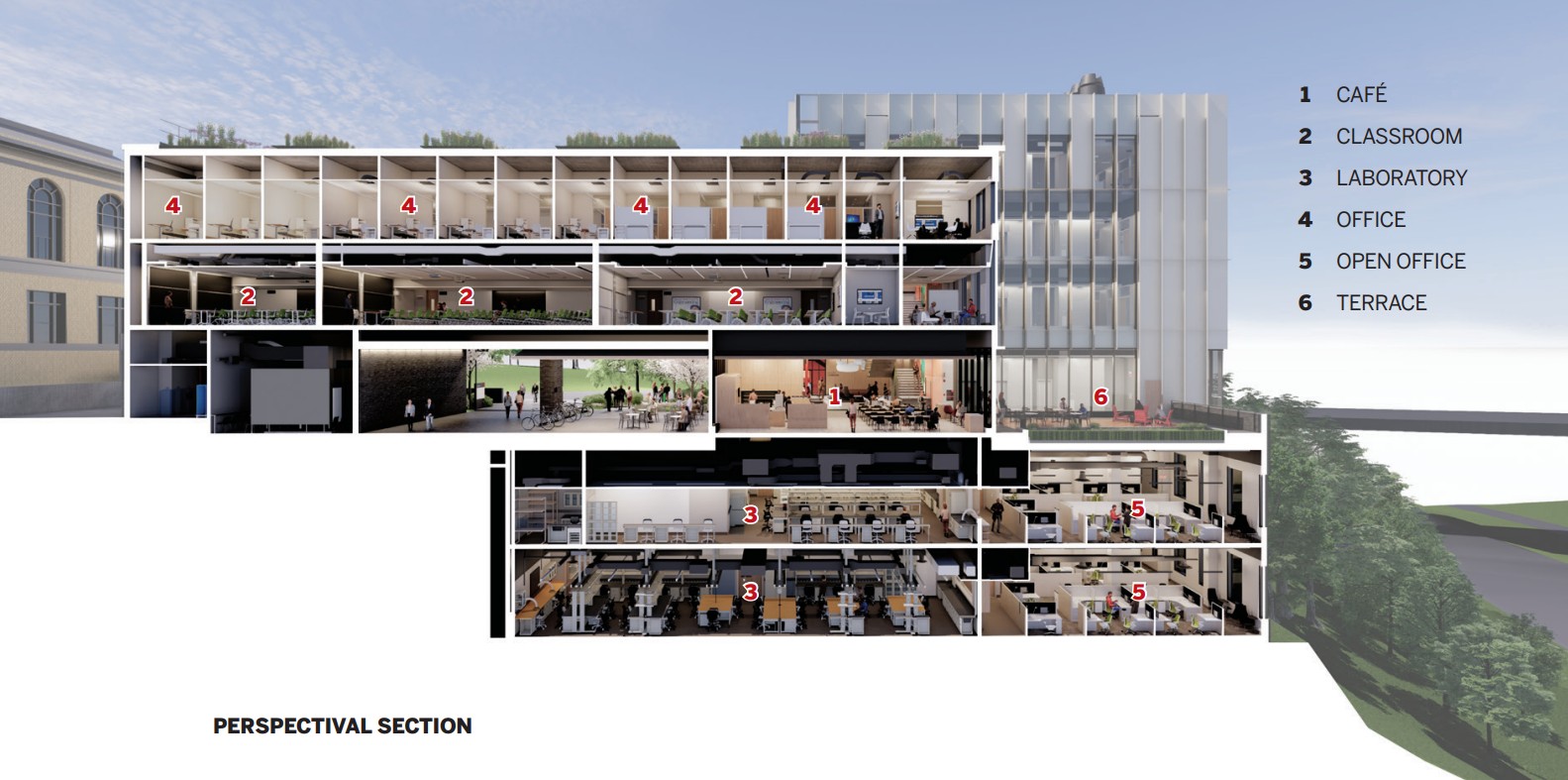
Image courtesy KieranTimberlake
Credits
Architect:
KieranTimberlake
Engineers:
Langan (civil); Buro Happold (structural, m/e/p/fp)
Consultants:
Spacesmith (FFE); Research Facilities Design (lab planning); Olin (landscape); Sci-Tek Consultants (geotechnic)
General Contractor:
PJ Dick
Client:
Carnegie Mellon University
Size:
85,000 square feet
Cost:
Withheld
Completion:
November 2023
Sources
Cladding:
Glen-Gery (bricks); QC Facades, United Architectural Metals (metals panels/curtain wall)
Roofing:
Siplast, Carlisle
Glazing:
Viracon
Doors:
Giffin Interior & Fixture, Masonite Architectural, Horton Automatic, Schweiss Doors, TGP
Windows:
Oldcastle BuildingEnvelope
Interior Finishes:
Armstrong (acoustical ceilings); Corian (solid surfacing)
Lighting:
Bega
Looking for a reprint of this article?
From high-res PDFs to custom plaques, order your copy today!