Landscape
Sanders Pace Architecture and Port Revitalize a Neglected Knoxville Quarry
Knoxville, Tennessee
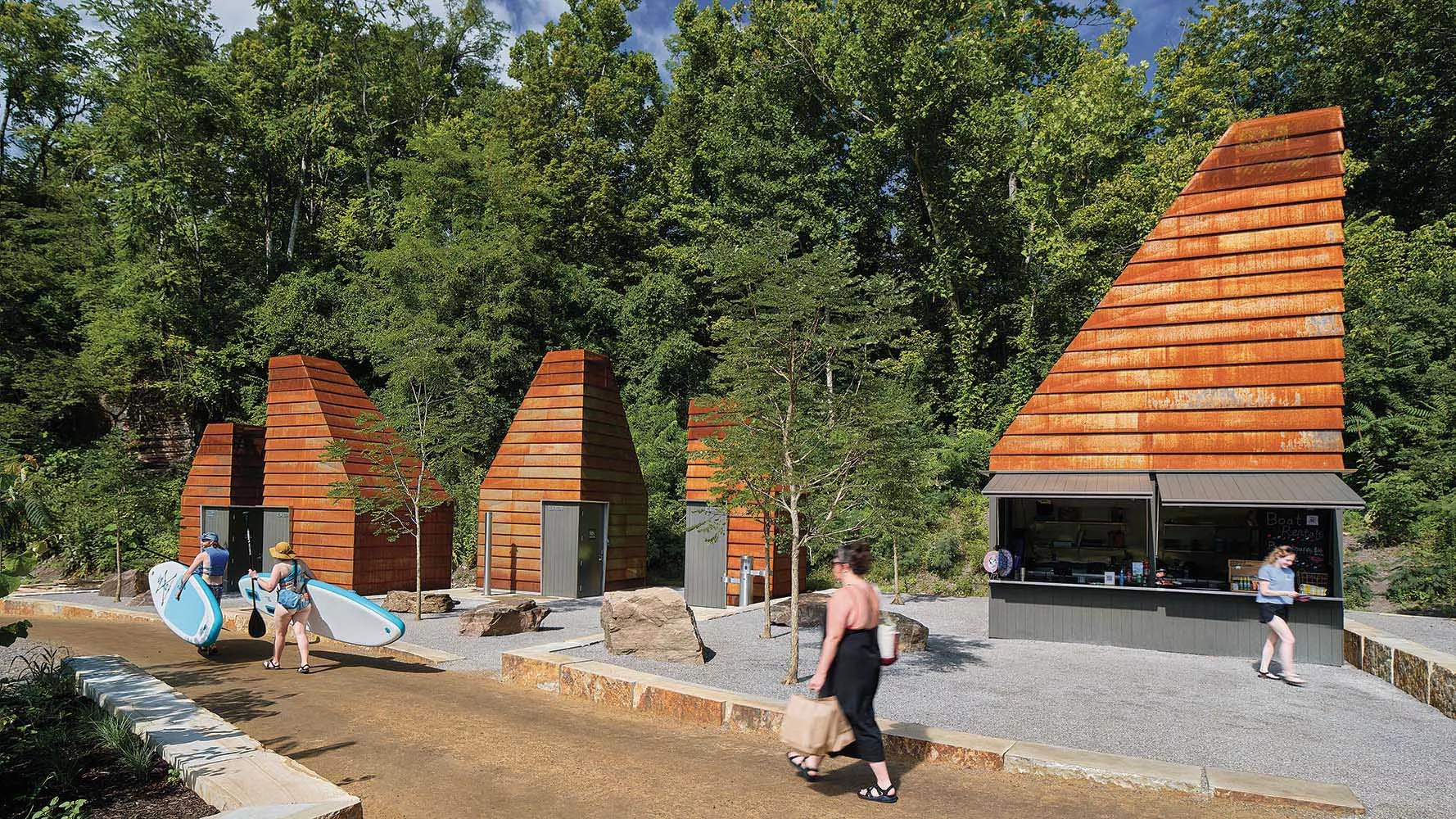
Abandoned quarries are plentiful in East Tennessee, where the many ridges and valleys of the Appalachian Mountains have long yielded rich mineral and sedimentary deposits. The sites, exhausted after decades of excavation, often take on second lives as informal wildlife preserves and overgrown parkland. In Knoxville, the Augusta Quarry filled such a role, albeit with a somewhat unsavory reputation and frequent drownings. In July 2025, after a multiyear effort, the site has been revamped by local firm Sanders Pace Architecture and landscape architecture studio Port, by way of weathering-steel amenity structures, along with thoughtfully integrated trails and docks.
The quarry, located in the southern half of Fort Dickerson Park, opened in the early 20th century to mine limestone aggregate but gradually, beginning in the 1970s, ceased operations. It was donated to the city government in 1994 and settled into a pattern of benign neglect in the succeeding decades. The driving force behind its transformation is the Aslan Foundation, a local organization with the broad mission to strengthen cultural assets and livability in Knoxville. In 2008, the nonprofit purchased nearby Loghaven, a 90-acre site with numerous cabins, dating from the 1930s. In 2014, Sanders Pace was commissioned to renew the location as an artists colony, rehabilitating the historic structures and adding new buildings to support programming.
During that multiphase project, which wrapped up in 2020, the Aslan Foundation tasked the design team to develop a master plan for the campus. Following review, Sanders Pace and Port (the latter was added to the team in 2016) suggested that the nonprofit look beyond the site and collaborate with the municipal government, among other stakeholders, to develop a cohesive plan for the surrounding area. Dubbed the Knoxville Battlefield Loop, the expanded master plan reenvisions some 600 acres of disjointed historic sites—some related to the Civil War—and postindustrial parcels as a network of connected ecological, cultural, and recreational destinations.
The Augusta Quarry was the first major portion of the Knoxville Battlefield Loop to be tackled. “We called it the outlaw quarry,” explains Port founding partner Andrew Moddrell. “There was no parking area, and an unmaintained gravel ramp led to the lake. It was a mess that was unsafe.”
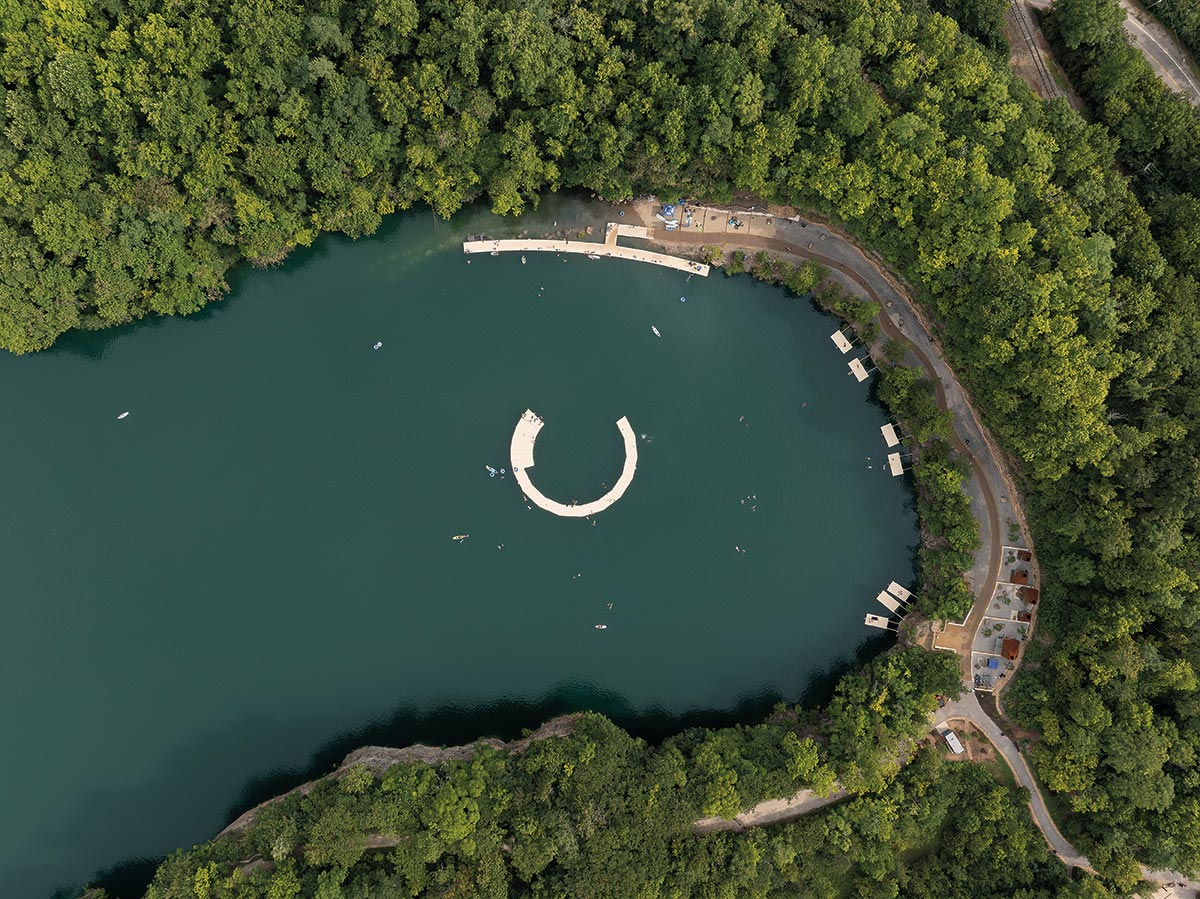
The lake is 350 feet long and over 250 feet deep. Photo © Keith Isaacs, click to enlarge.
The project scope included the introduction of a formal entryway at the park’s northern border and a 2,000-foot-long gravel road that winds its way through dense forest understory to deliver visitors to a parking lot. A new pathway, built of stabilized decomposed granite, which meets contemporary accessibility standards with gentle slopes and generous widths, steers park users toward vantage points and spots where they can go into the quarry lake. At the waterfront, visitors can access several sets of spacious docks. A float, 260 feet long and in the shape of an incomplete circle, sits within the lake’s center.
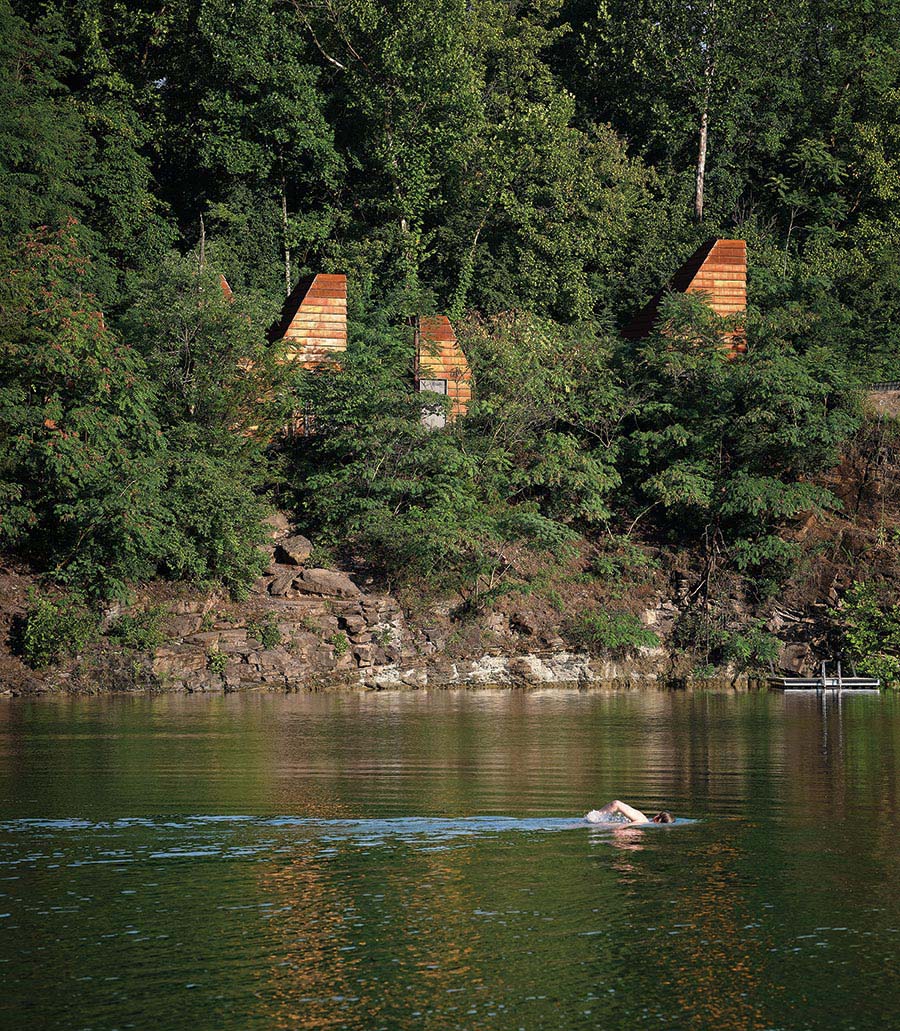
The pavilions blend into the forest. They are passively ventilated and provide much-needed amenities to park users. Photo © Keith Isaacs
Besides a handful of portable toilets and trash receptacles, the quarry was entirely without amenities. To support park operations and improve visitor experience, the design team erected five pavilions—three restrooms, one dressing room, and a vendor kiosk. Each is enclosed with weathering-steel framing and shingles, and rests atop concrete foundations. The shingles tilt upward to aid with ventilation, as do rooftop apertures that do double duty by also daylighting the interiors. Within, stainless-steel fixtures facilitate straightforward maintenance, and drainage systems underfoot connect the structures to the city’s sanitary and storm infrastructure.
Initially, the design team envisioned the amenities being housed in a single pavilion, but the project, with a construction cost of nearly $4 million, largely funded by municipal capital expenditures, could have been subject to shifting budgetary realities. “We decided to turn this into five discrete open-air buildings that could be completed in phases, should funding be cut,” explains Sanders Pace principal Brandon Pace. “They are also lighter-weight and have less of an impact infrastructurally on the landscape.”
During the day, visitors can rent numerous items from the vendor kiosk, such as paddleboards, floaties, and kayaks, which helps to reduce litter associated with abandoned lake toys. Since opening last summer, the renewed Augusta Quarry has been enthusiastically received by thousands luxuriating in the venue for leisure. If all goes as planned in the years ahead, they will gain additional access to trails and sites throughout Knoxville’s Battlefield Loop.
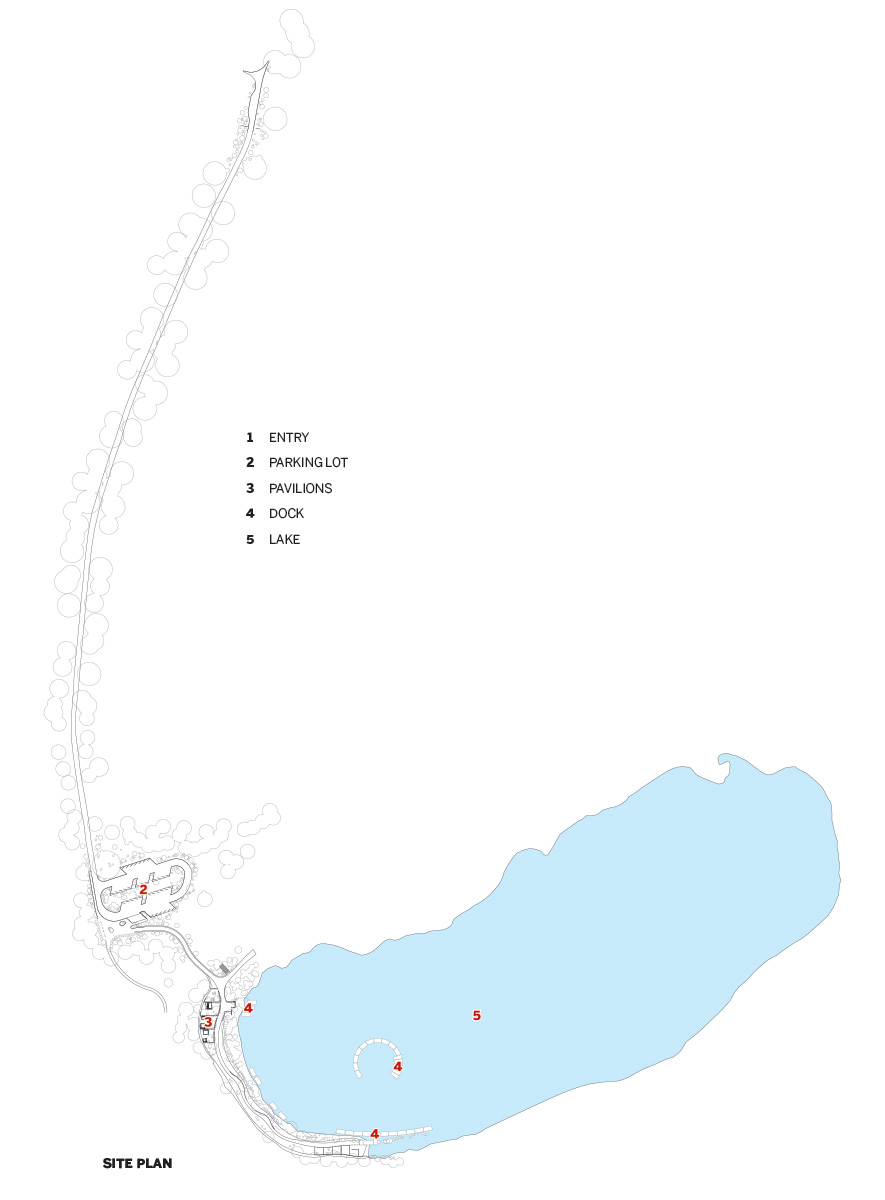
Image courtesy Sanders Pace Architecture
Credits
Architect:
Sanders Pace Architecture — Brandon Pace, principal in charge; John Sanders, principal; Michael Aktlay, Jake Froning, Daniel Jones, Natalia Almonacid, design team
Landscape Architect:
Port — Andrew Moddrell, principal in charge; Sean McKay, Brandon Biederman, Madelynne Clark, Anna Darling, Kara Swanick, design team
Engineers:
JMT (civil); Haines Structural Group (structural); Facility Systems Consultants (MEP)
General Contractor:
Southern Constructors
Clients:
Aslan Foundation, City of Knoxville
Size:
556 square feet; 65 acres
Cost:
$3.77 million (construction)
Completion:
July 2025
Sources
Structure:
Quality Machine and Welding
Metal Panels:
Baird and Wilson Sheet Metal
Interior Finishes:
Great Lakes Stainless
Looking for quick answers on architecture and design topics?
Try Ask RECORD, our new smart AI search tool.
Ask RECORD →
Looking for a reprint of this article?
From high-res PDFs to custom plaques, order your copy today!