Architectural Record
search
cart
facebook twitter linkedin youtube
  • Sign In
  • Subscribe
  • Sign Out
  • My Account
Architectural Record
  • NEWS
    • Latest News
    • Awards
    • Interviews
    • Obituaries
    • Podcasts
      • Design:Ed Podcast
      • Sponsored Podcasts
  • OPINION
    • Book Reviews / Excerpts
    • Exhibition Reviews
    • Forum
  • EXCLUSIVES
    • Videos
    • Design Vanguard
    • Top 300 Firms
    • Sponsored Content
    • Sponsored eBooks
    • From the Archives
  • CONTINUING ED
    • Editorial Continuing Ed
    • CE Center
    • CE Academies
  • PROJECTS
    • Buildings By Type
    • Reuse & Renovation
    • Museums & Arts Centers
    • Colleges & Universities
    • Multifamily Housing
    • Interiors
    • Lighting
    • Kitchen & Bath
  • HOUSES
    • Record Houses
    • House of the Month
    • Featured Houses
  • PRODUCTS
    • Products by Category
    • Record Products of the Year
    • Latest Products
  • EVENTS
    • Dates & Events
    • Record on the Road
    • Innovation Conference
    • Sustainability in Practice
    • Women In Architecture
    • Webinars
    • Ad Excellence Awards
    • Submit an Event
  • CONNECT
    • Ask RECORD AI
    • Newsletters
    • Contact
    • Advertise
    • Editorial Calendar
    • Store
    • Customer Service
  • SUBMIT
    • Submission Guidelines
    • RECORD Competitions
  • MAGAZINE
    • Subscribe
    • My Account
    • Digital Edition
    • Current Issue
    • Firm Pass
    • Historic Archive
ProjectsBuildings by TypeResidential ArchitectureHouse of the Month

House of the Month

Tall Architects’ Gabled Residence in Ocean Springs, Mississippi, Harmonizes Varied Forms

Ocean Springs, Mississippi
By Suzanne Stephens
Rayburn House
Photo © Andrew Welch
Rayburn House.
November 17, 2025

Architects & Firms

Tall Architects
✕
Image in modal.

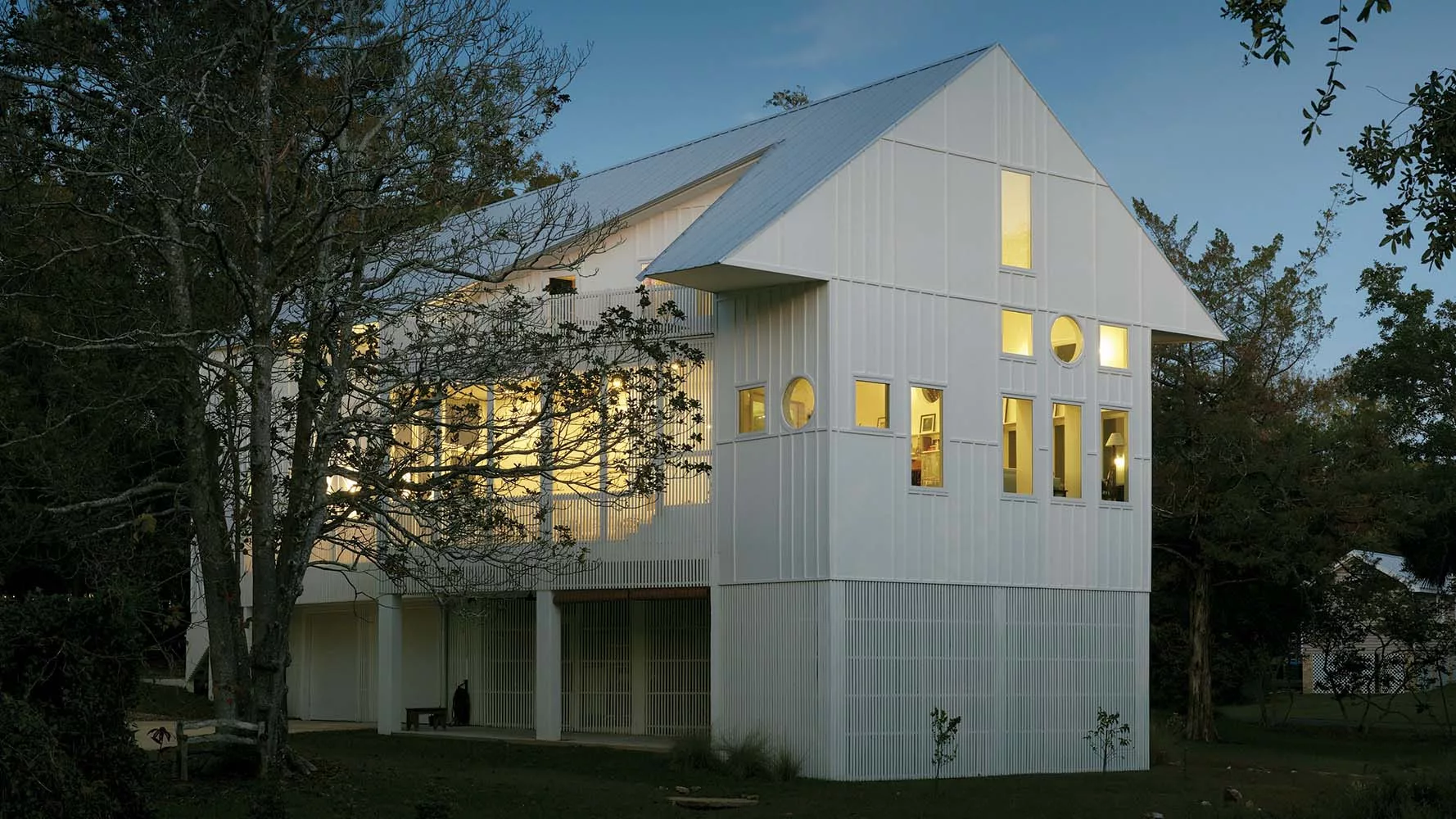
It is unexpected to find a new house in Ocean Springs, Mississippi, where the end elevations subtly evoke the facades of Robert Venturi and Denise Scott Brown’s Nantucket and Block Island houses of the early 1970s and ’80s. Not so long ago, these kinds of gables and paned windows were frowned upon for being nostalgic. But, in recent years, such Postmodern elements have been popping up in otherwise contemporary projects, such as this one, called Rayburn House.

In the case of the 3,000-square-foot, three-story house, the designers—Tall Architects’ founding principals Mark and Madison Talley—did not merely have Venturi and Scott Brown’s architecture in mind. They also credit Herzog & de Meuron’s Blue House (1981) in Oberwil, Switzerland as being particularly influential, with its steeply pitched roof, overhanging eaves, and quirky placement of circular windows. As Mark laments, “Modernism stripped away the playful, leaving only expansive window planes and flat roofs.” Madison adds, “It’s hard not to pull from architects we admire.”

The Talleys, who opened their office in 2014 after each graduated with a B.Arch. from Mississippi State University, had another reason to be drawn to peaked roofs and small, syncopated fenestration: the husband-and-wife team was adhering to the construction guidelines for scale, proportions of windows, materials, and colors given by the historic-preservation commission of this picturesque Southern town.

The clients for the Rayburn House (named for the street it faces) are Caroline Croom and Julian Rankin, a couple with two children. They had bought the small corner site, about a quarter of an acre, with an existing cottage. But, since the property was in a “special flood-hazard zone,” the architects and owners thought it best to replace the old house with a new one, where the main floor would be elevated about 8 feet above the ground.
Rayburn House
1
Rayburn House
2

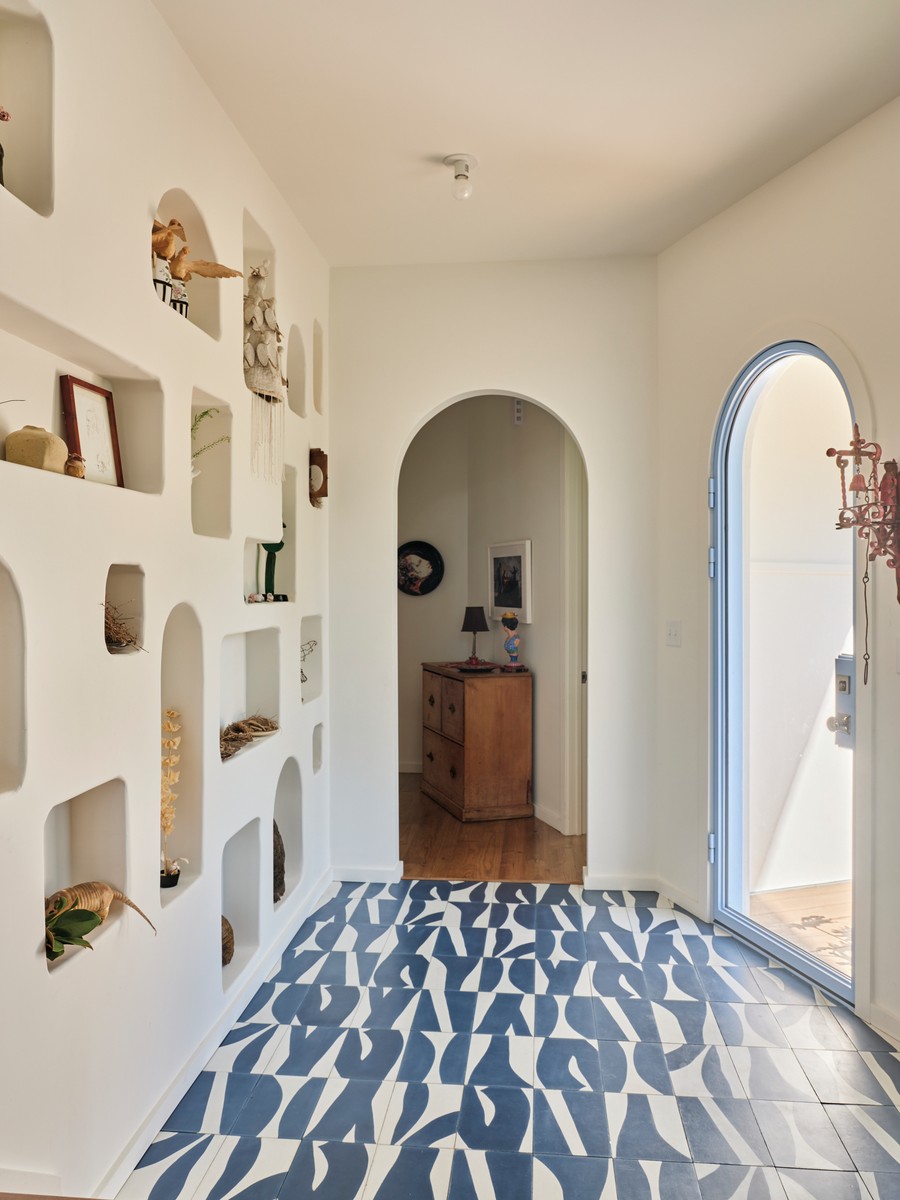
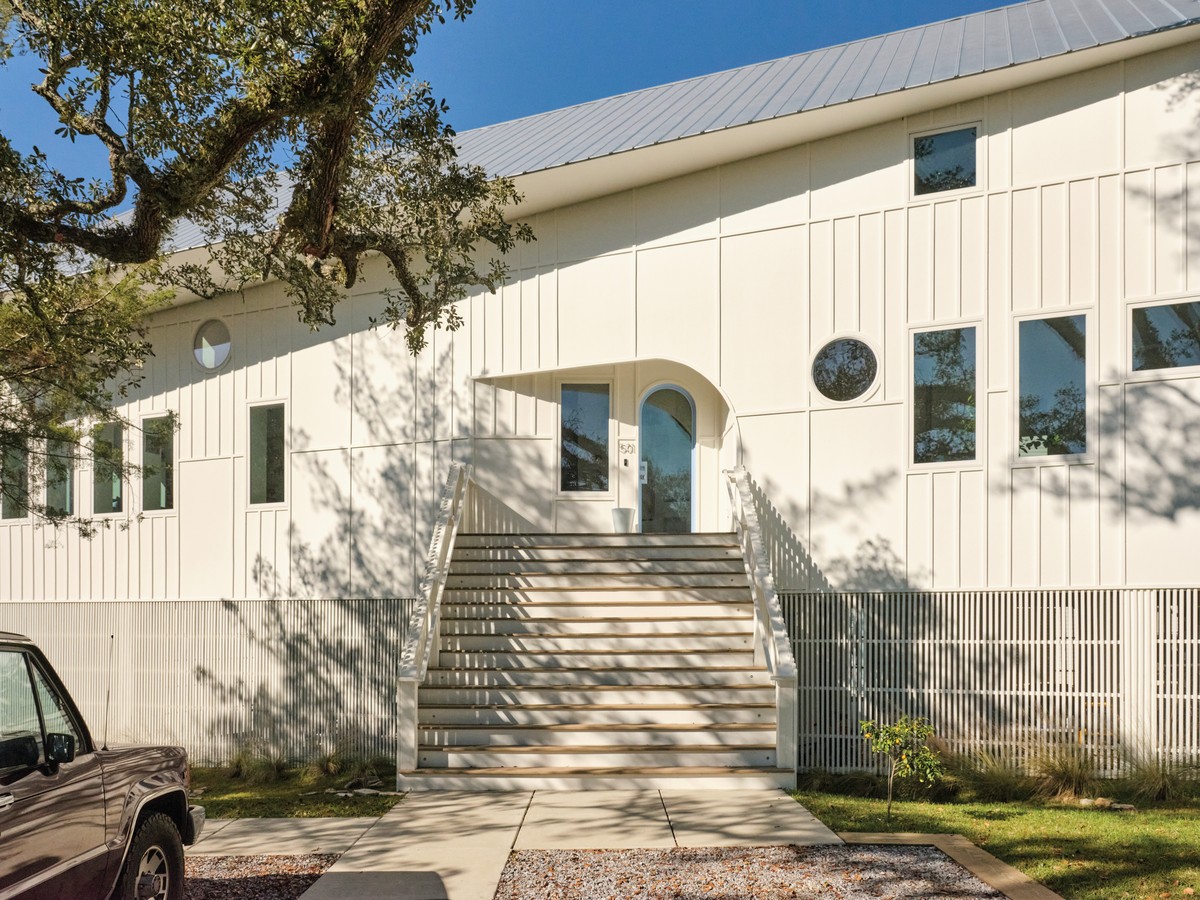
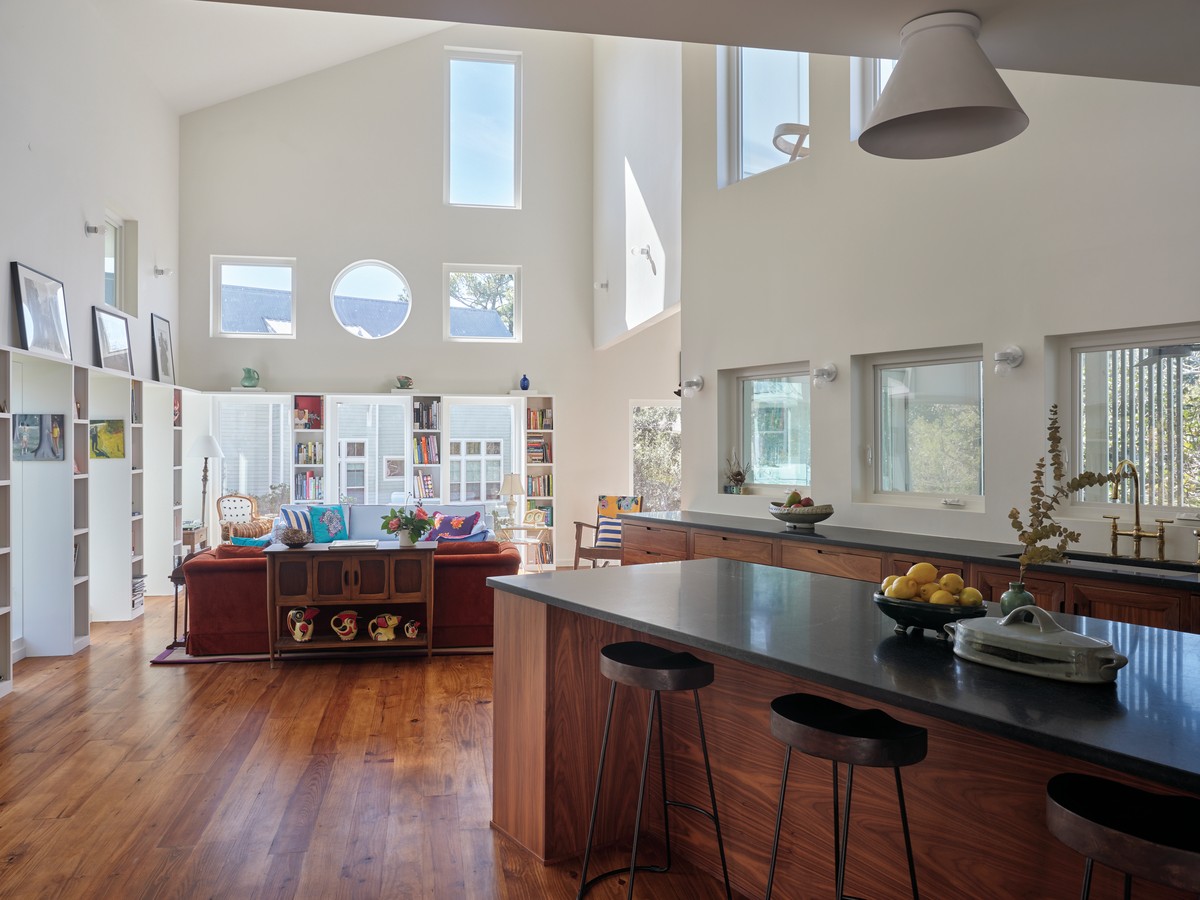
A staircase (1) leads to a vestibule with niches (2) and the combined living/dining area (3). Photos © Andrew Welch, click to enlarge.

Rayburn House
3

Rankin, an arts and communications consultant and author, and Croom, an art collector and consultant, met the Talleys through their involvement with a local museum. “We had a rapport before starting,” says Madison, who notes Croom’s “focused eye” and welcomed her involvement in selecting furnishings, finishes, cabinetry, and colors.

Tall Architects clad the wood-frame house in humidity-resistant cementitious boards and battens, placed according to an idiosyncratic rhythm of broad and narrow intervals. Then the firm enclosed the ground level for parking cars with a screen of wood slats, and used corrugated metal for the roof—both gestures to the budget and a vernacular palette.

To further keep costs down, the architects began with a simple rectangular plan, but angled a protruding screened porch out from the elevated main floor to the west. On the east side, facing Rayburn Avenue, they carved out an entrance, which, in turn opens onto a broad stairway projecting to the ground at another angle. In one more such gesture, the architects placed an open kitchen on a diagonal to the living area. Most of the rooms, however, are laid out on an orthogonal grid, and some levels are dropped or elevated slightly to enhance the spatial dynamic.

Looking for quick answers on architecture and design topics?
Try Ask RECORD, our new smart AI search tool.
Ask RECORD →

After visitors mount the outside stairs to the entrance vestibule, they climb several steps to the living area, where the ceiling vaults upward. Beyond the living area is a dining nook created by an arched ceiling of drywall, and from this point a few more steps lead down to the screened porch. The level changes are tricky, the architects admit, but they are important to add a sense of surprise when walking through the interior. “We wanted lower and higher ceilings to create distinct spaces,” says Mark. The duo also note that the manipulation of levels and apertures promotes cross ventilation along with more opportunities for daylight and views.
Rayburn House

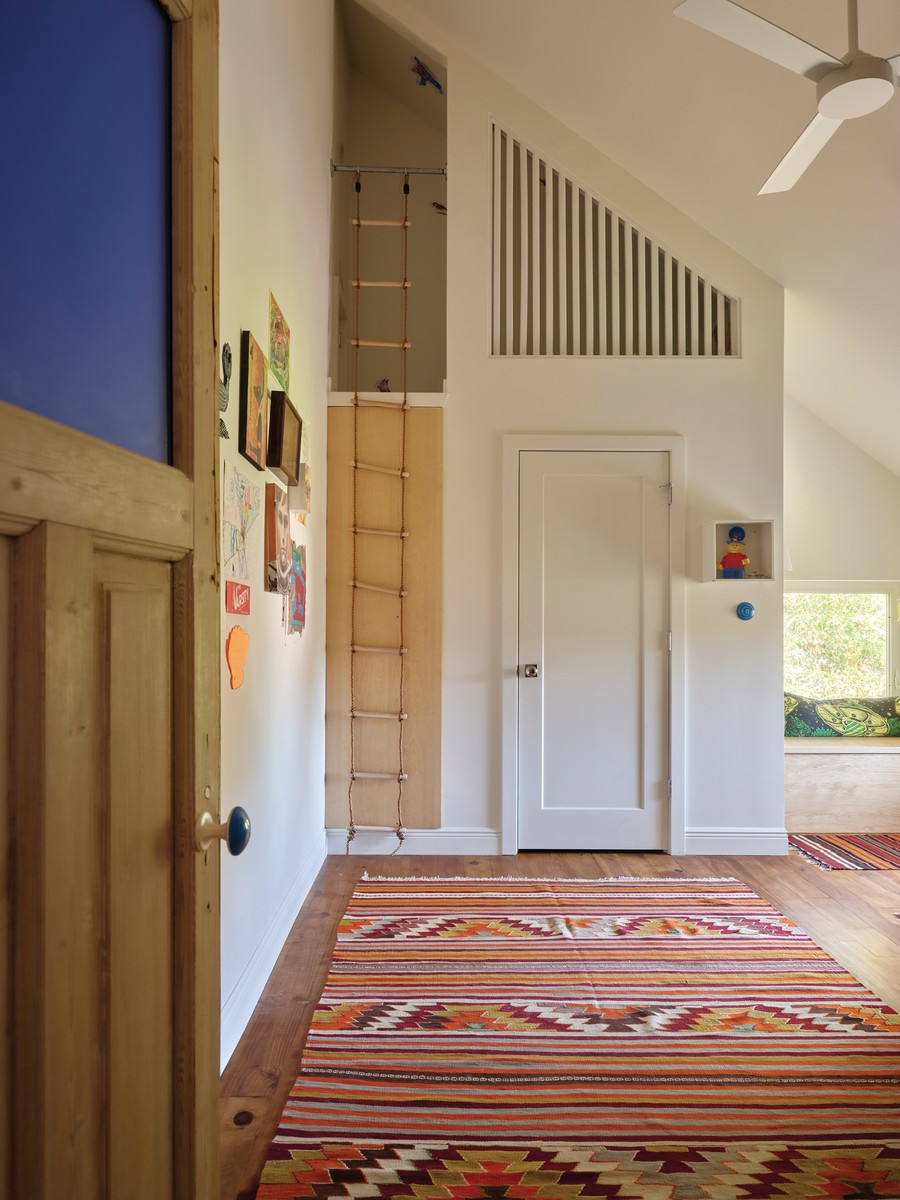
The childrens’ rooms are upstairs. Photo © Andrew Welch

Whereas the parents have their bedroom on the north end of the first floor, the children can claim their own turf on the top level. In addition to their bedrooms and a guest room, they have a playroom, where a large unglazed opening in the south wall encourages the two boys to keep in touch with their parents in the kitchen and living area below. Near the playroom, they can enjoy a balcony that is open to the outdoors by virtue of a wide, V-shaped notch in the roof.

The architects’ playful allusions, veering between past and present approaches to architecture, convincingly demonstrate why Tall Architects is included in the exhibition of emerging practices A South Forty: Contemporary Architecture and Design in the American South, at the National Building Museum in Washington, D.C. (on view through winter 2026). The Rayburn House has a quixotic freshness that stands out in its environs without being showy. And it reminds us of Philip Johnson’s famous saying “You cannot not know history.” But you should experiment with that history as well.
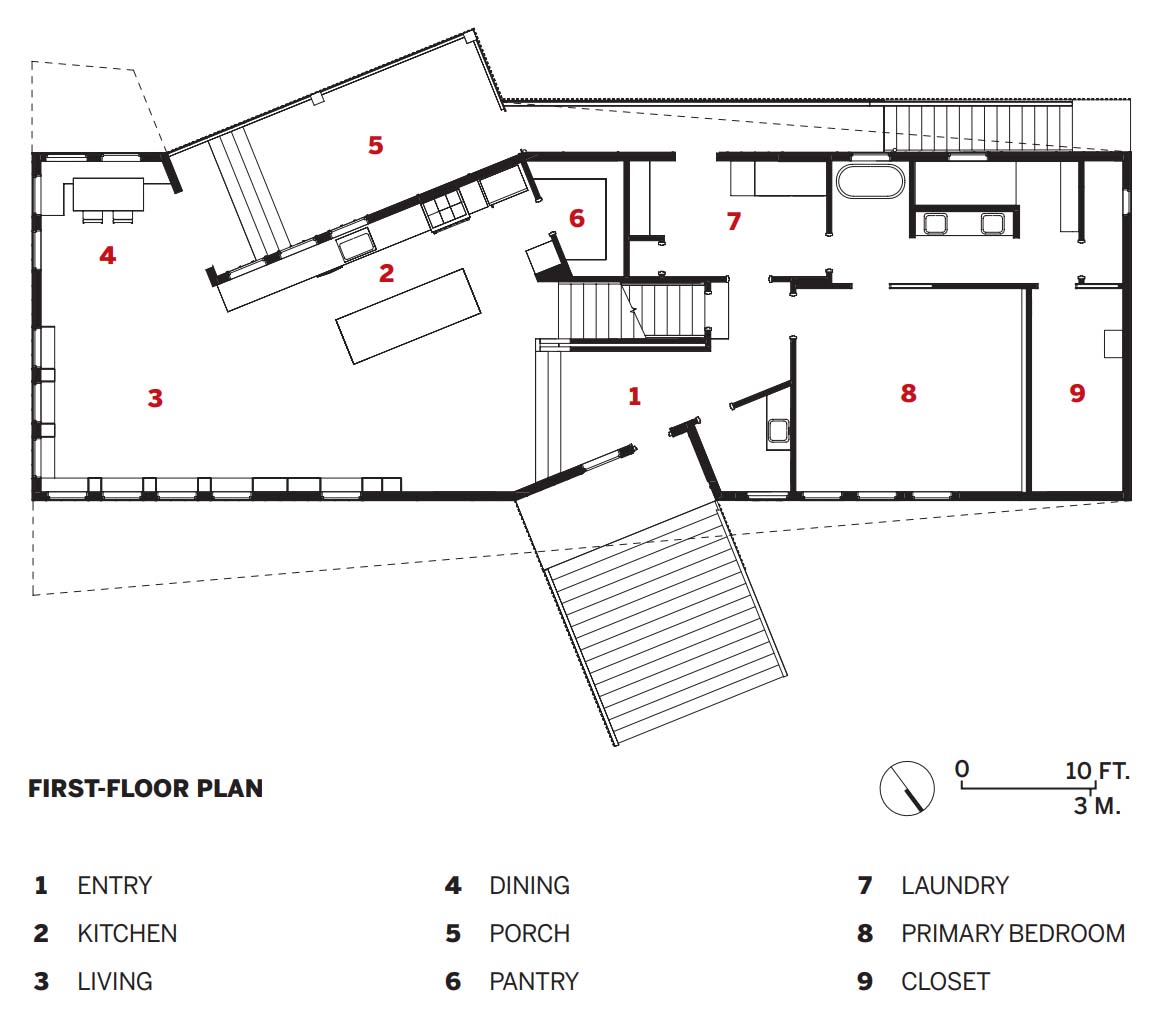
Rayburn House

Image courtesy Tall Architects

Credits

Architect:
Tall Architects — Madison Talley, Mark Talley, principals; Morgan Warmath, studio director

Engineer:
Terry Moran Engineering (structural)

Consultant:
Architerra (landscape)

Contractors:
Round 2, Dennis Frulla

Client:
Caroline Croom and Julian Rankin

Size:
3,080 square feet

Cost:
Withheld

Completion Date:
January 2024


Sources

Roofing:
Galvalume

Windows/Doors:
Sierra Pacific, Pinkys

Interior Finishes:
Sherwin-Williams (paint); Fireclay, Popham Design (tiles)

KEYWORDS: Mississippi modern residential architecture Postmodernism

Share This Story

Looking for a reprint of this article?
From high-res PDFs to custom plaques, order your copy today!

Stephens

Suzanne Stephens, a former deputy editor of Architectural Record, has been a writer, editor, and critic in the field of architecture for several decades. She has a Ph.D. in architectural history from Cornell University, and teaches a seminar in the history of architectural criticism in the architecture program of Barnard and Columbia colleges.

Post a comment to this article

Report Abusive Comment

Subscription Center
  • Create an Account
  • Start a Subscription
  • Manage My Account
  • Sign Up for Newsletters
  • Visit Customer Service
  • Update Preferences

More Videos

Sponsored Content

Sponsored Content is a special paid section where industry companies provide high quality, objective, non-commercial content around topics of interest to the Architectural Record audience. All Sponsored Content is supplied by the advertising company and any opinions expressed in this article are those of the author and not necessarily reflect the views of Architectural Record or its parent company, BNP Media. Interested in participating in our Sponsored Content section? Contact your local rep!

close
  • TAMLYN XtremeTrim Exterior Trim
    Sponsored byTamlyn

    Designing Cleaner Panel Facades: Why Exterior Trim Details Matter

  • Building with Vapor Barriers
    Sponsored byReef Industries, Inc.

    Vapor Barriers Help Control Moisture in Tighter Building Designs

  • Duct Interior with Prodeq System
    Sponsored byHenry, a Carlisle Company

    Designing Resilient Water Containment Systems

DESIGN:ED Podcast
Listen to Architectural Record’s DESIGN:ED Podcast

Events

June 16, 2026

Focus on the Façade: Exploring Steel, Timber & Fire-Rated Curtain Walls and Channel Glass Systems

Credits: 1 AIA LU/HSW; 1 AIBD P-CE; 0.1 ICC CEU

Explore modern façade and glazing systems that enhance daylighting, fire safety, and thermal performance while expanding architectural design possibilities.

June 18, 2026

Rebooting the Aging Office Building

Credits: 1 AIA LU/HSW; 1 AIBD P-CE; 0.1 ICC CEU; 1 PDH

Explore façade retrofit strategies and award-winning design concepts that can transform aging office buildings into healthier, higher-performing workplaces for today’s hybrid workforce.

View All Submit An Event

Products

2026 Architect's Square Foot Costbook

2026 Architect's Square Foot Costbook

See More Products

Popular Stories

Coronado Bridge

The Architect’s Guide to San Diego

SanDiegoAirport

Top 300 Architecture Firms of 2026

Crane Cove, ONO

Design Vanguard 2026 Winners

House on a Hill

Design Vanguard 2026: Forma

House A on a Hill

Design Vanguard 2026: Santiago Valdivieso

Focus on the Facade - Free Webinar - June 16, 2026

Related Articles

  • Hill House

    Joeb Moore's Gabled Pavilions Offer a Modern Take on Traditional Forms

    See More
  • Palm Springs Residence.

    The First Ray Kappe–Designed Residence Completed in Palm Springs

    See More
  • Shaw Residence

    Marlon Blackwell's Bold Residence in Fayetteville Provides a Study in Contrast within its Traditional Context

    See More

Related Products

See More Products
  • Architectural Record - May 2026

    Architectural Record May 2026 Issue

  • Architectural Record - April 2026

    Architectural Record April 2026 Issue

See More Products
×

The latest news and information

#1 Source for Architectural Design, News and Products

SUBSCRIBE
  • RESOURCES
    • Advertise
    • Contact Us
    • Submit
    • Store
  • ACCOUNT CENTER
    • Create an Account
    • Start a Subscription
    • Manage My Account
    • Sign Up for Newsletters
    • Visit Customer Service
    • Update Preferences
  • PRIVACY
    • PRIVACY POLICY
    • TERMS & CONDITIONS
    • DO NOT SELL MY PERSONAL INFORMATION
    • PRIVACY REQUEST
    • ACCESSIBILITY
  • SERVICES
    • Marketing Services
    • Reprints
    • Market Research
    • List Rental
    • Survey/Respondent Access
  • STAY CONNECTED
    • Linkedin
    • Facebook
    • Instagram
    • YouTube
    • X (Twitter)

Copyright ©2026. All Rights Reserved BNP Media, Inc. and BNP Media II, LLC.

Design, CMS, Hosting & Web Development :: ePublishing