Mithun Scores Multiple Sustainability Firsts with a Private K–12 School in Seattle
Architects & Firms
Just shy of six acres, the urban campus of the Bush School—a coeducational K–12 private school in Seattle that just last year celebrated its centennial—is an architectural hodgepodge reflective of its evolution within the city’s Madison Valley neighborhood. Among other structures, there’s a smattering of converted private residences, modern classroom buildings designed by leading local firms including NBBJ and the Miller Hull Partnership, and the school’s most emblematic edifice, the stately red-brick Gracemont mansion, built in 1914 and acquired by the then-all-girls school 30 years later. Bifurcated by John Charles Olmsted’s East Lake Washington Boulevard, the campus is divided into lower and upper sections. The recently renovated and seismically retrofitted Gracemont Alumni Hall anchors the school’s compact, thumb-shaped upper campus, which is largely hidden away on a densely wooded hillside overlooking Lake Washington.
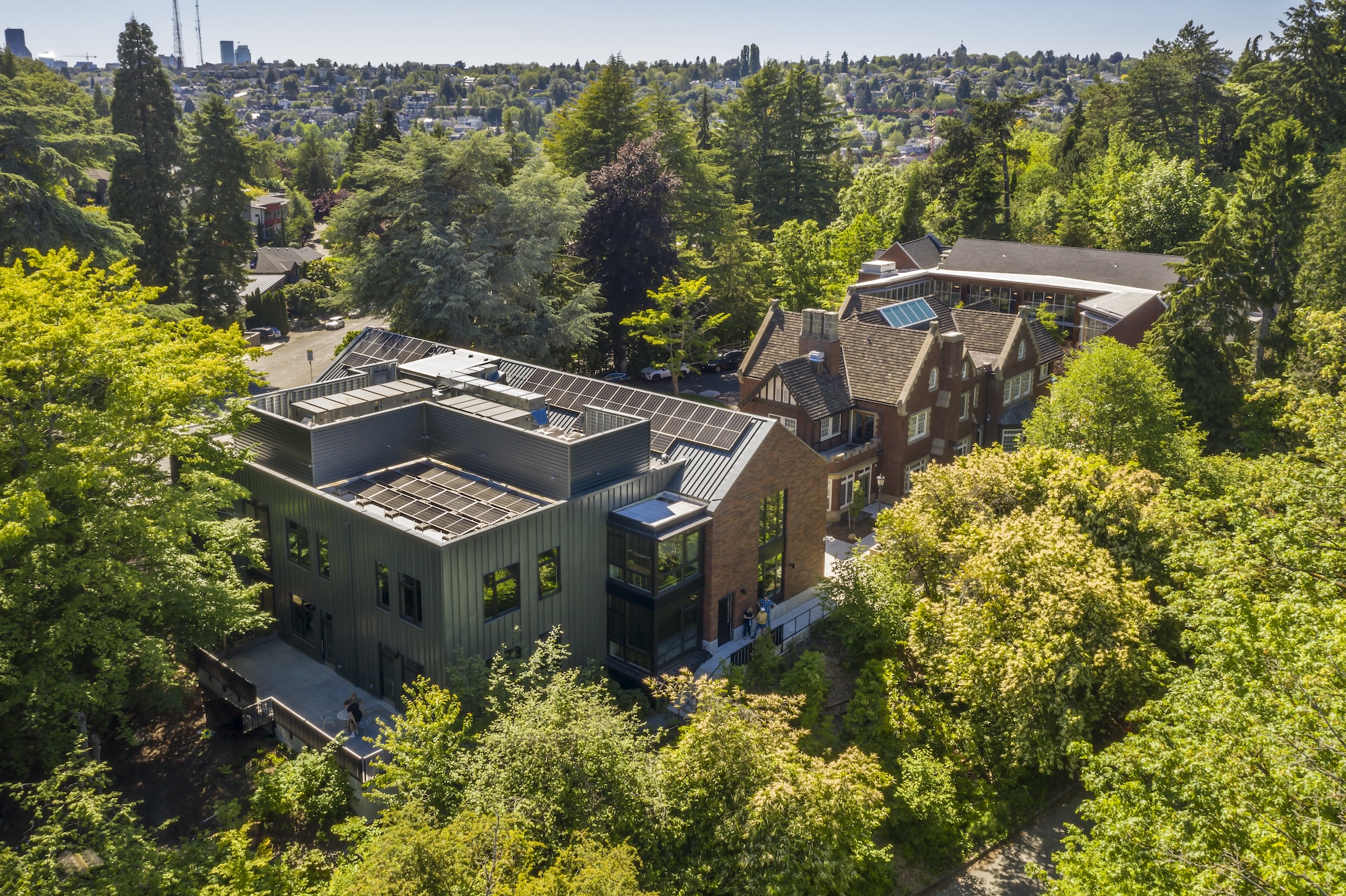
The Bush School upper campus, from left to right: the new Upper School building, Gracemont Alumni Hall, and Wissner Hall, a science and technology building. Photo © Lara Swimmer / Esto
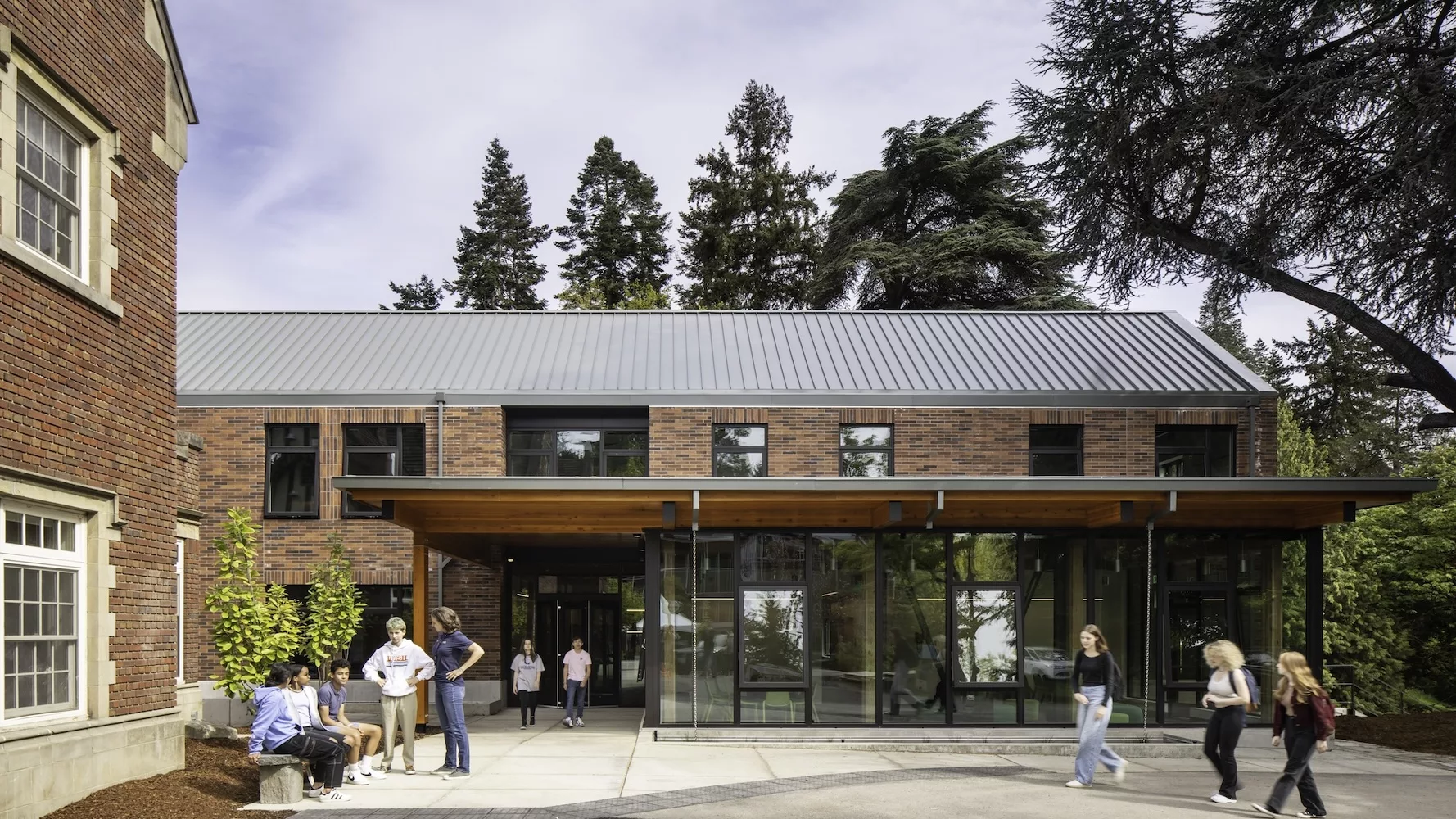
Gracemont now has an immediate neighbor with the arrival of the Bush School’s latest building: the 20,000-square-foot new Upper School. Designed by Mithun, the three-story academic building houses 11 flexible high-school classrooms, a smaller seminar room, a teacher workroom, breakaway spaces, and a glazed student lounge pavilion. Serving as a beacon or front porch of sorts, Mithun partner-in-charge Brendan Connolly calls the space “the heart” of the Upper School. “It’s a mixing chamber for students—an informal space that’s used as part art gallery, part seminar space, and part study,” he says. “It animates that whole courtyard and creates a bit more transparency.” On a below-grade level that was initially envisioned as parking, there’s a grab-and-go canteen and a large, 400-seat multipurpose teaching and gathering room.
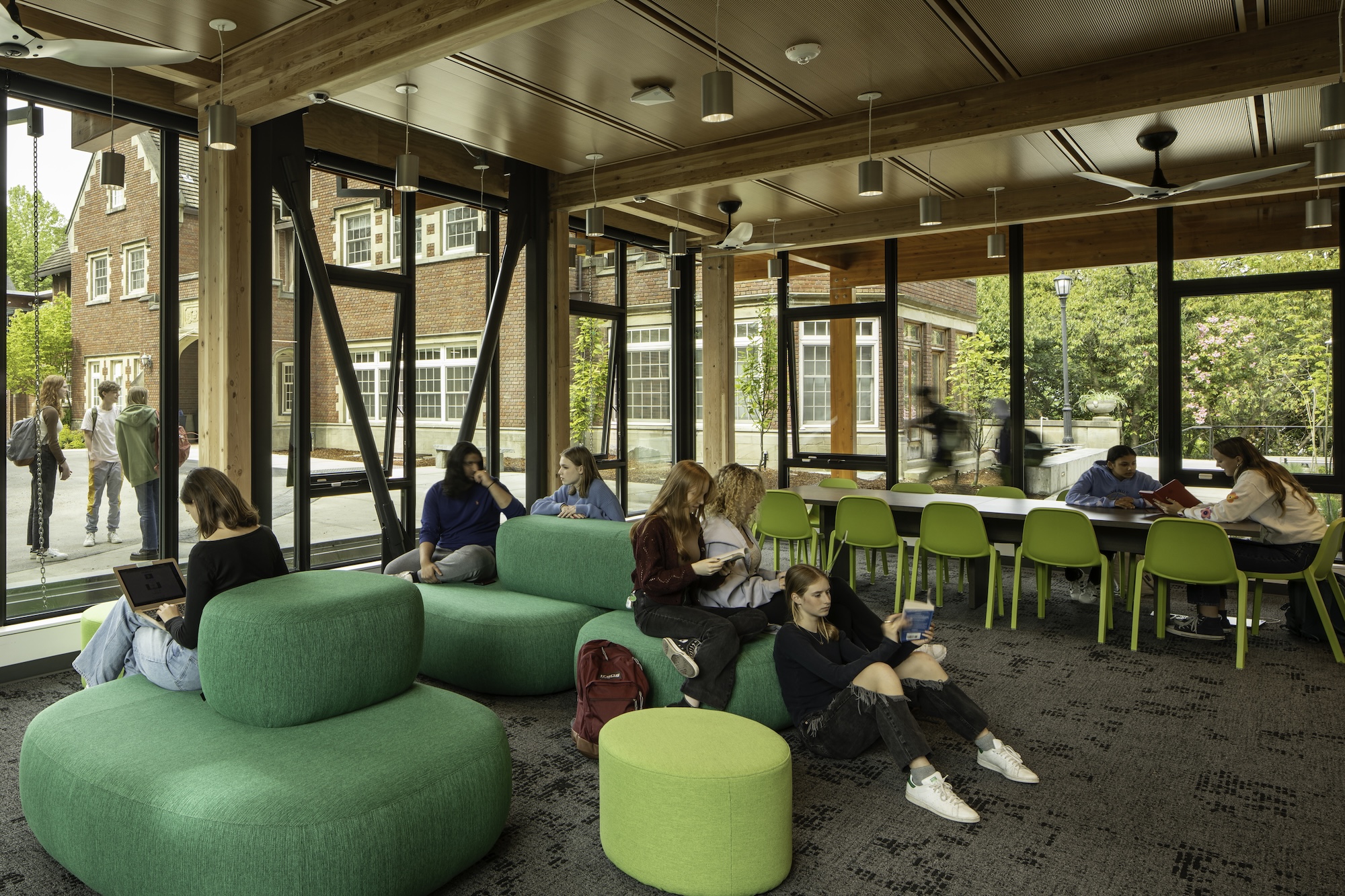
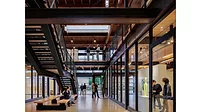
The Student Life Center serves as a social hub for the Bush School’s older students. Photo © Lara Swimmer / Esto
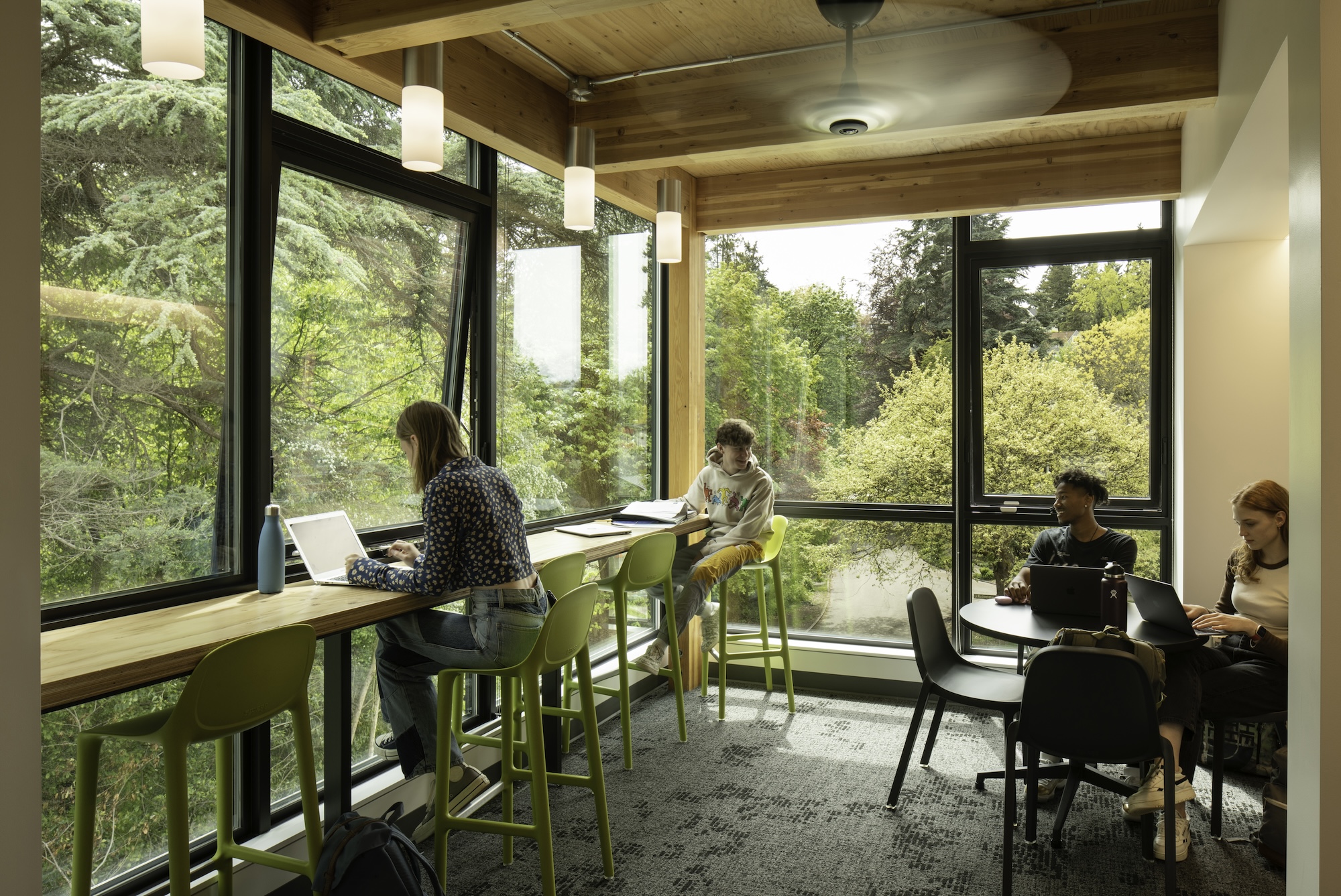
Biophillic deisgn strategies include clear connections to the forested surroundings. Photo © Lara Swimmer / Esto
Clad in brick and vertical rib metal panels, the structure’s deferential siting and massing both frames the sloping site’s historic architecture and protects its sensitive ecology while boldly reestablishing the Bush School’s longtime presence in the neighborhood.
“It’s fairly invisible,” says Connolly of the upper campus. “This was a first chance for the school to create a new image in the neighborhood and into the greater city.”
With 18 feet in grade change between the upper campus and East Lake Washington Boulevard, the Upper School also creates what Connolly calls an “accessibility bridge” between the previously difficult-to-navigate-between levels of the campus through an entry plazas that provides universal access.
Brick isn’t the only thing that Gracemont Hall and the New Upper School have in common. Both are wood-framed, with the new building featuring a mass-plywood panel structural (MPP) system. Prominent throughout the interior, the wood creates warmth, promotes a sense of environmental stewardship, and further connects the architecture to the school’s arboreal setting. (Beyond necessitating a tight building footprint, the preservation of the site’s heritage trees helps to mitigate direct thermal gain through strategic shading.)
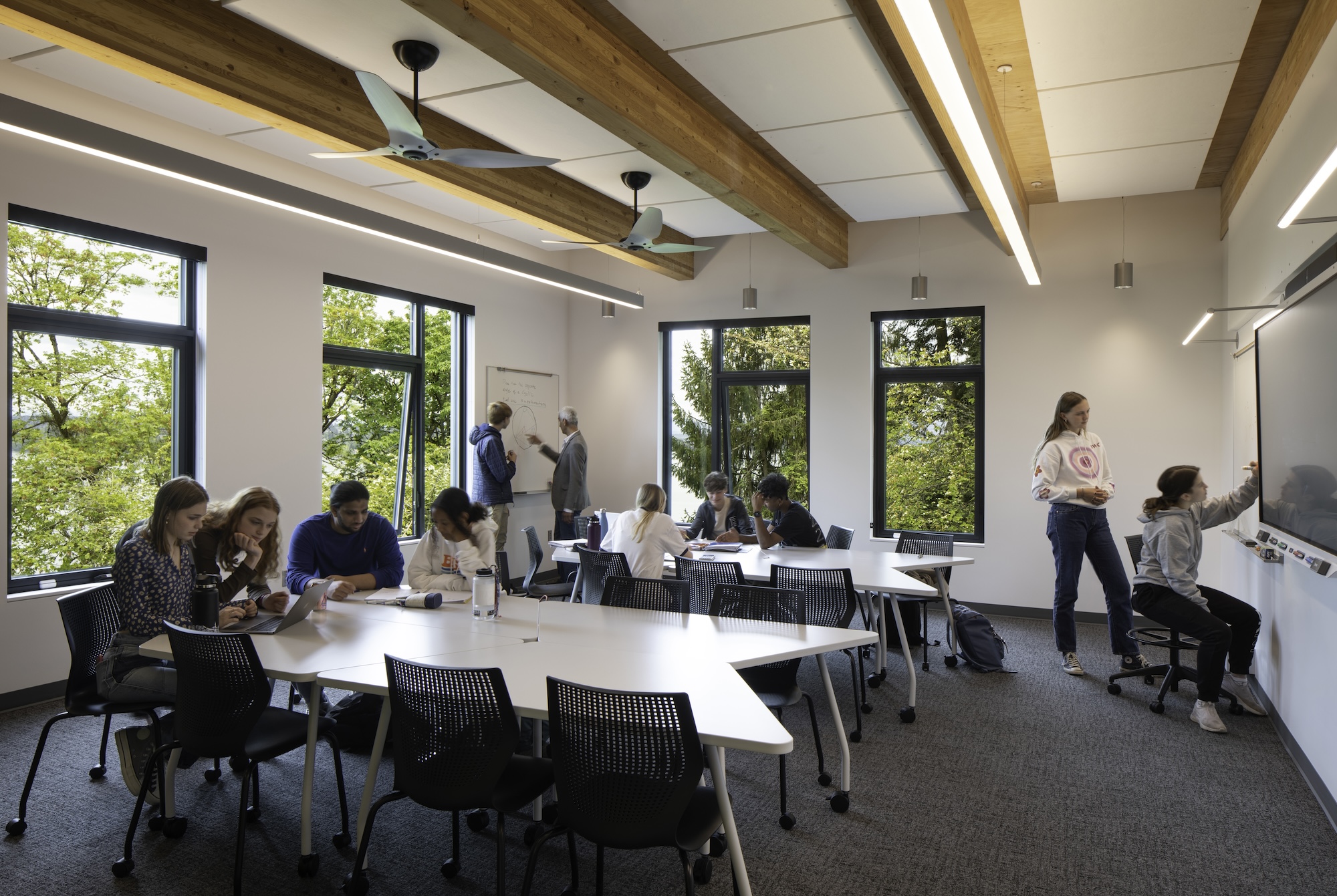
A seminar-style classroom with Lake Washington views. Photo © Lara Swimmer / Esto
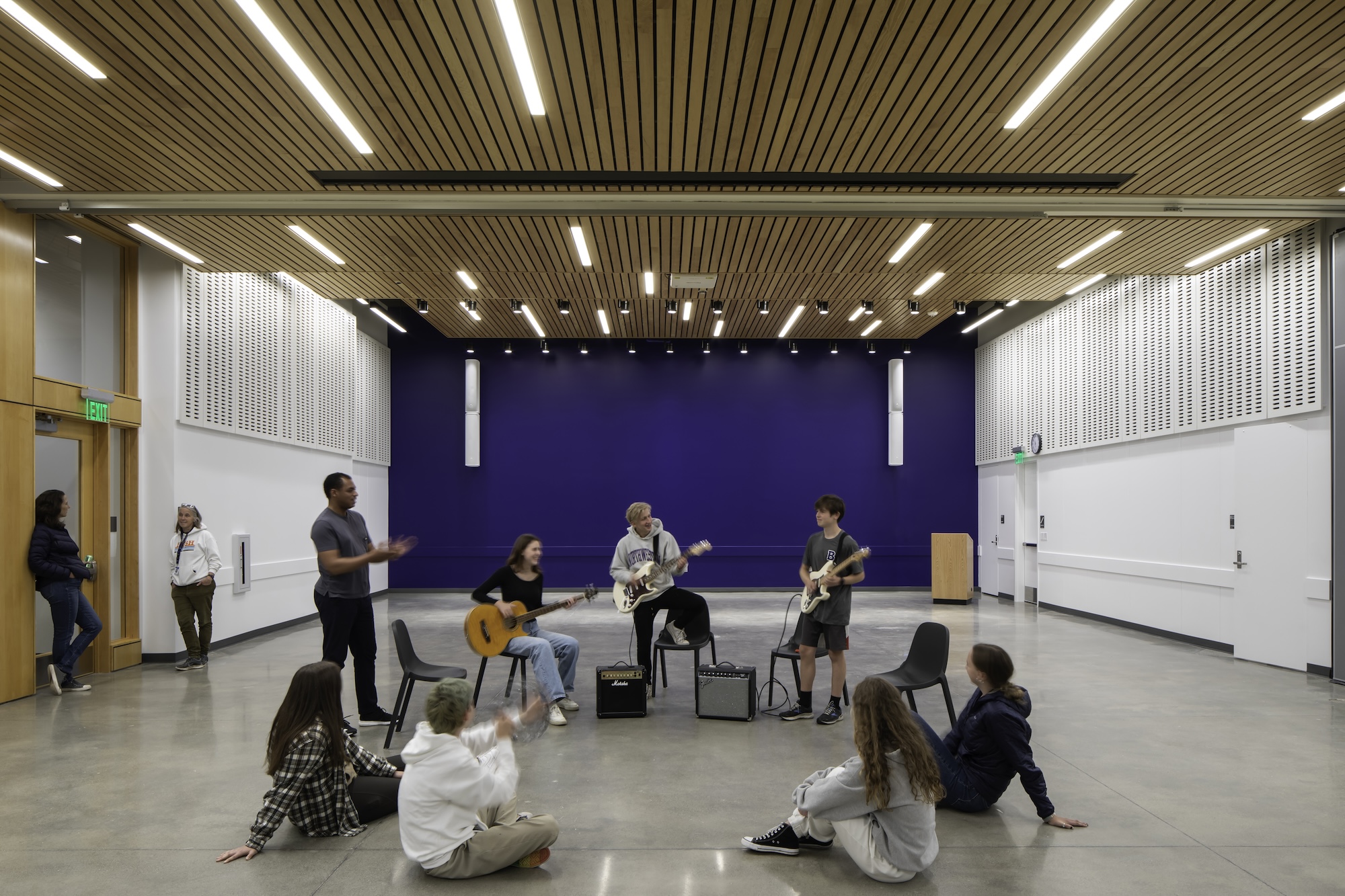
A spacious multipurpose room anchors the lower level. Photo © Lara Swimmer / Esto
“The whole thing came together like an Erector Set—it was impressive to see,” says Mithun principal and project architect Daniel Swaab, who notes that the locally sourced MPP was the most cost-effective and expressive mass-timber option at the time for the project.
Looking for quick answers on architecture and design topics?
Try Ask RECORD, our new smart AI search tool.
Ask RECORD →
In addition to the use of mass-timber to reduce embodied carbon, the Bush School’s new all-electric building can claim multiple other sustainability-related superlatives. Not only is it net-zero energy, but the project is also the first Phius Passive House certified school on the West Coast. Features that help the building achieve these standards are a high-performance envelope and triple-pane glass; large operable windows that enable passive cooling and allow for abundant daylight; a dedicated outside air system (DOAS) with heat recovery; rooftop photovoltaics, and more. (The new building itself has a modest 23-kilowatt solar array; a 142-kilowatt array was added to rooftops of larger, existing buildings on the lower campus to help the Upper School achieve net-zero certification.)
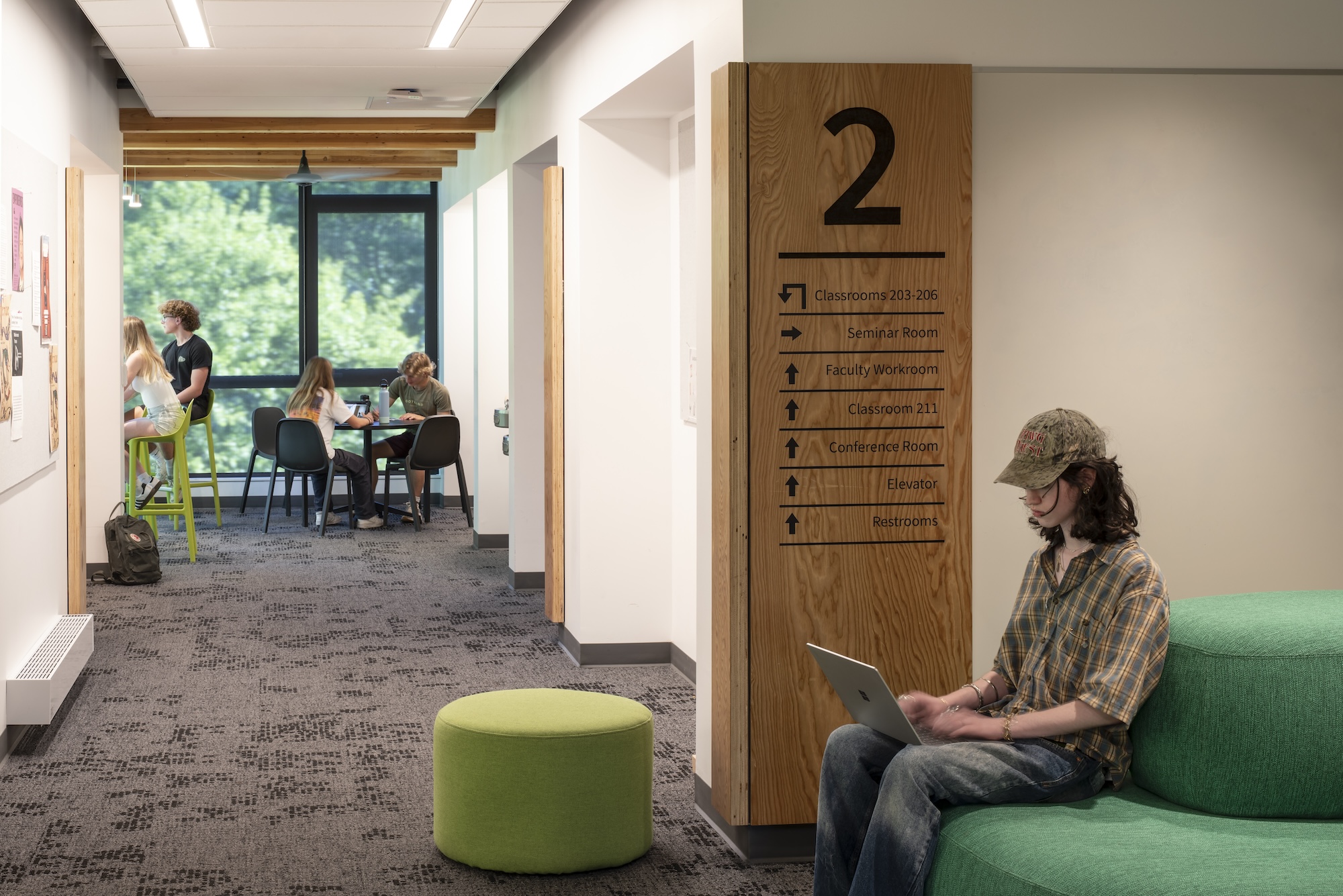
Informal study spaces complement Upper School classrooms dedicated to the humanities and world languages on the second and third floors. Photo © Lara Swimmer / Esto
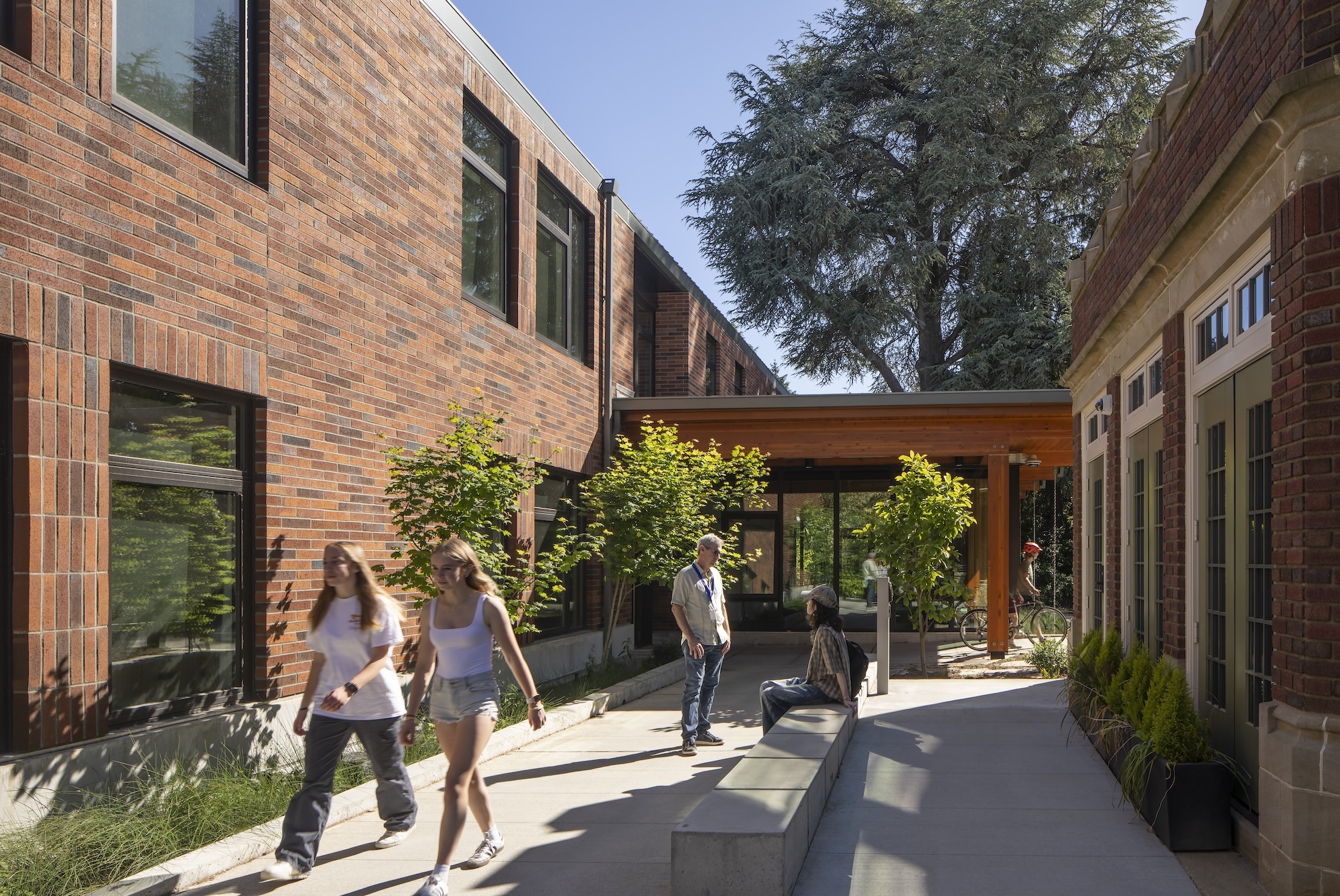
A courtyard fuses the new academic building with Gracemont Alumni Hall, which was recently renovated by SHKS Architects and is home to additional classrooms and administrative offices. Photo © Lara Swimmer / Esto
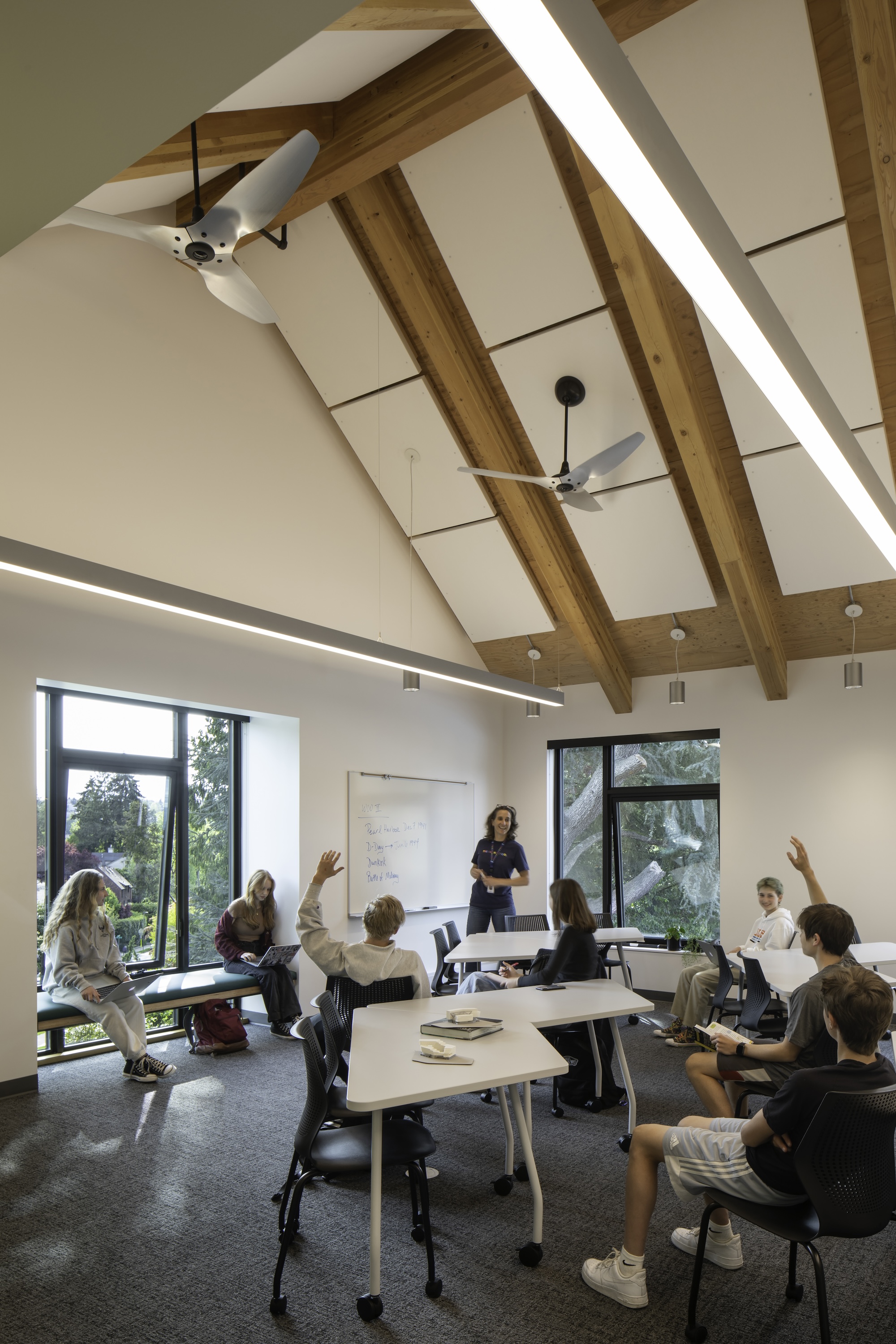
Photo © Lara Swimmer / Esto
The Bush School can also claim a more singular sustainability feat as the first K–12 school to be awarded with Salmon-Safe certification by an Oregon-based nonprofit of the same name. Gonzaga University and Lewis & Clark College are two other educational institutions that have also achieved this very Pacific Northwest metric, which aims to protect vital salmon spawning habitat through stormwater management, pesticide reduction, and other strategies.
Connolly remarks that the Bush School “wanted this project to be a visible sign of change, and also to influence what was around it.” Salmon-Safe certification was particularly meaningful for the school, which took it on as a campus-wide commitment with the new building acting as “a spearhead of that new metric for the school,” he says.
The New Upper School has been duly recognized for its sustainability including by the AIA Committee on the Environment (COTE), which bestowed the project with a 2025 COTE Top 10 Award. “There were a lot of important ‘first moments’ for the project,” says Connolly. He adds that the building serves as a “stepping stone” for subsequent Mithun educational projects that employ mass-timber strategies or are perusing Passive House certification. “It's great to see the intention of the project playing out.”

The Upper School overlooks East Lake Washington Boulevard, a historic Olmsted corridor overseen by the Seattle Department of Parks & Recreation. Photo © Lara Swimmer / Esto
In fact, these intentions will play out just across campus. Breaking ground early next year is a Mithun-led transformation of the Bush School’s 1950s-era middle school and dining hall building that melds new construction with renovation and incorporates cross-laminated timber.
Looking for a reprint of this article?
From high-res PDFs to custom plaques, order your copy today!