Mithun Reimagines the Café and Lounge at the Frank Gehry–Designed Museum of Pop Culture in Seattle
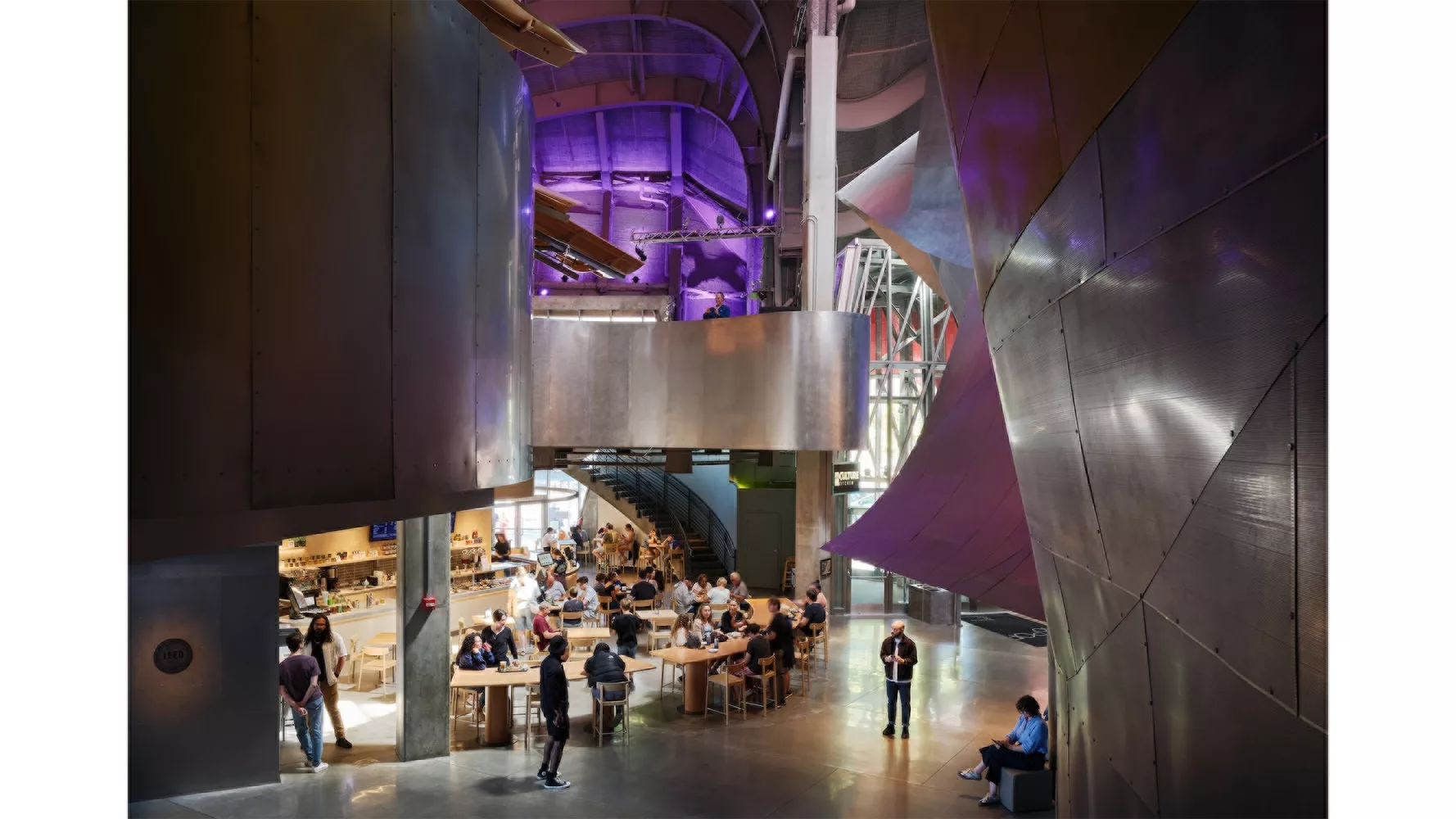
Interior view of renovated public areas at the Museum of Pop Culture, including the café and the second-floor lounge above it.
Architects & Firms
Seattle Center is a textbook example of a vibrant and enduring civic anchor. Famously first developed to host the 1962 Seattle World’s Fair, the complex brings together the performing arts, sports and entertainment, educational facilities, and generous swaths of open green space in a single 74-acre campus just north of the city’s central business district. Over the years, the old fairground has evolved into a multifaceted cultural hub that incorporates several landmark points of interest built for the expo, such as the Space Needle, the Seattle Center Monorail, and Minoru Yamasaki’s magnificent United States Science Pavilion, which reopened post-fair as the Seattle Science Center.
Many attractions at Seattle Center have come, gone, or been painstakingly reconstructed over the decades. Among the 21st-century additions are the Frank Gehry–designed Museum of Pop Culture (MOPOP), a 140,000-square-foot building on the east side of the center that opened in 2000 as the Experience Music Project and has persevered through a modest handful of rebrands in the years since. Completed between Gehry’s Guggenheim Museum Bilbao (1997) and Walt Disney Concert Hall (2003), the building employs the same swooping sheet-metal-clad construction as those structures. (Its form evokes a pulverized electric guitar, in line with the rock ‘n’ roll spirit of the original Paul Allen–backed music museum.) The $240 million project was, however, met with a more divisive—if not routinely scathing—reception compared to the well-known works by the architect that came directly before and after it. Still, many locals were thrilled to have a Gehry to call their own, critical lashings aside.
-Kevin-Scott.jpg "MOPOP interiors")
New seating at the museum café. Photo © Kevin Scott
Despite the museum’s historic struggles with identity and audience, MOPOP continues to evolve by finding new ways to engage with visitors, including in its non-exhibition areas. Two of these areas, the first-floor café and second-floor lounge, emerged last summer from a redesign led by Mithun. The renovation aims to position MOPOP as an inviting “third space” within the larger Seattle Center campus, where the public can congregate, no ticket required.
“Post-pandemic, cultural spaces are trying to figure out what their new role is in the urban fabric,” says Elizabeth Gordon, interior designer and partner at Mithun. “Organizations are thinking about what the next generation of patrons will look like while creating new experiences that truly bring a sense of hospitality and appeal to a broader audience.”
-Kevin-Scott.jpg "MOPOP interiors")
View of the lounge and the plywood canopy over the bar, an existing element that influenced much of the renovation. Photo © Kevin Scott
-Kevin-Scott.jpg "MOPOP interiors")
A live performance in the lounge area. Photo © Kevin Scott
Dramatically altering Gehry’s bold design was never in the cards. The renovation of the café and lounge is more a complementary and corrective effort that improves accessibility, eliminates circulation pinch points, and creates additional seating areas, such as curving communal tables and a skylight-lit banquette cove, for visitors to gather. The renovation also supports the museum’s operational needs for special events and diverse public programming. “We took the approach of simplifying a lot of the geometries, creating shapes and forms that related to the original architecture, and contrasting the daytime-feel café experience with the moodier lounge,” says Gordon.
-Kevin-Scott.jpg)
1
-Kevin-Scott.jpg)
2
View of the reconfigured museum café (1) and its new seating nooks (2). Photos © Kevin Scott
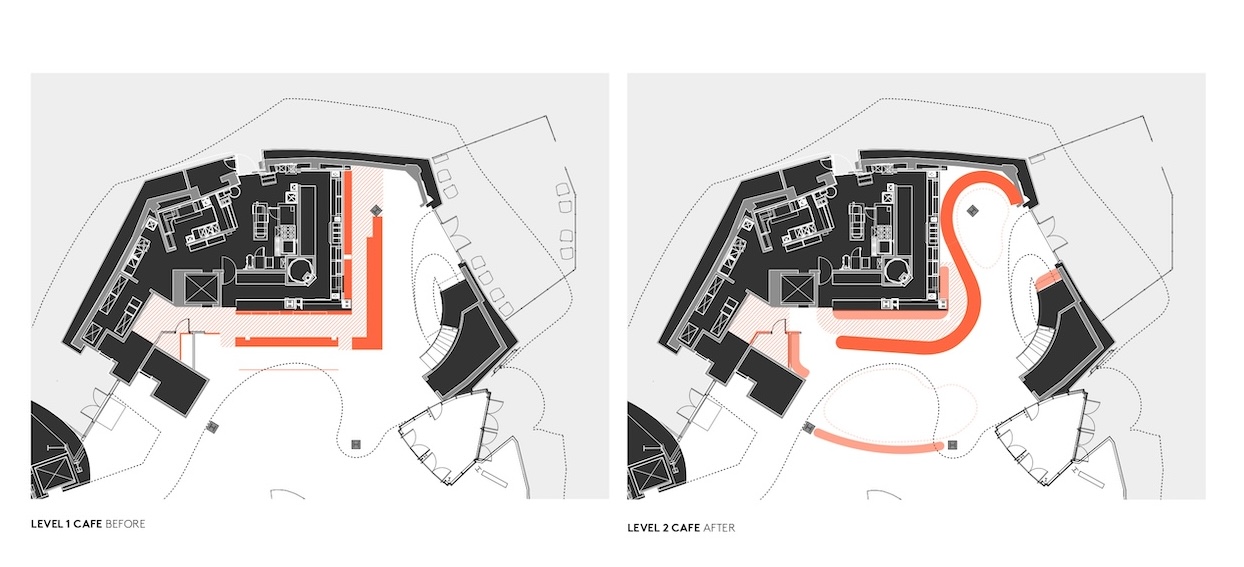
Before and after drawings of the café. Image courtesy Mithun
While the 2,300-square-foot café adjacent to the main entrance—now known as Culture Kitchen—had undergone several renovations (leaving it without a clear design language), the underutilized lounge had not changed since the museum’s opening in 2000.
Given that MOPOP offers guests what is frequently an immersive and high-sensory museum-going experience (current exhibits include Scared to Death: The Thrill of Horror Film and Indie Game Revolution), a core goal was to incorporate nooks and crannies pulled away from the main circulation paths—spaces where the lighting and acoustics work to create moments of pause and respite, including secondary seating areas where neurodiverse visitors can decompress.
Looking for quick answers on architecture and design topics?
Try Ask RECORD, our new smart AI search tool.
Ask RECORD →
-Kevin-Scott.jpg "MOPOP interiors")
Seating in the second-level lounge is newly ADA accessible. Photo © Kevin Scott
The material palette takes things down a notch while also honoring and reusing materials from the original building. Wood makes a major post-renovation appearance. An existing plywood canopy in the lounge was the starting point to introduce more of the material throughout both the lounge and café, where a curvilinear, wood-clad service counter serves guests. Instead of being concealed, select pops of color—such as a magenta metal panel behind the lounge’s bar that matches the building’s exterior—are emphasized and re-created for a more cohesive visual language. “We thought of our design as an extension of what was already there,” says Gordon.
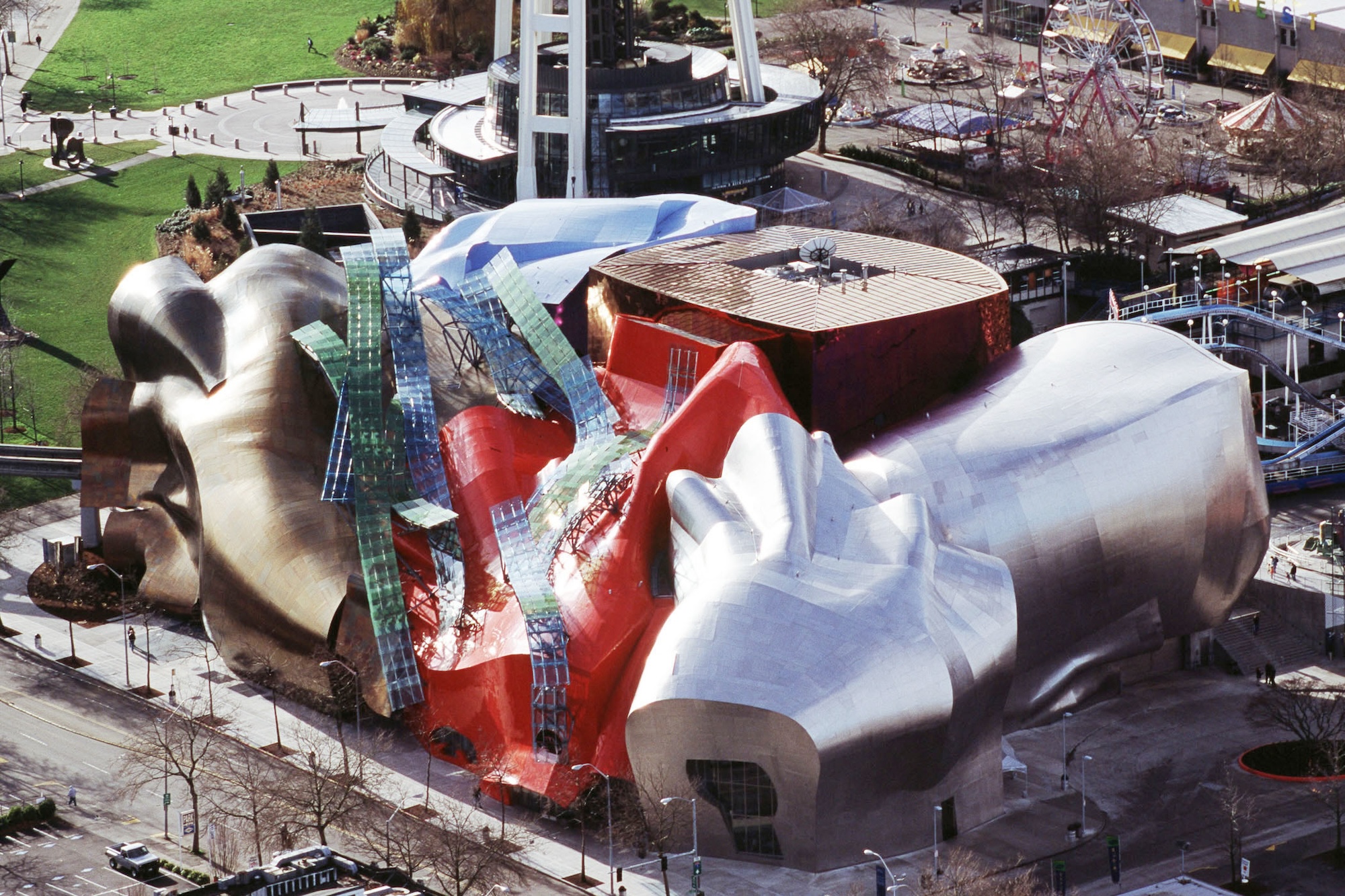
Archival photo of the Museum of Pop Culture. Opening in 2000 as the Experience Music Project, the building is located next to the base of the Space Needle at Seattle Center. Photo by EMPISFM Archive, Wikimedia Commons
The repositioning of MOPOP’s café and lounge from standard museum hospitality spaces to more informal, community hangout spots was prompted just as much by the changing urban landscape around Seattle Center as it was the museum’s own institutional evolution. (The renovation is the first phase of a larger master plan created for MOPOP by Mithun.) Within the next 15 years, two new light rail stations are set to open that will essentially flank Seattle Center to serve the once low-density residential neighborhoods around the complex that are rapidly filling in. Starting with the café and lounge, the team is envisioning how “the building responds to all these changes coming around it,” says Mithun partner and project lead Richard Franko. “There’s so much going on, including new pedestrian patterns coming into and out of the site, that the museum asked, ‘How do we engage with that?’’
Looking for a reprint of this article?
From high-res PDFs to custom plaques, order your copy today!