Set to Open this Month, 3XN’s Sydney Fish Market Aims to Revitalize an Industrial Bay and Become a Culinary Hub
Sydney
Architects & Firms
Sydney is known for its scenic waterfront and harborside landmarks, including Jørn Utzon’s Opera House—arguably the most iconic building of the 20th century. One mile southwest of the city’s central business district, on Blackwattle Bay, is another of Sydney’s claims to fame: the third-largest fish market (by volume sold) in the world. Over the last decade, the state government’s urban-transformation agency, Infrastructure New South Wales (NSW), has sought to revitalize this industrially zoned bay and its many outdated facilities, including the market.
Understandably so—anyone approaching the original fish market might feel as if they had wandered down the wrong street. Adapted from a print-storage warehouse in 1966, the two-story structure presents a windowless concrete wall to the street, made only slightly more hospitable by a coat of blue paint (presumably to reflect the aquatic affiliation of its use). Oddly placed signage and faded arrows lead pedestrians to a bustling parking lot, where they need to dodge hordes of shipping trucks going to and fro. Only after nearing the water would the smell of fresh seafood and saltwater fill the air, and crowds eating oysters under neat rows of white umbrellas come into view.
1
2
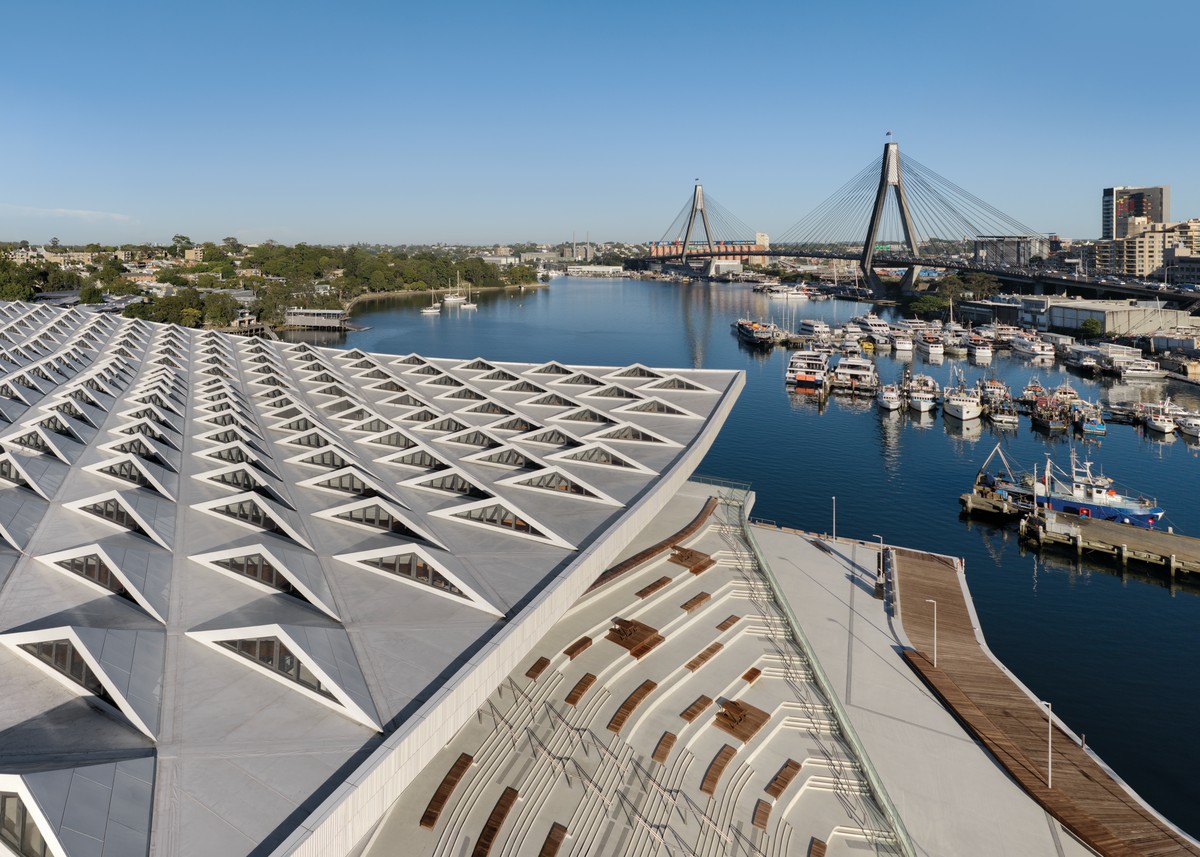
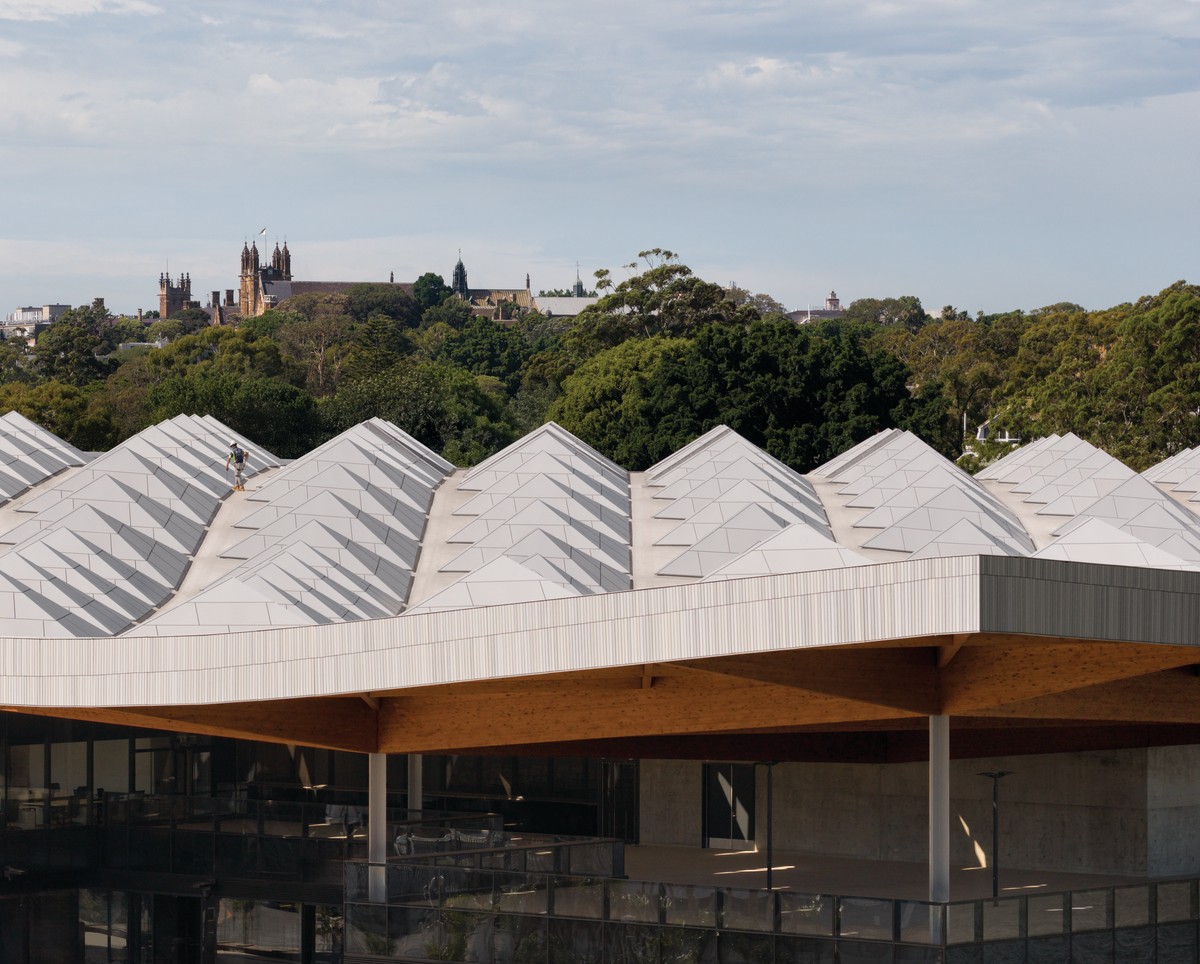
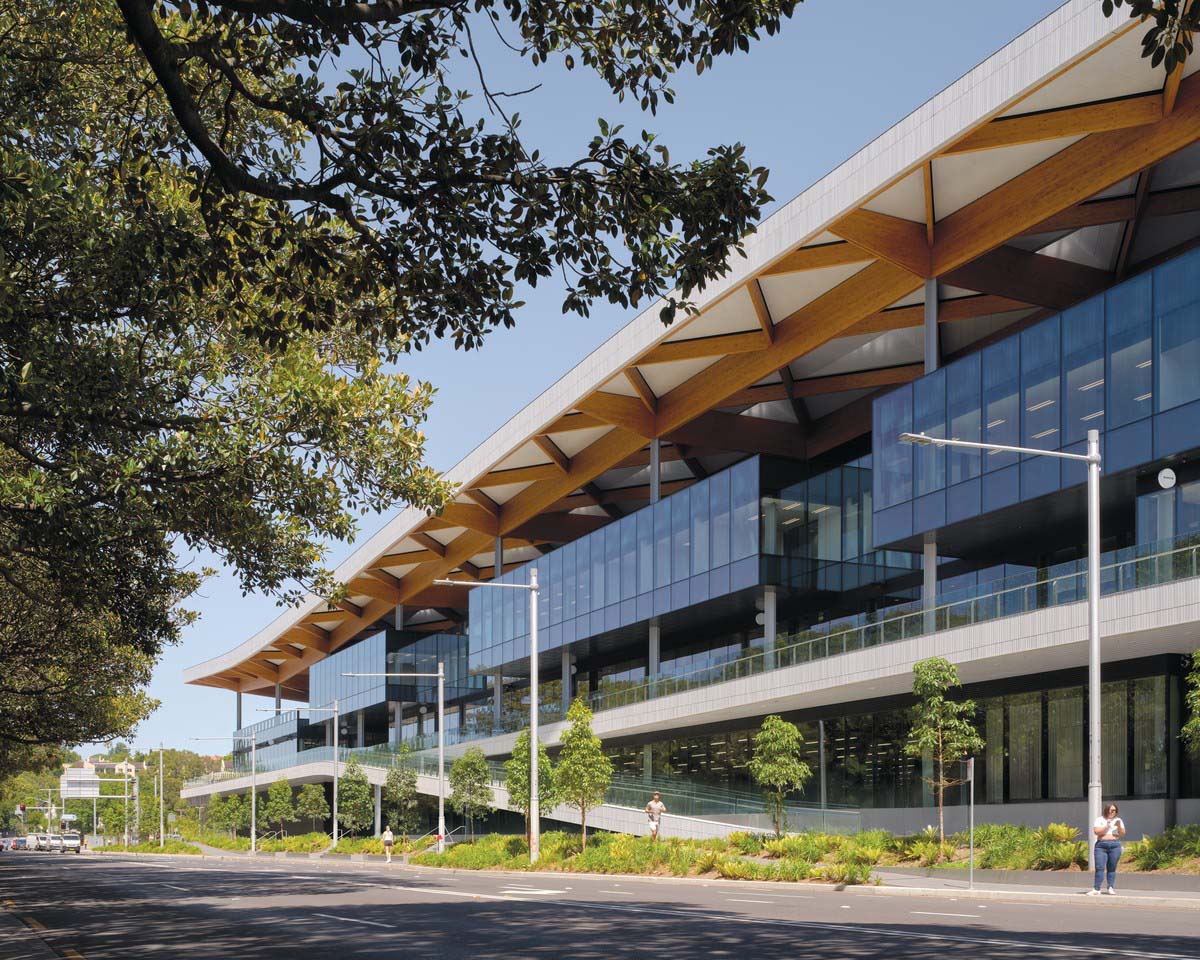
An undulant roof (top of page) is dotted by pyramidal modules (1 & 2) that create clerestory windows. Photos © Tom Roe
In its early days, the Sydney Fish Market only hosted wholesale transactions and auctions, but it later introduced stalls for shopping and dining, slowly building a reputation on the local foodie scene. At its peak, nearly 3 million visitors descended on the market each year, putting a severe strain on it and calling attention to the lack of easy access, both on land and from the water.
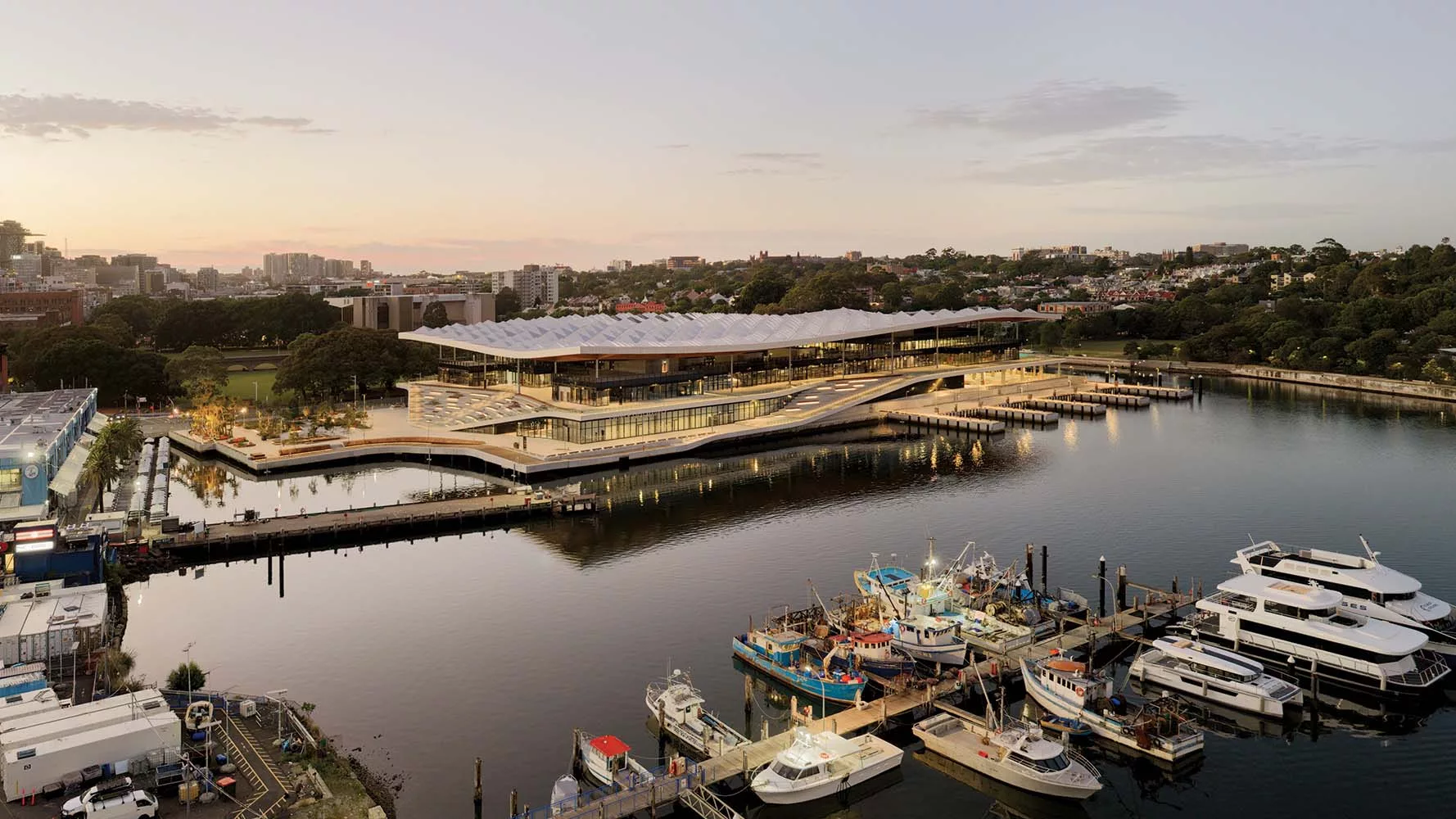
As part of Infrastructure NSW’s revitalization efforts, Danish architecture practice 3XN, working in partnership with local firm BVN—the same team behind Sydney’s Quay Quarter Tower—was commissioned to design an adjacent ground-up facility that could accommodate the needs of an operational fish market, serve as a proper culinary destination, and perhaps even become a new waterfront icon. (In order to fund the project, the old building was sold and will be razed for a mixed-use development that is currently in the works.)
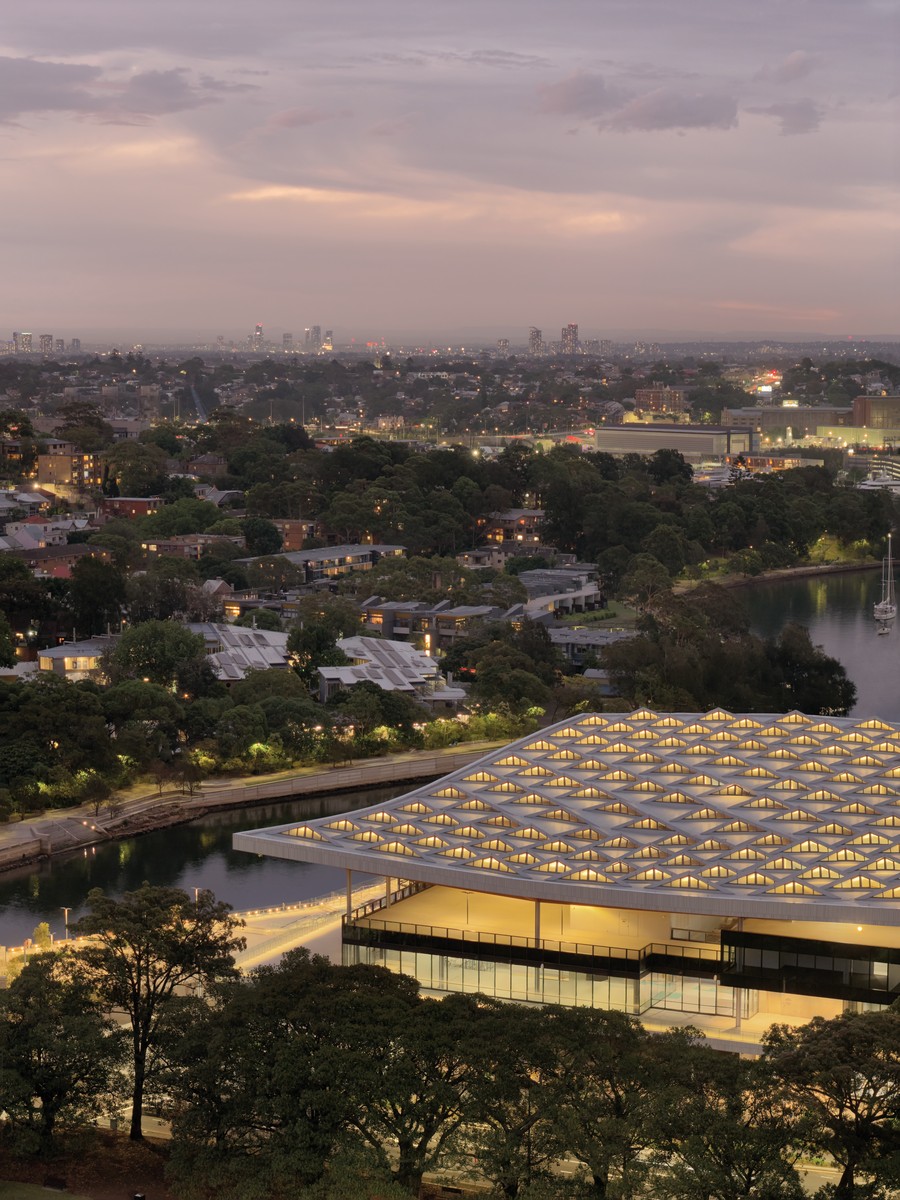
The fish market aims to become a new waterfront icon. Photo © Tom Roe
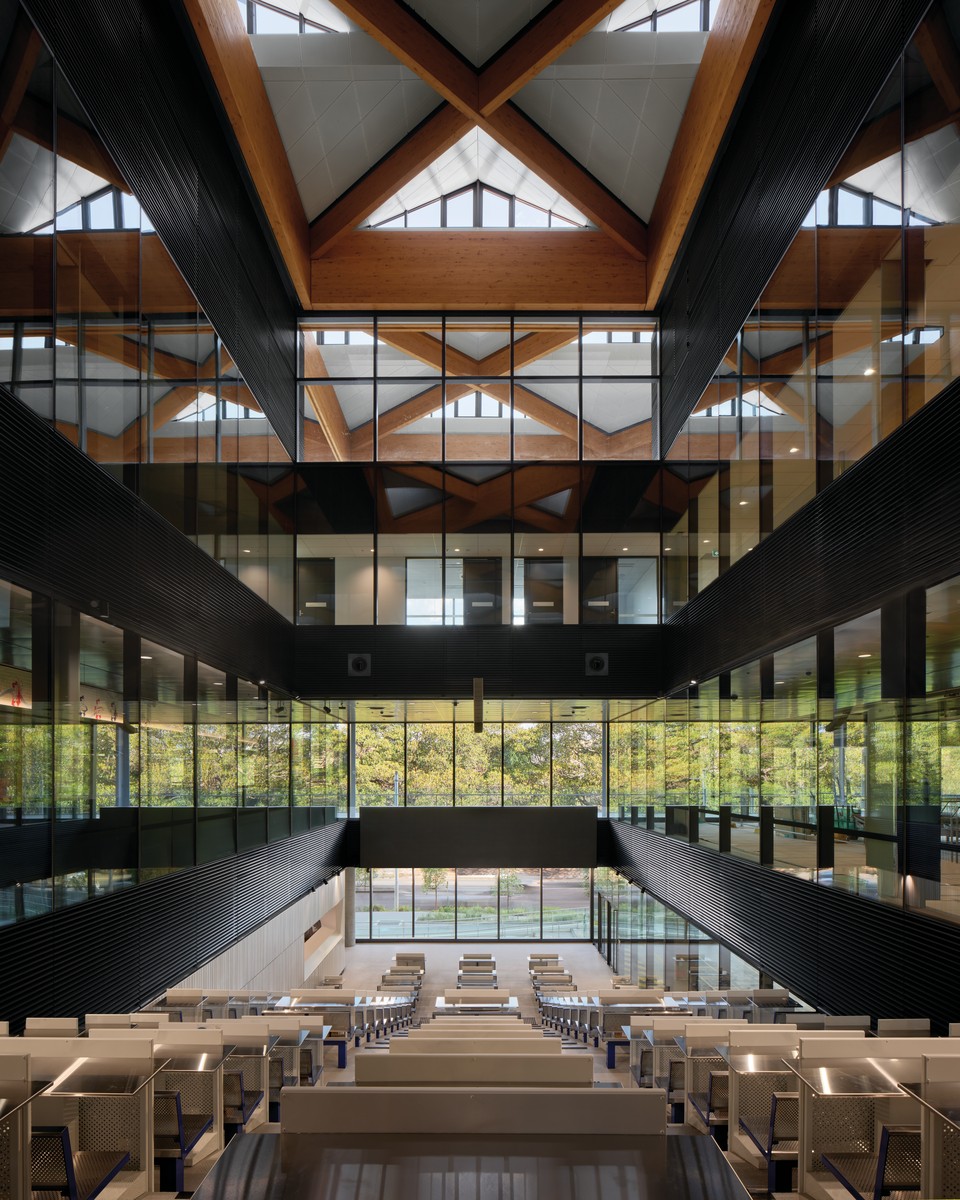
Beneath the canopy is an auction hall. Photo © Tom Roe
“The foundation of the design expands on the idea of markets as social hubs, which generally consist of rows of stalls grouped together under a canopy,” says architect Fred Holt, partner at 3XN and director of the firm’s Australian practice. Fittingly, the team has created a strong east–west axis that guides pedestrians through an open-air promenade under an expansive roof nearly the length of two football fields. Double the space of its predecessor, the purpose-built fish market vertically organizes its program: Parking and delivery are in the basement. The lower ground floor, tucked into a plinth, is fully enclosed for wholesale and auctions. A partial-height glass wall wraps the perimeter of the main floor, which hosts the stalls and restaurants, while bird netting continues up to the ceiling and allows fresh air to pass through. Lastly, a mezzanine houses administrative offices and a cooking school.
3
4
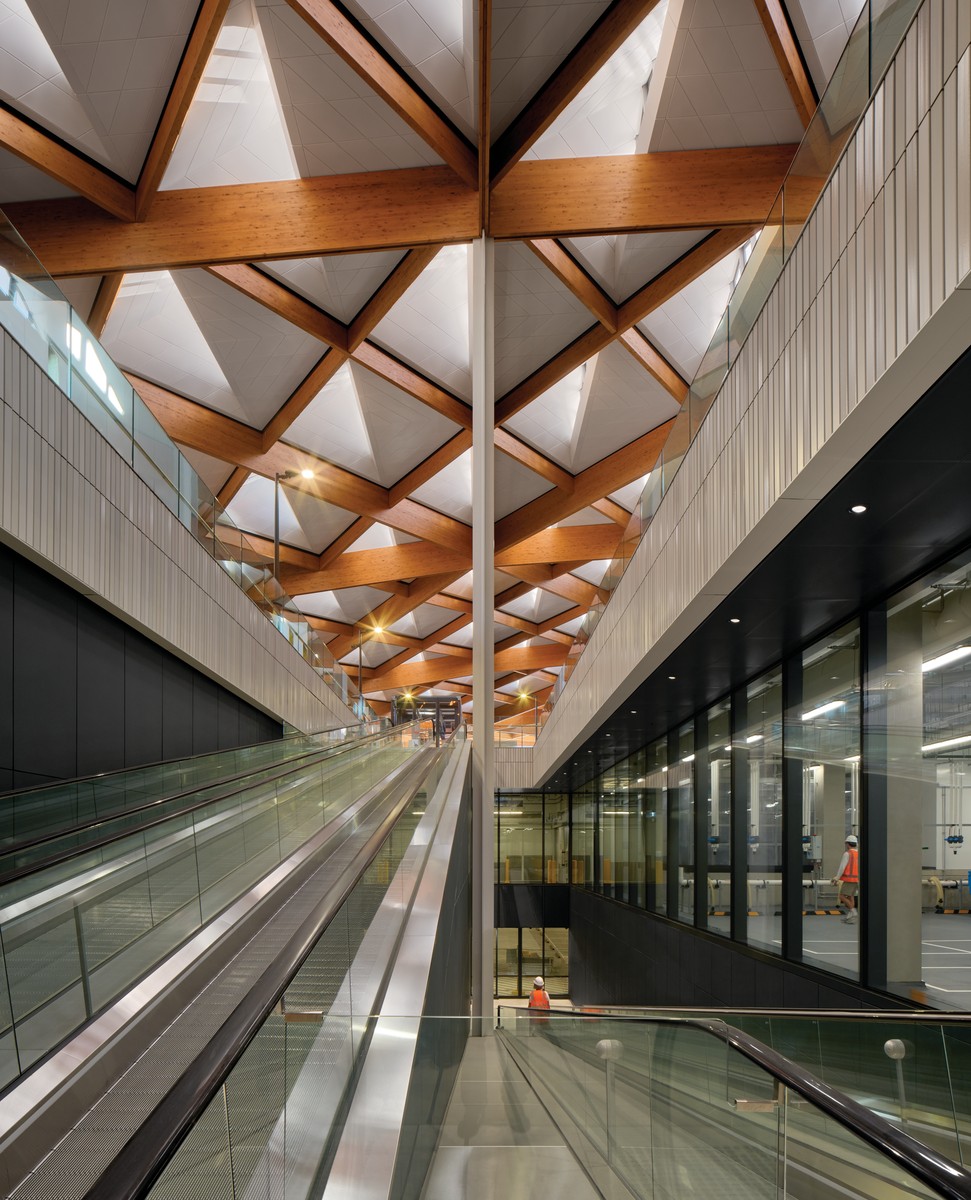
Vertical circulation (3) and glazed offices (4) beneath the canopy. Photos © Tom Roe
The undulant canopy overhead is a feat in itself—it is the largest timber roof structure in the southern hemisphere. A grid of 594 glue-laminated beams is infilled with 407 nearly square (in plan) aluminum modules, “tented” (in section) to create south-facing clerestories that introduce daylight. Sized for manufacturing and delivery from barges docked at nearby Glebe Island, the standardized units (they measure about 35 feet by 30 feet) were quickly dropped into the roof grid and have only four connection points, reducing installation time twofold. Holt concedes that the canopy’s geometry was inspired by ocean waves, but locals have taken to pointing out the likeness to fish scales—just as appropriate for the market.
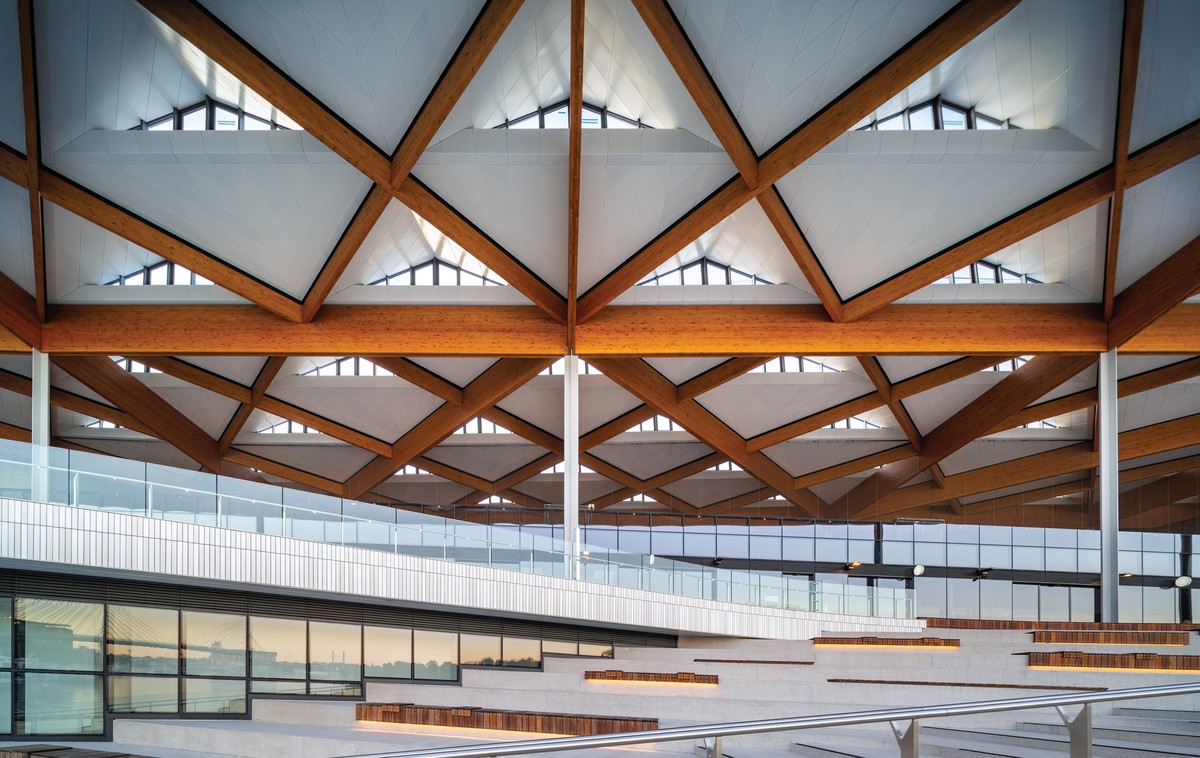
Exposed glulam beams add warmth to an otherwise minimal palette. Photo courtesy Infrastructure NSW
Rainwater capture and reuse also drove the shape of the roof’s surface; as Holt explains, two high points redirect all runoff to two lower points. The water is channeled to a filtration system, and then used for irrigation, amenities, and for the daily deep clean of innards and fishy surfaces, cutting water consumption by half.
Looking for quick answers on architecture and design topics?
Try Ask RECORD, our new smart AI search tool.
Ask RECORD →
The underside of this multifunctional canopy is left exposed, allowing the timber to introduce much-needed warmth to the otherwise stark palette of concrete and white ceramic tiles. But the wood was not locally felled. Engineers determined that native species lacked the structural capacity required for 115-foot spans, the longest. Using Australian timber would have necessitated more columns, complicating internal layouts and minimizing the efficiency of the roof modules. Amazingly, according to the architects, spruce sourced from Italy and transported by boat had a lower carbon footprint.
One of the most distinct aspects of the original facility was the ability for visitors to experience a working fish market so close to a city’s downtown—an experience not available elsewhere in Australia. In the new building, the use of triple-glazed curtain walls maintains food-safe temperatures while keeping the visual spectacle alive, as product moves about or becomes part of fanciful displays on ice.
Despite the chaos and freneticism of the market, views of the calm harbor seep into the building, a constant reminder that visitors are only a few steps away from water. For 3XN, authenticity is reflected in designs that highlight the specificity of a place. But on such a complex site, the grounds were also a key component of the redevelopment. Landscape-architecture firm Aspect Studios shaped the bay’s entire 9-mile stretch of waterfront. Wanting the area closest to the market to feel active, more like a park than a plaza, Aspect integrated amphitheater-style seating into the building’s plinth. Pedestrian access has been enhanced on all sides, and car and boat access has been limited to the lowest levels.
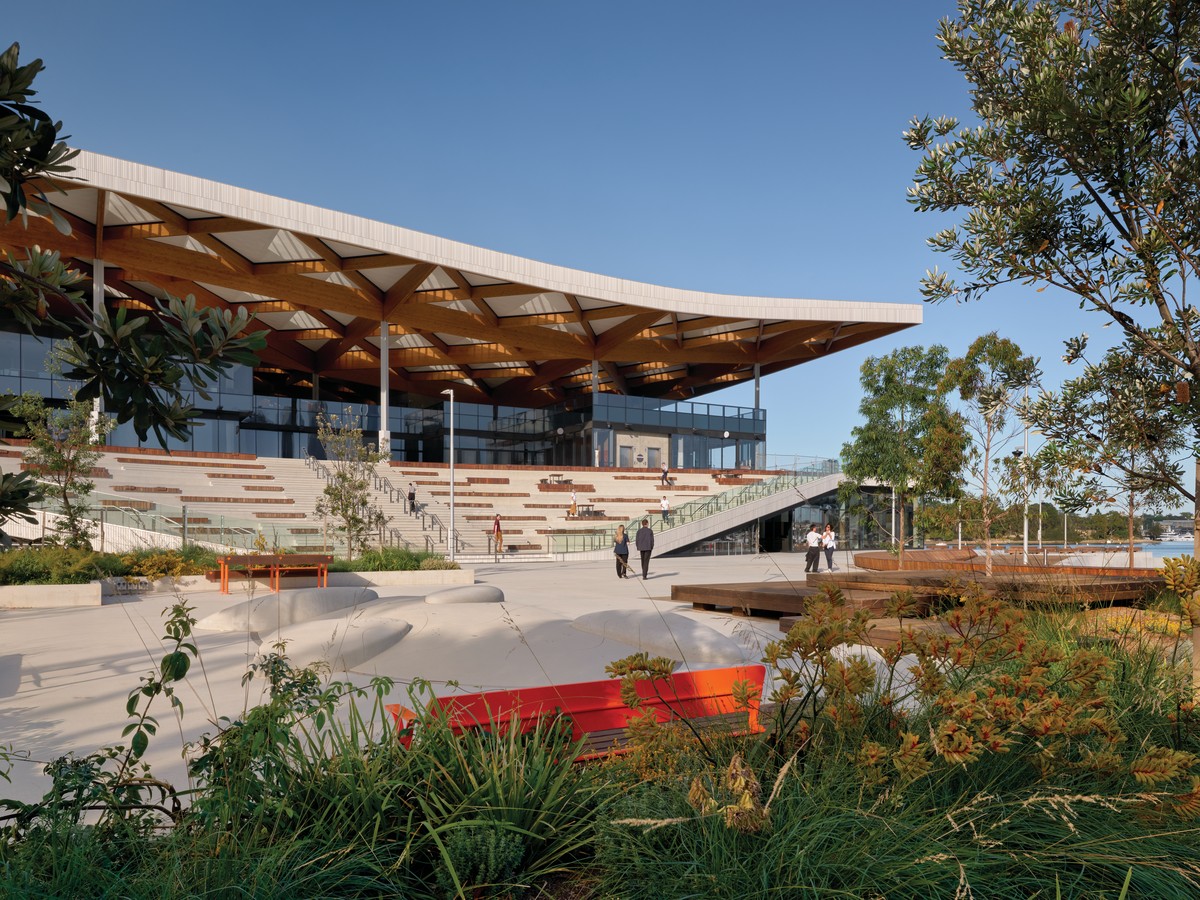
Amphitheater-style seating beneath the canopy. Photo © Tom Roe
Expectations are high for the Sydney Fish Market, following delays in construction, a ballooning budget, and opposition by some tenants against relocating to the new building. However, after securing one of Sydney’s highest-rated and most exclusive Japanese chefs, who was drawn to the idea of being closer to the source of the seafood, the tides started to turn. The market is now a little closer to becoming the world-class cultural attraction and foodie destination it was aiming to be.
With the new Sydney Fish Market slated to open to the public this month, it will be interesting to see how the experience traditionally associated with fish markets manifests in this evolved version. Will the familiar sensory overload of fishy smells, raucous shoppers, and shouting vendors still permeate throughout? One sure thing will be the presence of loitering seagulls and pelicans, looking to score an enticing meal.

Image courtesy 3XN Architects
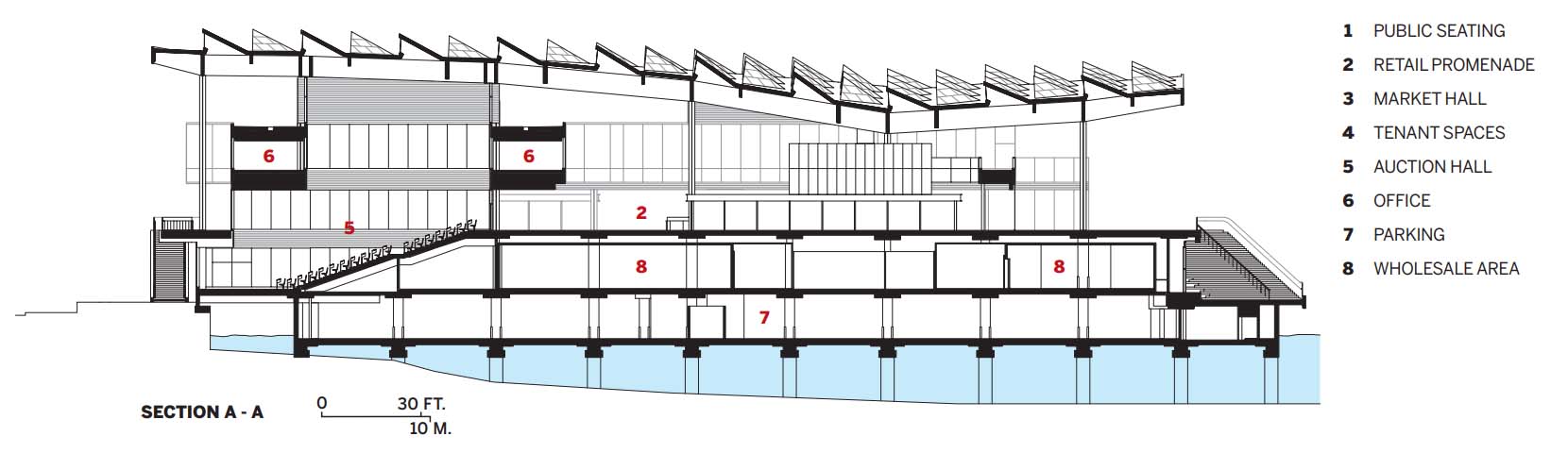
Image courtesy 3XN Architects
Credits
Architect:
3XN Architects — Kim Herforth Nielsen, founder; Audun Opdal, Jeanette Hansen, senior partners; Fred Holt, Daniel Cruddace, Australia partners; Lasse Lind, partner; John Sham, project lead
Architect of Record:
BVN — Catherine Skinner, Julian Ashton, principals; Asher Galvin, project director; Sally Campbell, principal of interiors
Landscape Architect:
Aspect Studios
Engineers:
Mott MacDonald, AT&L, AECOM, CSS (civil); AECOM, Stowe Australia (electrical); CJ Arms, Harris Page & Associates (hydraulic); AECOM, Equilibrium/Climatec Joint Venture (mechanical); Mott MacDonald, WSP (structural)
Consultants:
Apex, Prism (facade); S2D (logistics); Stantec, EMF Griffiths (sustainability); Dohrmann Consulting (ergonomic); WallnerWeiss (art)
General Contractor:
Multiplex
Client:
Infrastructure NSW
Size:
699,650 square feet
Cost:
$836 million (total)
Completion:
November 2025
Sources
Structure:
Rubner (glulam); Engineering Fabricators Newcastle (columns)
Curtain Wall:
Sharvain Projects
Doors:
Ikon, Austral Monsoon, Max Door Solutions, Safetech
Interior Finishes:
SAS International (acoustical ceilings); Dormakaba Australia (partitions); Laminex (paneling); Corian
Looking for a reprint of this article?
From high-res PDFs to custom plaques, order your copy today!