RECORD Forum
Chinese and American Architects’ Shifting Relationship
Who’s building big? Not America! So goes the conventional wisdom. Whether it’s constructing a high-speed-rail line or enough housing to meet a shortfall that analysts measure in millions of units, over the last two decades, America seems to have been suffering from a mismatch between its ambition and its follow-through. This perception is heightened by a glance across the Pacific. Even in 2004, Time magazine was heralding the imminent development of “China’s New Dreamscape”—and that future was erected in record time.
In his recent bestseller, Breakneck: China’s Quest to Engineer the Future, it takes Dan Wang only a few pages to make the case that, while America has been held back by lawyers and their pesky proceduralism, China has built more cities than they know what to do with. One might wonder whether the American building industry ought to capitalize on Chinese construction capability to reach its lofty goals.
This line of reasoning emphasizes one specific measure of bigness: gross square footage. Other metrics, however, depict Americans as virtuosos of the large. Last October, I had plenty of time to ponder the numbers at a conference of the Council on Vertical Urbanism (CVU), in Toronto. CVU formed to coordinate research on tall buildings, and their annual meeting has evolved into a trade show for the skyscraper industry—architects and developers jostling with purveyors of curtain-wall-constructing robots.
At keynote events, the latest bar charts on the construction of tall buildings were unveiled with fanfare. Hong Kong and Shenzhen unsurprisingly topped the list of cities with the most 500-foot-or-taller buildings, and Chinese cities claim four more spots in the Top 10. Although New York City is ranked No. 3, another slide clarified that America’s most vertical metropolis ranks No. 20 when it comes to the number of tall buildings currently under construction—a measly 11 buildings, compared to more than 73 in Shenzhen and 30 in Wuhan. Even Toronto handily beats the currently most prolific U.S. city, with 20 skyscrapers being built, versus Miami’s 13.
All that sounds grim for American enthusiasts of bigness, but another list, this time of the most prolific firms, tells a very different story. As the slides flashed by, my tally revealed that, of the 20 tallest buildings under construction worldwide—all but two of which are in China or Dubai—no fewer than 10 were by American designers. New York–based KPF is credited with four, Chicago-rooted global giant SOM has three, along with its protégé Adrian Smith + Gordon Gill Architecture, which also has three. America is building big, just not at home.
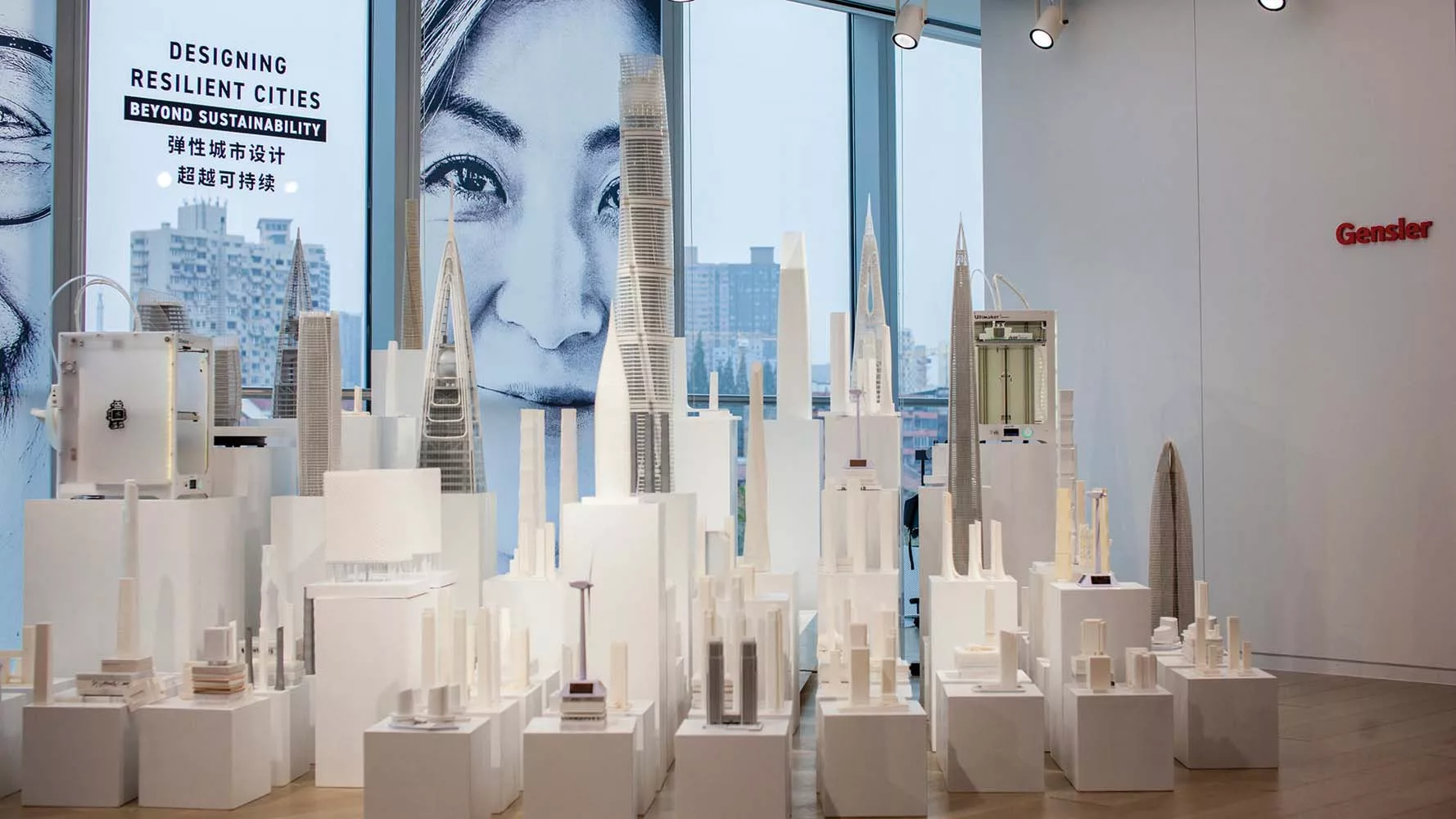
To make sense of the extraterritorial appeal of American architecture, I dropped by the Shanghai office of Gensler. Ascending their office tower at the edge of the city’s poshest residential district, the elevator opened onto a cornucopian display of models, with Shanghai Tower in the center. It is the tallest building in China, completed by Gensler a decade ago. Amid the crowd of elegant spires were a few cacti—a New World plant that serves as an apt metaphor for imported American forms. The design director and principal Hasan Syed welcomed me with a hug, and we embarked on a tour of the studio backdropped by the sea of greenery outside. Syed directs design in an office about the same size as Gensler HQ in San Francisco. Most but not all of their projects are in China. As we circled back around and I mused that the cactus-skyscrapers could only be built in Dubai, Syed paused for a moment before describing the beautifully tapering form of Shanghai Tower as an entirely rational outcome, with a twisting shape calculated to dampen vibration during typhoons and a vertical channel to “confuse the wind,” all wrapped with sky lobbies for energy performance and environmental comfort. It was a compelling pitch that combined form and function, engineering prowess and human-scale sensitivity. I departed confident that American entrepreneurship is simply unmatched.
Reflection soon tempered my assessment. Charisma is not the prime mover of real-estate markets. In fact, the building industry in China has erected bulwarks against the exertion of individual will. Gensler partnered on Shanghai Tower with the Tongji Architectural Design Group (TJAD), a firm that grew alongside the architecture school at Tongji University. Legal regulations in China typically require state-owned companies, called “institutes” or “design groups,” to serve as the architect of record on large projects. These are full-service architecture, engineering, and construction firms, and they’re often huge. The home of TJAD is a 700,000-square-foot former bus parking garage across the street from the university, and offshoots like experimental fabrication labs and community design groups dot the neighborhood.
Looking for quick answers on architecture and design topics?
Try Ask RECORD, our new smart AI search tool.
Ask RECORD →
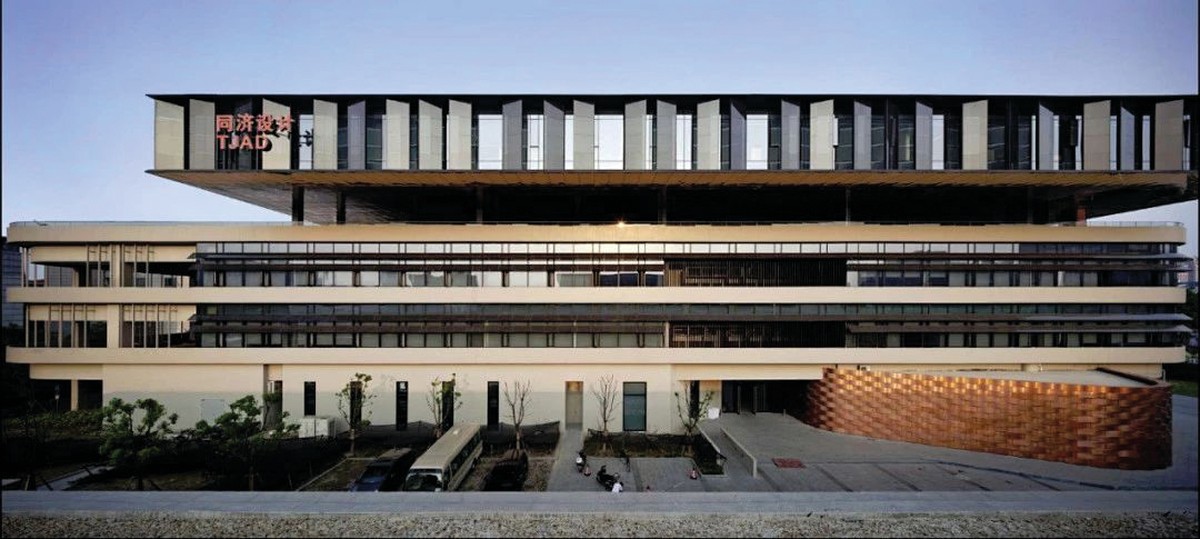
TJAD is one of the giant full service institutes that often serve as architect of record. Photo © LV Hengzhong, courtesy Tongji Architectural Design Group, click to enlarge.
The practice of partnering foreign with local firms emerged in China in its current form during the economic reopening directed by former paramount leader Deng Xiaoping, starting in 1978. The story of a key project of the era reads almost like a fairy tale. During a diplomatic visit, Deng stayed at the Peachtree Center, in Atlanta, designed by John Portman. He was so impressed, he invited the architect to build one of Shanghai’s first skyscrapers, in the early 1990s. Portman accepted and opened the very first American architecture office in contemporary China. The twist is that Deng’s patronage did not give Portman free rein, and his Shanghai Center was designed and built in collaboration with the East China Institute of Building Design.
Wariness of foreign designers has redoubled in the last decade. After OMA’s CCTV Headquarters—home of state-owned China Central Television—was indelibly likened in local media to a squatting pair of pants, the current paramount leader Xi Jinping declared there would be “no more weird architecture” in the country after 2014. Building institutes serve as checkpoints that help ensure compliance with informal iconographic policies.
A side-effect of this arrangement has been that the institutes have developed an oversize focus on construction. Shanghai Tower is a bit like an iPhone, the product of Californian design and Chinese execution. These partnerships are inherently unstable. Just as Syed leads an office equipped to push projects from the programming phase to post-occupancy, the institutes are headed by architects eager to begin work well before construction documentation. A notion of parity structures their partnerships with foreign firms; the most prominent foreign architects partner with the star designers leading the top studios within the top institutes. How could they not want the projects all to themselves?
American firms may soon face a new level of competition from these institutes. My own involvement with big projects in China began in a different era, two decades ago. I worked for a small office in Boston, and we partnered with one of the largest institutes in Beijing. What they gained in this exchange was a modicum of technological transfer and a strong impetus to develop a corner of the construction industry to world-class standards. The same basic arrangement was repeated many times over across the country. On a visit to the institute in the northern port city of Dalian in those years, the local architects reminisced about their fruitful partnership with the Austrian architect Wolf Prix on the city’s rather spaceship-like conference center—even as they winced at the memory of dealing with the countless custom-milled panels he insisted must clad the building inside and out. Chinese companies learned from cutting-edge American and, in that case, European practices, and they incorporated the latest techniques into their repertoires.
Since then, it has become clear that the value of the intellectual property that helped fuel the early-millennium building boom in China pales in comparison to the worth of the image these projects present on the global stage. While parametric software and updated construction techniques offered significant improvements in production efficiency and overall building quality, once they became commonplace, they no longer conveyed any competitive advantage to one firm over another, American or Chinese. The city skyline, conversely, became a more valuable arena when more prominent buildings began to loom. The biggest projects—like CCTV—often become important actors in the construction of collective identity. Once the latest swooping silhouettes became common property, a question arose: Why subject something as important as a city’s skyline to the theatrics of a jet-setting cadre of mostly American and European star architects?
Despite real-estate headwinds, China is still building plenty, and architects there are beginning to construct an audience to match the big scale of their work. Their projects are legible increasingly on the global stage. For example, the National Sliding Center, built in Yanqing for the 2022 Winter Olympics, is formally coded as both cosmopolitan contemporary and regionally specific. It’s SANAA’s Grace Farms meets a Chinese dragon. The only issue is that the designer—Li Xinggang—is obscured within the structure of recognition set up by the China Architecture Design and Research Group (CADG), where he is the chief architect.
It’s as if Steve Jobs had been the head of Foxconn instead of Apple. But CADG could, of course, change its emphasis—fame can be engineered. For those interested in American architectural greatness, as measured by the biggest designs: pay attention to the institutes. They’re going to give architects the world over a run for their recognition.
Looking for a reprint of this article?
From high-res PDFs to custom plaques, order your copy today!