The ‘Divine Darkness’ of Architectural Determination
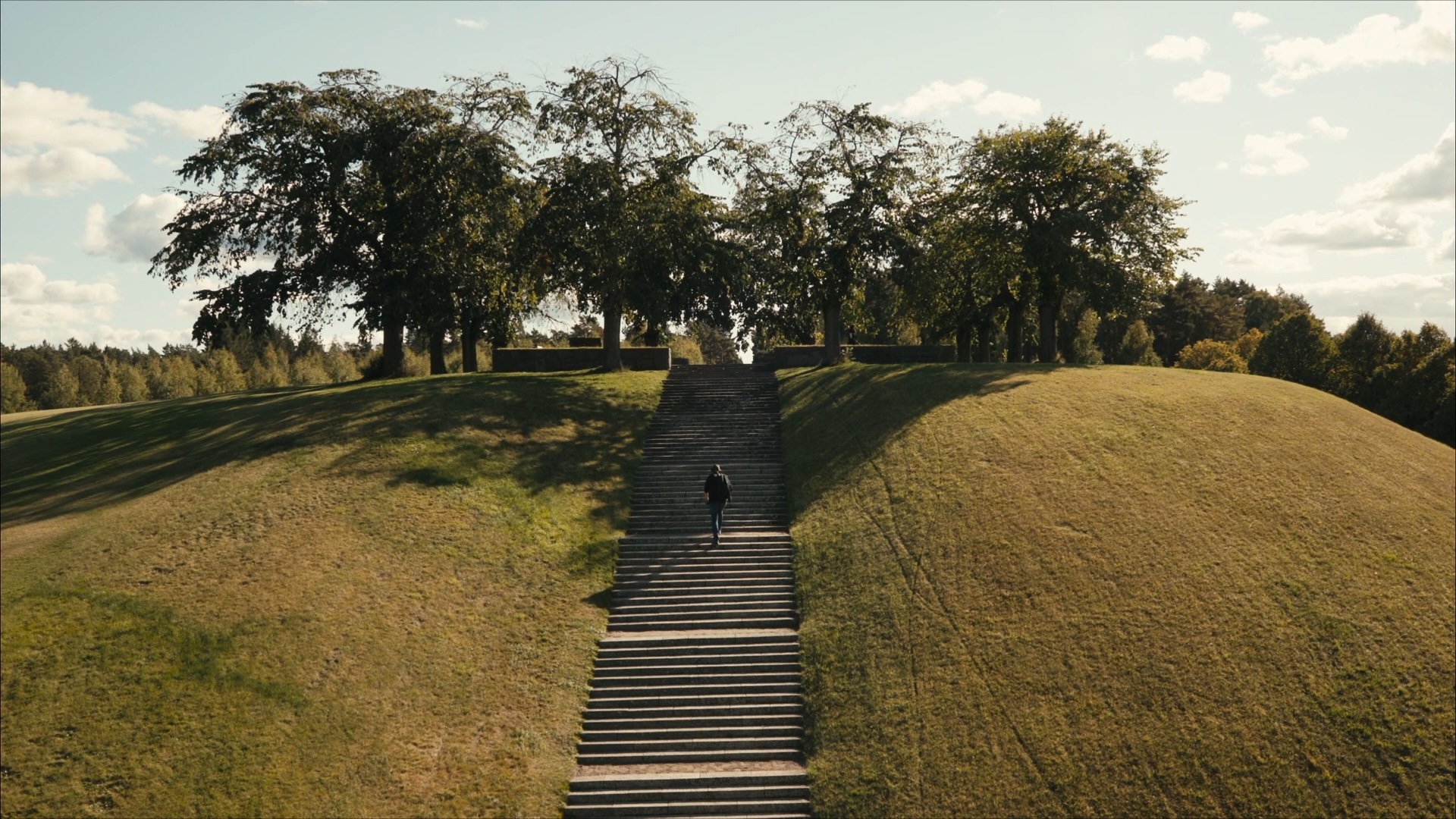
Woodland Cemetary, Skogskyrkogården. Photo © Sven Blume
The first part depicts Lewerentz early in his career, who, in collaboration with Gunnar Asplund, wins the international competition for Woodland Cemetery in 1915. Known not only for the pavilions that both Asplund and Lewerentz designed, the cemetery is recognized for the landscape that is the project’s key protagonist—a melancholic topography that serves as the mis-èn-scene that only death and mourning can inspire. Thought of as the up-and-comers of their time, both architects would begin to show their depth of talent. So too, each would reveal aspects of their character that would define their respective futures. Asplund, extroverted, charismatic, and verbose, would become the spokesperson of the project, engaged with the clients and public at large. Lewerentz, introverted, thoughtful, and silent, was the reflective mind that was focused on design, drawing, and the requisite ethics the construction process involved.
Lewerentz, an architect of precision, would make constant revisions to the Chapel of the Resurrection, with an active on-site presence in dialogue with the workers. The very quality that defined his work ethic was viewed by the client as the liability that they would eventually want to evade. In a fateful call, Yngve Larsson, who served as the client representative, telephoned Asplund to deliver an ultimatum, giving him the opportunity to complete the last phase of the project without Lewerentz or face the inevitability of launching a new competition. Even worse, he would give Asplund the responsibility of communicating the change of plans with Lewerentz, resulting in a bitter end of the collaboration without reconciliation. The first part concludes with Lewerentz’s loss of the legal dispute with Asplund and the Swedish Architectural Chapter over issues of authorship. This is exacerbated by a separate, though concurrent, vote of no confidence Lewerentz suffered over the Malmo Opera House, another competition he had won but was imposed into a forced marriage with the second-place architects.
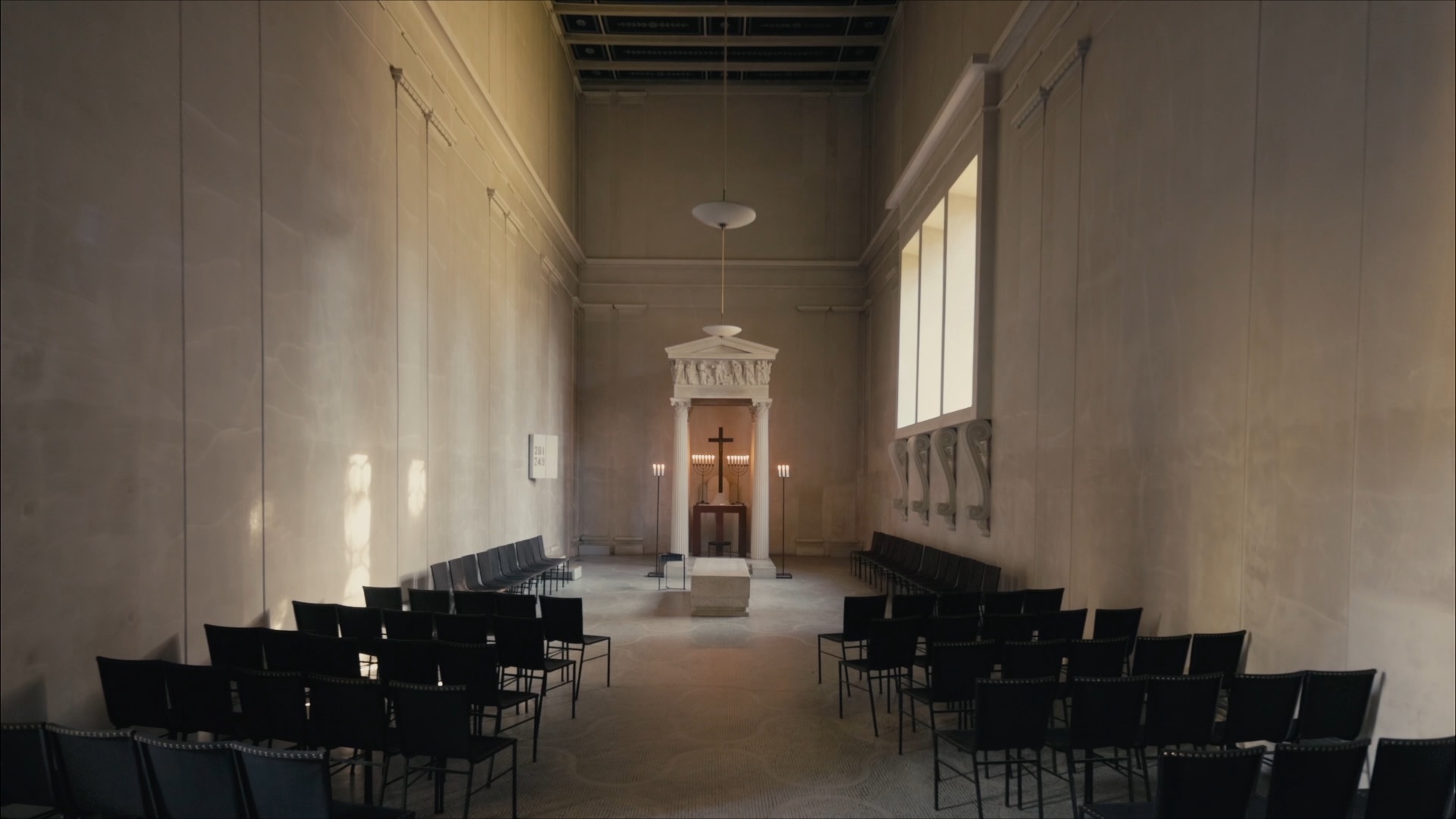
The Chapel of the Resurrection, Woodland Cemetery, Skogskyrkogården. Photo © Per Kristiansen
Distraught and wounded, the second part focuses on Lewerentz’s withdrawal from the profession—in part, seeking refuge from his recent indignities, but also, ostracized by the very collaborators who gave rise to his initial fame. Seeing an escape from Stockholm society as possibly the only path to inner peace, Lewerentz came upon the advertisement for the sale of a house in Eskilstuna, what “fortuitously” turned out to be a factory space. Prior to this, banking on the knowledge of his father’s glassworks company, Lewerentz had already invested in the design and manufacturing of glass wall systems. He had launched the IDESTA company to develop inventive details for double-glazed windows, thin steel frames, and large expanses of glass for curtain walls, all of which were targeted for architectural conditions he had anticipated in his buildings. With this new property, IDESTA would have a home, though with Lewerentz’s components destined for other architects’ buildings.
Indeed, the film suggests that Eskilstuna was not so much an expulsion from the profession, but rather the much sought after refuge Lewerentz had always wanted: to be left alone to think, focus, and draw in an environment where he could be supported by the one love he treasured throughout, his wife Edith. The Eskilstuna chapter gives body to the love story that held the extended family together. Within the factory, we learn of the apartment he carved out of the attic for his wife, but also the structured atmosphere of guarded work that organized their daily life. The family had to endure his devotion to work, and in turn, he rendered his affection for them with punctuated order. Lewerentz’s critical scrutiny could be said to form part of his thoughtfulness, but also his affliction. His incapacity for trust is humorously recounted by a former worker, whose every move—even the use of toilet paper—was carefully gauged. But with all that the factory achieved, it would also come to an end. Ironically, his unfluctuating love for Edith was what eventually undid Eskilstuna; her distaste for the long spiral stairs to the attic apartment prompted a move to the plains of Skanor—but even more important, a move back to the profession.
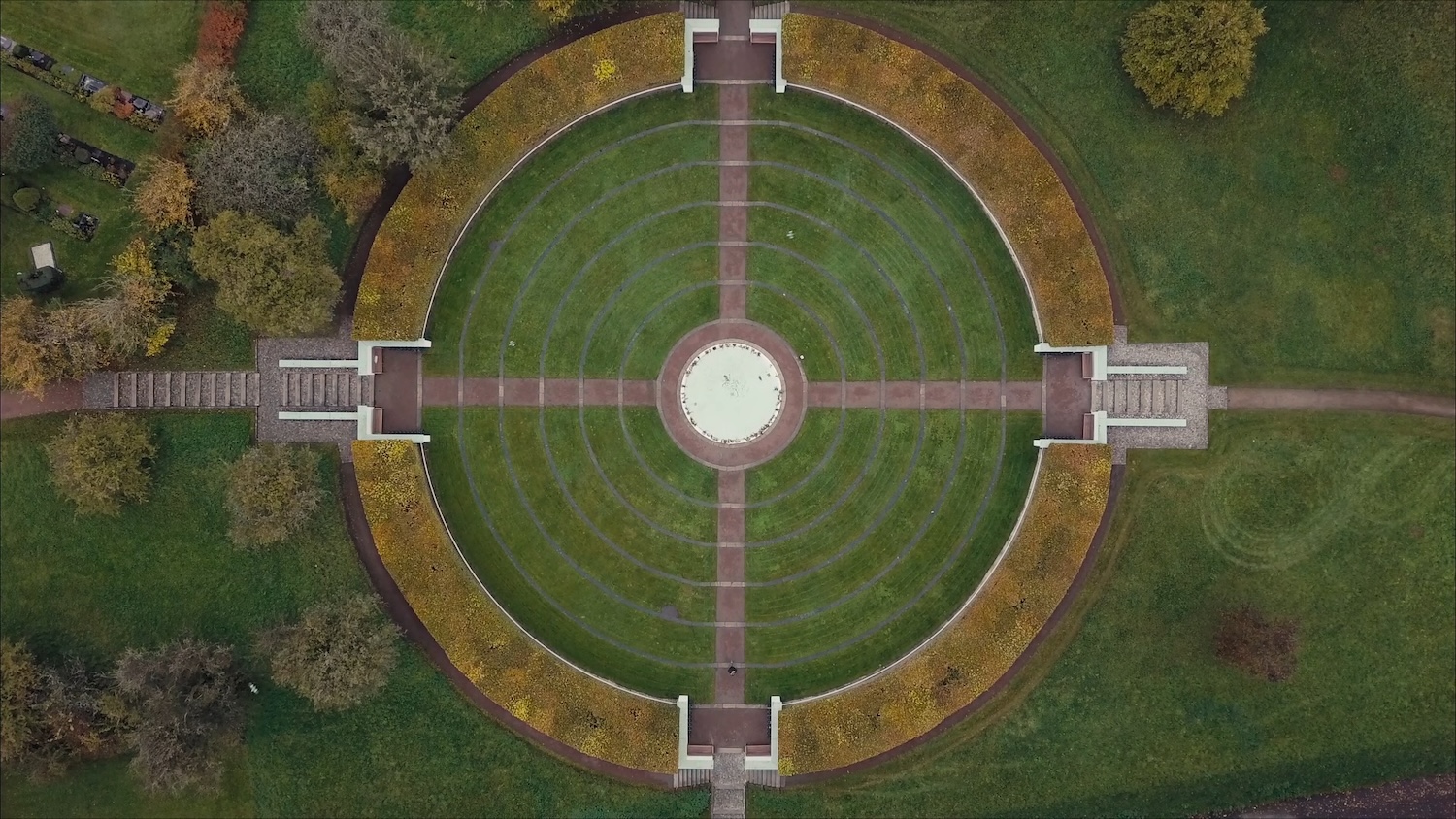
Eastern Cemetery, Malmö. Photo © Per Kristiansen
The third part focuses on Lewerentz’s return to practice, but with an approach that will produce an entirely different body of work. If the early work in the 1920s was characterized by a transformed neo-classicism, his work in the 1930s advanced the tropes of modernity that industrialization would trigger. His own crafted work at IDESTA during the 1940s ensured the rigors of these new tectonic assemblies—though with a Scandinavian slant. In the early 1960s, his work would yet again demonstrate a protean dexterity, but this time without the kind of referentiality on which the early work relied. This new work transcended anything he had done prior, in part because the idea of “divine darkness” is born out of this period of his work—but also unburdened of the emotional darkness of the preceding era.
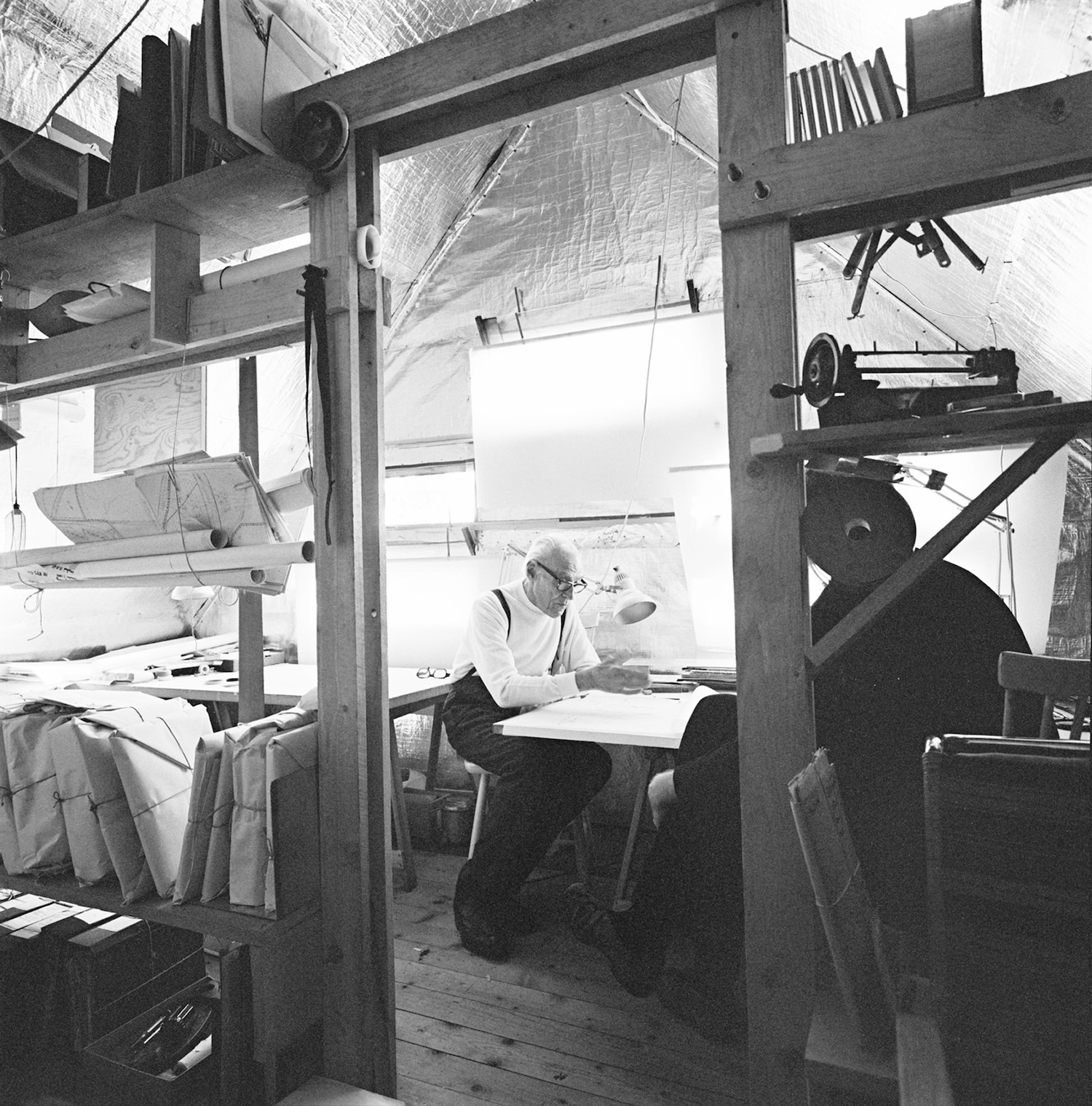
Sigurd Lewerentz. Photo © Karl-Erik Olsson-Snogeröd, ArkDes collection
In what is a challenge to the mass-industrialization of Sweden, St. Marks Church in Bjorkhagen and St. Peters Church in Klippan display an attitude toward craft, labor, and material resources that are entirely alien to their time, almost primitive. Neither typologically weighed by precedence, nor linguistically swayed by the iconography of ecclesiastic elements, these projects would be defined by brick alone: floors, walls, ceilings, and structures calibrated in accordance with what their functions may require, whether as walking surfaces, as vertical load-bearing piers, or vaulting spans. The mono-material “ethic” that is the basis for these buildings ensures that the consistency of medium foregrounds light as its main material, in what the film offers as an attribute of Caravaggio, whereby the light hits only the few and limited surfaces of importance. In a subsequent passage, the narrator inverts the description, arguing that if the historic plight of churches was to create divine light, then Lewerentz’s search was for “divine darkness.” With the time it requires for the eye to adjust to his interiors, void of unnecessary light, it is the many shades of darkness that illuminate an understanding of his architecture. In what is possibly the most characteristic of his approach, Lewerentz reveals the volume of light that penetrates the thickness of the brick wall masses, denying the eye of the window frame that would conventionally serve as threshold. In a deft manner, Lewerentz affixes the crisp window frames—what he himself developed at IDESTA—to the outer surface of the brick facades, as if a laminar application. In this phase of his life, it is as if in confronting the aesthetic and the biographical at once, Lewerentz is able to overcome the desire for absolute control while also regaining more agency than he had ever enjoyed before.
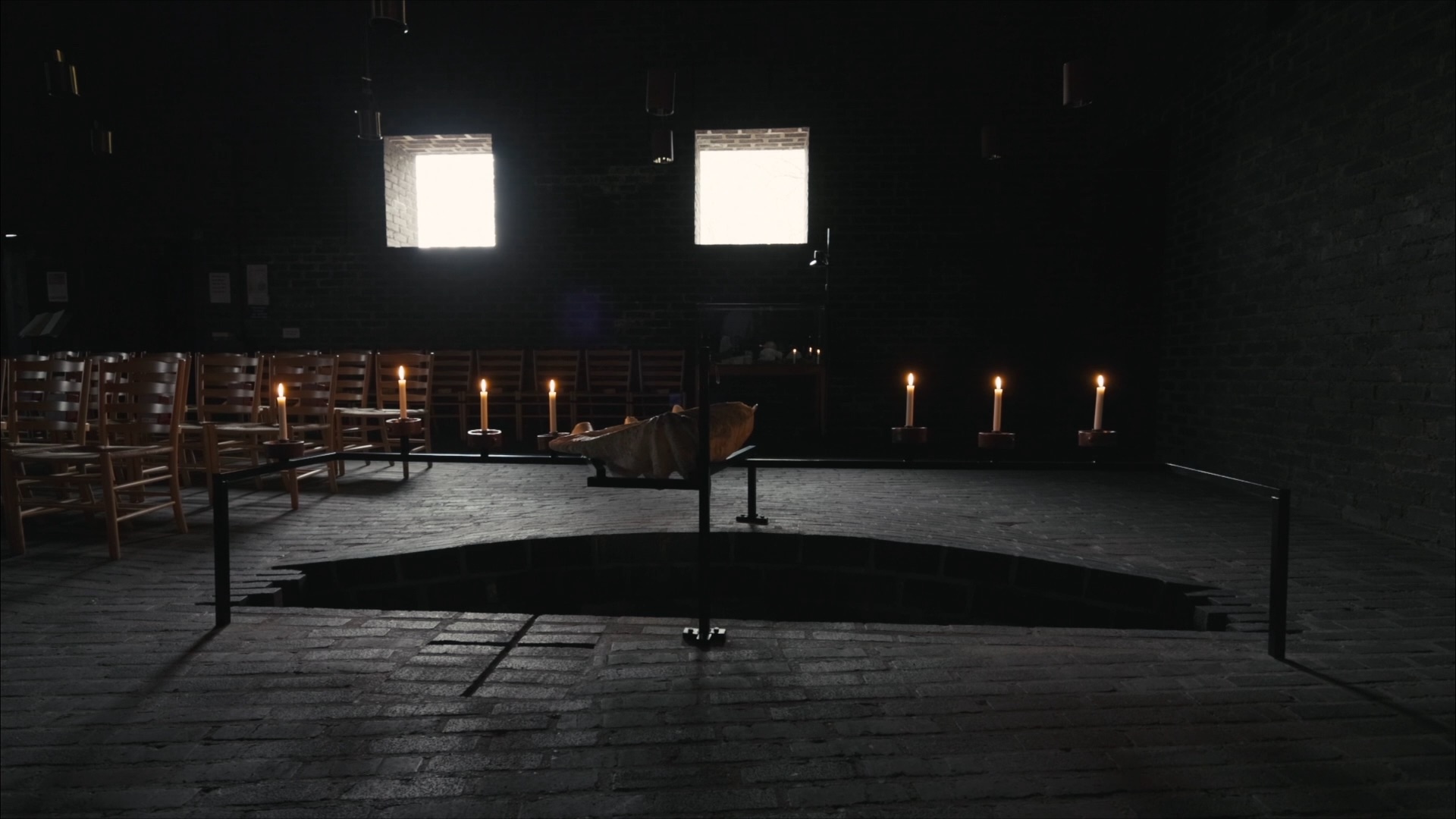
St. Peter's Church Klippan, Sweden. Photo © Per Kristiansen
Despite the claim that Lewerentz did not give interviews, nor lectures, by this time in the screening, the audience realizes that they have been seeing footage and hearing recordings of Lewerentz for the duration of the entire film. That is to reckon with the fact that Nyberg persisted over several decades, filming and recording telephone calls, knowing full well that these might someday amount to a story of substance. By the 1960s, Nyberg’s own life would become entirely intertwined with that of Lewerentz, in both daily practice and in thought. Though the intellectual partnership with Nyberg is a productive one for Lewerentz, it reveals itself to be even more poignant upon the death of his beloved Edith in 1969. We witness an aging Lewerentz lost in a deep sense of mourning, without the capacity to share his grief, even with close family. Here, Nyberg serves not only as partner, but as friend and caretaker, with the knowledge that Lewerentz’s well-being may best be secured through a devotion to work and the minutia of details that make for its complexities. Meanwhile, in parallel, the younger but ailing Nyberg is suffering from Multiple Sclerosis and equally aware of his own precarity. In these last years, both are focused on the few remaining projects they share: a chair, a national competition, and a Flower Kiosk.
Looking for quick answers on architecture and design topics?
Try Ask RECORD, our new smart AI search tool.
Ask RECORD →
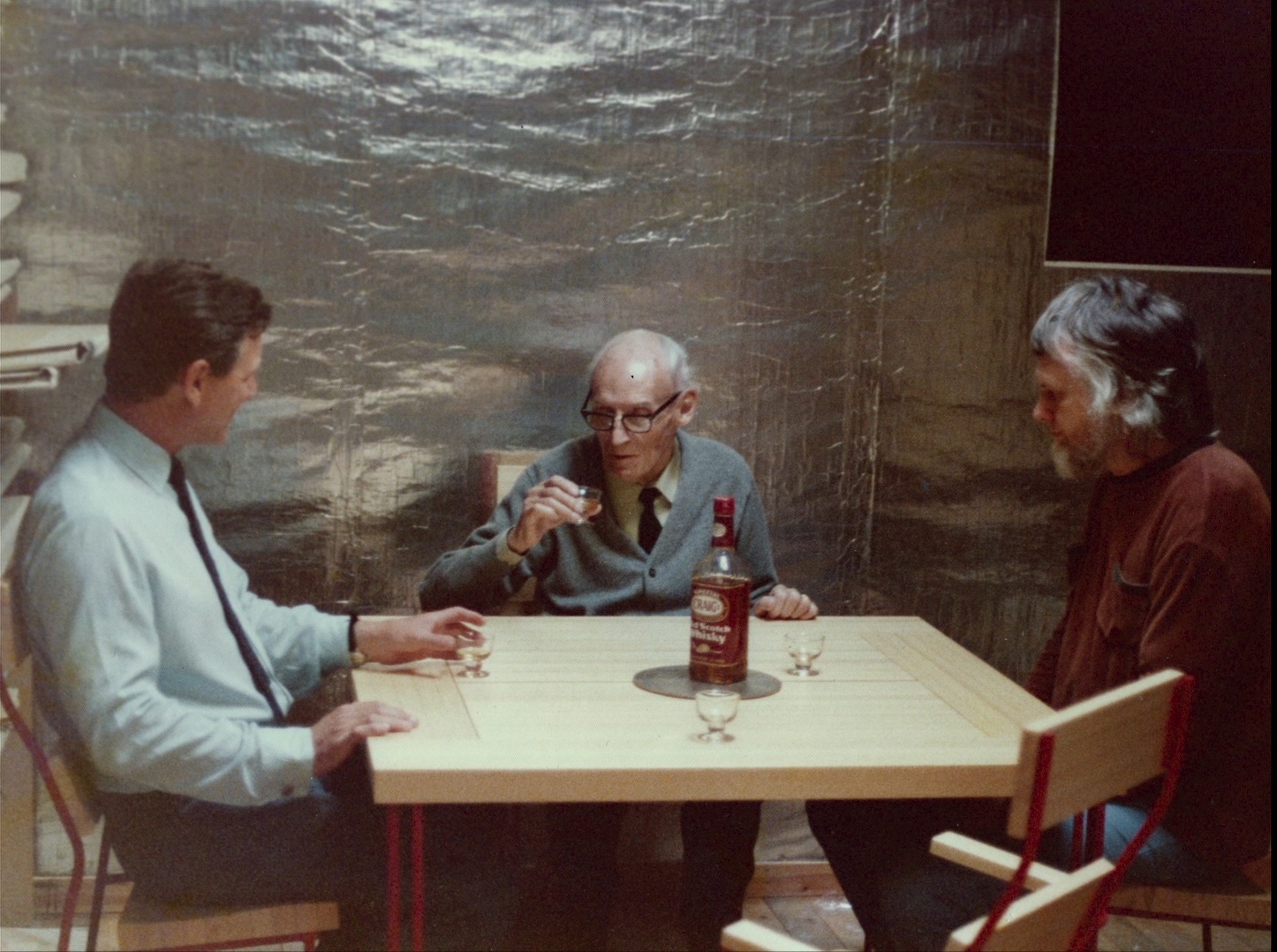
Lewerentz (middle) with Bernt Nyberg to his right. Photo © Karl-Erik Olsson Snogerod, ArkDes collection/em>
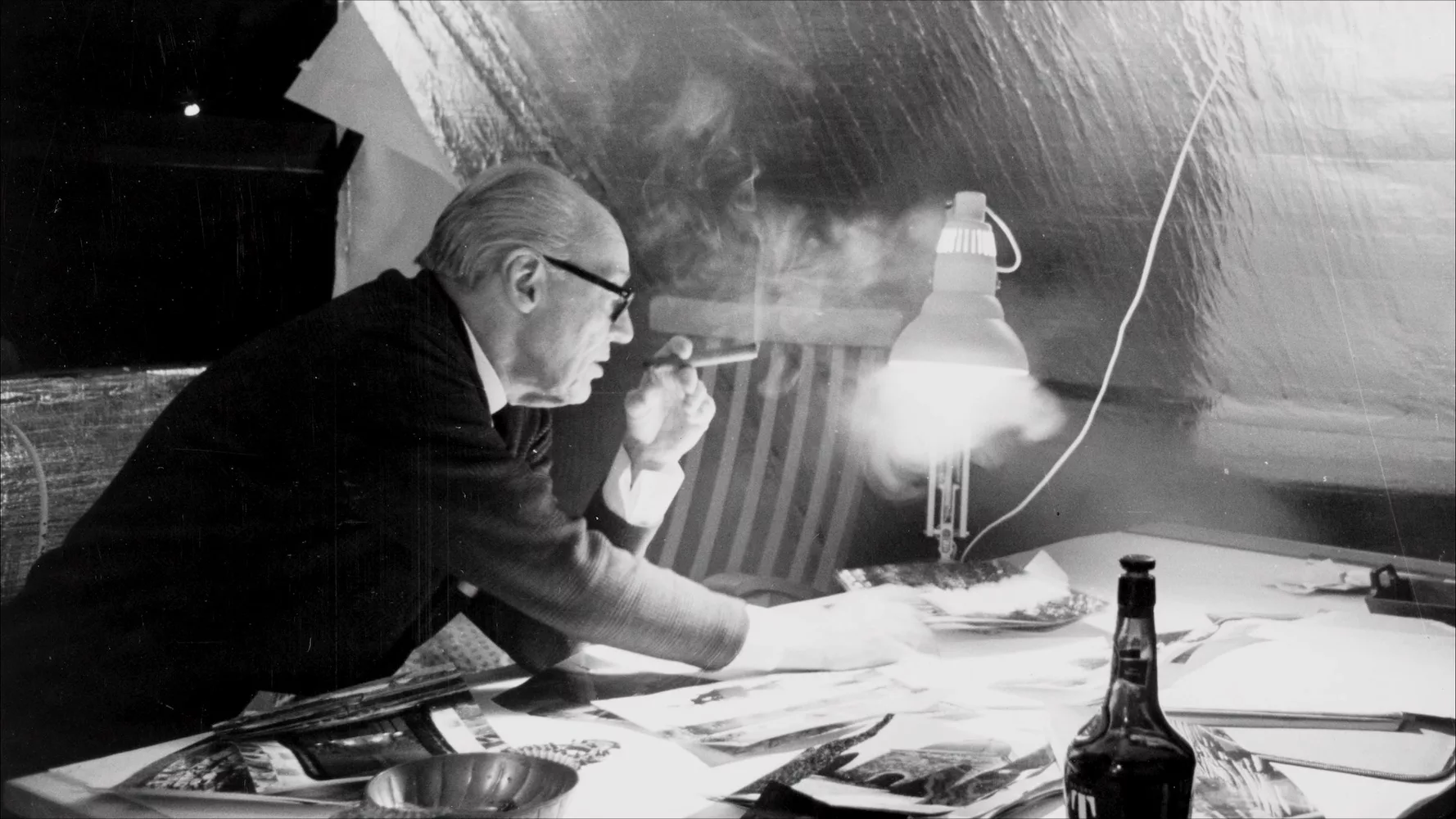
The film ends aptly with the termination of Lewerentz’s life; but in visiting his unmarked grave next to Edith, we come to realize that more than wishing to be remembered as an architect, Lewerentz wanted to “disappear behind the work” itself. The film does justice to this desired anonymity with nuanced readings of each building, but not without capturing the presence of Lewerentz, the man. His stature looms large during the entirety of the film, his black coat, glasses, and broody gaze. But as we view Blume’s assembly of this vast footage, crafted as it is, we also realize the presence of all the other protagonists that made it possible, with Nyberg’s lens being central to what we might see as the reality and myth behind this master architect.
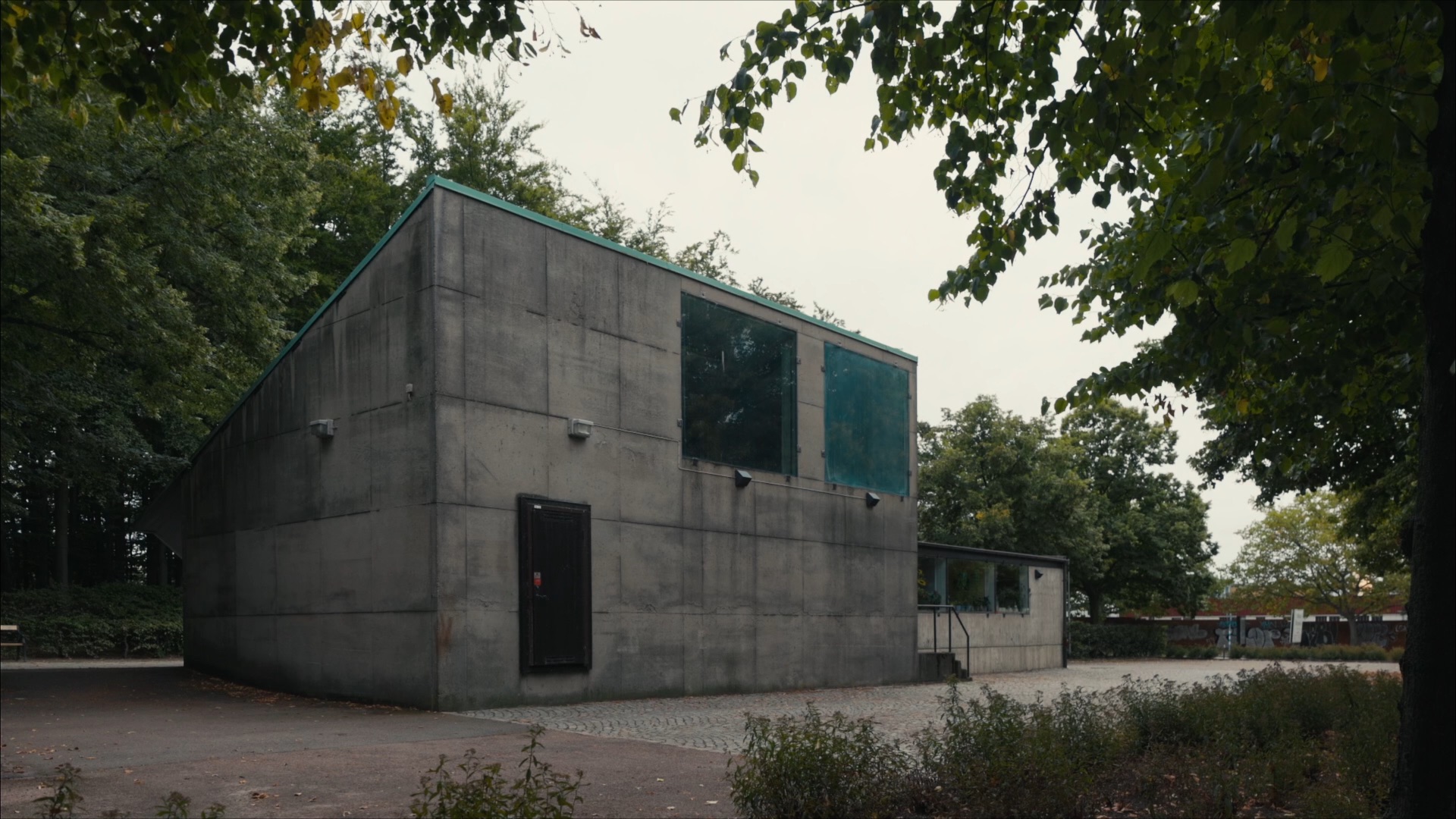
Flower kiosk, Eastern Cemetery, Malmö. Photo © Per Kristiansen
With 50 years passed, this film not only tells a story, but invariably it amasses a piece of history itself. Beyond the emotions it unleashes, which it does with power—the historical account arguably has the responsibility to demystify: the person, the practice, and the work. To this end, it would be wrong to say that the film does not celebrate the myth of Lewerentz: a combination of the ambience of vintage footage, the determination of his willfulness, and the decorum of his manner throughout his life, they all add up to a person of ample aura. But the darkness that lurks behind his insistent need for control is also something that is part of the human tragedy—a quality with which many viewers may empathize, if only because they might suffer the same burden. Not just myth, but the reality of the sheer difficulty of building any piece of architecture with a measure of consistency remains hard today, as it might always have. With the externalities of clients, politics, costs, and craft only to name a few, any architect must be vigilant at all times to know when to fight and when to acquiesce. The nuanced ability to do both without abdicating absolute agency is the stuff of brilliance. Lewerentz gets there eventually, even if late in his life. He reconciles the aesthetic and the personal, allowing his agency to be guided in accordance with a renewed power, one that does not wed him to coerced control, but rather to calibrated freedom.
Of the many things I have always appreciated in the work of Lewerentz—to which a bricklayer comments in the film, is his ethic towards brick bonding: that is, that no brick is to be cut, despite the figuration of the wall, vault, or floor to which it is assigned. Because of this, the mortar becomes his main actor, expanding and contracting to adapt to spatial and programmatic circumstances, not to mention the light it frames. And yet, every bricklayer knows this to be a technically suspect requirement, necessitating added cement to ensure the resilience of the wall. At the end, Lewerentz demands absolute adherence to the ethic of the brick, while giving generous latitude to the mortar. Guided by a compositional tolerance for primitive craft, Lewerentz also demonstrates a syntactic inventiveness unparalleled in the precision of his earlier works. For an architect whose oeuvre has primarily been theorized through experience and phenomenology, the sophistication of his bonding explorations also reconciles the visual and haptic dimensions of his thinking. And with this delicate balancing act, we witness a redemptive quality, allowing Blume’s documentation to celebrate the sublime nature of darkness in his work, while exposing the elusive nature of the enlightened person behind it.
Watch the trailer for Sven Blume's feature-length documentary on Swedish architect Sigurd Lewerentz (1885–1975). Video courtesy Sven Blume
Director Sven Blume will be screening Lewerentz Divine Darkness at the following U.S. locations starting next week:
ADFF: Chicago
February 21, 5:45 pm
Super Coming Attractions, University of Illinois Chicago
February 23, 6:00 pm
Rhode Island School of Design, Providence
February 24, 6:30 pm
Wentworth Institute of Technology, Boston
February 25, 6:00 pm
The Cooper Union, New York
February 26, 6:30 pm
Yale School of Architecture, New Haven
Screening of Crooked Lines of Beauty: My Grandfather, the Architect Carl Nyrén (2021)
February 27, 4:30 pm
Scandinavian Cultural Center, West Newton, Massachusetts
February 28, 1:00 pm
Harvard Graduate School of Design, Cambridge, Massachusetts
March 2, 9:00 am
Looking for a reprint of this article?
From high-res PDFs to custom plaques, order your copy today!