Books
A New Book Charts the Career of Architectural Cartoonist Alan Dunn
‘Alan Dunn: The Cartoonist as Architectural Critic’ by Gabriele Neri

Alan Dunn (1900–74) got his start in the 1920s as an illustrator for the New Yorker, where he often poked fun at the gritty, bustling, and rapidly modernizing city around him. The editors at RECORD took notice, and, in 1937, they invited Dunn to contribute to the magazine. His decades of illustrations for RECORD eventually won him the national AIA Architectural Critics’ Citation in 1973. Dunn’s life and incredible body of work are the focus of a new book by Gabriele Neri, himself a RECORD contributor, illustrated with over 200 drawings, photographs, watercolors, and unpublished sketches. The following excerpt tells the story of Dunn’s first RECORD commission.
Alan Dunn was paid $25 for his first cartoon in RECORD, which was selected with care from among the many “ruffs” he proposed. It shows a scene of typical American suburbia, with two single-family houses side by side, which are quite different from the national building tradition. On the right, in the foreground, we see a modern, geometrically abstract abode, with large windows placed in very slim walls, a flat roof, bright metal parapets, and no traces of decoration—in short, a work of architecture in line with the new style spreading in the country, and furthermore rather similar to the house by the English architect F.R.S. Yorke, published a few pages further on in the same issue.
Image courtesy the publisher, click to enlarge.
The house depicted by Dunn might seem to be a case of avant-garde design were it not for the fact that in the nearby background another house appears, with much bolder features. It is composed of a post set into the ground on which two bare slabs are wedged, which constitute the entire living space on their own, reached by means of a flight of steps equipped with a curving handrail that rises from the ground to the top. There are no other pillars, not even walls, roofing, or windows; the house is only this structure, in its sculptural incompleteness, a manifesto of a new way of living even more radical than prophesied by the pioneers of the modern at MoMA. Looking perfectly at ease, the inhabitant reads the paper, lounging on a futuristic chair, seemingly unperturbed by issues of lack of privacy or climate control.
This performance gets on the nerves of the modernist neighbors, irritated by such additional modernity. The wife complains to her husband that they are already out of style: “Well, we’re dated!—that abstractionist next door built his house in space-time.” It is a typical Dunn setup: an everyday scene (the husband coming home from work in an anonymous American context), altered by a surreal presence, in this case an utterly unconventional house. The reference to spacetime is interesting since, in the wake of the revolution in physics in the previous decade, this concept is in the air as part of the architectural debate of the day. For Dunn, a constant reader of writings that popularized science, this was undoubtedly familiar ground. We can notice that his cartoon foreshadows the title of the well-known book by Sigfried Giedion, Space, Time and Architecture, based on the Charles Eliot Norton Lectures at Harvard University he delivered in 1938–39; it would be published in 1941.
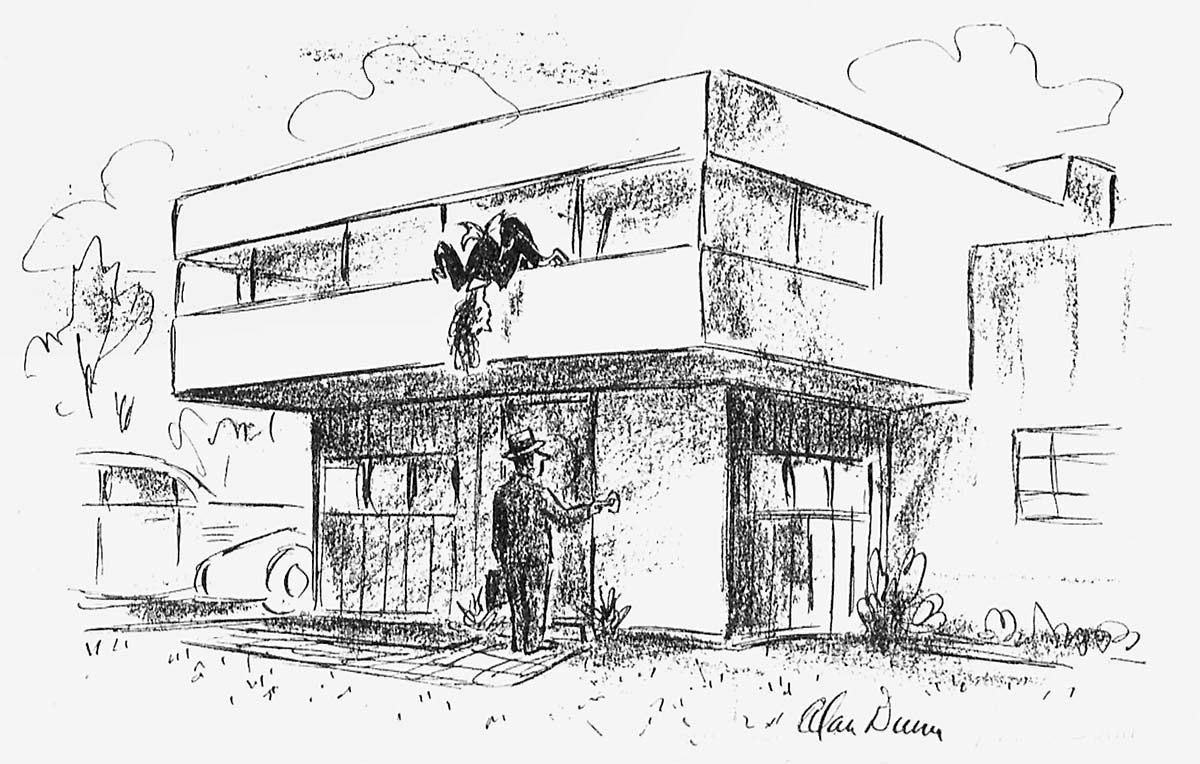
Image courtesy the publisher
It is worth noting that in May 1948, the New York Herald Tribune Weekly Book Review (with which he had previously collaborated) would publish a prominent front-page review of Giedion’s new book, Mechanization Takes Command, that was written by Frederick Gutheim and illustrated with three large cartoons by Dunn, including the “space-time” one.
Dunn’s drawing was very effective in its way of mocking the ongoing perishability of the very concept of architectural modernity. The modernity entering the lives of people in the United States was above all a phenomenon of form rather than substance, a passing fashion soon to be surpassed by new trends or convictions.
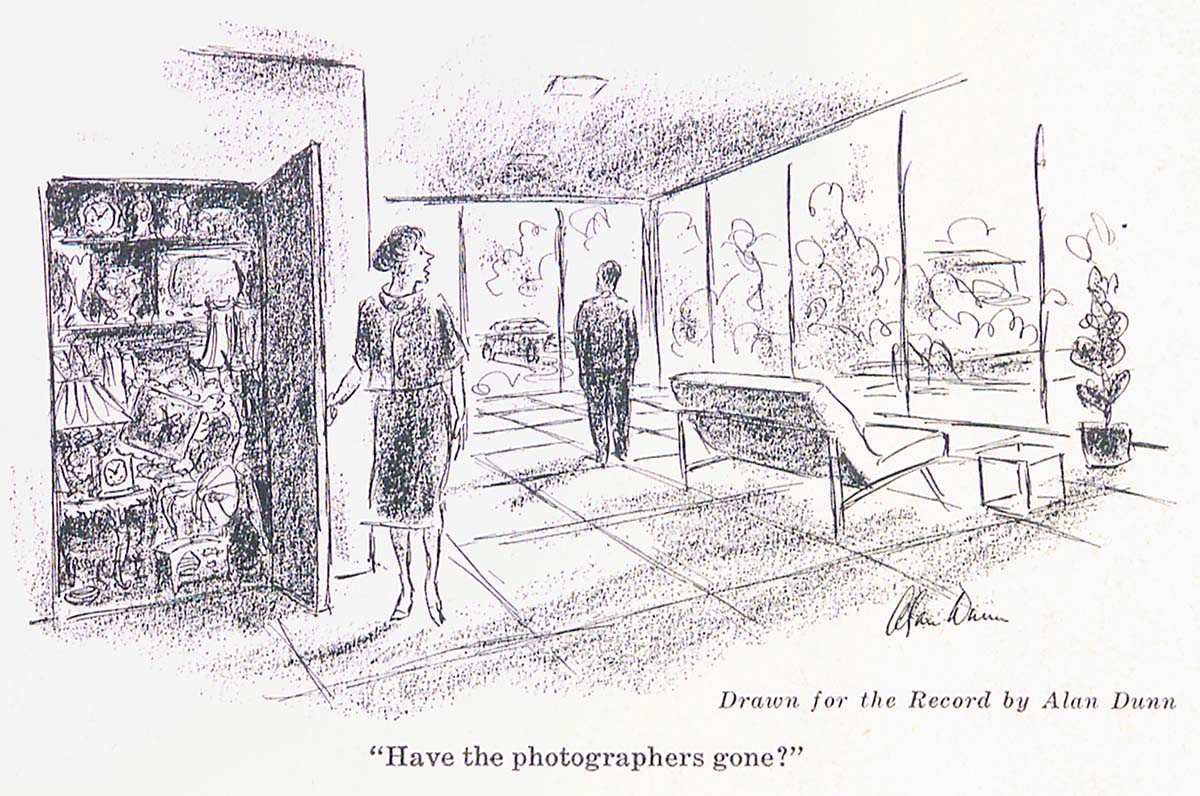
Image courtesy the publisher
Despite some initial caution on the part of the editor, from that moment on, the cartoons by Dunn were to become a regular, not-to-be-missed feature of RECORD. Already in the issue of September 1937 we can see readers’ interest in the artist’s work:
Planned (because of popular demand) but not promised are some revelations on this man Alan Dunn who graphically pokes fun in the RECORD at building, and in the New Yorker at building and anything else which strikes him as cockeyed. Where did he come from? Why does he pick on the building world so often? Is he an architect with his tongue permanently in his cheek? These, and other questions, are being asked. Maybe he won’t talk, but we’re going to work on him.
The next month saw the publication of a letter by Dunn, in which he introduced himself to readers with his proverbial understatement: “I appreciate your asking me about myself, but I am afraid I will be a disappointment—my life having been so regular as to lack color.” In the following issues, Dunn’s work is mentioned several times in the initial column, by now as a favorite contribution for readers; this column was soon defined as “his own special corner.”
Looking for quick answers on architecture and design topics?
Try Ask RECORD, our new smart AI search tool.
Ask RECORD →
Looking for a reprint of this article?
From high-res PDFs to custom plaques, order your copy today!