Columbia University Mounts a Retrospective of Michael Sorkin’s Architectural Work

Michael Sorkin moved to Manhattan in 1973, just before New York City declared bankruptcy and President Ford told it to “drop dead.” He lived in the Greenwich Village home he shared with his wife, philosopher Joan Copjec, until his death from Covid in 2020. In the years between these two inflection points in the history of the city, Sorkin built a career both as one of its fiercest critics and most stalwart advocates, arguing against the erosion of the urban fabric for financial gain and at the expense of people. Starting in the late 1970s, Sorkin worked as the architecture critic for the Village Voice, where he impressed readers with his withering critiques delivered in whip-smart prose.
RECORD was one of the first magazines to publish Sorkin. In “A Radical Alternative,” an essay in the December 1972 issue on the concerns of an emerging generation, Sorkin, fresh out of college, wrote that “To the radical architect, design is not an end in itself, it is a tactic.” A roughly 450-word excerpt from this manifesto introduces a series of texts reproduced on a wall in the Arthur Ross Architecture Gallery for People Cross Against the Light: Michael Sorkin’s New York, the first retrospective of his work since his death. Organized by the Columbia University Graduate School of Architecture, Planning and Preservation, and curated by Bart-Jan Polman with Jean Im, the show focuses on architectural projects from 1987 to 1996, a decade when Sorkin stopped writing for the Village Voice to turn his focus to design.
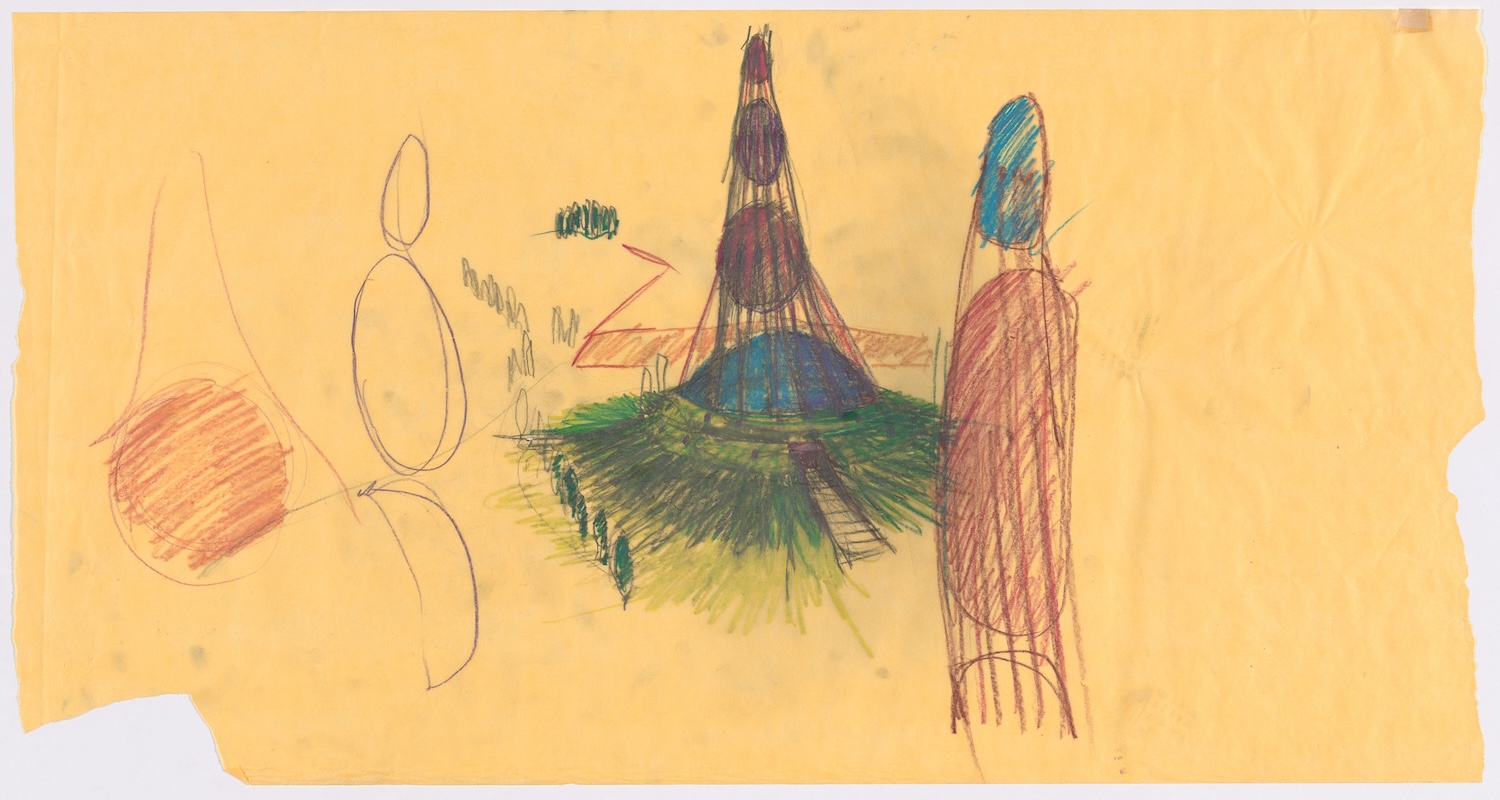
Michael Sorkin, Governor’s Island Proposal, 1995-1996. Governor's Island, New York. Courtesy Drawings and Archives, Avery Architectural & Fine Arts Library, Columbia University
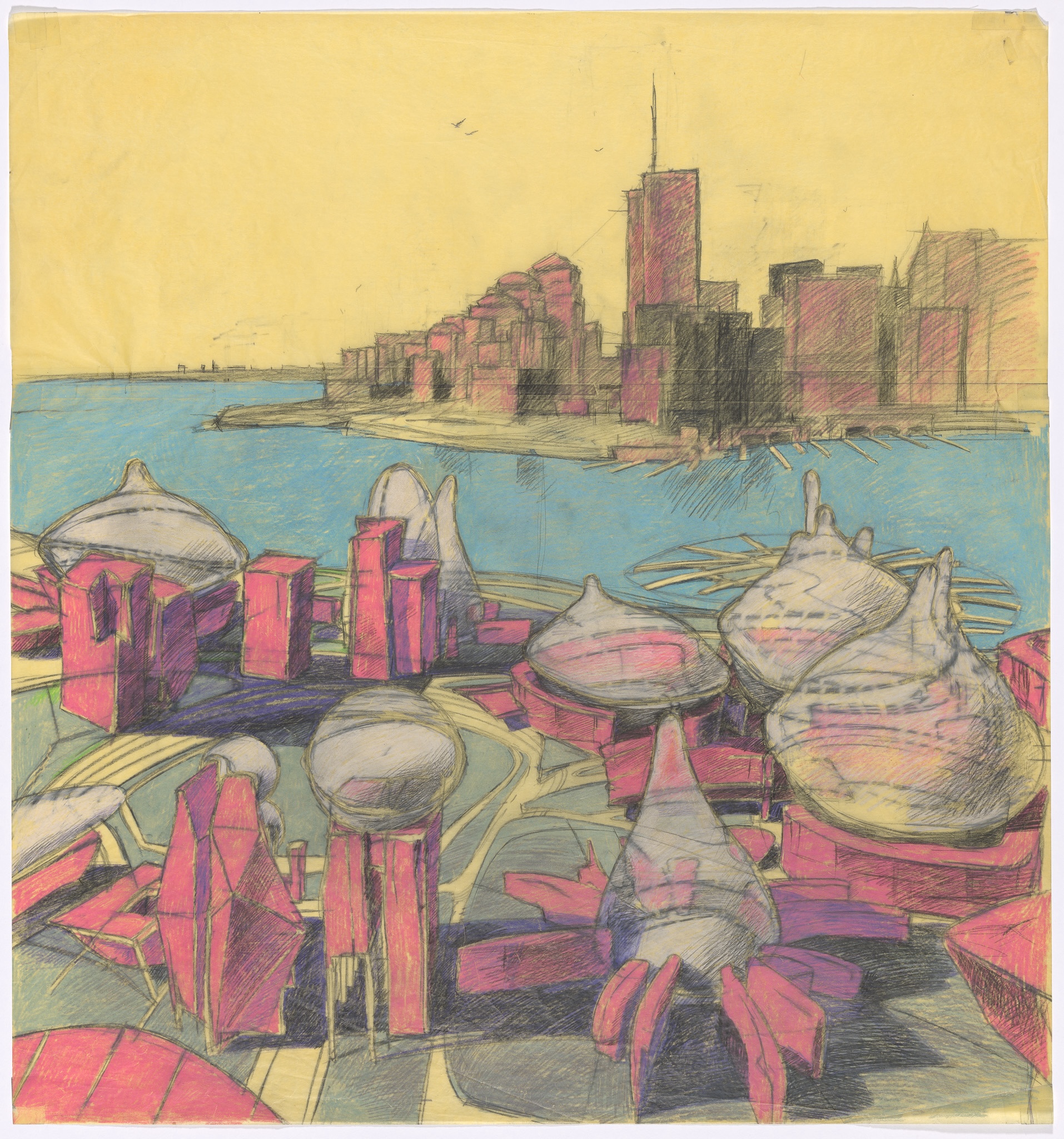
The exhibition takes the young Sorkin at his word when he concluded his RECORD article claiming that “this essay is part of that process. It is my architecture.” The curatorial conceit is to pair eight unbuilt projects for New York City with selections from Sorkin’s writings. The books, newspapers, and magazines where these texts were published—all borrowed from the Avery Architectural and Fine Arts Library at Columbia, like most of the objects in the exhibition—are arrayed on a table in the gallery in a glass vitrine. “If Sorkin’s criticism was looking for the social meaning of the formal,” the wall text explains, “then his designs may be understood as looking for the formal meaning of the social.”
Framed sketches, renderings, and line drawings ring the roughly 900-square-foot gallery, resting on picture rails, from which hang reproductions of Sorkin’s words and drawings on loose-leaf newsprint. The designs are formally eclectic, with projects like Animal Houses (1989–93) and Shrooms (1994) taking on biomorphic postures that seem to crawl along or spawn from their sites. There are two projects for Sorkin’s beloved Times Square, including Mass Movement (1987), a rotating skyscraper disco and hotel that looks like a dozen towers from The Jetsons collapsed into one.
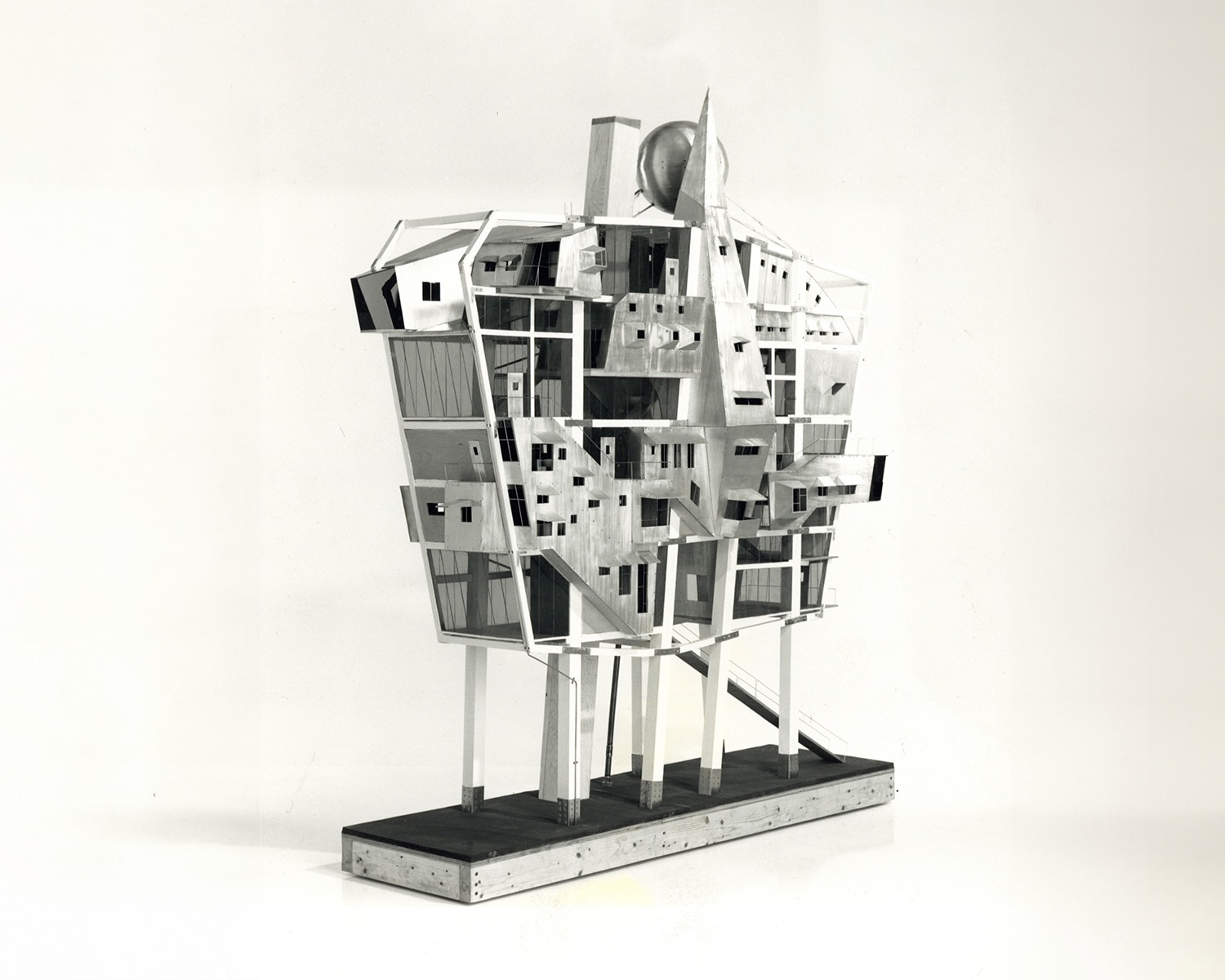
Michael Sorkin, Animal Houses (Sheep), 1993. Model courtesy Joan Copjec. Photograph courtesy of Drawings and Archives, Avery Architectural & Fine Arts Library, Columbia University
The second project for Times Square, produced for the television program The Eleventh Hour, along with Tracked House (1990) offer perhaps the most direct connection between one of the excerpted texts and the projects. Both were conceived as alternatives to the Trump Organization’s plans for redevelopment between 59th and 72nd Streets. Times Square/Eleventh Hour (1987), a collaboration with Lebbeus Woods and John Young, consisted of a series of vignettes and a video in which homeless encampments would grow into a new urban form. For Tracked House, Sorkin—possibly channeling Moisei Ginzburg’s Soviet Constructivist Green City—designed a kit of parts that could stack onto railway cars on the former Penn Central rail yards site to create a hodgepodge of mobile housing towers. In his 1985 critique of Trump’s redevelopment plan, the longest excerpt, Sorkin wrote, “the scheme is so stupid,” and with these counterproposals he offered radical, perhaps intentionally absurdist, responses.
Exploring the dialectic between text and drawings is interesting, but it doesn’t fully work in this show. The excerpts are “meant to reflect the breadth of his early writing,” Polman told RECORD, “from a more analytical and student activist approach, into architectural criticism, then the more personal attacks—and humor—he became known for.” But nearly all the blurbs hit the same note: scathing invectives and dismissals that border on world-weariness rather than demonstrating Sorkin’s passion. If the gallerygoer is meant to glean how his writing is a “starting point for alternative futures,” as the wall text encourages, these selections don’t shine a light on that optimistic path but rather leave one questioning what it was about architecture that Sorkin liked.
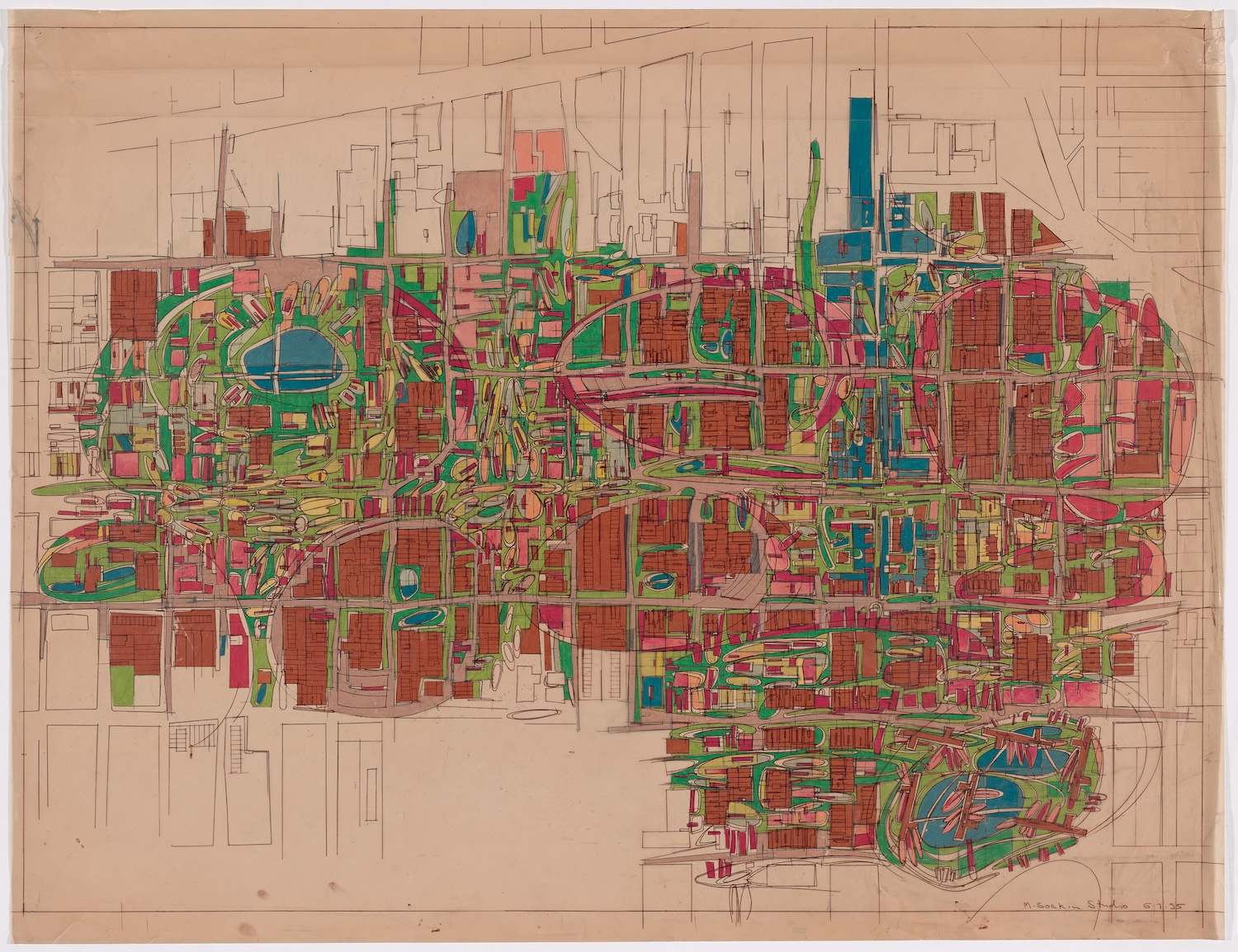
Michael Sorkin, East NY, 1995-1996. East NY, Brooklyn. Courtesy Drawings and Archives, Avery Architectural & Fine Arts Library, Columbia University
In the texts, architects ranging from Robert Venturi to Rem Koolhaas, Philip Johnson, Peter Eisenman, and Helmut Jahn come under fire. New York Times critic Paul Goldberger is a recurring villain, as are President Ronald Reagan and then-developer Donald Trump. Sorkin was nice enough to Alan Buchsbaum, whose obituary is among the excerpts, but dismissive of the High Tech movement associated with him. It’s no secret that Sorkin never pulled punches, and the validity of anything articulated in these excerpts is not the point.
Looking for quick answers on architecture and design topics?
Try Ask RECORD, our new smart AI search tool.
Ask RECORD →
“I thought of Michael as a bomb thrower,” said Cathleen McGuigan, former RECORD editor in chief speaking to the New York Times following his death. But therein lies the dissonance of this show. While writing can be bomb throwing, design is the often-tedious process of making, iterating, and refining. Criticism requires skepticism, but design needs a suspension of disbelief. While the curators treat writing and design as two sides of the same coin, the imbalance of the show demonstrates that the relationship is not that simple. With these excerpts setting the tone, one can’t help but wonder what Sorkin would have said about the very schematic, experimental verging on fantastical, work on display if it were not his own. In short, Sorkin was a stronger critic than designer.
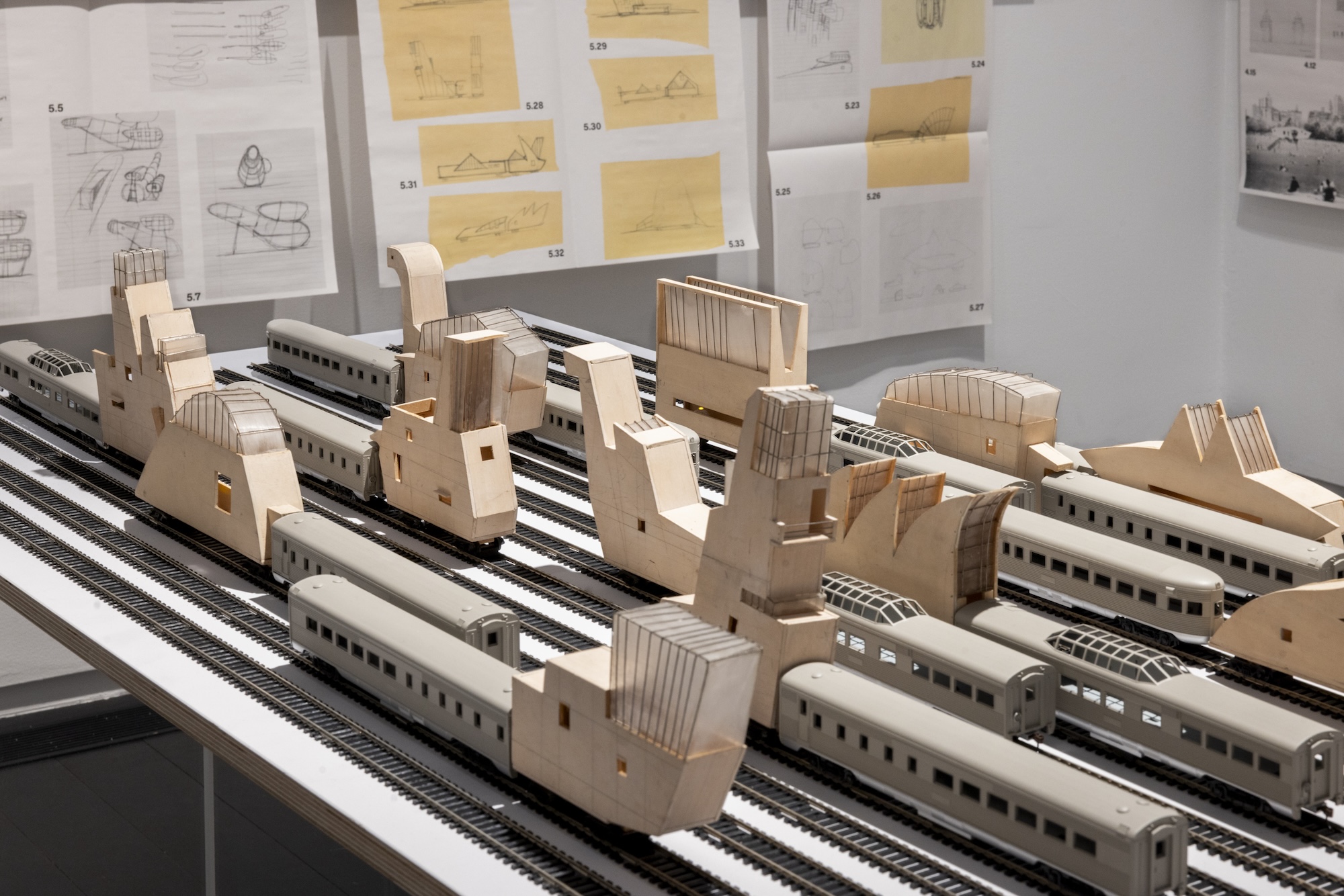
Photo by Timothy O' Connell
Hopeful visitors will need to schedule an appointment via email, request a QR code, and be sure to bring a photo ID to access the campus. While this is certainly beyond the control of anyone involved in this exhibition, the Checkpoint Charlie–like security around the Columbia campus bloc begs the question: Who is the show for? Students might draw inspiration from diagrammatic works aiming to challenge the status quo, and maybe out-of-context jabs at now mostly deceased leading figures of architecture garner smirks among Columbia faculty. But the repeated mention of Trump, from long before he entered national politics, feels excessive and suggests an insularity and effort to cater to today’s political drama.
The show’s title comes from Sorkin’s essay “Nine Fabulous Things About New York,” adopting his description of jaywalking as a model of defiance in the face of authority. So, it bears mentioning that Columbia is still embroiled in a lawsuit filed by nearby residents in 2025 over what they claim is the illegal blocking of 116th Street, which the university does not own, inhibiting the pedestrianism that Sorkin so fiercely advocated. Perhaps the inaccessibility of the campus and of the show demonstrates that Sorkin’s critiques of shortsighted schemes harming urban fabrics are more needed than ever.
People Cross Against the Light: Michael Sorkin’s New York is on view through June 26, 2026.
Looking for a reprint of this article?
From high-res PDFs to custom plaques, order your copy today!